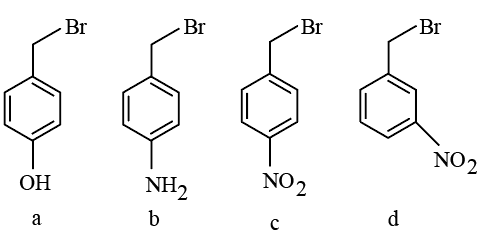
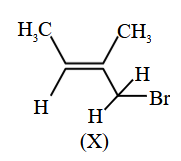
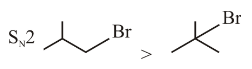
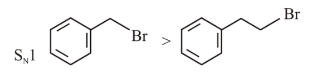
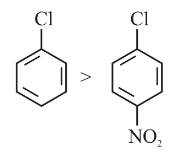
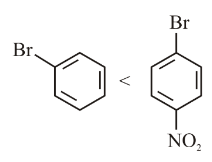
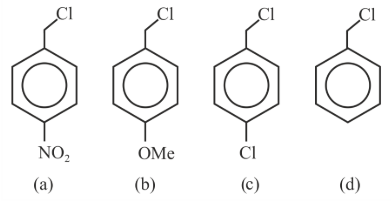
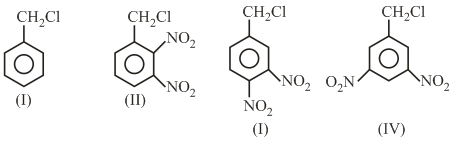
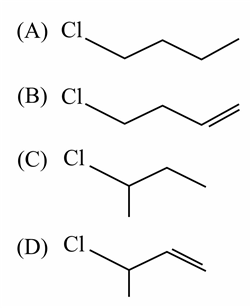
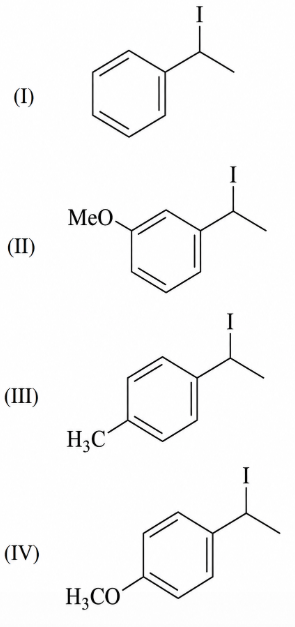
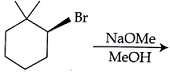
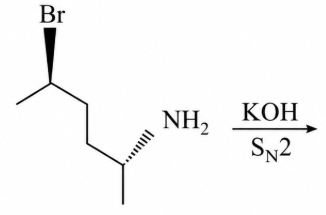
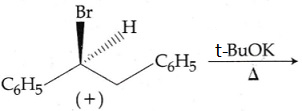
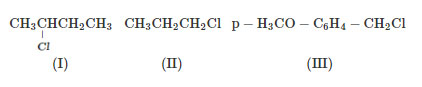
The correct order of reactivity of the following benzyl halides towards reaction with KCN is:
Sign in
Please select an account to continue using cracku.in
↓ →
Join Our JEE Preparation Group
Prep with like-minded aspirants; Get access to free daily tests and study material.
The correct order of reactivity of the following benzyl halides towards reaction with KCN is:
This reaction proceeds via the Sₙ1 mechanism.
The rate depends on the stability of the benzyl carbocation formed after departure of Br.
Key Idea:
Electron-donating groups increase carbocation stability and hence increase rate.
Electron-withdrawing groups decrease carbocation stability and hence decrease rate.
Resonance effects (para position) are stronger than inductive effects (meta position).
Analysis:
(b) p-NH₂
Strong +M effect, donates electron density by resonance, gives maximum stabilization → highest reactivity
(a) p-OH
Also shows +M effect but weaker than NH₂ → slightly lower reactivity
(d) m-NO₂
Shows -I effect only (no resonance at meta position) → moderate destabilization
(c) p-NO₂
Strong -M and -I effect, withdraws electron density strongly → least stable carbocation
Final Order:
b > a > d > c
Answer: p-NH₂ > p-OH > m-NO₂ > p-NO₂
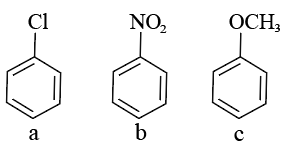
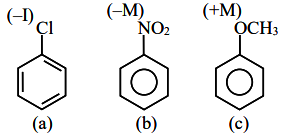
Consider the following compounds
Arrange these compounds in the increasing order of reactivity with nitrating mixture.
Nitration of benzene ∝ nucleophlicity of benzene ring. ∝ electron donating group on benzene ring.
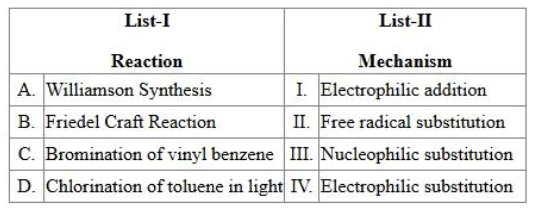
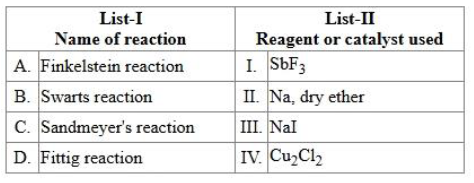
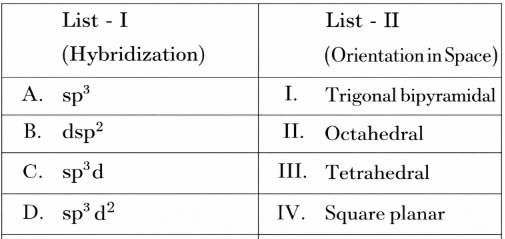
Match the List I with List II:

Choose the correct answer from the options given below
For each reaction we first identify the active intermediate and the bond-making/breaking pattern, then relate it to the standard mechanism types listed.
Case A: Williamson synthesis
The process is $$R\!-\!O^- + R'X \rightarrow R\!-\!O\!-\!R' + X^-$$.
An alkoxide ion (strong nucleophile) attacks an alkyl halide in a one-step $$\text{S}\!_\text{N}2$$ fashion. A nucleophile substitutes for the leaving halide ion, so the mechanism is $$\textbf{Nucleophilic substitution (III)}$$.
Case B: Friedel-Crafts reaction
Example: $$C_6H_6 + RCl + AlCl_3 \rightarrow C_6H_5R + HCl$$.
The Lewis acid $$AlCl_3$$ generates the electrophile $$R^+$$ (or $$Ac^+$$ in acylation). This electrophile then substitutes a hydrogen on the aromatic ring via the classical arenium ion pathway. Therefore the mechanism is $$\textbf{Electrophilic substitution (IV)}$$.
Case C: Bromination of vinyl benzene (styrene)
Styrene is an alkene; bromine adds across its double bond: $$C_6H_5CH{=}CH_2 + Br_2 \rightarrow C_6H_5CHBr\!-\!CH_2Br$$.
The $$Br_2$$ molecule polarises to give an electrophilic $$Br^+$$ that attacks the $$\pi$$-bond, followed by capture of $$Br^-$$. Addition of an electrophile to a double bond is classified as $$\textbf{Electrophilic addition (I)}$$.
Case D: Chlorination of toluene in sunlight
Under UV light, $$Cl_2$$ homolytically cleaves to give chlorine radicals. Chain propagation at the benzylic C-H bond produces benzyl chloride: $$C_6H_5CH_3 + Cl_2 \xrightarrow{h\nu} C_6H_5CH_2Cl + HCl$$.
This is a radical chain process, so the mechanism is $$\textbf{Free radical substitution (II)}$$.
Collecting the matches:
A → III, B → IV, C → I, D → II
The option containing this set is Option C which is: A-III, B-IV, C-I, D-II.
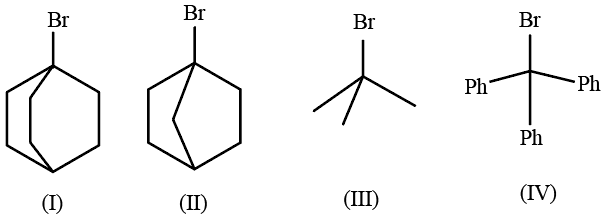
The correct order of the rate of reaction of the following reactants with nucleophile by $$S_{N}1$$ mechanism is :
(Given: Structures I and II are rigid)
Given below are two statements:
Statement I: 'C - Cl' bond is stronger in $$CH_{2}=CH-Cl\text{ and }CH_{3}-CH_{2}-Cl$$
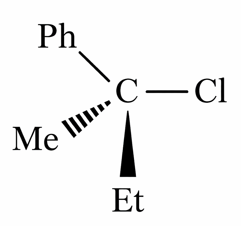
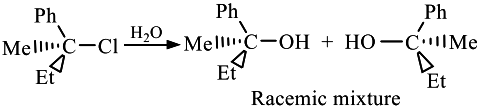
Statement II: The given optically active molecule,

on hydrolysis gives a solution that can rotate the plane polarized light.
In the light of the above statements, choose the correct answer from the options given below
Given below are two statements:
Statement I: The dipole moment of R-CN is greater than R-NC and R-NC can undergo hydrolysis under acidic medium to produce $$O\\||\\R-C-OH$$.
Statement II: R-CN hydrolyses under acidic medium to produce a compound which on treatment with $$SOCl_{2}$$, followed by the addition of $$NH_{3}$$ gives another compound(x). This compound (x) on treatment with NaOCl/NaOH gives a product, that on treatment with $$CHCl_{3}/KOH/ \Delta$$ produces R-NC
In the Light of the above statements, choose the correct answer from the options given below
We need to evaluate two statements about R-CN and R-NC.
Statement I: "The dipole moment of R-CN is greater than R-NC and R-NC can undergo hydrolysis under acidic medium to produce RCOOH."
The dipole moment of R-NC is actually greater than R-CN (isocyanides have higher dipole moments due to the lone pair on carbon and formal charges). Also, R-NC on hydrolysis gives R-NH₂ + HCOOH, not RCOOH.
Statement I is FALSE.
Statement II: "R-CN hydrolyses under acidic medium to produce RCOOH, which on treatment with SOCl₂ gives RCOCl, then with NH₃ gives RCONH₂ (compound x). Treatment of RCONH₂ with NaOCl/NaOH (Hofmann bromamide degradation) gives R-NH₂. Then R-NH₂ + CHCl₃/KOH/Δ (carbylamine reaction) gives R-NC."
Let's trace the sequence:
R-CN → (H₃O⁺) → RCOOH → (SOCl₂) → RCOCl → (NH₃) → RCONH₂ (compound x)
RCONH₂ → (NaOCl/NaOH, Hofmann degradation) → RNH₂
RNH₂ → (CHCl₃/KOH/Δ, carbylamine reaction) → RNC
This sequence is correct. Statement II is TRUE.
Therefore, Statement I is false but Statement II is true, which corresponds to Option 1.
As compared with chlorocyclohexane, which of the following statements correctly apply to chlorobenzene?
A. The magnitude of negative charge is more on chlorine atom.
B. The C - Cl bond has partial double bond character.
C. C - Cl bond is less polar.
D. C - Cl bond is longer due to repulsion between delocalised electrons of the aromatic ring and lone pairs of electrons of chlorine.
E. The C - Cl bond is formed using $$ sp^{2} $$ hybridised orbital of carbon.
Choose the correct answer from the options given below:
We need to identify which statements correctly describe chlorobenzene compared to chlorocyclohexane.
Statement A: "The magnitude of negative charge is more on chlorine atom."
In chlorobenzene, the C-Cl bond is less polar due to resonance effect (back-donation of lone pairs of Cl into the ring). This means the negative charge on Cl is less in chlorobenzene compared to chlorocyclohexane. Statement A is false.
Statement B: "The C-Cl bond has partial double bond character."
Due to resonance, the lone pair on Cl delocalizes into the benzene ring, giving the C-Cl bond partial double bond character. Statement B is true.
Statement C: "C-Cl bond is less polar."
Due to the $$sp^2$$ carbon being more electronegative than $$sp^3$$ carbon, and due to resonance, the C-Cl bond in chlorobenzene is less polar. Statement C is true.
Statement D: "C-Cl bond is longer due to repulsion between delocalised electrons and lone pairs."
Actually, the C-Cl bond in chlorobenzene is shorter than in chlorocyclohexane due to partial double bond character and the $$sp^2$$ carbon having a smaller atomic radius. Statement D is false.
Statement E: "The C-Cl bond is formed using $$sp^2$$ hybridised orbital of carbon."
In chlorobenzene, the carbon attached to Cl is $$sp^2$$ hybridized (part of the benzene ring), while in chlorocyclohexane it is $$sp^3$$. Statement E is true.
The correct statements are B, C, and E, which matches Option D.
Therefore, the answer is Option D.
The correct order of the rate of the reaction for the following reaction with respect to nucleophiles is:
$$CH_{3}Br + Nu^{\ominus} \rightarrow CH_{3}Nu+Br^{\ominus}$$
The reaction $$CH_3Br + Nu^- \to CH_3Nu + Br^-$$ is an SN2 reaction. The rate depends on the nucleophilicity of $$Nu^-$$.
Nucleophilicity order:
$$^-OH$$ is a strong nucleophile (small, high charge density).
$$PhO^-$$ (phenoxide) is a moderate nucleophile (resonance-stabilized, less nucleophilic than OH⁻).
$$CH_3COO^-$$ (acetate) is a weak nucleophile (resonance-stabilized carboxylate).
$$ClO_4^-$$ (perchlorate) is an extremely weak nucleophile (highly stabilized by resonance).
Order of nucleophilicity: $$^-OH > PhO^- > CH_3COO^- > ClO_4^-$$
The answer is Option 2: $$^-OH > PhO^- > CH_3COO^- > ClO_4^-$$.
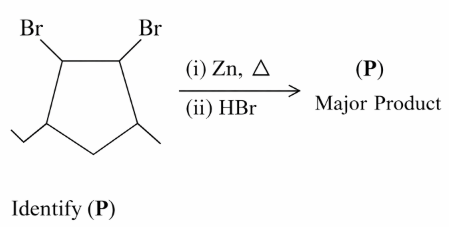
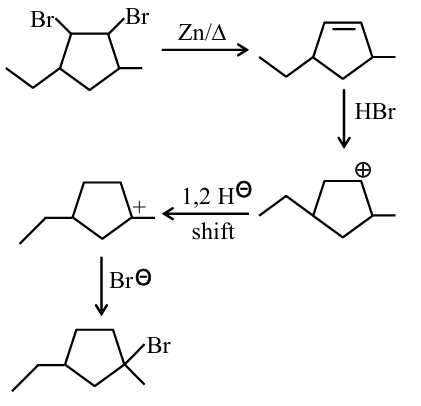
Step 1: Debromination with ($$Zn$$, $$\Delta$$)The reaction of a vicinal dibromide (1,2-dibromo compound) with zinc dust and heat undergoes an elimination reaction. The zinc removes the two bromine atoms to form a carbon-carbon double bond.
Step 2: Hydrobromination with ($$HBr$$)The intermediate alkene then reacts with ($$HBr$$). This is an electrophilic addition reaction following Markovnikov's rule.
Given below are two statements :
**Statement (I) :** Benzyl chloride reacts faster in S$$_N$$1 mechanism than ethyl chloride.
**Statement (II) :** Ethyl carbocation intermediate is less stabilized by hyperconjugation than benzyl carbocation by resonance.
In the light of the above statements, choose the correct answer from the options given below :
In an $$S_N1$$ mechanism the slow, rate-determining step is the heterolytic cleavage of the C-Cl bond:
$$R{-}Cl \;\xrightarrow{k_{\text{slow}}}\; R^{+} + Cl^{-}$$
Hence the rate law is $$\text{rate} = k[R{-}Cl]$$. The more stable the carbocation $$R^{+}$$ that is produced, the Smaller is the activation energy and the faster is the reaction.
Stability of the two carbocations
• Benzyl chloride $$C_6H_5CH_2Cl$$ gives the benzyl carbocation $$C_6H_5CH_2^{+}$$.
This cation is delocalised over the aromatic ring through resonance:
$$C_6H_5CH_2^{+} \;\longleftrightarrow\; C_6H_5^{+}{-}CH_2$$ and several other canonical forms.
The resonance disperses the positive charge over the entire ring and provides very high stabilisation.
• Ethyl chloride $$CH_3CH_2Cl$$ gives the ethyl carbocation $$CH_3CH_2^{+}$$.
It is a primary carbocation and can be stabilised only by hyperconjugation of three $$\sigma$$-C-H bonds with the empty $$p$$ orbital. Hyperconjugation is a relatively weak effect compared with resonance.
Comparing the reaction rates
Because the benzyl carbocation is far more stabilised than the ethyl carbocation, benzyl chloride ionises much more readily. Therefore benzyl chloride reacts faster than ethyl chloride in an $$S_N1$$ reaction. Statement (I) is true.
Evaluating the second statement
Statement (II) says: “Ethyl carbocation intermediate is less stabilised by hyperconjugation than benzyl carbocation by resonance.”
Resonance (delocalisation over several atoms) indeed provides greater stabilisation than the few hyperconjugative structures available to a primary carbocation. Hence Statement (II) is also true.
Final selection
Both statements are correct, and Statement (II) explains the reason behind Statement (I).
Option A which is: Both Statement I and Statement II are true
Correct statements regarding alkyl halides $$(R-X)$$ among the following are :
A. Alcohol being less polar solvent favours elimination with alcoholic KOH favours elimination reaction with $$R - X.$$
B. Order of reactivity towards $$S_N1$$ is $$C_6H_5-CH_2-Cl > C_6H_5-CHCl-C_6H_5$$.
C. Non substituted aryl halides exhibit properties similar to alkyl halides.
D. Vinyl chloride is example of haloalkene and allyl chloride is example of haloalkyne.
E. $$R-Cl$$ can be prepared by reacting $$R-OH$$ with $$SOCl_2$$ but $$Ar-Cl$$ cannot be prepared by reacting $$Ar-OH$$ with $$SOCl_2$$.
Choose the correct answer from the options given below :
The question asks us to test each statement (A - E) about halogen-substituted compounds and then pick the option that contains all and only the correct ones.
Statement A
“Alcohol being less polar solvent favours elimination with alcoholic KOH.”
• In aqueous KOH, the medium is highly polar; the hydroxide ion is strongly solvated and favours nucleophilic substitution (mainly $$S_N2$$).
• In alcoholic KOH, the solvent (ethanol, propanol etc.) is less polar, the hydroxide ion is less solvated, and a strong base character dominates. This promotes $$\beta$$-elimination ($$E_2$$) giving an alkene.
Therefore Statement A is correct.
Statement B
“Order of reactivity towards $$S_N1$$ is $$C_6H_5CH_2Cl \gt C_6H_5CHClC_6H_5$$.”
• $$S_N1$$ reactions proceed through a carbocation.
• For $$C_6H_5CH_2^+$$ (benzyl carbocation) resonance with one phenyl ring stabilises the cation.
• For $$C_6H_5CH^+C_6H_5$$ (benzhydryl carbocation) two phenyl rings provide resonance stabilisation. More resonance structures → greater stability → faster $$S_N1$$.
Hence $$C_6H_5CHClC_6H_5$$ reacts faster than $$C_6H_5CH_2Cl$$, the reverse of what the statement claims. Statement B is wrong.
Statement C
“Non substituted aryl halides exhibit properties similar to alkyl halides.”
• In aryl halides, the lone pair on halogen interacts with the aromatic ring, giving a partial $$C-X$$ double-bond character. Bond dissociation energy is high and the carbon is $$sp^2$$-hybridised.
• Consequently, aryl halides are far less reactive in both $$S_N1$$ and $$S_N2$$ than alkyl halides.
Hence their chemical behaviour is quite different, so Statement C is wrong.
Statement D
“Vinyl chloride is example of haloalkene and allyl chloride is example of haloalkyne.”
• Vinyl chloride: $$CH_2=CHCl$$ — yes, a haloalkene.
• Allyl chloride: $$CH_2=CHCH_2Cl$$ — also a haloalkene (the halogen is on the carbon next to a C=C). It is not an alkyne derivative.
Therefore Statement D is wrong.
Statement E
“$$R-Cl$$ can be prepared by reacting $$R-OH$$ with $$SOCl_2$$ but $$Ar-Cl$$ cannot be prepared by reacting $$Ar-OH$$ with $$SOCl_2$$.”
• Aliphatic alcohols readily convert to alkyl chlorides with thionyl chloride: $$R-OH + SOCl_2 \rightarrow R-Cl + SO_2 + HCl$$.
• Phenols do not undergo this reaction because the $$C-O$$ bond in $$Ar-OH$$ has partial double-bond character ($$sp^2$$ carbon and resonance), making direct replacement of $$-OH$$ by $$-Cl$$ extremely difficult.
Thus Statement E is correct.
Summary
Correct: A and E.
Incorrect: B, C, D.
The option containing only A and E is Option C.
Hence, the answer is:
Option C which is: A and E Only.
Match List-I with List-II.

Choose the correct answer from the options given below :
For nucleophilic substitution reactions two factors are crucial:
• Stability of the carbocation that would be produced in an $$\mathrm{S_N1}$$ mechanism.
• Ease of backside attack (absence of steric and electronic hindrance) for an $$\mathrm{S_N2}$$ mechanism.
List-I (type of halide) and List-II (behaviour) are compared one by one.
Case A: A is a normal primary alkyl halide, e.g. $$CH_3CH_2CH_2Cl$$.
• A primary carbocation is highly unstable, so $$\mathrm{S_N1}$$ is disfavoured.
• Back-side attack is unhindered, therefore the compound usually reacts by the bimolecular path $$\mathrm{S_N2}$$.
Hence A matches with “undergoes $$\mathrm{S_N2}$$ reaction” ⇒ Item III.
Case B: B is benzyl chloride, $$C_6H_5CH_2Cl$$.
• If chloride leaves, the benzyl carbocation $$C_6H_5CH_2^+$$ is stabilised by resonance with the aromatic ring.
• Such high stabilisation makes the unimolecular path very fast.
Therefore B matches with “undergoes $$\mathrm{S_N1}$$ reaction very readily” ⇒ Item I.
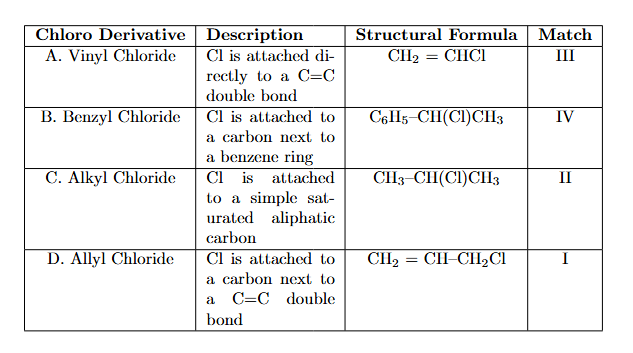
Case C: C is allyl chloride, $$CH_2=CHCH_2Cl$$.
• Loss of $$Cl^-$$ gives the allyl cation $$CH_2=CHCH_2^+$$ which is resonance-stabilised:
$$CH_2=CH-\overset{+}{C}H_2 \;\;\leftrightarrow\;\; ^{+}CH_2-CH=CH_2$$
• Resonance stabilisation again promotes the $$\mathrm{S_N1}$$ pathway.
Hence C is linked with “forms a resonance-stabilised carbocation” ⇒ Item IV.
Case D: D is vinyl chloride, $$CH_2=CHCl$$ (the halogen directly attached to a double-bonded carbon).
• The $$C-Cl$$ bond is polarised toward carbon because of $$sp^2$$-hybridisation and $$\pi$$ overlap; it acquires partial double-bond character.
• Nucleophilic substitution (both $$\mathrm{S_N1}$$ and $$\mathrm{S_N2}$$) becomes extremely slow; effectively the reaction does not occur under ordinary conditions.
Therefore D matches with “does not undergo normal nucleophilic substitution” ⇒ Item II.
Collecting all matches:
A → III B → I C → IV D → II
Among the given answer sets, this correspondence is given in Option B.
Hence the correct choice is:
Option B which is: A-III, B-I, C-IV, D-II.
n-Butane on monochlorination under photochemical condition gives an optically active compound "P". "P" on further chlorination gives dichloro compounds. The number of dichloro compounds obtained (ignore stereoisomers) is :
Given below are two statements:
Statement I: 3-phenylpropene reacts with HBr and gives secondary alkyl bromide having a chiral carbon atom as the major product.
Statement II: Aryl chlorides and aryl cyanides can be prepared by Sandmeyer reaction as well as Gattermann reaction.
In the light of the above statements, choose the correct answer from the options given below:
Given below are two statements :
Statement I : Due to increase in van der Waals forces, the order of boiling points is CH$$_3$$CH$$_2$$CH$$_2$$I > CH$$_3$$CH$$_2$$I > CH$$_3$$I.
Statement II : As

is more symmetric, its melting point is higher than

, however its boiling point is lower than

.
In the light of the above statements, choose the correct answer from the options given below :

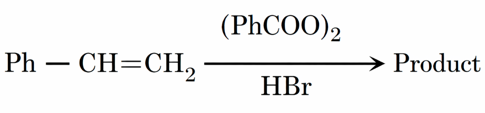
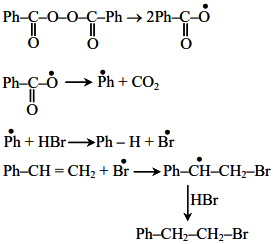
Consider the above reaction
A. The reaction proceeds through a more stable radical intermediate.
B. The role of peroxide is to generate H^{.} (Hydrogen radical).
C. During this reaction, benzene is formed as a byproduct.
D. 1-Bromo-2- phenylethane is formed as the minor product.
E. The same reaction in absence of peroxide proceeds via carbocation intermediate.
Identify the correct statements. Choose the correct answer from the options given below:
Match the LIST-I with LIST-II
Choose the correct answer from the options given below:
The correct order of reactivity of $$CH_{3} Br$$ in methanol with the following
nucleophiles is
$$F^{-}, I^{-}, C_{2}H_{5}O^{-}$$ and $$C_{6}H_{5}O^{-}$$
Find the correct order of reactivity of $$CH_3Br$$ in methanol with nucleophiles $$F^-$$, $$I^-$$, $$C_2H_5O^-$$, $$C_6H_5O^-$$.
$$CH_3Br$$ (primary substrate) undergoes $$S_N2$$ reaction with nucleophiles.
Methanol is a protic solvent. In protic solvents, nucleophilicity is strongly affected by solvation. Smaller, more charge-dense ions are more heavily solvated and thus less nucleophilic.
- $$I^-$$: Large, polarizable, weakly solvated in protic solvents → strongest nucleophile
- $$C_2H_5O^-$$: Good nucleophile (strong base, alkoxide), but solvated by H-bonding in methanol
- $$C_6H_5O^-$$: Weaker nucleophile than ethoxide because the negative charge is delocalized into the benzene ring
- $$F^-$$: Small, highly solvated in protic solvents → weakest nucleophile
Order: $$I^- > C_2H_5O^- > C_6H_5O^- > F^-$$
The correct answer is Option (1).
$$\text{RMgI}$$ when treated with ice cold water liberated a gas which occupied $$1.4\,\text{dm}^3/\text{g}$$ at STP. The gas produced is further reacted with iodine in presence of $$\text{HIO}_3$$ to give compound (X). Compound (X) in presence of Na and dry ether produced compound (Y). Molar mass of compound (Y) is $$\underline{\hspace{2cm}}$$ $$\text{g mol}^{-1}$$. (Nearest integer)
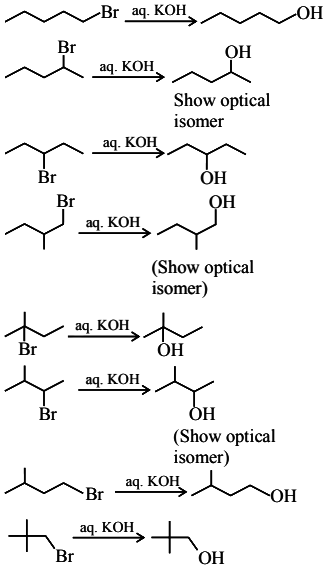
Consider all the structural isomers with molecular formula $$C_{5}H_{11}Br$$ are separately treated with KOH(aq) to give respective substitution products, without any rearrangement. The number of products which can exhibit optical isomerism from these is ______.
We need to find all structural isomers of $$C_5H_{11}Br$$, treat each with aqueous KOH (SN2/SN1 substitution, no rearrangement), and count how many products exhibit optical isomerism.
The structural isomers of $$C_5H_{11}Br$$ (monobromopentanes) are:
1. $$CH_3CH_2CH_2CH_2CH_2Br$$ (1-bromopentane)
2. $$CH_3CH_2CH_2CHBrCH_3$$ (2-bromopentane)
3. $$CH_3CH_2CHBrCH_2CH_3$$ (3-bromopentane)
4. $$(CH_3)_2CHCH_2CH_2Br$$ (1-bromo-3-methylbutane)
5. $$(CH_3)_2CHCHBrCH_3$$ (2-bromo-3-methylbutane)
6. $$(CH_3)_2CBrCH_2CH_3$$ (2-bromo-2-methylbutane)
7. $$(CH_3)_3CCH_2Br$$ (1-bromo-2,2-dimethylpropane / neopentyl bromide)
8. $$CH_3CH_2CH(CH_3)CH_2Br$$ (1-bromo-2-methylbutane)
Now, substitution with KOH(aq) replaces Br with OH. The product is the corresponding alcohol. For optical isomerism, the product must have a chiral center (asymmetric carbon).
1. 1-bromopentane → 1-pentanol: $$CH_3CH_2CH_2CH_2CH_2OH$$ — No chiral center. Not optically active.
2. 2-bromopentane → 2-pentanol: $$CH_3CH(OH)CH_2CH_2CH_3$$ — C2 has four different groups (H, OH, CH3, CH2CH2CH3). Chiral. Optically active.
3. 3-bromopentane → 3-pentanol: $$CH_3CH_2CH(OH)CH_2CH_3$$ — C3 has groups H, OH, CH2CH3, CH2CH3. Two groups are the same. Not chiral. Not optically active.
4. 1-bromo-3-methylbutane → 3-methyl-1-butanol: $$(CH_3)_2CHCH_2CH_2OH$$ — No chiral center. Not optically active.
5. 2-bromo-3-methylbutane → 3-methyl-2-butanol: $$(CH_3)_2CHCH(OH)CH_3$$ — C2 has groups H, OH, CH3, CH(CH3)2. All four different. Chiral. Optically active.
6. 2-bromo-2-methylbutane → 2-methyl-2-butanol: $$(CH_3)_2C(OH)CH_2CH_3$$ — C2 has groups OH, CH3, CH3, CH2CH3. Two CH3 groups are same. Not chiral. Not optically active.
7. 1-bromo-2,2-dimethylpropane → 2,2-dimethyl-1-propanol (neopentyl alcohol): $$(CH_3)_3CCH_2OH$$ — No chiral center. Not optically active.
8. 1-bromo-2-methylbutane → 2-methyl-1-butanol: $$CH_3CH_2CH(CH_3)CH_2OH$$ — C2 (the carbon bearing CH3) has groups H, CH3, CH2CH3, CH2OH. All four different. Chiral. Optically active.
The products that can exhibit optical isomerism are: 2-pentanol (from isomer 2), 3-methyl-2-butanol (from isomer 5), and 2-methyl-1-butanol (from isomer 8).
The answer is 3.
Identify the products [A] and [B], respectively in the following reaction :
An optically active alkyl halide $$C_4H_9Br$$ [A] reacts with hot KOH dissolved in ethanol and forms alkene [B] as major product which reacts with bromine to give dibromide [C]. The compound [C] is converted into a gas [D] upon reacting with alcoholic NaNH$$_2$$. During hydration 18 gram of water is added to 1 mole of gas [D] on warming with mercuric sulphate and dilute acid at 333 K to form compound [E]. The IUPAC name of compound [E] is:
The alkyl halide [A] has formula $$C_4H_9Br$$ and is given to be optically active.
For a compound with four carbon atoms to show optical activity it must possess a chiral centre.
The only $$C_4H_9Br$$ isomer that contains such a centre is $$CH_3-CHBr-CH_2-CH_3$$, i.e. $$2$$-bromobutane.
Therefore, $$[A] =$$ 2-bromobutane.
Hot ethanolic $$KOH$$ carries out $$\beta$$-elimination (dehydrohalogenation). Eliminating $$HBr$$ from 2-bromobutane gives the more substituted alkene as the major product:
$$[A] \xrightarrow[\text{EtOH}]{\text{hot }KOH} \; CH_3-CH=CH-CH_3$$
Thus $$[B] =$$ but-2-ene (mixture of $$E$$ and $$Z$$ forms).
Adding bromine across the double bond gives a vicinal dibromide:
$$[B] + Br_2 \rightarrow CH_3-CHBr-CHBr-CH_3$$
Hence $$[C] =$$ 2,3-dibromobutane (meso + racemic mixture).
Alcoholic $$NaNH_2$$ is a very strong base; with a vic-dibromide it removes two molecules of $$HBr$$ to form an alkyne:
$$[C] \xrightarrow[\text{alc.}]{NaNH_2} CH_3-C \equiv C-CH_3$$
Therefore $$[D] =$$ but-2-yne, a gaseous alkyne (molar mass $$=54$$ g mol$$^{-1}$$). During this step nothing else is added or lost other than $$2HBr$$, so the formula of $$[D]$$ is $$C_4H_6$$.
The statement “18 g of water is added to 1 mol of gas $$[D]$$” confirms that exactly one mole of $$H_2O$$ (18 g) adds to each mole of alkyne, matching hydration of a single triple bond.
Markovnikov hydration of an internal alkyne is carried out with dilute acid and mercuric sulphate catalyst at 333 K. First an enol forms, which then tautomerises to a ketone:
$$CH_3-C \equiv C-CH_3 \xrightarrow[\text{HgSO}_4]{H_2O/H^+, \;333\,\text{K}} CH_3-CO-CH_2-CH_3$$
The product $$[E]$$ is $$CH_3-CO-CH_2-CH_3$$, whose IUPAC name is butan-2-one.
Thus the correct option is Option C: Butan-2-one.
Given below are two statements: Statement I: The conversion proceeds well in the less polar medium.
$$\mathrm{CH_3-CH_2-CH_2-CH_2-Cl} \;\xrightarrow{\;\;HO^-\;\;} \mathrm{CH_3-CH_2-CH_2-CH_2-OH} + \mathrm{Cl^{(-)}}$$
Statement II: The conversion proceeds well in the more polar medium.
In the light of the above statements, choose the correct answer from the options given below
Given below are two statements :
Statement (I) : Alcohols are formed when alkyl chlorides are treated with aqueous potassium hydroxide by elimination reaction.
Statement (II) : In alcoholic potassium hydroxide, alkyl chlorides form alkenes by abstracting the hydrogen from the $$\beta$$-carbon.
In the light of the above statements, choose the most appropriate answer from the option given below :
The behaviour of alkyl halides changes with the nature of the $$KOH$$ medium.
Case 1: Aqueous $$KOH$$ reacts with alkyl chlorides mainly through nucleophilic substitution ($$S_{N1}$$ or $$S_{N2}$$).
• The hydroxide ion $$OH^-$$ attacks the carbon bearing the chlorine and replaces $$Cl^-$$.
• This produces an alcohol: $$R{-}Cl + KOH_{(aq)} \rightarrow R{-}OH + KCl$$.
• The mechanism is substitution, not elimination.
Therefore Statement (I) is incorrect because it labels the reaction as “elimination” instead of “substitution.”
Case 2: Alcoholic $$KOH$$ behaves as a strong base rather than a nucleophile.
• The ethoxide/alkoxide ion ($$RO^-$$ formed in situ) abstracts a hydrogen from a $$\beta$$-carbon (carbon adjacent to the one carrying $$Cl$$).
• Simultaneously the $$Cl^-$$ leaves, giving an alkene: $$R{-}CH_2{-}CH_2Cl \xrightarrow[KOH_{(alc)}]{} R{-}CH{=}CH_2 + KCl + H_2O$$.
• This is an elimination (E2/E1) reaction, exactly as described in Statement (II).
Hence Statement (II) is correct.
Combining the conclusions:
• Statement (I) - Incorrect.
• Statement (II) - Correct.
Thus the most appropriate choice is Option B.
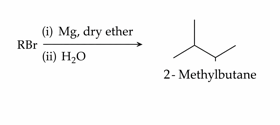
The maximum number of RBr producing 2-methylbutane by above sequence of reactions is ________ -
(Consider the structural isomers only)
The reaction sequence shown is:
The products A and B in the following reactions, respectively are
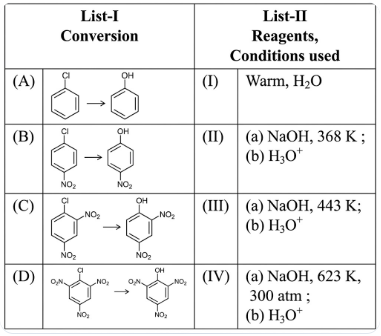
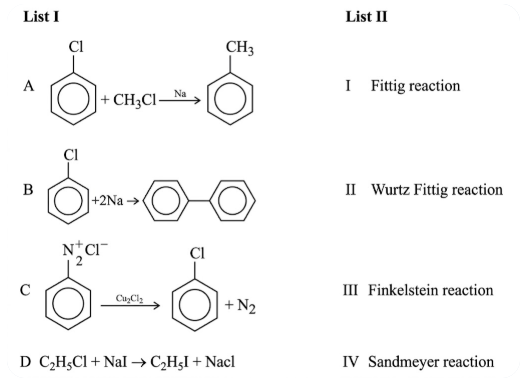
Match List-I with List-II .

Choose the correct answer from the options given below :
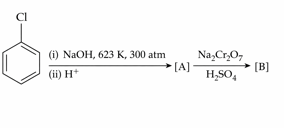
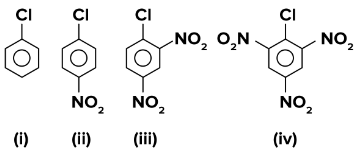
In every conversion a chloride atom on an aromatic ring is being replaced by $$\!OH$$ to give a phenol. This transformation proceeds by a nucleophilic aromatic substitution (SNAr) of the $$Cl^{-}$$ ion by the nucleophile $$OH^{-}$$.
Rate of SNAr increases sharply when the ring has strong $$-I$$ and $$-M$$ groups (such as $$NO_{2}$$) at the ortho and/or para positions. These groups stabilise the intermediate Meisenheimer complex by delocalising the negative charge.
Therefore, the more $$NO_{2}$$ groups present, the milder the conditions required for hydrolysis. Arrange the four substrates in increasing ease of hydrolysis:
chlorobenzene < p-nitrochlorobenzene < 2,4-dinitrochlorobenzene < picryl chloride (2,4,6-trinitrochlorobenzene).
Now match the reagents/conditions given in List-II with this order:
Case 1: Chlorobenzene → phenol
Very unreactive; Dow’s process is used.
Reagents: $$NaOH$$, $$623\text{ K}$$, $$300\,\text{atm}$$, then $$H_{3}O^{+}$$ ⇒ Item (IV).
Case 2: p-Nitrochlorobenzene → p-Nitrophenol
One $$NO_{2}$$ group activates the ring; moderate temperature is sufficient.
Reagents: $$NaOH$$, $$443\text{ K}$$, then $$H_{3}O^{+}$$ ⇒ Item (III).
Case 3: 2,4-Dinitrochlorobenzene → 2,4-Dinitrophenol
Two $$NO_{2}$$ groups give higher activation; still milder conditions than above.
Reagents: $$NaOH$$, $$368\text{ K}$$, then $$H_{3}O^{+}$$ ⇒ Item (II).
Case 4: Picryl chloride (2,4,6-Trinitrochlorobenzene) → Picric acid (2,4,6-Trinitrophenol)
Three $$NO_{2}$$ groups make the ring so activated that simple warming with water suffices.
Reagent/condition: warm $$H_{2}O$$ ⇒ Item (I).
Thus the correct pairing is:
(A) → (IV), (B) → (III), (C) → (II), (D) → (I).
Comparing with the options, this corresponds to Option C.
Propane molecule on chlorination under photochemical condition gives two di-chloro products, " x " and " y ". Amongst " x " and " y ", " x " is an optically active molecule. How many tri-chloro products (consider only structural isomers) will be obtained from " x " when it is further treated with chlorine under the photochemical condition?
Propane chlorination gives two dichloro products x and y, and x is optically active. Possible dichloropropane structural isomers are 1,1-dichloropropane: CHCl$$_2$$CH$$_2$$CH$$_3$$; 1,2-dichloropropane: CH$$_2$$ClCHClCH$$_3$$ (which has a chiral center at C2); 1,3-dichloropropane: ClCH$$_2$$CH$$_2$$CH$$_2$$Cl$$; and 2,2-dichloropropane: CH$$_3$$CCl$$_2$$CH$$_3$$. Only 1,2-dichloropropane is optically active, so x = CH$$_2$$ClCHClCH$$_3$$.
Further chlorination of CH$$_2$$ClCHClCH$$_3$$ can replace a hydrogen at three distinct positions. Substitution at C1 gives CHCl$$_2$$CHClCH$$_3$$ (1,1,2-trichloropropane); substitution at C2 yields CH$$_2$$ClCCl$$_2$$CH$$_3$$ (1,2,2-trichloropropane); and substitution at C3 gives CH$$_2$$ClCHClCH$$_2$$Cl (1,2,3-trichloropropane). Although C3 initially has three equivalent hydrogens, chlorination at any one of them leads to the same product.
In total, there are 3 structural trichloro isomers obtainable from x.
The correct answer is Option D: 3.
The product formed in the following reaction sequence is :
The ascending order of relative rate of solvolysis of following compounds is :
The structure of the major product formed in the following reaction is :
An organic compound (X) with molecular formula $$C_3H_6O$$ is not readily oxidised. On reduction it gives $$(C_3H_8O)(Y)$$ which reacts with HBr to give a bromide (Z) which is converted to Grignard reagent. This Grignard reagent on reaction with (X) followed by hydrolysis gives 2,3-dimethylbutan-2-ol. Compounds (X), (Y) and (Z) respectively are:
The molecular formula of compound $$(X)$$ is $$C_3H_6O$$. Such a formula can represent either an aldehyde or a ketone.
(i) Aldehydes are oxidised very easily, whereas ketones resist mild oxidising agents.
Given statement: $$(X)$$ “is not readily oxidised”.
Therefore $$(X)$$ must be a ketone.
The only ketone having the formula $$C_3H_6O$$ is propan-2-one (acetone):
$$CH_3COCH_3$$
Hence $$\boxed{X = CH_3COCH_3}$$.
(ii) When a ketone is reduced (NaBH4/LiAlH4) it gives a secondary alcohol.
Formula wise: $$C_3H_6O \xrightarrow[\text{reduction}]{[H]} C_3H_8O$$.
Reduction of acetone gives isopropyl alcohol (propan-2-ol):
$$CH_3COCH_3 \;\;{\xrightarrow{[H]}}\;\; CH_3CH(OH)CH_3$$
Therefore $$\boxed{Y = CH_3CH(OH)CH_3}$$.
(iii) Secondary alcohols react with $$HBr$$ via $$S_N1$$ to give the corresponding 2° bromides.
$$CH_3CH(OH)CH_3 + HBr \longrightarrow CH_3CH(Br)CH_3 + H_2O$$
Thus $$\boxed{Z = CH_3CH(Br)CH_3}$$.
(iv) Bromide $$(Z)$$ is treated with Mg in dry ether to form the Grignard reagent:
$$CH_3CH(Br)CH_3 + Mg \;\xrightarrow{\text{dry ether}}\; CH_3CH(MgBr)CH_3$$
(v) A Grignard reagent adds to the carbonyl carbon of a ketone; after hydrolysis a tertiary alcohol is formed.
General rule: $$R\!-\!MgBr + R'CO R'' \;\xrightarrow{\text{anh.\,ether}}\; R\!-\!C(OMgBr)(R')(R'') \xrightarrow{H_2O} R\!-\!C(OH)(R')(R'')$$
Here,
$$R = CH_3CH(CH_3)\;,$$ the isopropyl group from the Grignard reagent, and
$$R' = R'' = CH_3$$ from acetone.
Product after hydrolysis:
central carbon attached to $$OH$$, two $$CH_3$$ groups, and an $$CH(CH_3)_2$$ group $$\rightarrow$$ a six-carbon tertiary alcohol.
Draw the longest chain (four carbons) and locate the substituents:
CH3-C(OH)(CH3)-CH(CH3)-CH3
Naming this structure gives 2,3-dimethylbutan-2-ol, exactly as stated in the question. Therefore our chosen set $$X, Y, Z$$ is consistent with every step.
The set appears in Option B:
$$X = CH_3COCH_3,\;\; Y = CH_3CH(OH)CH_3,\;\; Z = CH_3CH(Br)CH_3.$$
Hence the correct answer is Option B.
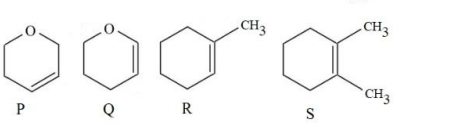
Following are the four molecules "P", "Q", "R" and "S". Which one among the four molecules will react with
$$H-Br_{(aq)}$$ at the fastest rate?
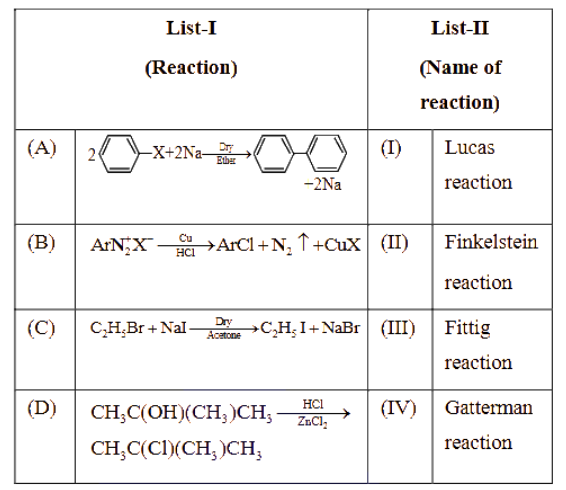
Match List-I with List-II.

Choose the correct answer from the options given below :
Which among the following halides will generate the most stable carbocation in the nucleophilic substitution reaction?
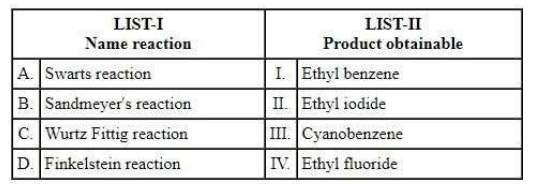
Match the LIST-I with LIST-II
Choose the correct answer from the options given below:
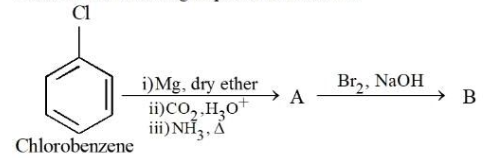
Consider the following sequence of reactions:

11.25 mg of chlorobenzene will produce __________$$\times 10^{-1}mg$$ of product B . (Consider the reactions result in complete conversion.) [Given molar mass of C, H, O, N and Cl as 12, 1, 16, 14 and $$35.5 g mol^{-1}$$ respectively]
Match List I with List II

Choose the correct answer from the options given below:
Match List I with List II

Choose the correct answer from the options given below:
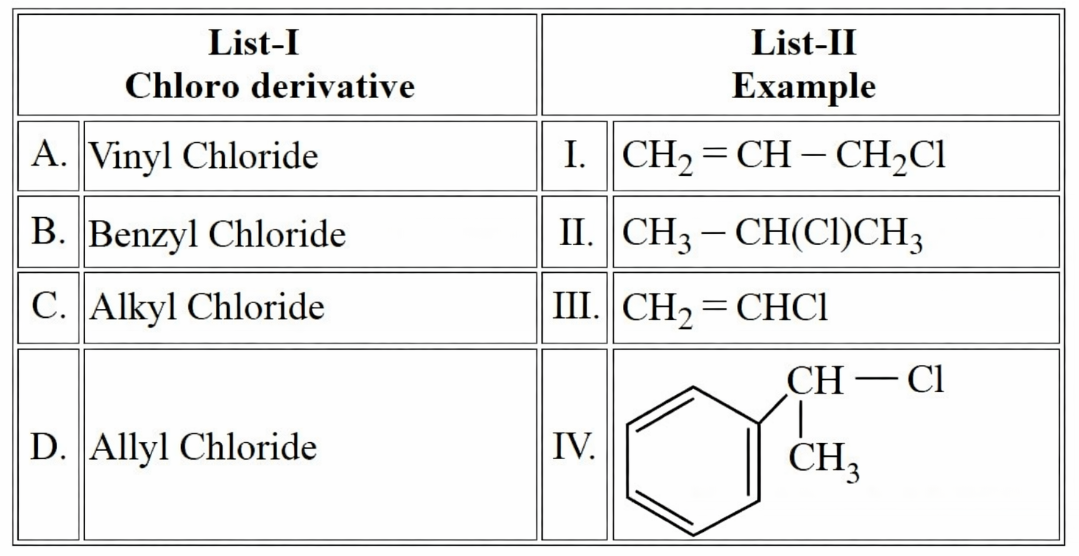
Example of vinylic halide is
Given below are two statements : One is labelled as Assertion (A) and the other is labelled as Reason (R). Assertion (A) : Enthalpy of neutralisation of strong monobasic acid with strong monoacidic base is always $$-57 \text{ kJ mol}^{-1}$$. Reason (R) : Enthalpy of neutralisation is the amount of heat liberated when one mole of $$H^+$$ ions furnished by acid combine with one mole of $$OH^-$$ ions furnished by base to form one mole of water. In the light of the above statements, choose the correct answer from the options given below.
Assertion (A): Enthalpy of neutralisation of strong monobasic acid with strong monoacidic base is always $$-57$$ kJ/mol.
This is true. For strong acid-strong base neutralisation, the net reaction is simply $$H^+ + OH^- \rightarrow H_2O$$, and the enthalpy is $$-57.1$$ kJ/mol (approximately $$-57$$ kJ/mol).
Reason (R): Enthalpy of neutralisation is the heat liberated when 1 mol $$H^+$$ combines with 1 mol $$OH^-$$ to form 1 mol water.
This is true and is the definition of enthalpy of neutralisation.
Since both are true and (R) correctly explains why (A) is always $$-57$$ kJ/mol (because for strong acid and strong base, the only reaction is $$H^+ + OH^- \rightarrow H_2O$$, there's no extra energy for dissociation), (R) is the correct explanation of (A).
The correct answer is Option (3): Both (A) and (R) are true and (R) is the correct explanation of (A).
Given below are two statements one is labeled as Assertion (A) and the other is labeled as Reason (R).
Assertion (A): $$CH_2=CH-CH_2-Cl$$ is an example of allyl halide
Reason (R): Allyl halides are the compounds in which the halogen atom is attached to $$sp^2$$ hybridised carbon atom.
In the light of the two above statements, choose the most appropriate answer from the options given below:
Assertion (A): "$$CH_2=CH-CH_2-Cl$$ is an example of allyl halide."
This is TRUE. An allyl halide is a compound in which the halogen atom is bonded to a carbon atom that is adjacent to a carbon-carbon double bond (i.e., the halogen is on the allylic carbon). In $$CH_2=CH-CH_2-Cl$$, the chlorine is attached to the $$CH_2$$ group which is next to the $$C=C$$ double bond. This is indeed allyl chloride (3-chloropropene).
Reason (R): "Allyl halides are the compounds in which the halogen atom is attached to $$sp^2$$ hybridised carbon atom."
This is FALSE. In allyl halides, the halogen is attached to an $$sp^3$$ hybridised carbon atom (the allylic carbon, $$-CH_2-Cl$$), not an $$sp^2$$ hybridised carbon. Compounds where the halogen is attached to an $$sp^2$$ hybridised carbon are called vinyl halides (e.g., $$CH_2=CH-Cl$$), not allyl halides.
Therefore, (A) is true but (R) is false.
Match List - I with List - II.
Choose the correct answer from the options given below:

Identify (B) and (C) and how are (A) and (C) related ?
Identify $$A$$ and $$B$$ in the given chemical reaction sequence
The product (C) in the below mentioned reaction is: $$CH_3-CH_2-CH_2-Br \xrightarrow[\Delta]{KOH_{alc}} A \xrightarrow{HBr} B \xrightarrow[\Delta]{KOH_{aq}} C$$
$$CH_3CH_2CH_2Br \xrightarrow{KOH_{alc}} CH_3CH=CH_2$$ (A = propene, elimination).
$$CH_3CH=CH_2 \xrightarrow{HBr} CH_3CHBrCH_3$$ (B = 2-bromopropane, Markovnikov addition).
$$CH_3CHBrCH_3 \xrightarrow{KOH_{aq}} CH_3CH(OH)CH_3$$ (C = propan-2-ol, substitution).
The answer is Option (4): Propan-2-ol.
Consider the given chemical reaction :
This reagent combination acts as a strong oxidizing agent that completely cleaves the carbon-carbon double bond ($$\text{C}=\text{C}$$).
Major product of the following reaction is:
In the above chemical reaction sequence "A" and "B" respectively are:
The major product (P) in the following reaction is
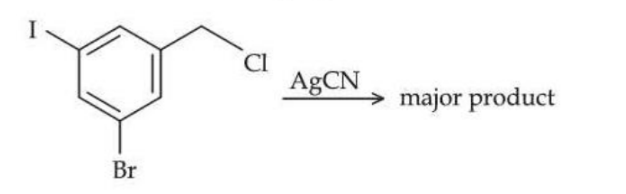
Alkyl halide is converted into alkyl isocyanide by reaction with
We need to identify which reagent converts an alkyl halide into an alkyl isocyanide. The key distinction lies in the ambident nature of the cyanide ion ($$CN^-$$), which can bond through either the carbon atom or the nitrogen atom. Bonding through carbon ($$C$$) gives an alkyl cyanide (nitrile) $$R-CN$$, while bonding through nitrogen ($$N$$) yields an alkyl isocyanide $$R-NC$$.
According to the HSAB (Hard-Soft Acid-Base) principle, $$NaCN$$ and $$KCN$$ are ionic cyanides that provide free $$CN^-$$ ions in solution; these ions attack preferentially through the carbon end, forming alkyl cyanides (nitriles). By contrast, $$AgCN$$ is a covalent cyanide in which silver is bonded to the carbon end of $$CN$$, leaving the nitrogen end free to attack the alkyl halide and form an alkyl isocyanide.
The reaction with $$AgCN$$ is:
$$R-X + AgCN \rightarrow R-NC + AgX$$
This pathway produces an alkyl isocyanide because the nitrogen atom of $$CN$$ attacks the carbon of the alkyl halide. Therefore, the correct answer is Option 4: AgCN.
In the above reaction product '$$P$$' is :
In a substitution scenario, the cyanide ion (CN-) acts as a nucleophile rather than a base.
It is important to note that if the question mention alc KOH then we would be using and elimination pathway, however as the question mentions KCN we must understand that KCN is a substituting agent than a solvent.
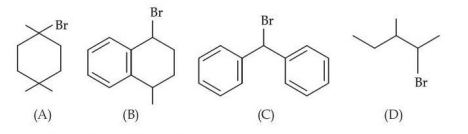
Which among the following halide/s will not show $$S_N1$$ reaction:
{image}
Given below are two statements: one is labelled as Assertion A and the other is labelled as Reason R. Assertion A: Haloalkanes react with KCN to form alkyl cyanides as a main product while with AgCN form isocyanide as the main product. Reason R: KCN and AgCN both are highly ionic compounds. In the light of the above statement, choose the most appropriate answer from the options given below:
Assertion A: Haloalkanes react with KCN to form alkyl cyanides as the main product while with AgCN they form isocyanides as the main product.
Analysis of Assertion A:
KCN is an ionic compound where $$CN^-$$ attacks through the carbon end (since C is a better nucleophile in ionic conditions), forming alkyl cyanides (R-CN).
AgCN is a covalent compound where the carbon is bonded to Ag, and the free end (nitrogen) attacks, forming isocyanides (R-NC).
Assertion A is correct.
Reason R: KCN and AgCN both are highly ionic compounds.
Analysis of Reason R:
KCN is ionic (K⁺ and CN⁻), but AgCN is predominantly covalent due to the high polarizing power of Ag⁺ (Fajans' rules). The covalent character of AgCN is what causes the nitrogen end to attack.
Reason R is incorrect because AgCN is NOT highly ionic — it is covalent.
Conclusion: A is correct but R is not correct.
The answer is Option A: A is correct but R is not correct.
Identify the correct set of reagents or reaction conditions 'X' and 'Y' in the following set of transformation:
Given below are two statements:
Statement - I: High concentration of strong nucleophilic reagent with secondary alkyl halides which do not have bulky substituents will follow $$S_N2$$ mechanism.
Statement - II: A secondary alkyl halide when treated with a large excess of ethanol follows $$S_N1$$ mechanism.
In the light of the above statements, choose the most appropriate from the options given below:
We need to evaluate both statements about nucleophilic substitution mechanisms with secondary alkyl halides.
Background - Key factors determining S$$_N$$1 vs S$$_N$$2 mechanism:
1. S$$_N$$2 mechanism is favored by: strong nucleophile, high nucleophile concentration, polar aprotic solvent, primary or secondary substrate without bulky groups.
2. S$$_N$$1 mechanism is favored by: weak nucleophile, polar protic solvent, stable carbocation (tertiary > secondary), and the rate depends only on the substrate concentration.
Analysis of Statement I:
"High concentration of strong nucleophilic reagent with secondary alkyl halides which do not have bulky substituents will follow S$$_N$$2 mechanism."
In S$$_N$$2, the rate law is: $$\text{Rate} = k[\text{substrate}][\text{nucleophile}]$$. A high concentration of a strong nucleophile increases the rate of the S$$_N$$2 pathway. Secondary alkyl halides can undergo both S$$_N$$1 and S$$_N$$2, but with a strong nucleophile at high concentration and no steric hindrance (no bulky substituents), the S$$_N$$2 pathway dominates because the nucleophile can effectively attack the electrophilic carbon via backside attack.
Therefore, Statement I is TRUE.
Analysis of Statement II:
"A secondary alkyl halide when treated with a large excess of ethanol follows S$$_N$$1 mechanism."
Ethanol ($$C_2H_5OH$$) is a weak nucleophile and a polar protic solvent. In S$$_N$$1, the rate-determining step is the formation of the carbocation: $$R\text{-}X \rightarrow R^+ + X^-$$. A polar protic solvent like ethanol stabilizes both the carbocation intermediate and the leaving group through solvation. Since ethanol is a weak nucleophile (it does not strongly drive S$$_N$$2), and it acts as a polar protic solvent that stabilizes the carbocation, the reaction follows the S$$_N$$1 pathway. The large excess of ethanol means it acts primarily as the solvent rather than as a concentrated nucleophile driving a bimolecular mechanism.
Therefore, Statement II is TRUE.
Since both statements are true, the correct answer is Option (4): Both Statement I and Statement II are true.
Identify A and B in the following sequence of reaction:
$$CH_3-CH_2-CH_2-Br + NaOH \xrightarrow{C_2H_5OH}$$ Product 'A'.
Consider the above reactions, identify product $$B$$ and product $$C$$.
{image}
Given below are two statements : one is labelled as Assertion A and the other is labelled as Reason R :
Assertion A : Aryl halides cannot be prepared by replacement of hydroxyl group of phenol by halogen atom.
Reason R : Phenols react with halogen acids violently.
In the light of the above statements, choose the most appropriate from the options given below:
A: Aryl halides cannot be prepared by replacing -OH of phenol with halogen. True — the C-OH bond in phenol has partial double bond character.
R: Phenols react with halogen acids violently. False — phenols do not react with HX.
A is true but R is false. Option (3).
Identify major product 'P' formed in the following reaction:
The correct statement regarding nucleophilic substitution reaction in a chiral alkyl halide is :
In nucleophilic substitution reactions of chiral alkyl halides:
$$S_N1$$ reaction: Proceeds through a planar carbocation intermediate. The nucleophile can attack from either side, leading to racemisation.
$$S_N2$$ reaction: Proceeds through a backside attack mechanism (concerted). The nucleophile attacks from the opposite side of the leaving group, leading to inversion of configuration (Walden inversion).
The answer is: Racemisation occurs in $$S_N1$$ reaction and inversion occurs in $$S_N2$$ reaction, which corresponds to Option (4).
Major product formed in the following reaction is a mixture of:
An ideal gas, $$\bar{C}_v = \frac{5}{2}R$$, is expanded adiabatically against a constant pressure of 1 atm until it doubles in volume. If the initial temperature and pressure is $$298 \text{ K}$$ and $$5 \text{ atm}$$, respectively then the final temperature is _______ K (nearest integer). [$$\bar{C}_v$$ is the molar heat capacity at constant volume]
Adiabatic expansion against constant external pressure (irreversible).
$$q = 0$$, so $$\Delta U = w = -P_{ext}(V_2 - V_1)$$.
$$nC_v(T_2 - T_1) = -P_{ext}(V_2 - V_1)$$. Using ideal gas: $$PV = nRT$$.
$$V_1 = nRT_1/P_1 = nR(298)/5$$, $$V_2 = 2V_1 = 2nR(298)/5$$.
$$nC_v(T_2 - 298) = -1 \times (2V_1 - V_1) = -V_1 = -nR(298)/5$$.
$$\frac{5R}{2}(T_2 - 298) = -\frac{R(298)}{5}$$
$$T_2 - 298 = -\frac{2 \times 298}{25} = -23.84$$
$$T_2 = 298 - 23.84 = 274.16 \approx 274$$ K.
The answer is 274.
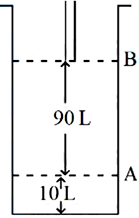
Consider the figure provided. 1 mol of an ideal gas is kept in a cylinder, fitted with a piston, at the position A, at $$18°C$$. If the piston is moved to position B, keeping the temperature unchanged, then '$$x$$' L atm work is done in this reversible process. $$x =$$ ______ L atm. (nearest integer) [Given: Absolute temperature $$= °C + 273.15$$, $$R = 0.08206 \text{ L atm mol}^{-1} \text{K}^{-1}$$]
$$\Delta_{vap}H^{\ominus}$$ for water is $$+40.79 \text{ kJ mol}^{-1}$$ at 1 bar and $$100°C$$. Change in internal energy for this vapourisation under same condition is _____ $$\text{kJ mol}^{-1}$$. (Given $$R = 8.3 \text{ JK}^{-1}\text{mol}^{-1}$$)
We need to find the change in internal energy for the vaporisation of water at 100°C and 1 bar.
The relationship between enthalpy change and internal energy change is given by $$\Delta H = \Delta U + \Delta n_g RT$$, where $$\Delta n_g$$ is the change in number of moles of gas.
For the reaction $$H_2O(l) \rightarrow H_2O(g)$$, one mole of water vaporises from the liquid so that $$\Delta n_g = 1 - 0 = 1$$, since the liquid has negligible molar volume compared to the gas.
The standard enthalpy of vaporisation at 100°C is $$\Delta_{vap}H^{\ominus} = +40.79 \text{ kJ mol}^{-1}$$, the temperature is $$T = 100°C = 373 \text{ K}$$, and the gas constant is $$R = 8.3 \text{ J K}^{-1}\text{mol}^{-1}$$.
Substituting into the expression for internal energy change gives:
$$\Delta U = \Delta H - \Delta n_g RT$$
$$\Delta U = 40.79 - 1 \times 8.3 \times 10^{-3} \times 373$$
$$\Delta U = 40.79 - 3.0959$$
Therefore,
$$\Delta U = 40.79 - 3.10 = 37.69 \text{ kJ mol}^{-1}$$
Rounding to the nearest integer yields $$\Delta U \approx 38 \text{ kJ mol}^{-1}$$.
The answer is $$\boxed{38}$$.
When equal volume of $$1$$ M HCl and $$1$$ M $$H_2SO_4$$ are separately neutralised by excess volume of $$1$$ M NaOH solution. $$x$$ and $$y$$ kJ of heat is liberated respectively. The value of $$y/x$$ is _______
When 1 M HCl (strong monoprotic acid) is neutralized by excess NaOH:
$$HCl + NaOH \rightarrow NaCl + H_2O$$
Each mole of HCl releases 1 mole of $$H^+$$. For volume V: moles of $$H^+$$ = V × 1 = V mol.
Heat released = $$x$$ kJ.
When 1 M $$H_2SO_4$$ (strong diprotic acid) of the same volume is neutralized:
$$H_2SO_4 + 2NaOH \rightarrow Na_2SO_4 + 2H_2O$$
Each mole of $$H_2SO_4$$ releases 2 moles of $$H^+$$. For volume V: moles of $$H^+$$ = V × 2 = 2V mol.
Heat released = $$y$$ kJ.
Since the heat of neutralization is per mole of $$H^+$$ (for strong acid-strong base), and $$H_2SO_4$$ produces twice as many $$H^+$$ ions as HCl for equal volumes at equal molarity:
$$y = 2x$$
$$\frac{y}{x} = 2$$
The answer is $$\boxed{2}$$.
For the reaction at $$298 \text{ K}$$, $$2A + B \rightarrow C$$. $$\Delta H = 400 \text{ kJ mol}^{-1}$$ and $$\Delta S = 0.2 \text{ kJ mol}^{-1} \text{K}^{-1}$$. The reaction will become spontaneous above ___________ K.
The heat of combustion of solid benzoic acid at constant volume is $$-321.30 \text{ kJ}$$ at $$27°C$$. The heat of combustion at constant pressure is $$(-321.30 - xR) \text{ kJ}$$, the value of $$x$$ is ______.
The combustion of benzoic acid is represented by the reaction $$C_6H_5COOH(s) + \frac{15}{2}O_2(g) \rightarrow 7CO_2(g) + 3H_2O(l)$$.
The relation between heat at constant pressure and constant volume is given by $$\Delta H = \Delta U + \Delta n_g RT$$, where $$\Delta n_g$$ is the difference between the moles of gaseous products and reactants. Calculating, $$\Delta n_g = 7 - \frac{15}{2} = -\frac{1}{2}$$.
Substituting this value into the relation yields $$\Delta H = \Delta U + \left(-\frac{1}{2}\right)RT = -321.30 - \frac{1}{2}RT$$.
At $$T = 27°C = 300$$ K, the enthalpy change becomes $$\Delta H = -321.30 - \frac{1}{2}(R)(300) = -321.30 - 150R$$, from which it follows that $$x = 150$$.
Therefore, the value of x is 150.
The heat of solution of anhydrous $$CuSO_4$$ and $$CuSO_4 \cdot 5H_2O$$ are $$-70$$ kJ mol$$^{-1}$$ and $$+12$$ kJ mol$$^{-1}$$ respectively. The heat of hydration of $$CuSO_4$$ to $$CuSO_4 \cdot 5H_2O$$ is $$-x$$ kJ. The value of $$x$$ is ______ (nearest integer).
Using Hess's law:
$$CuSO_4(s) + aq \rightarrow CuSO_4(aq)$$, $$\Delta H_1 = -70$$ kJ/mol (dissolution of anhydrous)
$$CuSO_4 \cdot 5H_2O(s) + aq \rightarrow CuSO_4(aq)$$, $$\Delta H_2 = +12$$ kJ/mol (dissolution of hydrated)
We want: $$CuSO_4(s) + 5H_2O(l) \rightarrow CuSO_4 \cdot 5H_2O(s)$$, $$\Delta H_{hydration} = ?$$
By Hess's law: $$\Delta H_1 = \Delta H_{hydration} + \Delta H_2$$
$$-70 = \Delta H_{hydration} + 12$$
$$\Delta H_{hydration} = -70 - 12 = -82 \text{ kJ/mol}$$
So $$x = 82$$.
The answer is $$\boxed{82}$$.
Compound from the following that will not produce precipitate on reaction with AgNO$$_3$$ is
The compound which will have the lowest rate towards nucleophilic aromatic substitution on treatment with OH$$^-$$ is
Nucleophilic aromatic substitution is facilitated by electron-withdrawing groups (especially at ortho and para positions) which stabilize the intermediate carbanion (Meisenheimer complex).
The order of reactivity towards nucleophilic aromatic substitution:
- p-NO₂ chlorobenzene > o-NO₂ chlorobenzene > m-NO₂ chlorobenzene > chlorobenzene
NO₂ at para and ortho positions activate nucleophilic substitution by stabilizing the negative charge in the Meisenheimer complex through resonance.
NO₂ at meta position provides only inductive withdrawal, so it's less effective.
Chlorobenzene without any NO₂ group has the lowest rate of nucleophilic aromatic substitution.
The correct answer is Option 3: Chlorobenzene (no NO₂).
Where Nu = Nucleophile
Find out the correct statement from the options given below for the above two reactions.
The methoxy group (—OMe) at the para-position is a highly powerful electron-donating group (EDG) via resonance (+M effect). When the chloride leaving group departs, the resulting benzylic carbocation is strongly stabilized by the lone pairs on the oxygen atom. Because a highly stable carbocation forms effortlessly, this pathway strictly undergoes an SN1 mechanism, making it a 1st order reaction.
The nitro group (—NO2) at the para-position is an exceptionally powerful electron-withdrawing group (EWG) via both resonance (−M) and induction (−I). An EWG strongly destabilizes any positive charge, making an SN1 carbocation path energetically unfavorable. Instead, the electron-withdrawing nature pulls electron density away from the benzylic carbon, making it highly partial-positive and susceptible to a direct, backside concerted attack by the nucleophile. Therefore, this pathway strictly proceeds through an SN2 mechanism, making it a 2nd order reaction.
Which of the following is true about freons?
We need to identify the correct statement about freons.
Define freons.
Freons are the trade name for a group of chlorofluorocarbon (CFC) compounds. They are organic compounds that contain carbon, chlorine, and fluorine atoms. Common examples include:
- Freon-12 ($$CCl_2F_2$$, dichlorodifluoromethane)
- Freon-11 ($$CCl_3F$$, trichlorofluoromethane)
- Freon-22 ($$CHClF_2$$, chlorodifluoromethane)
Properties and uses.
Freons are chemically inert, non-toxic, non-flammable, and easily liquefiable gases. They were widely used as refrigerants, propellants in aerosol cans, and as solvents. However, they are now largely banned because they cause ozone layer depletion when they reach the stratosphere.
Evaluate the options.
Option (1): "These are chlorofluorocarbon compounds" - This is the correct and precise definition of freons.
Option (2): "These are chemicals causing skin cancer" - This is misleading. While ozone depletion caused by freons can lead to increased UV radiation (which may cause skin cancer), freons themselves are not directly chemicals causing skin cancer.
Option (3): "These are radicals of chlorine and chlorine monoxide" - This is incorrect. Radicals of Cl and ClO are formed when freons decompose in the stratosphere, but freons themselves are not radicals.
Option (4): "All radicals are called freons" - This is completely incorrect.
The correct answer is Option (1): These are chlorofluorocarbon compounds.
Which of the following compounds is an example of Freon?
Freons are chlorofluorocarbons (CFCs) — compounds containing carbon, chlorine, and fluorine atoms.
Among the options:
C$$_2$$H$$_2$$F$$_2$$ — contains H, no Cl (not a Freon)
C$$_2$$F$$_4$$ — contains only F, no Cl (not a Freon, this is a perfluorocarbon)
C$$_2$$HF$$_3$$ — contains H, no Cl (not a Freon)
C$$_2$$Cl$$_2$$F$$_2$$ — contains both Cl and F (this is a Freon)
The correct answer is C$$_2$$Cl$$_2$$F$$_2$$.
The isomeric deuterated bromide with molecular formula C$$_4$$H$$_8$$DBr having two chiral carbon atoms is
We need to find the isomeric deuterated bromide with molecular formula $$C_4H_8DBr$$ that has two chiral carbon atoms.
We start by noting that
Option 1: 2-Bromo-1-deuterobutane ($$CH_2D-CHBr-CH_2-CH_3$$)
C-1 is bonded to: H, H, D, and $$CHBr-CH_2CH_3$$. Since C-1 has two identical H atoms, it is not a chiral centre.
C-2 is bonded to: $$CH_2D$$, Br, H, and $$CH_2CH_3$$. These are four different groups, so C-2 is chiral.
This compound has only 1 chiral centre. Not the answer.
Option 2: 2-Bromo-2-deuterobutane ($$CH_3-CBrD-CH_2-CH_3$$)
C-2 is bonded to: $$CH_3$$, Br, D, and $$CH_2CH_3$$. These are four different groups, so C-2 is chiral.
No other carbon has four different groups attached.
This compound has only 1 chiral centre. Not the answer.
Option 3: 2-Bromo-3-deuterobutane ($$CH_3-CHBr-CHD-CH_3$$)
C-2 is bonded to: $$CH_3$$, H, Br, and $$CHD-CH_3$$. These are four different groups, so C-2 is chiral.
C-3 is bonded to: $$CH_3$$, H, D, and $$CHBr-CH_3$$. Since D and H are different atoms (deuterium is an isotope of hydrogen), these are four different groups, so C-3 is chiral.
This compound has 2 chiral centres. This is our answer.
Option 4: 2-Bromo-1-deutero-2-methylpropane ($$CH_2D-CBr(CH_3)-CH_3$$)
C-2 is bonded to: $$CH_2D$$, Br, $$CH_3$$, and $$CH_3$$. Since two of the groups ($$CH_3$$) are identical, C-2 is not chiral.
This compound has 0 chiral centres. Not the answer.
Deuterium (D) and hydrogen (H) are different isotopes and are treated as different substituents for chirality analysis. This makes C-3 in 2-bromo-3-deuterobutane a chiral centre.
The correct answer is Option (3): 2-Bromo-3-deuterobutane.
Match List I with List II
Assertion A: Hydrolysis of an alkyl chloride is a slow reaction but in the presence of NaI, the rate of hydrolysis increases.
Reason R: $$I^-$$ is a good nucleophile as well as a good leaving group.
In the light of the above statements, choose the correct answer from the options given below.
Assertion A: Hydrolysis of an alkyl chloride is a slow reaction but in the presence of NaI, the rate of hydrolysis increases.
This is true. Alkyl chlorides undergo slow hydrolysis because Cl$$^-$$ is not as good a leaving group. When NaI is added, the I$$^-$$ ion (which is a good nucleophile) first displaces the Cl$$^-$$ via SN2 to form an alkyl iodide (Finkelstein reaction). The alkyl iodide then undergoes hydrolysis much faster because I$$^-$$ is a much better leaving group than Cl$$^-$$. This two-step process is faster overall than direct hydrolysis of the alkyl chloride.
Reason R: I$$^-$$ is a good nucleophile as well as a good leaving group.
This is true. I$$^-$$ is a good nucleophile (it attacks the carbon in alkyl chloride) and also a good leaving group (it leaves easily in the subsequent hydrolysis step). Both properties are needed to explain the catalytic effect of NaI.
Moreover, R is the correct explanation of A. The reason NaI accelerates hydrolysis is precisely because I$$^-$$ can act as a nucleophile to displace Cl$$^-$$ (forming R-I) and then I$$^-$$ leaves readily during hydrolysis (since it is a good leaving group).
The answer is Option C: Both A and R are true and R is the correct explanation of A.
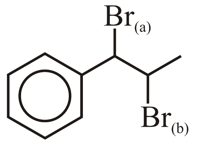
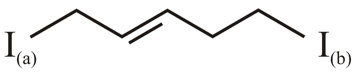
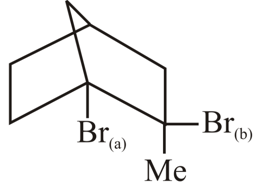
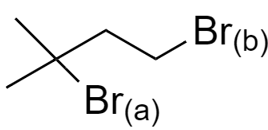
Choose the halogen which is most reactive towards SN1 reaction in the given compounds (A, B, C & D)
A.
B.
C.
D.
The rate of an SN1 reaction depends entirely on the stability of the carbocation intermediate formed during the rate-determining step after the leaving group departs.
Compound A contains two bromine atoms labeled as Br(a) and Br(b):
Therefore, for Compound A, Br(a) is significantly more reactive towards an SN1 pathway.
By applying the same structural principles across all four standard system variants:
For the reaction

The correct statement is
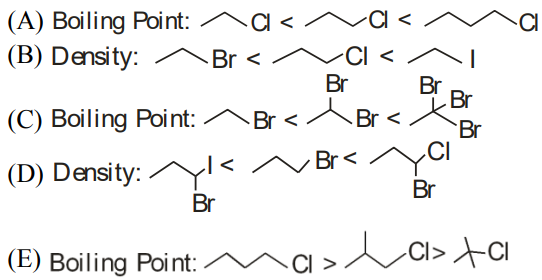
Identify the incorrect option from the following:
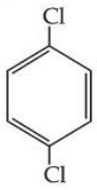
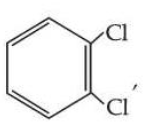
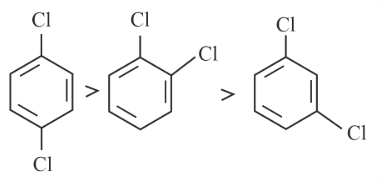
The correct order of melting point of dichlorobenzenes is
Identify the correct order for the given property for following compounds

Choose the correct answer from the option below:
Identify the correct order of reactivity for the following pairs towards the respective mechanism
(A)
(B)
(C) Electrophilic substitution
(D) Nucleophilic substitution
Choose the correct answer from the options given below:
Rule: The rate of an SN2 reaction decreases as the steric hindrance around the leaving group increases:
Primary 1 > Secondary 2>Tertiary 3 degree
hence a is correct.
For SN1 reaction, The rate of an reaction depends directly on the stability of the carbocation intermediate formed during the rate-determining step, Benzylic=Allylic > Tertiary > Secondary > Primary
hence B is correct
Electrophilic Aromatic Substitution (EAS)
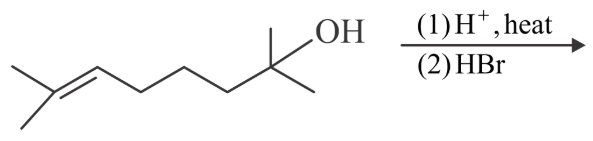
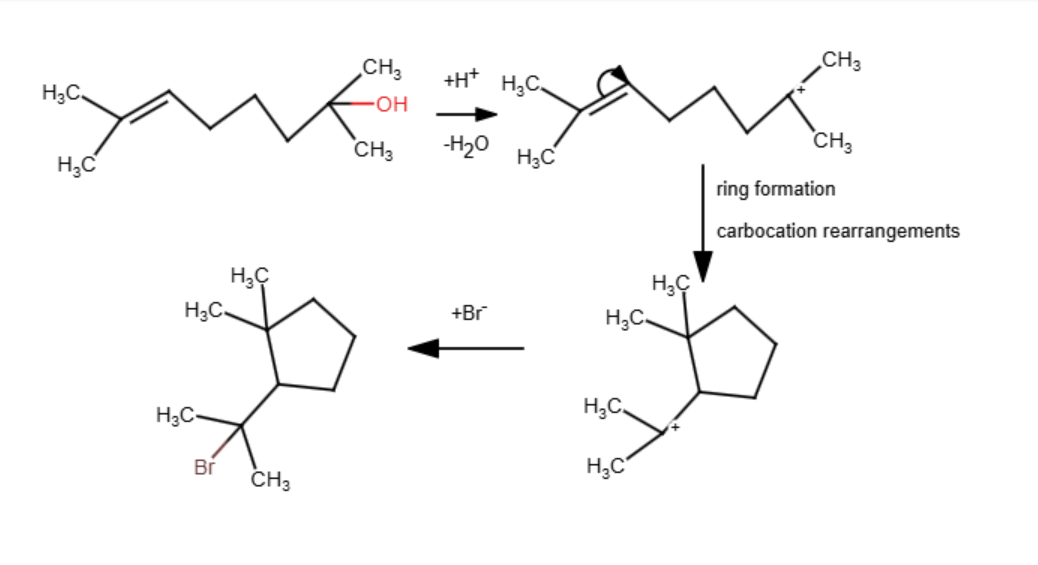
In the following given reaction 'A' is:
Firstly the Carbocation is formed near the ring. The ring expands to relieve steric strain and forms a ring of 5 carbons. Now, the carbocation gets attached to the Br- molecule and product C is formed.
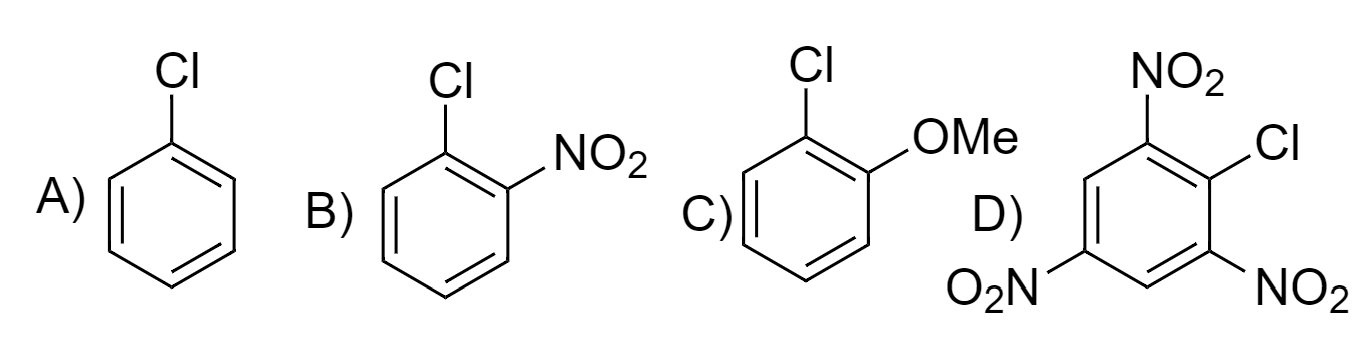
The correct order of reactivity of following haloarenes towards nucleophilic substitution with aqueous NaOH is:
Compound (D): Has three strong electron-withdrawing nitro groups (NO2) at the two ortho positions and the para position. This deactivates the ring to the maximum extent towards electrons but makes it highly reactive toward nucleophilic attack.
Compound (B): Has one strong electron-withdrawing nitro group (NO2) at the ortho position, which activates the ring for nucleophilic substitution.
Compound (A): Chlorobenzene has no extra activating or deactivating groups on the ring. It undergoes substitution only under very drastic conditions
Compound (C): Has a strong electron-donating methoxy group (-OMe) at the ortho position. Via its +M resonance effect, it increases electron density on the ring, making the nucleophilic attack extremely difficult. This is the least reactive compound
hence , D>B>A>C
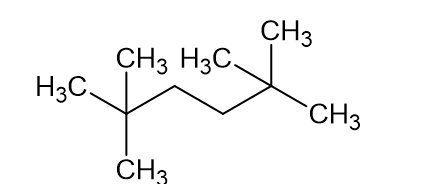
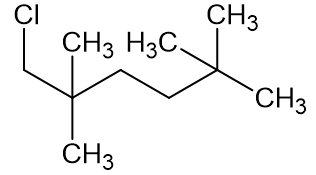
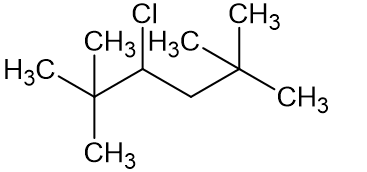
Maximum number of isomeric monochloro derivatives which can be obtained from 2,2,5,5-tetramethylhexane by chlorination is _____
The IUPAC name of ethylidene chloride is
Ethylidene chloride is a common name for a compound where two chlorine atoms are attached to the same carbon of ethane.
Identify the structure of ethylidene chloride: The prefix "ethylidene" refers to the $$CH_3CH=$$ group (a divalent group derived from ethane by removing two hydrogens from the same carbon). When two chlorine atoms attach to this group, we get:
$$CH_3CHCl_2$$
Apply IUPAC nomenclature: The parent chain is ethane (2 carbons). Both chlorine atoms are on carbon-1 (the carbon bearing the most substituents when numbering to give the lowest locants).
$$\Rightarrow$$ 1, 1-dichloroethane
Evaluate the options: Option A: 1-chloroethene — This would be vinyl chloride ($$CH_2=CHCl$$), which is incorrect.
Option B: 1, 2-dichloroethane — This is ethylene dichloride ($$ClCH_2CH_2Cl$$), where chlorines are on different carbons. Incorrect.
Option C: 1, 1-dichloroethane — This matches $$CH_3CHCl_2$$. Correct.
Option D: 1-chloroethyne — This would be $$HC \equiv CCl$$, which is incorrect.
The correct answer is Option C: 1, 1-dichloroethane.
Identify the correct statement for the below given transformation.
Consider the following reaction,

What is A in the above reaction?
The major product in the given reaction is
The major product of the following reaction is
The structure of A in the given reaction is
The major product in the reaction
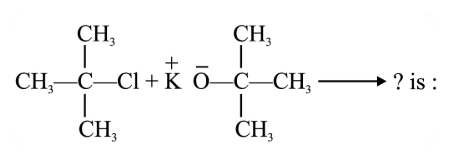
We need to find the major product when tert-butyl chloride reacts with potassium tert-butoxide.
Identify the substrate and reagent: Substrate: $$(CH_3)_3C{-}Cl$$ (tert-butyl chloride) — a tertiary alkyl halide.
Reagent: $$K^+ \; ^-OC(CH_3)_3$$ (potassium tert-butoxide) — a strong, bulky base.
Determine the reaction pathway: With a tertiary substrate:
$$\bullet$$ $$S_N2$$ is not possible due to steric hindrance at the tertiary carbon.
$$\bullet$$ $$S_N1$$ could occur but is disfavored because tert-butoxide is a strong base, not just a nucleophile.
$$\bullet$$ The bulky tert-butoxide base strongly favors E2 elimination over substitution.
Determine the elimination product: E2 elimination of HCl from $$(CH_3)_3CCl$$:
$$(CH_3)_3C{-}Cl \xrightarrow{KOC(CH_3)_3} (CH_3)_2C{=}CH_2 + KCl$$
The product is 2-methylprop-1-ene (isobutylene), formed by removal of H from one of the methyl groups and Cl from the tertiary carbon.
Evaluate the options: Option A: t-Butyl ethyl ether — Would require $$S_N$$ reaction, which is not favored here.
Option B: 2-Methyl pent-1-ene — Incorrect carbon count; the substrate has only 4 carbons.
Option C: 2, 2-Dimethyl butane — Would require C-C bond formation, not possible in this reaction.
Option D: 2-Methyl prop-1-ene — Correct. This is the E2 elimination product.
The correct answer is Option D: 2-Methyl prop-1-ene.
Two isomers (A) and (B) with Molar mass 184 g/mol and elemental composition C, 52.2%; H, 49% and Br 42.9% gave benzoic acid and p-bromobenzoic acid, respectively on oxidation with KMnO$$_4$$. Isomer 'A' is optically active and gives a pale yellow precipitate when warmed with alcoholic AgNO$$_3$$. Isomer 'A' and 'B' are, respectively:
Which one of the following compounds is inactive towards $$S_N1$$ reaction?
The rate-determining step of an SN1 (Substitution Nucleophilic Unimolecular) reaction relies entirely on the loss of a leaving group (like Cl¯) to form a stable carbocation intermediate.
Option C represents a bridged bicyclic compound where the chlorine atom is attached to a bridgehead carbon. Attempting an SN1 pathway on this molecule fails severely due to geometric constraints:
Bredt's Rule states: A double bond or a planar sp2 hybridized center cannot form at a bridgehead position of a small bridged bicyclic system (rings containing fewer than 8 carbons), because the rigid bridge network prevents the carbon from flattening out.
Let's look at why the other molecules given in the question are reactive:
Because forming a carbocation at the bridgehead position in Option C creates immense angle strain that cannot be relieved, the energy barrier to break the C-Cl bond via an SN1 pathway is too high. Thus, it remains completely inert.
Compound 'A' undergoes following sequence of reactions to give compound 'B'. The correct structure and chirality of compound 'B' is [where Et is $$-C_2H_5$$]
Total number of isomers (including stereoisomers) obtained on monochlorination of methylcyclohexane is ______.
We need to find the total number of isomers (including stereoisomers) obtained on monochlorination of methylcyclohexane.
Methylcyclohexane has a cyclohexane ring with a methyl group at C1. The distinct hydrogen positions are:
- $$CH_3$$ group (methyl hydrogens): 3 equivalent H atoms
- C1 (tertiary hydrogen): 1 H atom
- C2 and C6 (equivalent by symmetry): each has 2 H atoms
- C3 and C5 (equivalent by symmetry): each has 2 H atoms
- C4: 2 H atoms
(i) Chlorination at the methyl group:
Replacing one H on $$CH_3$$ gives a $$CH_2Cl$$ group attached to the ring.
No chiral center is created. This gives 1 product.
(ii) Chlorination at C1 (tertiary position):
Cl replaces the tertiary H. C1 now bears $$CH_3$$, Cl, and two ring carbons. The molecule has a plane of symmetry through C1-C4, so no chirality.
This gives 1 product.
(iii) Chlorination at C2 (or C6):
This produces 1-methyl-2-chlorocyclohexane. Both C1 and C2 become stereocenters.
- cis-1-methyl-2-chlorocyclohexane: The two substituents are on the same side of the ring. C1 and C2 are both chiral centers with no internal plane of symmetry, giving a pair of enantiomers = 2 stereoisomers.
- trans-1-methyl-2-chlorocyclohexane: The two substituents are on opposite sides. Again, C1 and C2 are chiral centers giving a pair of enantiomers = 2 stereoisomers.
Subtotal from C2/C6 position: 4 stereoisomers.
(iv) Chlorination at C3 (or C5):
This produces 1-methyl-3-chlorocyclohexane. Both C1 and C3 are stereocenters.
- cis-1-methyl-3-chlorocyclohexane: Enantiomeric pair = 2 stereoisomers.
- trans-1-methyl-3-chlorocyclohexane: Enantiomeric pair = 2 stereoisomers.
Subtotal from C3/C5 position: 4 stereoisomers.
(v) Chlorination at C4:
This produces 1-methyl-4-chlorocyclohexane. The molecule has a plane of symmetry through C1 and C4.
- cis-1-methyl-4-chlorocyclohexane: Has a plane of symmetry, so it is achiral = 1 stereoisomer.
- trans-1-methyl-4-chlorocyclohexane: Also has a plane of symmetry, so it is achiral = 1 stereoisomer.
Subtotal from C4 position: 2 stereoisomers.
| Position | Number of isomers |
|---|---|
| Methyl group | 1 |
| C1 | 1 |
| C2/C6 | 4 |
| C3/C5 | 4 |
| C4 | 2 |
| Total | 12 |
Therefore, the total number of isomers (including stereoisomers) is $$\boxed{12}$$.

The correct pair(s) of the ambident nucleophiles is (are):
(A) AgCN / KCN
(B) RCOOAg / RCOOK
(C) AgNO$$_2$$ / KNO$$_2$$
(D) AgI / KI
An ambident nucleophile is a nucleophile that has two different nucleophilic sites through which it can attack. The key pairs to consider are those where the silver salt and potassium salt of the same anion react through different atoms.
(A) In the case of $$\text{CN}^-$$, the cyanide ion can attack through either carbon or nitrogen. $$\text{KCN}$$ typically gives cyanides (attack through carbon), while $$\text{AgCN}$$ gives isocyanides (attack through nitrogen). This demonstrates the ambident nature of $$\text{CN}^-$$.
(B) The carboxylate ion $$\text{RCOO}^-$$ has two equivalent oxygen atoms, but both give the same product (an ester). The silver and potassium salts do not produce fundamentally different products based on different nucleophilic sites, so this is not a typical ambident nucleophile pair.
(C) The nitrite ion $$\text{NO}_2^-$$ can attack through either nitrogen or oxygen. $$\text{KNO}_2$$ gives nitro compounds (attack through nitrogen), while $$\text{AgNO}_2$$ gives nitrite esters (attack through oxygen). This demonstrates ambident behavior.
(D) The iodide ion $$\text{I}^-$$ has only one nucleophilic site, so it is not an ambident nucleophile.
Therefore, the correct pairs of ambident nucleophiles are (A) and (C) only.
The gas 'A' is having very low reactivity reaches to stratosphere. It is non-toxic and non-flammable but dissociated by UV-radiations in stratosphere. The intermediates formed initially from the gas 'A' are:
Among the following compounds I - IV, which one forms a yellow precipitate on reacting sequentially with
(i) NaOH (ii) dil. HNO$$_3$$ (iii) AgNO$$_3$$
The correct order of the following compounds showing increasing tendency towards nucleophilic substitution reaction is:
Correct Order: (i) < (ii) < (iii) < (iv)
The Core Concept: Nucleophilic Aromatic Substitution (SNAr) Normally, aryl halides (like chlorobenzene) are highly unreactive towards nucleophilic substitution. This is because the carbon-chlorine bond has partial double-bond character due to resonance, making it hard to break. Furthermore, the electron-rich benzene ring naturally repels incoming nucleophiles.
The Role of Electron-Withdrawing Groups To make an aryl halide reactive, you need strong electron-withdrawing groups (EWGs), such as the nitro group (-NO₂), attached to the ring.
Evaluating the Compounds: The tendency to undergo nucleophilic substitution increases directly with the number of electron-withdrawing -NO₂ groups at the ortho and para positions:
Therefore, the reactivity steadily increases as you add more nitro groups: (i) < (ii) < (iii) < (iv).
Identify A and B in the chemical reaction.
Alkyl iodides are often prepared by the reaction of alkyl chlorides/bromides with NaI in dry acetone. This reaction is known as the Finkelstein reaction.
R-X + NaI → R-I + NaX
(where X = Cl, Br)
Major product P of above reaction, is:
First reaction is addition of HBr in presence of peroxide which takes place according to anti-markonikov's rule.
The synthesis of alkyl fluorides is best accomplished by heating an alkyl chloride/bromide in the presence of a metallic fluoride such as AgF, Hg₂F₂, CoF₂ or SbF₃. The reaction is termed as Swarts reaction.
$$H_3C-Br + AgF \longrightarrow H_3C-F + AgBr$$, however this does not effect the bromine directly attached to the benzene ring.
The product formed in the first step of the reaction with excess Mg / Et$$_2$$O / Et = $$C_2H_5$$ is
Grignard Reagent is formed in presence of anhydrous solvent.
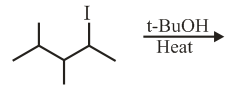
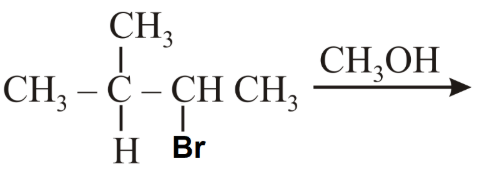
In the given reaction 3-Bromo-2, 2-dimethyl butane $$\xrightarrow{C_2H_5OH}$$ 'A' (Major Product). Product A is:
The starting material is 3-bromo-2,2-dimethylbutane. Numbering the butane backbone from left to right (C1-C2-C3-C4), carbon C2 bears two methyl substituents and carbon C3 bears the bromine. The explicit structure is $$\text{CH}_3\text{-C(CH}_3)_2\text{-CHBr-CH}_3$$, which has a total of six carbons including the two methyl groups on C2.
When treated with ethanol (C₂H₅OH), a weak nucleophile and weak base, the reaction proceeds via an SN1 mechanism. The C-Br bond ionizes to give a secondary carbocation at C3: $$\text{CH}_3\text{-C(CH}_3)_2\text{-}\overset{+}{\text{CH}}\text{-CH}_3$$.
This secondary carbocation undergoes a 1,2-methyl shift from the adjacent C2 to the cationic C3, generating the more stable tertiary carbocation at C2: $$\text{CH}_3\text{-}\overset{+}{\text{C}}\text{(CH}_3)\text{-CH(CH}_3)\text{-CH}_3$$. In this rearranged cation, C2 now carries only one methyl group (the original one at C2 that did not migrate), the migrated methyl is at C3, and the positive charge sits at C2.
Ethanol attacks this tertiary carbocation at C2 as a nucleophile, and loss of a proton gives the ether product: $$\text{CH}_3\text{-C(OC}_2\text{H}_5\text{)(CH}_3)\text{-CH(CH}_3)\text{-CH}_3$$. This is 2-ethoxy-2,3-dimethylbutane, which corresponds to Option 3.
The correct order of reactivity of the given chlorides with acetate in acetic acid is:
The correct order of reactivity for these chlorides with acetate in acetic acid is governed by the
$$S_N1$$
solvolysis mechanism, where the rate-determining step is the departure of the chloride leaving group to form a carbocation intermediate. 3-chloro-4-methylcyclohexene forms a resonance-stabilized secondary allylic carbocation; its ionization is uniquely accelerated by ground-state steric relief (B-strain) between the adjacent bulky
$$-CH_3$$ and $$-Cl$$ groups, making its reaction the fastest. 3-chloro-1-methylcyclohexene lacks this severe ground-state steric strain but forms a highly stable allylic carbocation that benefits from tertiary resonance character, placing it closely second in reactivity. 3-(chloromethyl)cyclohexene ionizes to form a primary carbocation, but it reacts much faster than a typical primary or secondary halide due to significant anchimeric assistance (neighboring group participation) from the adjacent
$$\pi$$-bond, which stabilizes the transition state via a non-classical homoallylic carbocation. Finally, 5-chloro-3-methylcyclohexene forms an isolated, non-allylic secondary carbocation that completely lacks any resonance stabilization or
$$\pi$$-bond assistance, rendering it the least stable intermediate and consequently the least reactive chloride in the series.

Which of the following compounds will form the precipitate with aq. AgNO$$_3$$ solution most readily?
Among the following compounds, which one has the shortest C-Cl bond?
The decreasing order of reactivity of the following organic molecules towards AgNO$$_3$$ solution is:
We are asked to arrange the four given halides in the order in which they react with an ethanolic solution of silver nitrate, $$AgNO_3$$. Silver-nitrate in ethanol brings about ionisation of the C-X bond and thus follows an $$S_N1$$ mechanism. In the $$S_N1$$ pathway the rate-determining step is the formation of a carbocation, so the more stable the carbocation, the faster the reaction. Hence we simply have to compare the stabilities of the carbocations that would be produced from the four substrates.
First, let us write the general ionisation step which every substrate must undergo:
$$R-X \;\xrightarrow[\text{EtOH}]{AgNO_3}\; R^{+} \;+\; AgX\!\downarrow$$
The precipitate, $$AgX$$, appears only after the carbocation $$R^{+}$$ has formed, so the relative rate of precipitation mirrors the relative ease of carbocation formation. Now we look at each compound.
Compound (B) possesses a benzylic chloride. When the C-Cl bond breaks, the resulting benzylic carbocation is resonance-stabilised over the aromatic ring. We can draw:
$$\overset{+}{CH_2}-C_6H_5 \;\longleftrightarrow\; CH_2= C_6H_5^{+}$$
Because several equivalent resonance structures distribute the positive charge, the benzylic cation is extremely stable, so (B) will ionise fastest.
Compound (A) is a tertiary alkyl chloride. Tertiary carbocations are stabilised by the +I (electron-releasing) effect and hyperconjugation from three neighbouring alkyl groups. They are very stable, but still slightly less so than the resonance-delocalised benzylic cation. Therefore (A) comes after (B).
Compound (C) is an allylic chloride. Cleavage of the C-Cl bond furnishes an allylic carbocation that is resonance-stabilised over the adjacent C=C bond:
$$\overset{+}{CH_2}-CH=CH_2 \;\longleftrightarrow\; CH_2=CH-CH_2^{+}$$
This resonance gives appreciable stability, but not as much as in a benzylic or tertiary situation, so (C) reacts more slowly than (A).
Compound (D) is a simple primary alkyl chloride without any resonance or strong inductive stabilisation. The primary carbocation generated would be highly unstable, making ionisation very slow. Consequently (D) is the least reactive of the four.
Collecting these observations, the order of decreasing reactivity is
$$\text{(B) > (A) > (C) > (D)}$$
This exactly matches Option 4 in the given list.
Hence, the correct answer is Option 4.
The decreasing order of reactivity of the following compounds towards nucleophilic substitution ($$S_N2$$) is:
The major product in the following reaction is:
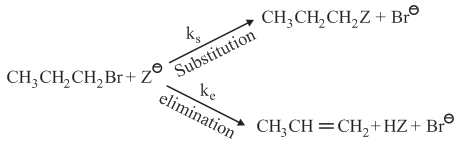
For the following reactions
where:
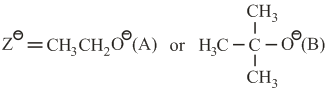
k$$_s$$ and k$$_e$$ are respectively the rate constants for substitution and elimination, and $$\mu = \frac{k_s}{k_e}$$, the correct option is
The decreasing order of reactivity towards dehydrohalogenation (E$$_1$$) reaction of the following compounds is:
The increasing order of the boiling points of the major products A, B and C of the following reactions will be:


The major product obtained from $$E_2$$-elimination of 3-bromo-2-fluoropentane is:
Consider the reaction sequence given below:
Which of the following statements is true:
In the following reaction sequence, structures of A and B are, respectively
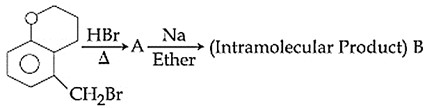
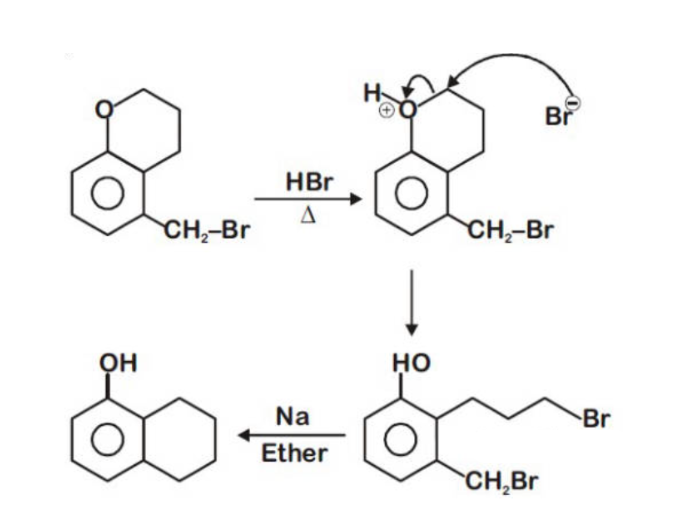
Cyclohexanone-CH$$_2$$Br $$\xrightarrow{\text{HBr}}$$ A $$\xrightarrow{\text{Na/Ether}}$$ (Intramolecular Product) B
The mechanism of Sn1 reaction is given as:
$$R - X \rightarrow R^\oplus X^\ominus \rightarrow R^\oplus \| X^\ominus \xrightarrow{Y^\ominus} R - Y + X^\ominus$$
Ion pair Solvent separated ion pair
A student writes general characteristics based on the given mechanism as:
(a) The reaction is favoured by weak nucleophiles.
(b) $$R^\oplus$$ would be easily formed if the substituents are bulky
(c) The reaction is accompanied by racemization
(d) The reaction is favoured by non-polar solvents.
Which observations are correct?
For an $$\mathrm{S_N1}$$ (unimolecular nucleophilic substitution) process, the mechanism proceeds in two distinct kinetic steps. First, the substrate $$R\!-\!X$$ ionises to form a carbocation $$R^{\oplus}$$ and a leaving group $$X^{\ominus}$$. Second, the nucleophile $$Y^{\ominus}$$ attacks the planar carbocation. Symbolically, the elementary events are
$$R - X \;\longrightarrow\; R^{\oplus} + X^{\ominus}$$
followed by
$$R^{\oplus} + Y^{\ominus} \;\longrightarrow\; R - Y.$$
The experiment-based rate law for an $$\mathrm{S_N1}$$ reaction is stated first:
$$\text{rate} \;=\; k\,[R\!-\!X]$$
because the slow step is the formation of the carbocation. This rate law contains no concentration term for the nucleophile, so increasing or decreasing nucleophile strength hardly alters the rate.
Now we judge each student observation one by one using the above principles.
(a) “The reaction is favoured by weak nucleophiles.” Since the nucleophile does not appear in the rate law, even very weak nucleophiles react readily after the carbocation is formed. Therefore the statement is true.
(b) “$$R^{\oplus}$$ would be easily formed if the substituents are bulky.” Bulky alkyl substituents mean more alkyl groups attached to the positively charged carbon. More alkyl groups stabilise a carbocation by the inductive effect and by hyperconjugation. The order of carbocation stability is $$\text{tertiary} > \text{secondary} > \text{primary} > \text{methyl}.$$ Hence a bulky (tertiary) substrate ionises faster, so this statement is also true.
(c) “The reaction is accompanied by racemization.” After the leaving group departs, the carbocation centre is trigonal planar. The nucleophile $$Y^{\ominus}$$ can attack from either side with almost equal probability, giving both inversion and retention products. The net result is racemisation (usually partial but often substantial). Thus statement (c) is true.
(d) “The reaction is favoured by non-polar solvents.” Formation of a carbocation and a free anion creates highly polar species. Polar protic solvents (e.g. water, alcohols) stabilise these ions through solvation and therefore accelerate the reaction. Non-polar solvents cannot stabilise ions efficiently, so the reaction rate drops. Thus statement (d) is false.
Collecting the results, (a), (b) and (c) are correct, while (d) is incorrect.
Hence, the correct answer is Option C.
Which of the following compounds will show retention in configuration on nucleophilic substitution by $$OH^-$$ ion?
We begin by recalling that the word retention means that the absolute configuration (R or S) of the stereogenic centre remains the same after the substitution has taken place.
There are three usual mechanistic possibilities for a nucleophilic substitution on a chiral carbon bearing a leaving group X:
1. In a one-step $$S_N2$$ process the nucleophile approaches from the side opposite to the leaving group, causing a single inversion of configuration.
2. In a two-step $$S_N1$$ process the leaving group departs first, giving a planar carbocation. The nucleophile can then attack from either side, giving a racemic mixture (50 % retention + 50 % inversion in the ideal case).
3. In a mechanism involving neighbouring-group participation the atom of a neighbouring group with a lone pair (often another halogen) first displaces the leaving group intramolecularly. This produces a three-membered cyclic ion. The nucleophile then opens this ring from the back side. Each of the two intramolecular steps proceeds with inversion, so the overall result is double inversion => net retention.
With these facts we examine every option.
Option A is $$CH_3-\underset{\displaystyle *}{C(Br)(H)}-C_6H_{13}$$. Here the stereogenic carbon is directly bonded to Br, H, CH3 and C6H13. There is no neighbouring atom with a lone pair capable of participating. Hence the reaction will proceed either by $$S_N2$$ (one inversion) or, less likely, by $$S_N1$$ (racemisation). Retention is not expected.
Option B is $$CH_3-\underset{\displaystyle *}{CH(Br)}-C_6H_5$$ (benzyl bromide). The benzyl cation derived from it is highly stabilised, so an $$S_N1$$ pathway is favoured, producing racemisation. Again, no net retention.
Option C is $$CH_3-\underset{\displaystyle *}{CH(Br)}-CH_3$$ (sec-butyl bromide). Being a simple secondary bromide with no assisting group, it reacts mainly by $$S_N2$$ with a single inversion. Net retention is impossible.
Option D is $$CH_3-\underset{\displaystyle *}{CH(C_2H_5)}-CH_2Br$$. Here the stereogenic carbon is α to a $$CH_2Br$$ group. The bromine atom on the neighbouring carbon possesses lone pairs that can assist. Let us write every algebraic step.
Step 1: Intramolecular displacement (first inversion).
The lone pair on the neighbouring bromine attacks the stereogenic centre while the leaving bromide departs:
$$\text{(R or S)-CH}_3-\overset{*}{CH(C_2H_5)}-CH_2Br \;\xrightarrow{\text{l.p. on Br}}\; \bigl[\text{bicyclic bromonium ion}\bigr]^+ + Br^-$$
This internal attack must come from the back side of the C-Br bond that is breaking, so the stereogenic centre undergoes one inversion.
Step 2: Nucleophilic attack by $$OH^-$$ (second inversion).
The $$OH^-$$ ion now opens the three-membered bromonium ring from the side opposite to the bridging bromine:
$$\bigl[\text{bromonium ion}\bigr]^+ + OH^- \;\longrightarrow\; CH_3-\overset{*}{CH(C_2H_5)}-CH_2OH + Br^-$$
This ring opening is also a backside attack, so a second inversion occurs. Performing two consecutive inversions brings the configuration back to its original sense, i.e. overall retention.
Therefore only Option D provides the necessary neighbouring-group participation that gives double inversion and hence net retention.
Hence, the correct answer is Option 4.
The major product of the following reaction is:
The conversion begins with 1-chloro-4-(2-chloropropyl)benzene undergoing an E2 dehydrohalogenation reaction when treated with alcoholic potassium hydroxide. The strong hydroxide base selectively abstracts a highly acidic benzylic proton from the aliphatic side chain, forcing the elimination of the adjacent chloride ion. This step yields the thermodynamically favoured intermediate, 1-chloro-4-(prop-1-en-1-yl)benzene (also known as p-chloropropenylbenzene), where the newly formed alkene double bond is highly stabilized through extended conjugation with the aromatic ring; the aryl chloride attached directly to the benzene ring remains completely unreactive due to its partial double-bond character. In the second step, this conjugated alkene intermediate undergoes free radical polymerization initiated by a thermal radical source like benzoyl peroxide or AIBN. The radical initiator adds to the alkene monomer, breaking its $\pi$-bond to generate a reactive benzylic radical that successively attacks subsequent monomer units. This continuous propagation chain link builds a high-molecular-weight polymer backbone of alternating carbon atoms, resulting in the final product: poly[1-chloro-4-(prop-1-en-1-yl)benzene]
Which of the following compounds will produce a precipitate with $$AgNO_3$$?
Which one of the following is likely to give a precipitate with AgNO$$_3$$ solution?
We first recall the standard qualitative test: when an alkyl (or benzyl/allyl) halide is treated with ethanolic silver nitrate, the halide ion $$X^-$$ that departs from the molecule combines with the silver ion $$Ag^+$$ to form a curdy white precipitate of silver halide $$AgX$$.
This observation is explained by the nucleophilic substitution mechanism. The rate of substitution for chlorides follows the order
$$\text{tert-alkyl chloride} > \text{sec-alkyl chloride} > \text{prim-alkyl chloride} \gg \text{vinyl or aryl chloride}.$$
Now we analyse each option one by one.
Option A : $$CH_2 = CH{-}Cl$$ (vinyl chloride)
The chlorine atom here is directly attached to an $$sp^2$$ hybridised carbon of a C=C double bond. Such $$C{-}Cl$$ bonds are very strong and do not undergo the usual $$S_N1$$ or $$S_N2$$ processes in ethanolic $$AgNO_3$$. Hence no chloride ion is liberated, so no $$AgCl$$ precipitate forms.
Option B : $$(CH_3)_3CCl$$ (tert-butyl chloride)
This chloride is tertiary. In ethanolic medium the $$C{-}Cl$$ bond ionises readily to give the stable tert-butyl carbocation $$\,(CH_3)_3C^+\,$$ and the chloride ion $$Cl^-$$:
$$ (CH_3)_3CCl \;\longrightarrow\; (CH_3)_3C^+ + Cl^- $$
The released $$Cl^-$$ immediately reacts with silver ion to give an insoluble precipitate:
$$ Ag^+ + Cl^- \;\longrightarrow\; AgCl\downarrow $$
So a white precipitate appears quickly.
Option C : $$CCl_4$$ (carbon tetrachloride)
Although $$CCl_4$$ contains four chlorine atoms, the central carbon has no empty orbital for coordination and the molecule is quite resistant to ionisation in protic solvents. Therefore $$Cl^-$$ is not produced and no precipitate is observed.
Option D : $$CHCl_3$$ (chloroform)
Chloroform is also rather inert toward substitution under these conditions; the $$C{-}Cl$$ bonds are not cleaved by ethanolic $$AgNO_3$$, so again no $$Cl^-$$ is released.
Among the four compounds, only the tertiary chloride $$(CH_3)_3CCl$$ readily furnishes chloride ions that can precipitate silver as $$AgCl$$.
Hence, the correct answer is Option 2.
The major product of the following reaction is: (compound with Cl reacting with NaOEt/heat)
We have the substrate $$CH_3CHClCH_2CO_2CH_2CH_3$$ (ethyl 3-chlorobutanoate). The chlorine atom is attached to the carbon that is α to the ester carbonyl, while two different sets of β-hydrogen atoms are available for an E2 elimination.
Because the reagent is $$NaOEt$$ in ethanol and the reaction is carried out under heat, we immediately recognise that a strong base is present and that the reaction will proceed predominantly through the E2 mechanism rather than substitution. In an E2 process the base removes a β-hydrogen that is anti-periplanar to the leaving group, the C-H and C-Cl bonds break simultaneously and a C=C double bond is formed. The general E2 equation can be written as
$$\text{Base} + RCH_2CH_2Cl \;\longrightarrow\; RCH=CH_2 + Cl^- + \text{Base-H}$$
In our molecule we label the carbon bearing chlorine as $$C_\alpha$$ and the two adjacent carbons as $$C_{\beta 1}$$ (the CH2 group next to the ester) and $$C_{\beta 2}$$ (the terminal CH3 group). Hence the two distinct elimination possibilities are:
1. Removal of a hydrogen from $$C_{\beta 1}$$ (the CH2 between the Cl-bearing carbon and the carbonyl).
2. Removal of a hydrogen from $$C_{\beta 2}$$ (the terminal CH3).
We now write both possible eliminations explicitly.
Path 1 : β-H from $$C_{\beta 1}$$
The base abstracts one of the two hydrogens on $$C_{\beta 1}$$:
$$\begin{aligned} CH_3CHClCH_2CO_2CH_2CH_3 &\xrightarrow[\text{E2}]{NaOEt/\,\Delta} CH_3CH = CHCO_2CH_2CH_3 + Cl^- + HOEt \end{aligned}$$
The double bond produced is between $$C_\alpha$$ and $$C_{\beta 1}$$, giving us ethyl but-2-enoate (also called ethyl crotonate). This alkene is (i) trisubstituted and therefore more highly substituted, and (ii) conjugated with the carbonyl group of the ester, giving it extra resonance stabilisation. The resonance can be shown as
$$CH_3CH = CHCO_2Et \;\rightleftharpoons\; CH_3CH^- - CH = C^+O_2Et$$
Such conjugation lowers the overall energy of the molecule, favouring its formation.
Path 2 : β-H from $$C_{\beta 2}$$
If instead the base removes a hydrogen from the terminal CH3, we obtain
$$\begin{aligned} CH_3CHClCH_2CO_2CH_2CH_3 &\xrightarrow[\text{E2}]{NaOEt/\,\Delta} CH_3CH_2CH = CHCO_2CH_2CH_3 + Cl^- + HOEt \end{aligned}$$
This product is ethyl but-3-enoate (a terminal, monosubstituted alkene). It is less substituted and it is not conjugated with the carbonyl, so it is thermodynamically less stable.
According to Zaitsev’s rule, “in an elimination the more substituted (and therefore more stable) alkene is formed preferentially.” Furthermore, conjugation with the ester carbonyl provides an additional driving force. Therefore Path 1 overwhelmingly dominates.
Thus the major product is
$$\boxed{CH_3CH = CHCO_2CH_2CH_3}$$
This structure matches Option 3 in the given list.
Hence, the correct answer is Option 3.
The major product of the following reaction is:
Increasing order of reactivity of the following compounds for S$$_N$$1 substitution is:
The ease of SN-1 reaction depends on the most stable Carbocation. +M and +I effect increase the stability of the carbocation formed. Moreover, more methyl substituted carbocation is more stable compared to lesser methyl substitutions due to +I effect of Alkyl groups.
Which of the following potential energy (P.E.) diagrams represents the S$$_N$$1 reaction?
Increasing rate of S$$_N$$1 reaction in the following compounds is:
The major product of the following reaction is:
An 'Assertion' and a 'Reason' is given below. Choose the correct answer from the following options:
Assertion (A): Vinyl halides do not undergo nucleophilic substitution easily.
Reason (R): Even though the intermediate carbocation is stabilized by loosely held $$\pi$$-electrons, the cleavage is difficult because of the strong bonding.
We have to check two separate things - first, whether the assertion about vinyl (alkenyl) halides is true, and second, whether the given reason is itself true and whether it really explains the assertion.
Vinyl halide means a molecule in which the halogen atom is directly attached to an $$\mathrm{sp^2}$$-hybridised carbon atom of a carbon-carbon double bond, for example $$CH_{2}=CH-Cl$$. Let us recall the two main nucleophilic substitution pathways:
1. $$\mathrm{S_N1}$$ mechanism 2. $$\mathrm{S_N2}$$ mechanism
For an $$\mathrm{S_N1}$$ process, the first step is:
$$R-X\; \longrightarrow \; R^{+ + X^{-}}$$
That is, heterolytic cleavage of the C-X bond to give a carbocation. The stability of the intermediate carbocation determines whether this step is easy or difficult. A vinyl carbocation would look like
$$CH_{2}=CH^{+}$$
The positive charge resides on an $$\mathrm{sp^2}$$ carbon which possesses $$50\%$$ $$s$$-character. Greater $$s$$-character holds the electrons more tightly to the nucleus, so the carbon is already electron-deficient; adding a full positive charge makes the ion highly unstable. Therefore:
$$\text{Stability: } \mathrm{vinyl\; carbocation} \ll \mathrm{allyl\; or\; tert\; carbocation}$$
Because the required carbocation is extremely unstable, the $$\mathrm{S_N1}$$ path is practically blocked.
For an $$\mathrm{S_N2}$$ process, the nucleophile must perform a backside attack on the carbon that carries the leaving group, while the C-X bond breaks simultaneously. In vinyl halides, that carbon is part of a $$\pi$$ bond, i.e.
$$C(sp^2)$$
Geometrically, the $$\pi$$ bond occupies the region exactly where the nucleophile would need to approach, so backside overlap is impossible. Hence the $$\mathrm{S_N2}$$ path is also blocked.
Thus, vinyl halides do not undergo nucleophilic substitution easily. The assertion (A) is therefore true.
Now let us analyse the reason (R). It says: “Even though the intermediate carbocation is stabilized by loosely held $$\pi$$-electrons, the cleavage is difficult because of the strong bonding.”
We have already seen that the vinyl carbocation is not stabilised; the $$\pi$$-electrons are not “loosely held”. Instead, the high $$s$$-character makes the positive charge on an $$\mathrm{sp^2}$$ carbon especially unstable. Hence the first part of (R) is wrong. The second part, about strong C-X bonding, is also inaccurate; the principal difficulty is not an exceptionally strong $$\sigma$$ bond but rather the inability to form a stable carbocation or permit backside attack.
Therefore, the reason (R) is false, and it certainly does not explain the (true) assertion.
So, we have:
$$\text{Assertion (A): true}, \qquad \text{Reason (R): false}$$
Hence, the correct answer is Option D.
The major product 'Y' in the following reaction is:
The major products A and B for the following reactions are, respectively:
The major product formed in the following reaction is:
Which of the following will most readily give the dehydrohalogenation product?
The major product of the following reaction is:
The major product obtained in the following reaction is,
$$t-BuOK$$ with heat ($$\Delta$$): The bulky tert-butyl group makes $$t-BuOK$$ a very poor nucleophile for substitution ($$S_N2$$) but a powerful base for elimination.
Hence, the major product is the alkene $$C_6H_5CH=CHC_6H_5$$. The substitution products (ethers) shown in options B, C, and D are minor and not formed in major quantities due to the high steric hindrance of the base.
The increasing order of the reactivity of the following halides for the S$$_{N}$$1 reaction is
In an $$S_N1$$ reaction, reactivity depends on the stability of the carbocation formed: $$3^\circ > 2^\circ > 1^\circ$$
(II) is a $$1^\circ$$ alkyl halide, forming an unstable primary carbocation → least reactive.
(I) is a $$2^\circ$$ alkyl halide, forming a more stable secondary carbocation.
(III) is a benzylic halide. The carbocation formed is highly stabilized by resonance and the $$+M$$ effect of the $$-OCH_3$$ group.
Therefore, the increasing order of $$S_N1$$ reactivity is: $$(II)<(I)<(III)$$
The major product of the following reaction is:
The given substrate is a tertiary alkyl bromide. In the presence of $$C_2H_5ONa$$/$$C_2H_5OH$$, which is a strong base, β-elimination (E2) reaction takes place. It follows the Saytzeff's rule, and formation of a more substituted alkene is favoured.
Thus, the major product is option A
In the following reaction sequence:

Compound I is
We start with compound I, whose molecular formula is given as $$C_3H_6Cl_2$$. We need to decide which dichloropropane isomer it is. The whole decision will be based on the behaviour of the products formed in the subsequent steps.
First, I is treated with aqueous $$KOH$$. A well-known result of treating a gem-dichloride (both chlorines on the same carbon) with aqueous alkali is hydrolysis to a gem-diol, which then immediately loses water to give a carbonyl compound. The overall transformation is
$$R_2CCl_2 + 2\,KOH_{(aq)} \;\rightarrow\; R_2C(OH)_2 + 2\,KCl$$
followed by
$$R_2C(OH)_2 \;\rightarrow\; R_2C=O + H_2O$$
If I were the gem-dichloride $$CH_3-C(Cl)_2-CH_3$$ (2,2-dichloropropane), the reaction would be
$$CH_3-C(Cl)_2-CH_3 + 2\,KOH_{(aq)} \;\rightarrow\; CH_3-C(OH)_2-CH_3 + 2\,KCl$$
and immediately
$$CH_3-C(OH)_2-CH_3 \;\rightarrow\; CH_3-CO-CH_3 + H_2O$$
Thus compound II would be $$CH_3-CO-CH_3$$, that is, acetone (propan-2-one).
Now II is treated with methylmagnesium bromide and then hydrolysed. Before using the reagent, we recall the Grignard addition formula to a ketone:
$$R_2C=O + R'MgX \;\rightarrow\; R_2C(OMgX)R' \;\overset{H_2O/H^+}{\longrightarrow}\; R_2C(OH)R' + Mg(OH)X$$
Applying it to acetone:
$$CH_3-CO-CH_3 + CH_3MgBr \;\rightarrow\; (CH_3)_3C-O^-MgBr$$
and acid work-up gives
$$ (CH_3)_3C-O^-MgBr + H_2O/H^+ \;\rightarrow\; (CH_3)_3C-OH + MgBr(OH)$$
Therefore compound III is $$ (CH_3)_3C-OH$$, namely tert-butyl alcohol (2-methyl-2-propanol).
Finally, III is tested with Lucas reagent (anhydrous $$ZnCl_2$$ + concentrated $$HCl$$). The Lucas test relies on the following:
- Tertiary alcohols give turbidity immediately.
- Secondary alcohols turn turbid in about 5 min.
- Primary alcohols remain clear for a long time.
Because turbidity appears at once, III must be a tertiary alcohol. Our deduction already shows III is tert-butyl alcohol, perfectly matching the observation.
Hence compound I must be the gem-dichloride $$CH_3-C(Cl)(Cl)-CH_3$$, that is, 2,2-dichloropropane.
Hence, the correct answer is Option A.
Which one of the following reagents is not suitable for the elimination reaction?
Elimination requires a strong base to remove a $$\beta$$-hydrogen and form an alkene.
$$NaOEt/EtOH$$ and $$NaOH$$ (with heat or alcohol) act as strong bases, so they favor elimination.
$$NaI$$ provides $$I^-$$, which is a good nucleophile but a weak base. Hence, it undergoes substitution instead of elimination.
Therefore, $$NaI$$ is not suitable for the reaction.
2-chloro-2-methylpentane on reaction with sodium methoxide in methanol yields:
(i)
(ii)
(iii)
Both elimination and substitution reactions are possible.

Hence, all the three products given are possible.
A compound A with molecular formula $$C_{10}H_{13}Cl$$, gives a white precipitate on adding silver nitrate solution. A on reacting with alcoholic KOH gives compound B as the main product. B on ozonolysis, gives C and D. C gives Cannizaro reaction, but not aldol condensation. D gives aldol condensation, but not Cannizaro reaction. A is
The synthesis of alkyl fluorides is best accomplished by:
We begin by recalling the well-known named reactions that are commonly taught in organic chemistry for the replacement of halogen atoms.
First, the Swarts reaction is a halogen-exchange reaction which specifically converts an alkyl chloride, bromide or iodide into the corresponding alkyl fluoride. The general form of the reaction is written as
$$R{-}X \;+\; AgF \;\longrightarrow\; R{-}F \;+\; AgX,$$
where $$R$$ represents any alkyl group and $$X$$ can be $$Cl$$, $$Br$$ or $$I$$. Silver fluoride, antimony trifluoride $$\big(SbF_3\big)$$ or other metal fluorides are typically used because fluorine itself is too reactive to be handled safely in most laboratory situations. Thus, Swarts reaction is deliberately designed to give alkyl fluorides smoothly and selectively.
Next, we examine free-radical fluorination. Although it can, in principle, introduce a fluorine atom into an alkane, it proceeds via a chain-radical mechanism that is extremely vigorous. Side reactions, over-fluorination and even explosions are frequent. Therefore, it is not the method “best accomplished” for controlled synthesis of specific alkyl fluorides.
Sandmeyer’s reaction is employed for converting diazonium salts into chlorides, bromides or cyanides, not fluorides. Hence Sandmeyer’s reaction does not suit the present need.
Finkelstein reaction is another halogen-exchange reaction, but it is used for interconverting alkyl chlorides or bromides and alkyl iodides, typically with sodium iodide in acetone:
$$R{-}Cl \;+\; NaI \;\longrightarrow\; R{-}I \;+\; NaCl.$$
This reaction does not generate fluorides either.
Comparing all four possibilities, only the Swarts reaction is both selective and practical for preparing alkyl fluorides from other alkyl halides. Therefore, we conclude that the best method for synthesising alkyl fluorides is indeed the Swarts reaction.
Hence, the correct answer is Option A.
The major organic compound formed by the reaction of 1, 1, 1 - trichloroethane with silver powder is:
We have to find what happens when $$\text{1,1,1-trichloroethane}$$, whose condensed formula is $$CH_3CCl_3$$, is treated with finely divided silver metal. Silver in the zero-valent state is a strong reducing agent that removes halogen atoms as silver halide, $$AgCl$$. Whenever all the halogen atoms that are attached to the same carbon (a geminal arrangement) are removed in this way, the carbon momentarily attains a divalent “carbene” state, which then couples with another such species. The overall result is the formation of a carbon-carbon triple bond.
First, write the reduction of one molecule of the trihalide by three atoms of silver.
$$CH_3CCl_3 + 3\,Ag \;\rightarrow\; CH_3C: \;+\; 3\,AgCl$$
In this equation $$CH_3C:$$ represents the carbene (a divalent carbon bearing only six electrons). Such a highly reactive species never stays free for long; two of them immediately combine by forming a new carbon-carbon bond. That coupling step is
$$2\,CH_3C: \;\rightarrow\; CH_3C \equiv CCH_3$$
Combining the two half-steps for two starting molecules gives the overall stoichiometric equation
$$2\,CH_3CCl_3 + 6\,Ag \;\rightarrow\; CH_3C \equiv CCH_3 + 6\,AgCl$$
The product $$CH_3C \equiv CCH_3$$ is 2-butyne, an alkyne containing four carbon atoms with the triple bond between the second and third carbons (counting from either end).
No alkene can appear because removal of all three halogens from a geminal trihalide forces the carbon to use the remaining valence electrons to make a triple bond after coupling. Therefore the major organic compound is the alkyne 2-butyne.
Hence, the correct answer is Option 3.
The major product formed when 1, 1, 1-trichloropropane is treated with aqueous potassium hydroxide is:
The compound given is 1,1,1-trichloropropane, which has the structure $$CH_{3}-CH_{2}-CCl_{3}$$. Here, the carbon atom at position 1 (the terminal carbon) is bonded to three chlorine atoms.
When treated with aqueous potassium hydroxide (KOH), this compound undergoes hydrolysis. Aqueous KOH provides hydroxide ions ($$OH-$$) that act as a nucleophile. The reaction involves the substitution of chlorine atoms by hydroxyl groups, but due to the presence of three chlorine atoms on the same carbon, the process leads to the formation of a carboxylic acid.
The mechanism proceeds as follows:
First, one hydroxide ion attacks the carbon atom bearing the chlorine atoms, replacing one chlorine atom to form an intermediate:
$$CH_{3}-CH_{2}-CCl_{3} + OH- -\gt CH_{3}-CH_{2}-CCl_{2}OH + Cl-$$
This intermediate, $$CH_{3}-CH_{2}-CCl_{2}OH$$, is unstable because it has two chlorine atoms and a hydroxyl group on the same carbon. It readily loses a chloride ion and rearranges to form a dichlorocarbene-like species, but in aqueous conditions, it undergoes further hydrolysis.
The intermediate reacts with another hydroxide ion:
$$CH_{3}-CH_{2}-CCl_{2}OH + OH- -\gt CH_{3}-CH_{2}-CCl(OH)2 + Cl-$$
Now, we have $$CH_{3}-CH_{2}-CCl(OH)2$$, which is a geminal diol with one chlorine. This compound is highly unstable and undergoes rapid hydrolysis. The chlorine atom is replaced by another hydroxyl group:
$$CH_{3}-CH_{2}-CCl(OH)2 + OH- -\gt CH_{3}-CH_{2}-C(OH)3 + Cl-$$
The resulting compound, $$CH_{3}-CH_{2}-C(OH)3$$, is a geminal triol. Geminal triols are unstable and spontaneously lose a water molecule to form the corresponding carboxylic acid:
$$CH_{3}-CH_{2}-C(OH)3 -\gt CH_{3}-CH_{2}-COOH + H_{2}O$$
Thus, the overall reaction is:
$$CH_{3}-CH_{2}-CCl_{3} + 2KOH -\gt CH_{3}-CH_{2}-COOH + 2KCl + H_{2}O$$
The product is propionic acid, which has the formula $$CH_{3}CH_{2}COOH$$.
Now, comparing with the options:
The major product is propionic acid, corresponding to option C.
Hence, the correct answer is Option C.
For the compounds CH$$_3$$Cl, CH$$_3$$Br, CH$$_3$$I and CH$$_3$$F, the correct order of increasing C-halogen bond length is:
To determine the correct order of increasing carbon-halogen bond length in the compounds CH$$_3$$F, CH$$_3$$Cl, CH$$_3$$Br, and CH$$_3$$I, we need to understand how bond length relates to the halogen atoms. Bond length is the distance between the nuclei of two bonded atoms. Since the carbon atom is the same in all these compounds, the bond length depends primarily on the size of the halogen atom bonded to it.
Halogens belong to Group 17 of the periodic table. As we move down the group, the atomic size increases due to the addition of electron shells. The atomic radii increase in the order: fluorine (F) < chlorine (Cl) < bromine (Br) < iodine (I). Therefore, the covalent radius of fluorine is the smallest, and iodine is the largest.
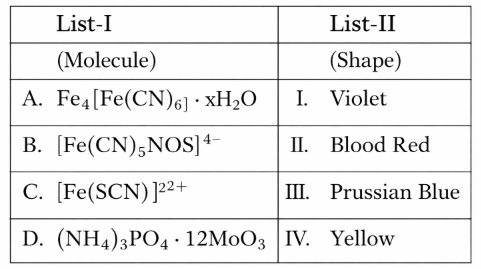
In a covalent bond, the bond length is approximately the sum of the covalent radii of the bonded atoms. Since carbon has a fixed covalent radius, the carbon-halogen bond length will increase as the covalent radius of the halogen increases. Thus, the C-F bond will be the shortest, and the C-I bond will be the longest.
Let us list the bonds:
Based on the halogen sizes, the bond lengths should follow the order: C-F < C-Cl < C-Br < C-I. Therefore, the compounds should be ordered as: CH$$_3$$F < CH$$_3$$Cl < CH$$_3$$Br < CH$$_3$$I.
Now, comparing with the given options:
This order is also supported by the trend in bond strength. The C-F bond is the strongest due to better orbital overlap with the small fluorine atom, and bond strength decreases down the group (C-F > C-Cl > C-Br > C-I). Stronger bonds are shorter, confirming the bond length order.
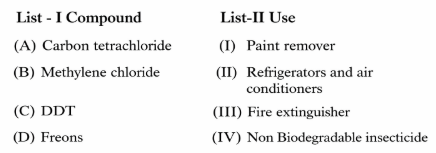
Hence, the correct answer is Option C.
In a nucleophilic substitution reaction: R $$-$$ Br + Cl$$^-$$ $$\xrightarrow{DMF}$$ R $$-$$ Cl + Br$$^-$$, which one of the following undergoes complete inversion of configuration?
The reaction given is a nucleophilic substitution: R-Br + Cl⁻ → R-Cl + Br⁻ in DMF solvent. DMF is a polar aprotic solvent, which favors the SN2 mechanism. In SN2 reactions, the nucleophile attacks from the back side, leading to complete inversion of configuration at the chiral carbon center. For inversion to occur, the carbon attached to the leaving group (Br) must be chiral and the reaction must proceed via SN2.
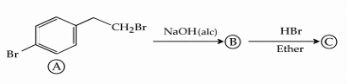
Now, let's analyze each option to determine which compound has a chiral carbon that undergoes SN2 and hence complete inversion.
Option A: C₆H₅CHC₆H₅Br, which is (C₆H₅)₂CHBr. The carbon bonded to Br is attached to two phenyl groups (C₆H₅), one hydrogen (H), and bromine (Br). Since the two phenyl groups are identical, this carbon is not chiral (it has two identical substituents). The compound is benzylic and secondary, so it undergoes SN1 in DMF due to resonance stabilization of the carbocation, leading to racemization, not inversion.
Option B: C₆H₅CCH₃C₆H₅Br, which is (C₆H₅)₂CBrCH₃. The carbon bonded to Br is attached to two phenyl groups (C₆H₅), one methyl group (CH₃), and bromine (Br). Again, the two phenyl groups are identical, so this carbon is not chiral. The compound is tertiary and undergoes SN1, leading to racemization.
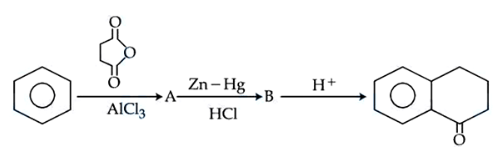
Option C: C₆H₅CH₂Br, which is benzyl bromide. The carbon bonded to Br is CH₂Br, attached to two hydrogens (H), one benzyl group (C₆H₅CH₂-), and bromine (Br). With two identical H atoms, it is not chiral. Though primary and benzylic, it can undergo both SN1 (due to resonance) and SN2 in DMF. However, SN1 may occur, preventing complete inversion.
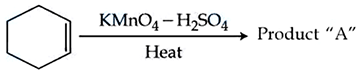
Option D: C₆H₅CH₂CH₂Br, which is 2-bromoethylbenzene. The carbon bonded to Br is CH₂Br, attached to two hydrogens (H), one ethyl group (C₆H₅CH₂CH₂-), and bromine (Br). Like option C, it has two identical H atoms, so it is not chiral. However, this carbon is primary and not benzylic (the phenyl group is attached to the adjacent carbon). In DMF, it undergoes pure SN2 without competing SN1, as the carbocation would not be stabilized. If this carbon were chiral (e.g., if one H were different), it would undergo complete inversion via SN2. Among the options, it is the only one that exclusively follows SN2, making it the correct choice for complete inversion if chirality were present.
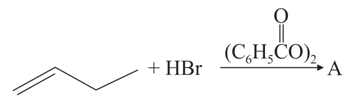
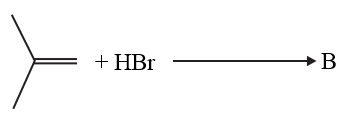
Although none of the compounds have a chiral carbon, option D is selected because it undergoes a clean SN2 mechanism, which is necessary for complete inversion. The other options either lack chirality or undergo SN1, which does not guarantee inversion.
Hence, the correct answer is Option D.
In S$$_N$$2 reactions, the correct order of reactivity for the following compounds: CH$$_3$$Cl, CH$$_3$$CH$$_2$$Cl, (CH$$_3$$)$$_2$$CHCl and (CH$$_3$$)$$_3$$CCl is:
In bimolecular nucleophilic substitution, written as $$S_N2$$, a nucleophile attacks the electrophilic carbon from the side opposite to the leaving group and forms the transition state in a single concerted step. Because both the nucleophile and the substrate appear in the rate-law expression, the experimentally observed rate is
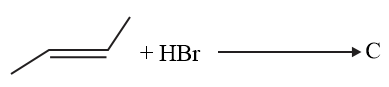
$$\text{Rate}=k\,[\text{Substrate}]\,[\text{Nucleophile}].$$
This one-step mechanism requires that the nucleophile approach the carbon atom easily; therefore, any crowding (steric hindrance) around that carbon slows the reaction. The guiding principle is:
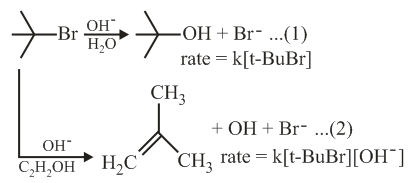
$$\text{Less steric hindrance}\;\Rightarrow\;\text{Faster }S_N2\;\text{reaction}.$$
For alkyl chlorides we classify the carbon bearing chlorine as
$$\begin{aligned} &\text{Methyl} &:&\; CH_3Cl \\ &\text{Primary} &:&\; CH_3CH_2Cl \\ &\text{Secondary} &:&\; (CH_3)_2CHCl \\ &\text{Tertiary} &:&\; (CH_3)_3CCl \end{aligned}$$
The steric bulk increases in the same sequence, so the ease of backside attack decreases accordingly. Translating this qualitative idea into a quantitative rate sequence, we have
$$\text{Methyl} > \text{Primary} > \text{Secondary} \gg \text{Tertiary}.$$
Substituting the given compounds into this general order yields
$$CH_3Cl \; \big( \text{methyl} \big) \; > \; CH_3CH_2Cl \; \big( \text{primary} \big) \; > \; (CH_3)_2CHCl \; \big( \text{secondary} \big) \; > \; (CH_3)_3CCl \; \big( \text{tertiary} \big).$$
Comparing our derived sequence with the four options, only Option B lists the order exactly as obtained.
Hence, the correct answer is Option B.
The major product obtained in the photo catalysed bromination of 2-methylbutane is:
The photo-catalysed bromination of 2-methylbutane is a free radical substitution reaction. Under UV light, bromine molecules ($$Br_2$$) undergo homolytic cleavage to form bromine radicals ($$Br^\bullet$$). These radicals abstract hydrogen atoms from the alkane, leading to alkyl radicals. The stability of the alkyl radical determines the major product, as bromination is selective for the most stable radical.
The structure of 2-methylbutane is $$CH_3-CH(CH_3)-CH_2-CH_3$$. We identify the types of hydrogen atoms:
The stability order of alkyl radicals is tertiary > secondary > primary. Bromine radicals preferentially abstract the tertiary hydrogen due to its higher stability, even though there is only one tertiary hydrogen compared to multiple primary and secondary hydrogens.
Abstraction of the tertiary hydrogen at carbon 2:
$$ CH_3-\underset{\underset{CH_3}{|}}{CH}-CH_2-CH_3 + Br^\bullet \rightarrow CH_3-\underset{\underset{CH_3}{|}}{\overset{\bullet}{C}}-CH_2-CH_3 + HBr $$This forms a tertiary alkyl radical at carbon 2. This radical then reacts with a bromine molecule:
$$ CH_3-\underset{\underset{CH_3}{|}}{\overset{\bullet}{C}}-CH_2-CH_3 + Br_2 \rightarrow CH_3-\underset{\underset{CH_3}{|}}{C}-CH_2-CH_3 + Br^\bullet $$ $$ Br $$The product is 2-bromo-2-methylbutane ($$CH_3-CBr(CH_3)-CH_2-CH_3$$).
Comparing with the options:
Due to the high selectivity of bromine for tertiary hydrogens (relative rate approximately 1600 times that of primary), the major product is the tertiary bromide, 2-bromo-2-methylbutane.
Hence, the correct answer is Option D.
In nucleophilic substitution reaction, order of halogens as incoming (attacking) nucleophile is: $$I^- > Br^- > Cl^-$$. The order of halogens as departing nucleophile should be :
The ease with which a group can leave the substrate in a nucleophilic substitution depends on how stable the group is after departure. Such a group is called a leaving group.
Concept: A good leaving group is the conjugate base of a strong acid. The weaker the basicity of the anion, the more stable it is, and hence the better it can depart.
Among the halide ions, acid strength of the corresponding hydrohalic acids increases down the group:
$$HI \gt HBr \gt HCl$$
Therefore, basicity of their conjugate bases follows the reverse order:
$$I^- \lt Br^- \lt Cl^-$$
Less basic (more stable) ⇒ better leaving group. Hence the leaving-group ability follows the order
$$I^- \gt Br^- \gt Cl^-$$
Thus, the order of halogens as departing nucleophiles is exactly the same as their order as incoming nucleophiles given in the question.
Correct order: $$I^- \gt Br^- \gt Cl^-$$
This matches Option B.
The order of reactivity of the given haloalkanes towards nucleophile is :
The order of reactivity of haloalkanes towards nucleophiles depends on the strength of the carbon-halogen bond. A weaker bond is easier to break, making the compound more reactive in nucleophilic substitution reactions.
Consider the bond dissociation energies:
Thus, the bond strength order is: C-Cl > C-Br > C-I.
Since reactivity is inversely proportional to bond strength, the reactivity order is: RI > RBr > RCl.
Comparing with the options:
Option A matches our derived order.
Hence, the correct answer is Option A.
The Wurtz-Fittig reaction involves condensation of:
First, let us recall the general idea behind coupling reactions that employ metallic sodium. The classic Wurtz reaction couples two molecules of an alkyl halide in the presence of sodium metal to give a symmetrical alkane:
$$2\,R{-}X \;+\; 2\,Na \;\rightarrow\; R{-}R \;+\; 2\,NaX$$
Here $$R$$ is an alkyl group and $$X$$ is a halogen such as $$Cl$$, $$Br$$ or $$I$$.
A modification of this reaction was developed to obtain compounds in which one carbon fragment is aromatic (aryl) and the other is aliphatic (alkyl). This modified reaction is called the Wurtz-Fittig reaction. In it, metallic sodium couples an aryl halide with an alkyl halide. Stating the general form first and then writing the equation, we have:
$$\text{Aryl halide} \;+\; \text{Alkyl halide} \;+\; 2\,Na \;\rightarrow\; \text{Alkyl-aryl hydrocarbon} \;+\; 2\,NaX$$
To make the discussion concrete, let the aryl halide be chlorobenzene $$C_6H_5Cl$$ and the alkyl halide be methyl chloride $$CH_3Cl$$. In dry ether and in the presence of two atoms of sodium, the reaction proceeds as:
$$C_6H_5Cl \;+\; CH_3Cl \;+\; 2\,Na \;\rightarrow\; C_6H_5CH_3 \;+\; 2\,NaCl$$
We see that one molecule of an aryl halide and one molecule of an alkyl halide jointly condense (couple) to yield an alkyl-substituted aromatic hydrocarbon. The presence of exactly these two different halides is what distinguishes the Wurtz-Fittig reaction from the ordinary Wurtz reaction (two alkyl halides) or other coupling variants.
Looking at the given options, the statement that matches this description is “one molecule of each of aryl-halide and alkyl-halide.”
Hence, the correct answer is Option B.
Compound (A), $$C_8H_9Cl$$, gives a white precipitate when warmed with alcoholic AgNO$$_3$$. Oxidation of (A) gives an acid (B), $$C_8H_6O_4$$. (B) easily forms anhydride on heating. Identify the compound (A).
We have compound (A) with the molecular formula $$C_8H_9Cl$$. A first clue is given by the test with alcoholic silver nitrate: a white precipitate of $$AgCl$$ appears when (A) is warmed with alcoholic $$AgNO_3$$. This reaction proceeds rapidly only if the chlorine atom is present in a benzylic or allylic alkyl chloride; an aryl chloride $$\left(-Cl\; \text{directly on the benzene ring}\right)$$ does not react under these conditions. Hence the $$-Cl$$ must be attached to a benzylic $$CH_2$$ group rather than to the ring itself.
Next, (A) is oxidised to give compound (B) whose formula is $$C_8H_6O_4$$. Let us examine this formula. A benzene ring contributes $$C_6$$, so only $$C_2$$ atoms remain outside the ring. The oxygen count (four oxygens) strongly suggests the presence of two carboxyl groups, because each $$-COOH$$ contains two oxygens. The simplest aromatic dicarboxylic acid with two adjacent carboxyls is phthalic acid, $$C_{6}H_{4}(COOH)2$$, whose molecular formula is exactly $$C_8H_6O_4$$. In addition, phthalic acid readily forms phthalic anhydride on heating, exactly as stated in the question. Therefore
$$\text{(B)} = \text{phthalic acid, } C_6H_4(COOH)_2.$$
Oxidation of an alkyl side-chain on a benzene ring to a carboxyl group is a standard reaction; every benzylic carbon that still possesses at least one hydrogen converts completely to $$-COOH$$. Consequently (A) must contain two one-carbon side chains (each having at least one benzylic hydrogen) located ortho to each other, so that both become carboxyl groups during oxidation.
Let us write the general form of such a molecule before oxidation:
$$C_6H_4-CH_3 \quad\text{and}\quad C_6H_4-CH_2Cl$$ placed ortho to each other.
Now we verify the molecular formula. Counting atoms in $$\text{o-(chloromethyl)toluene}$$, i.e. 1-chloromethyl-2-methylbenzene, we have
Ring carbons: $$6$$; side-chain carbons: $$1+1=2 \;\; \Rightarrow \;\; C_8.$$ Hydrogens on the ring: because two ring positions carry substituents, only four hydrogens remain $$\;(H_4)$$. Hydrogens on the methyl group: $$H_3.$$ Hydrogens on the chloromethyl group: $$H_2.$$ Total hydrogens: $$4+3+2 = 9.$$ Chlorine atoms: $$1.$$
Thus the calculated formula is indeed $$C_8H_9Cl$$, matching the given formula for (A). Moreover, the benzylic $$CH_2Cl$$ reacts with alcoholic $$AgNO_3$$ to give a white precipitate of $$AgCl$$, while both benzylic side chains oxidise to yield phthalic acid. All experimental facts are satisfied.
Therefore compound (A) is $$\text{o-(chloromethyl)toluene}$$ (1-chloromethyl-2-methylbenzene), which corresponds to option (2).
Hence, the correct answer is Option 2.
Among the following chloro-compound having the lowest dipole moment is
What is DDT among the following:
Which of the following statements is wrong?
Consider the following bromides: 
The correct order of $$S_N1$$ reactivity is
Which of the following on heating with aqueous KOH, produces acetaldehyde?
The organic chloro compound, which shows complete stereochemical inversion during a $$S_N 2$$ reaction, is
Which of the following is the correct order of decreasing $$SN^2$$ reactivity?
HBr reacts with $$CH_2 = CH - OCH_3$$ under anhydrous conditions at room temperature to give
$$$CH_3Br + Nu^- \longrightarrow CH_3 - Nu + Br^-$$$ The decreasing order of the rate of the above reaction with nucleophiles $$(Nu^-)$$ A to D is $$[Nu^- = (A)PhO^-, (B) AcO^-, (C) HO^-, (D) CH_3O^-]$$
Fluorobenzene $$(C_6H_5F)$$ can be synthesized in the laboratory
The structure of the major product formed in the following reaction is
Reaction of trans-2-phenyl-1-bromocyclopentane on reaction with alcoholic KOH produces
Tertiary alkyl halides are practically inert to substitution by $$S_N 2$$ mechanism because of
Alkyl halides react with dialkyl copper reagents to give
Elimination of bromine from 2-bromobutane results in the formation of-
The compound formed on heating chlorobenzene with chloral in the presence concentrated sulphuric acid is
Terms of Service
Predict your JEE Main percentile, rank & performance in seconds
Educational materials for JEE preparation