
Join Our JEE Preparation Group
Prep with like-minded aspirants; Get access to free daily tests and study material.
Sign in
Please select an account to continue using cracku.in
↓ →
Join Our JEE Preparation Group
Prep with like-minded aspirants; Get access to free daily tests and study material.
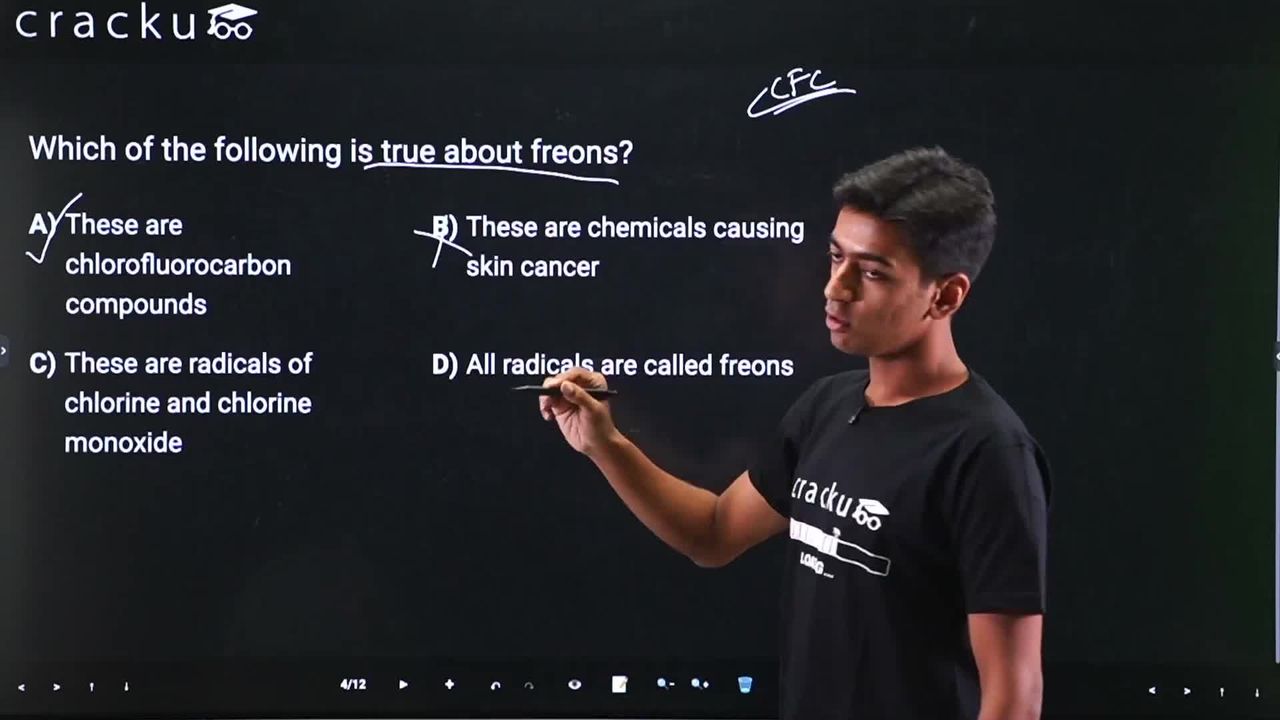
We need to identify the correct statement about freons.
Define freons.
Freons are the trade name for a group of chlorofluorocarbon (CFC) compounds. They are organic compounds that contain carbon, chlorine, and fluorine atoms. Common examples include:
- Freon-12 ($$CCl_2F_2$$, dichlorodifluoromethane)
- Freon-11 ($$CCl_3F$$, trichlorofluoromethane)
- Freon-22 ($$CHClF_2$$, chlorodifluoromethane)
Properties and uses.
Freons are chemically inert, non-toxic, non-flammable, and easily liquefiable gases. They were widely used as refrigerants, propellants in aerosol cans, and as solvents. However, they are now largely banned because they cause ozone layer depletion when they reach the stratosphere.
Evaluate the options.
Option (1): "These are chlorofluorocarbon compounds" - This is the correct and precise definition of freons.
Option (2): "These are chemicals causing skin cancer" - This is misleading. While ozone depletion caused by freons can lead to increased UV radiation (which may cause skin cancer), freons themselves are not directly chemicals causing skin cancer.
Option (3): "These are radicals of chlorine and chlorine monoxide" - This is incorrect. Radicals of Cl and ClO are formed when freons decompose in the stratosphere, but freons themselves are not radicals.
Option (4): "All radicals are called freons" - This is completely incorrect.
The correct answer is Option (1): These are chlorofluorocarbon compounds.
Was this solution helpful?
Click on the Email ☝️ to Watch the Video Solution
Create a FREE account and get:
_1.webp)

Educational materials for JEE preparation

Ask our AI anything

AI can make mistakes. Please verify important information.
AI can make mistakes. Please verify important information.
