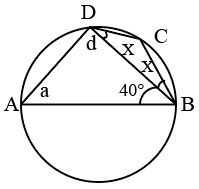
In the figure given below $$L_1 \mid \mid L_2$$ then x = ______________.
Sign in
Please select an account to continue using cracku.in
↓ →
In the figure given below $$L_1 \mid \mid L_2$$ then x = ______________.

Let $$\angle\ HBG$$ = 2y
$$\angle\ BAF$$ = 2y (corresponding angles are equal)
$$\angle\ FAC\ =\ \angle\ CAB$$ = y
$$\angle\ ABG$$ = 180 - 2y
$$\angle\ ABC\ =\ \angle\ CBG$$ = 90 - y
Sum of all angles of a triangle = $$180^{\circ\ }$$
In traingle, $$\angle\ CAB$$ = y, $$\angle\ ABC$$ = 90-y
y + 90 - y + $$\angle\ ACB$$ = 180
$$\angle\ ACB$$ = $$90^{\circ\ }$$
$$\angle\ ECB$$ = 180 - 90 = 90
2x = 90
x = $$45^{\circ\ }$$
Answer is option B
If $$h, c, v,$$ are the height, the curved surface area and the volume of a cone, then $$3\pi vh^3$$ is
$$c\ =\ \pi\ rl\ =\ \pi\ r\sqrt{\ r^2+h^2}$$
$$v\ =\ \frac{1}{3}\pi\ r^2h$$
$$3\pi\ vh^3\ =\ 3\pi\ \left(\frac{1}{3}\pi\ r^2h\right)h^3\ =\ \pi\ ^2r^2h^4$$
A) $$9v^2-c^2h^3\ =\ 9\left(\frac{1}{3}\pi\ r^2h\right)^2-\pi\ ^2r^2\left(h^2+r^2\right)h^{3\ }=\ \pi\ ^2r^4h^2-\pi\ ^2r^2h^5-\pi\ ^2r^4h^3$$
B)$$c^2h^2-9v^2\ =\ \pi\ ^2r^2\left(h^2+r^2\right)h^2-9\left(\frac{1}{3}\pi\ r^2h\right)^2=\ \pi\ ^2r^2h^4+\pi\ ^2r^4h^{2\ }-\ \pi\ ^2r^4h^2\ =\ \pi\ ^2r^2h^4$$ = $$3\pi\ vh^3$$
option C and D is not equal to $$3\pi\ vh^3$$
Answer is option B.
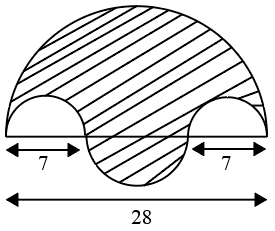
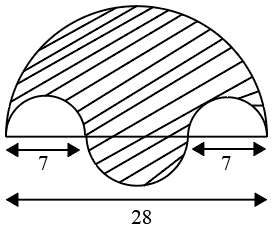
In the following diagram there are four semi circular arcs and a shaded region. The diameter of largest semi circle is 28cm and of the smallest is 7cm. The area of shaded region is
we have :
28-7-7 =14
So we have 4 semicircles with diameters 28,7,7 and 14 .
Now area of shaded region = Area of bigger semicircle (radius 14 ) - 2 (Area of smaller semicircles with radius 3.5 ) +Area of semicircle with radius 7
we get $$\pi\ \ \frac{14^2}{2}-\ 2\ \frac{\pi\left(3.5\right)^2}{2}+\pi\ \ \frac{\left(7\right)^2}{2}$$
= $$98\pi+24.5\pi\ -12.25\pi\ \ =110.25\pi\ $$
An umbrella is made by stitching 10 triangular pieces of cloth of two different colours each piece measuring 30cm, 60cm, 60cm. How much cloth of each colour is required for Umbrella?
s = $$\ \frac{\ a+b+c}{2}$$ = $$\ \frac{\ 30+60+60}{2}$$ cm =75 cm
Using Heron's formula
Area=√[s(s-a)(s-b)(s-c)]
=√[75(75-60)(75-60)(75-30)]
=$$225\sqrt{\ 15}$$ cm
There are total 10 pieces
First colour=5*($$225\sqrt{\ 15}$$) = $$1125\sqrt{15}$$ cm
Second colour=5*($$225\sqrt{\ 15}$$) = $$1125\sqrt{15}$$ cm
B is the correct answer.
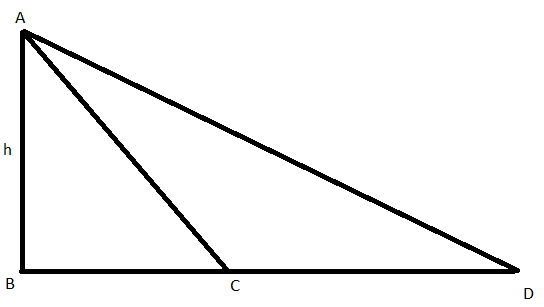
In the figure given below, a Cylinder is inserted into a cone and the vertical height of the cone is 30 cm. The diameter of the cylinder is 8. What is the volume of the cone? The base of the cylinder and the base of the cone are on the same plane.
Given AD = 30 cm
In triangle ACD,
$$\tan\angle ACD\ =\ \ \frac{\ AD}{DC}$$
$$\sqrt{\ 3}\ =\ \ \frac{\ 30}{DC}$$
DC = $$10\sqrt{\ 3}$$
radius of cone = DC = $$10\sqrt{\ 3}$$
Volume of cone = $$\frac{1}{3}\pi\ r^2h$$ = $$\frac{1}{3}\pi\ \left(10\sqrt{\ 3}\right)^2\left(30\right)$$ = $$3000\pi\ cm^3$$
Answer is option A.
If the ratio of sides of a rectangle is 2 : 7 and perimeter is 360 m, then find out its length and breadth.
Let the sides of the rectangle be 2x, 7x
It is given that the perimeter = 360m
2(2x+7x) = 360
x= 20m
Length = 7*20 = 140m, breadth = 2*20 = 40m
A is the correct answer.
Mr. Sandeep was placing an order with his carpenter to make wooden boxes to pack his cotton toys which were to be delivered to his friend. Sandeep wanted 2 types of boxes. The larger one with a dimension of 25cm x 20cm x 5cm and the smaller box with a dimension of 15cm x 12cm x 5cm. Sandeep also told the carpenter that 5% of total surface area is required as extra to cover the overlaps. If the cost of the wood is Rs.4/- cmz, the cost of wood required for supplying 250 boxes of each type would be Rs. ______.
[Note:-D0 NOT include spaces in your answer)
Surface area of one bigger box =2(25×20+20×5+5×25)
=1450cm2
By adding 5% for overlaps =1450+72.5=1522.5cm2
Area for 250 bigger boxes =1522.5×250cm2
Cost for 250 bigger boxes =1522.5×250×4=Rs.1522500
Surface area of smaller box =2(15×12+12×5+5×15)=630cm2
By adding 5% for overlaps =630+31.5=661.5cm2
Area for 250 small boxes =661.5×250×4=Rs.661500
Total cost =1522500+661500=Rs.2184000
Mahesh has a toy which has the shape of a trapezium. The two sides which are parallel have a length of 60 cm and 77 cm and the other sides are 25 cm and 26 cm. He requests you to calculate the area and you help him to arrive at the correct answer which is sq.cm.
[Note:- DO NOT include spaces in your answer)
We have :

Now h^2 +x^2 =625
and h^2 +(17-x)^2 =676
subtracting the equations we get
34x=289+625-676
we get 34x =238
we get x=7
Therefore
we get h =24
Therefore area = 1/2 (137)(24)
= 1644
SNAP Geometry is one of the important topics in the Quantitative, Data Interpretation & Data Sufficiency section of the SNAP 2026 Exam. Geometry questions test a candidate's understanding of shapes, angles, lines, triangles, circles, polygons, mensuration, and coordinate geometry concepts. These questions require strong conceptual clarity and the ability to apply formulas efficiently. Practicing topic-wise questions and solving problems from SNAP Previous Papers is an effective way to improve problem-solving skills and accuracy. Additionally, attempting SNAP Mock Tests will help you understand the latest exam pattern and the types of geometry questions that can be expected in the actual exam. To gain a better understanding of all the topics covered in the exam, candidates should also refer to the SNAP Syllabus.
Yes, Geometry is an important topic in the SNAP exam. Questions from geometry regularly appear in aptitude exams and can help candidates score well with proper preparation and formula revision.
SNAP does not have a fixed number of geometry questions every year. However, candidates can expect questions from topics such as triangles, circles, polygons, mensuration, and coordinate geometry.
SNAP may include questions on triangles, quadrilaterals, circles, mensuration, surface area and volume, coordinate geometry, and properties of angles and lines. Most questions focus on concept application and formula-based problem solving.
Start by learning and revising important geometry formulas and theorems. Practice a variety of questions from different geometry topics, solve questions from SNAP Previous Papers, and regularly attempt SNAP Mock Tests to improve speed and accuracy.
The difficulty level of geometry questions in SNAP is generally easy to moderate. While many questions are formula-based, some may require logical reasoning and a deeper understanding of geometric concepts.
Cracku's SNAP Geometry Questions are designed according to the latest SNAP exam pattern and difficulty level. They provide topic-wise practice questions, detailed solutions, shortcut methods, and performance analysis to help aspirants strengthen their concepts and improve their scores.
Educational materials for CAT preparation