91- 6303239042


 Group
Group


 Preferred Source

 Google Discover

SNAP Averages, Ratio and Proportion Questions
The Quantitative, Data Interpretation and Data Sufficiency section in the SNAP exam 2026 tests your understanding of basic mathematical concepts, calculation speed, and problem-solving ability. Among the important topics in this section, Averages, Ratio and Proportion are frequently asked and can help you score well if you understand the concepts properly.
Many students think these questions are difficult because they involve lengthy calculations. However, most SNAP Averages, Ratio and Proportion Questions are based on simple concepts and require the right approach. The challenge is not the formula but identifying the correct method to solve the question quickly.
In SNAP, every second matters. You should focus on improving calculation speed along with accuracy. Practising different types of average, ratio, and proportion questions regularly will help you identify patterns and solve questions faster during the exam.
Try solving at least 10 to 15 Quantitative Aptitude questions daily. Include different difficulty levels so that you become comfortable with all types of questions instead of preparing only one pattern.
SNAP Averages, Ratio and Proportion Questions PDF
A well-organised SNAP Averages, Ratio and Proportion Questions PDF can make your preparation easier and more effective. Instead of searching for questions from different sources, a single PDF helps you practise important questions in a structured way.
A good practice PDF should include previous year SNAP questions, expected questions, topic-wise practice sets, and detailed solutions. Solutions are important because they help you understand the approach used to solve a problem and learn faster methods.
Use the PDF regularly for revision and practice. Try solving questions within a fixed time limit to improve your speed. After completing a set, analyse your mistakes and understand where you went wrong. This process will help you avoid repeating the same errors in the actual SNAP exam.
SNAP Averages, Ratio and Proportion Questions PDF
How to Solve These Top 25 SNAP Averages, Ratio and Proportion Questions
Here are some methods that can help you solve SNAP Averages, Ratio and Proportion Questions effectively:
Understand the basic formulas first: Before solving questions, make sure your concepts are clear. Learn important formulas related to averages, ratios, and proportions. A strong foundation helps you solve even tricky questions easily.
Convert words into numbers: Most SNAP questions are based on real-life situations such as ages, marks, money distribution, or quantities. Read the question carefully and convert the given information into mathematical expressions.
Use shortcuts wherever possible: SNAP is a speed-based exam, so lengthy calculations can waste valuable time. Learn shortcuts like the average replacement method, ratio comparison tricks, and cross multiplication techniques.
Focus on the relationship between values: In ratio and proportion questions, understanding the relationship between quantities is more important than calculating every value. Identify whether the quantities are directly or inversely related before solving.
Practice different question types: Do not solve only one type of question. SNAP can include averages of marks, age problems, partnership questions, mixtures, and quantity comparisons. Practising different patterns improves your confidence.
Improve calculation speed: Fast calculations can make a big difference in SNAP. Practise mental maths, percentage conversions, fractions, and multiplication tables to save time during the exam.
Analyse your mistakes regularly: Many students solve questions but do not review their errors. Check every wrong answer and understand whether the mistake happened due to calculation, concept, or misunderstanding the question.
Question 1
A person travels one fourth of his distance with 20 km/hr,half of the distance with 40 km/hr and the rest of the distance with 10 km/hr.What is his average speed throughout the journey ?
correct answer:- 1
Question 2
Find the ratio in which a shopkeeper mixed two types of rice of cost 32/- per kg and 38/- per kg, if he sold the mixed rice for 42/- per kg at 20% profit ?
correct answer:- 3
Question 3
Which investment gives a better return, assuming the face value of shares to be Rs. 10?
A. 5% stock at 75, subject to 30% income tax
B. 4% stock at 90, tax free
correct answer:- 2
Question 4
The ratio of Appu and Babu’s weights are in the ratio 5:6. If Appu’s weight reduces by 10 kilos, the ratio becomes 2:3. What is Babu’s weight?
correct answer:- 4
Question 5
A solution A contains alcohol and water in the ratio 1 : 3 and a solution B contains alcohol and water in ratio 4 : 5. If both the solutions are mixed in equal quantities what is the ratio of alcohol and water in the final mixture?
correct answer:- 2

Question 6
The radius of a wire is decreased to one - third and its volume remains the same. The new length is how many times the original length?
correct answer:- 4
Question 7
Sonali invests 15% of her monthly salary in insurance policies. She spends 55% of her monthly salary in shopping and on household expenses. She saves the remaining amount of Rs. 12,750. What is Sonali’s monthly income?
correct answer:- 1
Question 8
Three candidates "A", "B", "C" participated in an election. "A" gets 40% of the votes more than "B". "C" gets 20% votes more than "B". "A" also overtakes "C" by 4000 votes. If 90% voters voted and no invalid or illegal votes were cast, then what will be the number of voters in the voting list?
correct answer:- 2
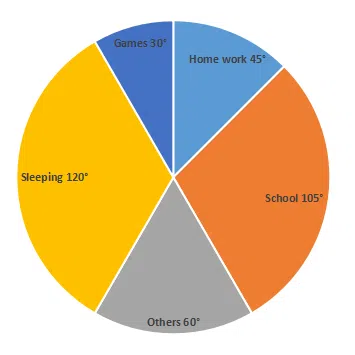
The following pie chart shows the hourly distribution in a day (in degrees) of all the major activities of a student. Moreover, a day has 24 hours.
Question 9
If he spends the time in games equal to the home work and remains constant in other activities, then the percentage decrease in time of sleeping:
correct answer:- 2
Question 10
A reduction of 20% in the price of sugar enables a person to purchase 6 kg more for Rs. 240. What is the original price per kg of sugar?
correct answer:- 1

Question 11
If 20% of x = y, then y% of 20 is same as
correct answer:- 4
Question 12
Find the value of 1% of 1% of 25% of 1000 is
correct answer:- 1
Question 13
A, B, C and D purchased a restaurant for Rs. 56 lakhs. The contribution of B, C and D together is 460% that of A, alone. The contribution of A, C and D together is 366.66% that of B’s contribution and the contribution of C is 40% that of A, B and D together. The amount contributed by D is:
correct answer:- 4
Question 14
In an examination, Raman scored 25 marks less than Rohit. Rohit scored 45 more marks than Sonia. Rohan scored 75 marks which is 10 more than Sonia. Ravi's score is 50 less than, maximum marks of the test. What approximate percentage of marks did Ravi score in the examination, if he gets 34 marks more than Raman ?
correct answer:- 2
Question 15
Wheat is now being sold at Rs. 27 per kg. During last month its cost was Rs. 24 per kg. Find by how much per cent a family reduces its consumption so as to keep the expenditure fixed.
correct answer:- 4

Question 16
Mr Giridhar spends 50% of his monthly income on household items and out of the remaining he spends 50% on transport, 25% on entertainment, 10% on sports and the remaining amount of Rs. 900 is saved. What is Mr Giridhar's monthly income?
correct answer:- 2
In a team there are 240 members (males and females). Two-third of them are males. Fifteen percent of males are graduates. Remaining males are nongraduates. Three-fourth of the females are graduates. Remaining females are non-graduates
Question 17
What is the sum of the number of females who are graduates and the number of males who are non-graduates?
correct answer:- 4
Question 18
Last year there were 610 boys in a school. The number decreased by 20 percent this year. How many girls are there in the school if the number of girls is 175 percent of the total number of boys in the school this year?
correct answer:- 1
Question 19
The speed of scooter, car and train are in the ratio of 1 : 4 : 16. If all of them cover equal distance then the ratio of time taken/velocity for each of the vehicle is:
correct answer:- 1
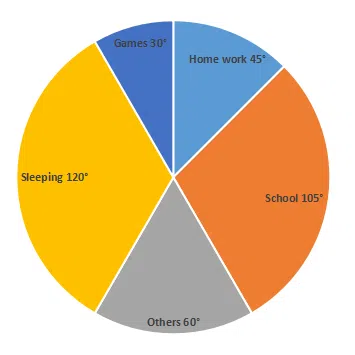
The following pie chart shows the hourly distribution in a day (in degrees) of all the major activities of a student. Moreover, a day has 24 hours.
Question 20
How much time (in per cent) does he spend in games in comparison to sleeping?
correct answer:- 3

Question 21
An agent sells goods of value of Rs. 15,000. The commission which he receives at the rate of $$12\frac{1}{2}\%$$ is
correct answer:- 1
Question 22
A 14.4 kg gas cylinder runs for 104 hours when the smaller burner on the gas stove is fully opened while it runs for 80 hours when the larger burner on the gas stove is fully opened. Which of these values are closest to the percentage difference in the usage of gas per hour, of the smaller burner over the larger burner?
correct answer:- 4
Question 23
In an examination, out of 480 students 85% of the girls and 70% of the boys passed. How many boys appeared in the examination if total pass percentage was 75%?
correct answer:- 3
Question 24
An alloy of gold and silver weighs 50 gms. It contains 80% gold. How much gold should be added to the alloy so that percentage of gold is increased to 90?
correct answer:- 1
Question 25
Weekly incomes of two persons are in the ratio of 7 : 3 and their weekly expenses are in the ratio of 5 : 2. If each of them saves Rs. 300 per week, then the weekly income of the first person is
correct answer:- 3