91- 6303239042


 Group


 Preferred Source

 Google Discover
SNAP 2026: 60 questions in 60 minutes strategy
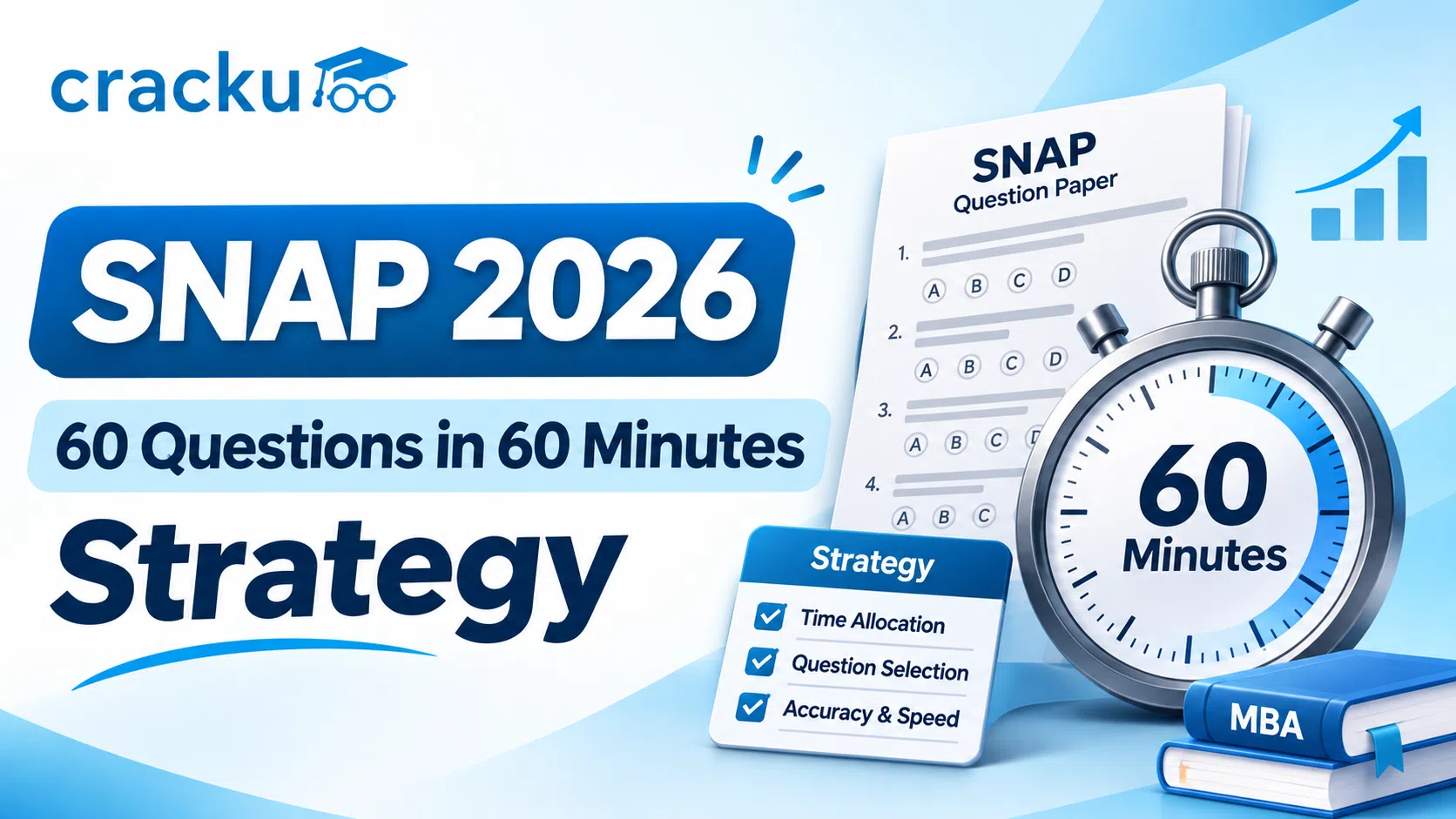
The SNAP 2026 will be conducted in Computer-Based Test (CBT) mode. Students will face questions from four sections, containing 60 questions of 60 marks. The biggest challenge is to solve each question within one minute. This makes time management and question selection important parts of the SNAP 2026 preparation strategy. Not every question in the SNAP exam can be solved within a minute. While students get an average of one minute per question, some questions can be answered in just a few seconds, whereas others may require more time and calculations. This makes SNAP one of the toughest and most unique MBA entrance exams, where speed, accuracy, and smart question selection play an equally important role. This article will help you learn how to solve questions in sufficient time and how to develop the ability to identify questions and decide how much time to devote to each question.
How to Attempt 60 Questions in 60 Minutes in SNAP 2026?
Students must know which questions to attempt first, when to skip a difficult question, and how to distribute their time across all four sections to manage 60 questions in 60 minutes. However, this alone will not help students manage time; speed also matters, and speed comes with practice. Students should know that the goal is not simply to complete all questions as quickly as possible. The focus should be on using the time limit efficiently, avoiding unnecessary delays and limiting incorrect attempts because of negative marking. Students can follow a three-round approach to solve 60 questions in 60 minutes.
Round | Time Allocation | Strategy | What to Focus On |
Round 1: Quick Attempts | 0–35 minutes | Attempt easy and familiar questions across all four sections. | First solve direct questions, familiar concepts and questions that require less calculation and less time. Skip lengthy or confusing questions. |
Round 2: Moderate Attempts | 35–52 minutes | Return to questions skipped in the first round. | Focus on moderately difficult questions that require additional calculations or logical thinking. |
Round 3: Final Review | 52–60 minutes | Review unanswered and marked questions. | Recheck all answers, attempt questions where you can eliminate incorrect options and can guess smartly not randomly. |
SNAP 2026 Section-Wise Time Management Strategy
SNAP 2026 has 60 questions in 60 minutes (after the addition of the new Ethics, Morality & Values section). If we calculate, that's one minute per question if you attempt everything. But all sections and all questions don't require the same time; some questions might get solved within a few seconds, while others might take more than a minute. Students can also use SNAP previous year question papers to practise question selection and improve time management. Below is the section-wise time strategy for SNAP 2026.
Section | Number of Questions | Suggested Time | Key Strategy |
General English | 10 | 7–10 minutes | Solve vocabulary and grammar questions quickly |
Analytical & Logical Reasoning | 20 | 10–20 minutes | Prioritise direct questions; skip lengthy puzzles |
Quantitative, DI & DS | 20 | 20–22 minutes | Attempt easy calculations first; avoid lengthy DI sets |
Ethics, Morality & Values | 10 | 8–10 minutes | Focus on balanced and logical decisions |
Buffer/Review | — | 2–4 minutes | Review marked questions and check answers |
Total | 60 | 56–60 minutes | Adjust time allocation to fit the 60-minute exam |
Which Section Should You Attempt First in SNAP 2026?
There is no single “fixed” section order that works for every SNAP aspirant. But ideally, students should start with a section that is less difficult and less time-consuming; this will increase your confidence level and motivation to solve further sections. Solving easier questions first will save you time for difficult questions. General English and Ethics, Morality and Values can be considered one of the interesting and easy-to-solve sections. SNAP 2026 has no sectional time limit, the time you save in these easy sections so that you can devote more time for Logical Reasoning and QADI. Students have 60 minutes to attempt all 60 questions. Before finalising any strategy, students should analyse their SNAP mock test scores and find their strengths and weaknesses while solving these questions. Choose the section that gives the best combination of speed and accuracy.
Strategy | Section Attempt Order | Best For |
Strength-First | Strongest section → Second strongest → Remaining sections | Candidates who know their strongest sections and consistently score well in them |
Quick-Scan | English → Ethics → Reasoning → Quant | Candidates who want to begin with familiar questions and build momentum |
High-Yield-First | Reasoning → Quant → English → Ethics | Candidates who want to prioritise the two 20-question sections before attempting the 10-question sections |
Note: These are suggested strategies, not fixed rules. The best SNAP 2026 section order depends on your mock-test performance, accuracy, and time management.
Read More: SNAP Ethics, Morality and Values 2026: Preparation Guide
SNAP 2026 Good Attempts for Each Section
By analysing the SNAP previous years' papers, students will find that most of the questions were of an easy to moderate level. Students who prepared well for the exam can comfortably solve around 40-45 questions. Instead of attempting all 60 questions without proper consideration and doing blind guessing, candidates should focus on answering questions they are confident about. Overall, students with good speed could target 40+ attempts.
SNAP 2026 Section | Total Questions | Good Attempts |
General English | 10 | 8–10 |
Analytical & Logical Reasoning | 20 | 15–17 |
Quantitative, DI & Data Sufficiency | 20 | 13–15 |
Ethics, Morality and Values | 10 | 7–9 |
Total | 60 | 43–51 |
How to Improve Speed and Accuracy in SNAP 2026?
Many MBA aspirants study well and know all the answers, but on the actual exam day, they make minor mistakes or struggle to complete the paper on time. SNAP is a speed-based exam where students need to solve 60 questions in 60 minutes; this puts extra pressure on the students. This happens because they focus only on studying, but not on speed and accuracy. Below are some of the best ways given to improve speed and accuracy in SNAP 2026.
- Practice With Time Every Day: Always use a timer when you study. If you are solving questions, set a time limit. Try to finish the test a few minutes early.
- Understand Concepts Clearly: Many students try to solve fast but forget that without a clear understanding, speed never improves. Students must revise all the formulas, shortcuts, and concepts every day.
- Learn to Skip and Return: Sometimes, one difficult question takes a lot of time. Don't get stuck on it. Move to the next one and come back later if you have time left.
- Analyse Your Mock Tests: After every test, spend some time understanding your mistakes. Spend time on knowing the best section order that suits you, through which you are getting high marks.
Read More: How to Score 45+ Marks in SNAP Exam 2026, Check Now
How to Avoid Negative Marking and Maximize Your SNAP 2026 Score?
To avoid negative marking and maximise their SNAP 2026 score, students should focus on accuracy rather than chasing all 60 attempts. Attempting every question with low accuracy can reduce the overall score due to negative marking. Students should also avoid spending too much time on a single question, as it may cost them the opportunity to solve multiple easier questions. Blind guessing, especially in the last few minutes of the exam, should be avoided unless candidates can eliminate some incorrect options. Students should also analyse their mock test performance to find repeated mistakes and conceptual gaps instead of taking multiple mocks without reviewing them. Finally, avoid changing your question-selection strategy on exam day and follow the approach you have consistently practised during mock tests.
Read More: SNAP 30 Day Preparation Plan 2026, Section-wise Strategy
SNAP 2026 60 Questions in 60 Minutes Strategy: Conclusion
The SNAP 2026 60 questions in 60 minutes strategy is mainly about managing time, selecting the right questions, and maintaining accuracy. Students should focus on solving easy questions first, avoiding lengthy calculations and following a section-wise time management plan. Practising SNAP mock tests regularly can help improve speed and confidence before the examination.
Students should remember that attempting all 60 questions is not necessary to achieve a good score. Instead, focus on maximising correct attempts and avoiding unnecessary negative marking. Follow a consistent exam strategy, analyse your mistakes and revise important concepts to improve your overall performance in SNAP 2026.