91- 6303239042


 Group
Group


 Preferred Source

 Google Discover
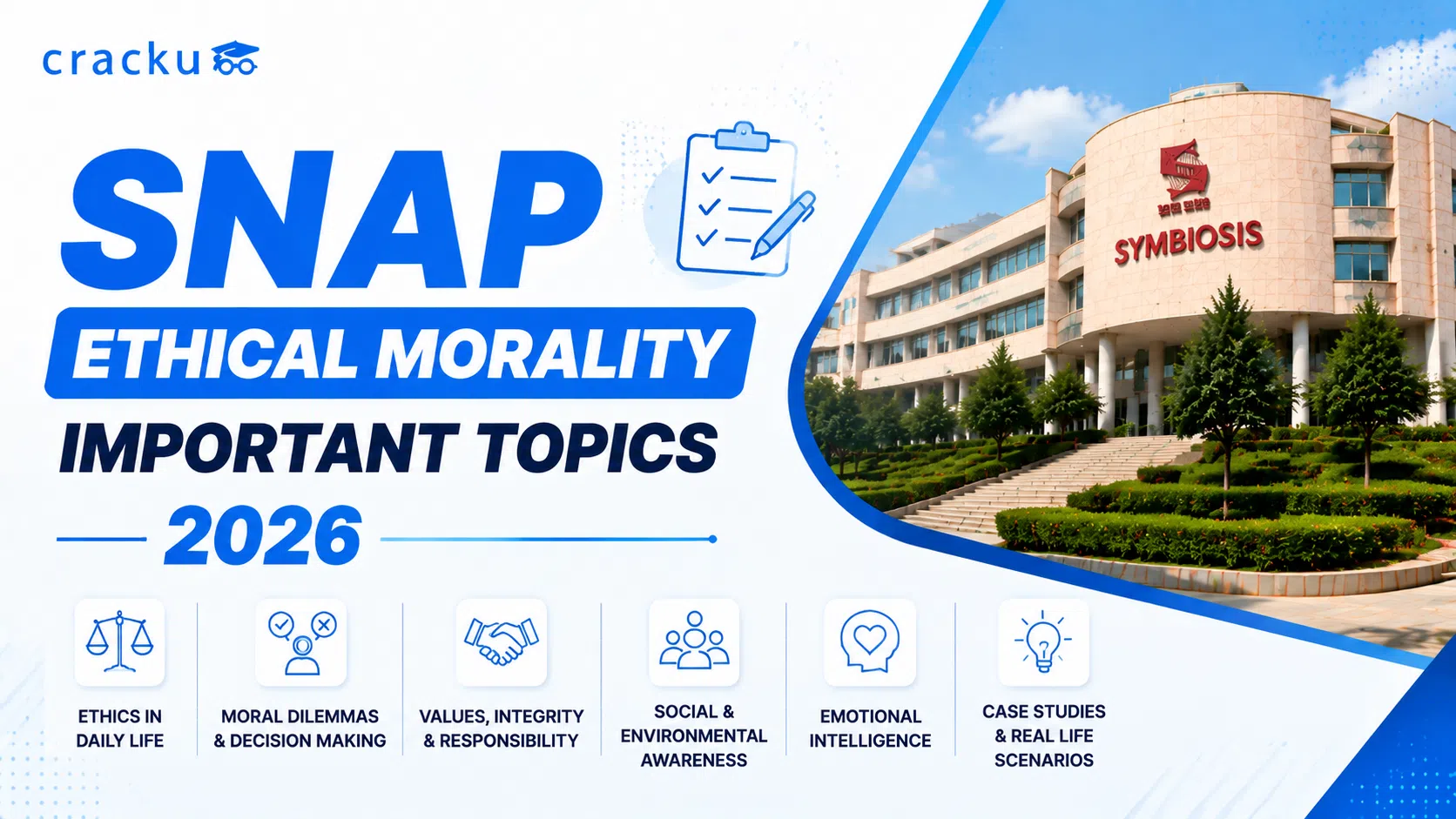
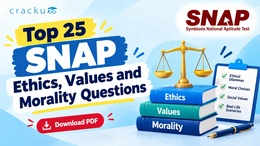
SNAP Ethical Morality Important Topics 2026
The Ethics, Morality and Values section has been included in the SNAP exam pattern for 2026. Thus,SNAP has now become a four section test as opposed to its earlier three section format. The structure of the test that will comprise of 60 questions, having a score of 60 marks, which will be administered as an hour-long computer-based test has not changed, however what has changed is the distribution of the 60 questions. This article gives information about the SNAP Ethical Morality Important Topics 2026, which also explains the weightage of each theme, and gives you a practical, week-by-week plan to convert this unfamiliar section into a scoring opportunity.
SNAP Ethical Morality Important Topics PDF
SNAP Ethical Morality Section Overview 2026
The SNAP paper pattern will still contain the 60 marks, 60 minutes structure. In order to add this 10 marks part in the SNAP paper without raising the time limit, 5 questions were taken out from General English & 5 from Analytical & Logical Reasoning
Parameter | SNAP 2026 Updated Details |
Total Sectional Questions | 10 Multiple Choice Questions (MCQs) |
Total Sectional Marks | 10 Marks (1 mark per correct answer) |
Negative Marking | -0.25 marks for every incorrect answer |
Sectional Time Limit | None (Candidates navigate freely across all four sections) |
Target Attempt Time | 5 to 7 minutes for all 10 questions |
Question Type | Objective/MCQ (No TITA questions) |
The following table gives the SNAP new exam pattern for the year 2026:
Section | Number of Questions | Marks |
General English | 10 | 10 |
Analytical & Logical Reasoning | 20 | 20 |
Quantitative, DI & Data Sufficiency | 20 | 20 |
Ethics, Morality and Values (New) | 10 | 10 |
Total | 60 | 60 |
Read More: SNAP Ethical Morality Syllabus 2026 PDF, Important Topics
Key Ethical Morality Topics with Weightage
The ethics section of the SNAP exam evaluates a candidate's maturity to deal with business-related problems, focus on right decisions and organisational ethics. The questions are spread over theoretical concepts and applied business contexts
Topic Cluster | Approx. Weightage (out of 10 Qs) | Focus Area |
Workplace Ethics & Professional Conduct | 2 - 3 questions | Integrity, honesty, accountability, conflict of interest |
Corporate Social Responsibility (CSR) & Sustainability | 1 - 2 questions | Business responsibility toward society and environment |
Diversity, Equity & Inclusion (DEI) | 1 - 2 questions | Fairness, bias, equal opportunity in organisations |
Data Privacy & Digital Ethics | 1 - 2 questions | Confidentiality, consent, responsible use of information |
Moral Reasoning & Decision-Making Dilemmas | 2 - 3 questions | Judging the 'most ethical' course of action in a scenario |
Read More: How to Prepare for SNAP Ethical Morality 2026? Check Now
Important Ethical Morality Topics for SNAP 2026
From the official section description as well as the experience with similar skills testing MB A entrance tests, the following important Ethical Morality Topics for SNAP 2026 are the ones you ought to pay attention to:
Integrity, Honesty and Accountability: In these type of questions, a situation is given like -maybe an employee reports less work done on error basis or perhaps a superior asks not to consider some issue, in this regard you would want to mark the right options which highlight the importance of honesty, accountability of results instead of momentary gain.
Fairness and Justice in Decision-Making: It implies equal opportunities, impartiality in judging matters etc. For example in dealing with division of work and compensation as a team member or team leader of a team when a team member doesn’t cooperate.
Corporate Social Responsibility (CSR): Here, candidates are checked regarding the organization’s role in profit making as compared to their responsibilities to society, environment etc. One would definitely want to have familiarity with some Indian corporate houses’ social responsibility endeavors.
Diversity, Equity and Inclusion (DEI): This topic checks the candidates’ attitude toward biases, inclusion of all types of employees at workplaces, and equal opportunities -of late CSR and DEI are becoming huge important topics.
Data Privacy and Digital Ethics: As digital business is getting more important, questions around information use, confidentiality and consent are likely candidates on data security related to online activities with customers and employees.
Workplace Dilemmas and Conflict of Interest: These types of questions will assess your approach in any situation where personal interest meets the organizational goal. For example, if an employee is selecting his family member then what approach you adopt and it should lean towards organizational benefits only and definitely a report should be submitted.
Environmental and Sustainability Ethics: Your knowledge regarding the company’s responsibility towards society’s environmental health and long-term effects should reflect through your answers and this would come via real-world corporate responsibility and ethical framework.
Rights, Duties and Professional Conduct: Under this heading, a wide range of issues may be touched, like rights of the employees and society and the company’s duty toward them; codes of professional conduct etc. Whistle blower kind of cases might be presented in these situations.
SNAP Ethical Morality Preparation Tips to Maximize Your Score in 2026
Because this section has no legacy question bank, your preparation for it will need to differ from how you train for Quant or Reasoning, and you’ll want to employ these SNAP Ethical Morality preparation tips to increase both speed and accuracy:
Think in stakeholders, not just rules: In every situational question ask who would be impacted: the organization, individual(s), consumers, or society, and then decide on an answer which seems to be in the best and most balanced interest of the stakeholders involved.
Practice with XAT Decision Making questions: Without available sample papers for SNAP, the XAT’s Decision Making (situation analysis and judgement) is currently the only closely available resource.
Follow Indian businesses'CSR and Governance case studies: Keeping abreast of current trends and ethical approaches in Indian organizations to issues like sustainability, diversity & inclusivity, and governance would serve to develop the intuition needed.
Avoid options at the extremes: Highly severe or lenient answers, or those which completely bypass the core dilemma (distractors) are usually not appropriate and the balanced choice will typically stand out.
Time limit this section during practice: With 10 EMV questions, but no independent timer section, fix on your overall target minutes on this portion and maintain discipline to free up time to attempt Quant and Reasoning questions. Keep an eye out for the official mock. If Symbiosis publishes an official SNAP 2026 mock with the new section, work with it in priority over anything offered by outside parties- it would offer a much more reliable benchmark.
Talk about scenarios: Discussing the ethics behind the dilemmas and your reasoning with a friend or study group would help highlight decision-making deficiencies far quicker than solving questions alone would.
3-Month Preparation Timeline for SNAP Ethical Morality
The best way to approach this, and to ace, the new pattern in Business Ethics: theory as well as application is by a structured, stepwise methodology, ensuring that by the time you finish you have a good grasp.
Month 1: Basics of vocabulary, terminology and conceptual study
- Week 1-2: Study business ethics terminology in depth, such asCorporate Governance, CSR, DEI, and Whistleblowing. Make sure you write about 50-70 key terms with definitions.
- Week 3-4: Understand the definition of Shareholders vs. Stakeholders. Understand the case studies of some of the largest corporate failures that are built upon breaches in business ethics(e.g. Enron, Theranos, pollution cases in various areas) and try to assess on what grounds there was a failure in ethics and how that affected all stakeholders. Dedicate 20-30 minutes daily to read business editorials.
Month 2: Application based practice and judgment cases
- Week 5-6: Moving from theory, into application. Start practicing decision-making questions, similar to that found in XAT (though perhaps shorter), where the prime idea is to map the stakeholders and the dilemma involved.
- Week 7-8: Practice systematically eliminates obvious extreme options which are either too aggressive or clearly unethical. Prepare and practice 15-20 multiple choice questions based on situations. For this aspect it is best to give your answer first rather than worry about how fast you finish. Analyze every mistake that you commit in these practice questions to find out why a test-maker would mark your preferred choice.
Month 3: Calibrating time and mocks
- Week 9-10: Start solving it in full length of 60 minute mock tests keeping the pattern in mind: 10 questions General English, 20 Questions in Aptitude - logical reasoning and Data Interpretation and Data Sufficiency & DS and 10 questions of Ethics. Try a variation of attempt orders - many candidates prefer attempting ethics and General English first to bank 20 marks in under 15 mins.
- Week 11-12: Focus on nothing but time. Ensure that the time taken for you to solve one Ethics question remains at 45 secs or less. Revise your terminology bank and review all errors from the full length mock tests and trust your first ethically sound reasoning in a simulated mock-test rather than thinking about second options and the thinking process behind it in detail.
Phase | Duration | Focus Areas | Target Outcome |
Month 1: Foundation | Weeks 1 - 4 | Read about CSR, DEI, workplace ethics, and data privacy; build a topic-wise notes file | Conceptual familiarity with all key themes |
Month 2: Applied Practice | Weeks 5 - 8 | Solve XAT Decision Making sets; attempt EMV-style questions from available prep platforms | Comfort with scenario-based judgement |
Month 3: Mock Integration | Weeks 9 - 12 | Attempt full-length SNAP mocks (including official ones once released); review every EMV error | Section-level speed, accuracy, and confidence |
Key Takeaways for SNAP Ethical Morality 2026
- New section, equal weight: Ethics, Morality and Values section is no newbie - it carries 10 questions and 10 marks, equal to General English.
- Applied, not abstract: Be ready for a scenario and judgmental approach, not definitional recall.
- Unknown curriculum: Get ready on the topics suggested by Symbiosis (ethics, values, CSR, DEI, data security and Workplace conduct) and readjust as we roll outmocks.
- Practice XAT Decision Making: It is the closest mock for SNAP style question pattern in absence of real SNAP EMV prior papers.
- Balanced choice: Opt for fair and unbiased and balanced answers, nothing too biased towards one party.
- Manage your clock: As there isn’t a sectional timer;allocate a fixed time for the EMV section of SNAP in your strategy.
SNAP Ethical Morality Important Topics 2026: Conclusion
The introduction of Ethics, Morality and Values has changed the SNAP 2026 preparation strategy for MBA aspirants. Since this is a new section, students cannot depend on previous year SNAP papers and must focus on understanding ethical principles, workplace behaviour, business responsibility, and real-life decision-making scenarios. Topics such as integrity, accountability, CSR, DEI, data privacy, sustainability, and ethical dilemmas should be prioritised during preparation.
With a structured approach, this new SNAP section can become a scoring opportunity rather than a challenge. Candidates should build conceptual clarity, practise situation-based questions, analyse stakeholder impact, and regularly attempt mock tests to improve accuracy. A balanced preparation strategy covering theory, application, and time management can help aspirants perform confidently in the SNAP Ethical Morality section 2026