91- 6303239042


 Group


 Preferred Source

 Google Discover
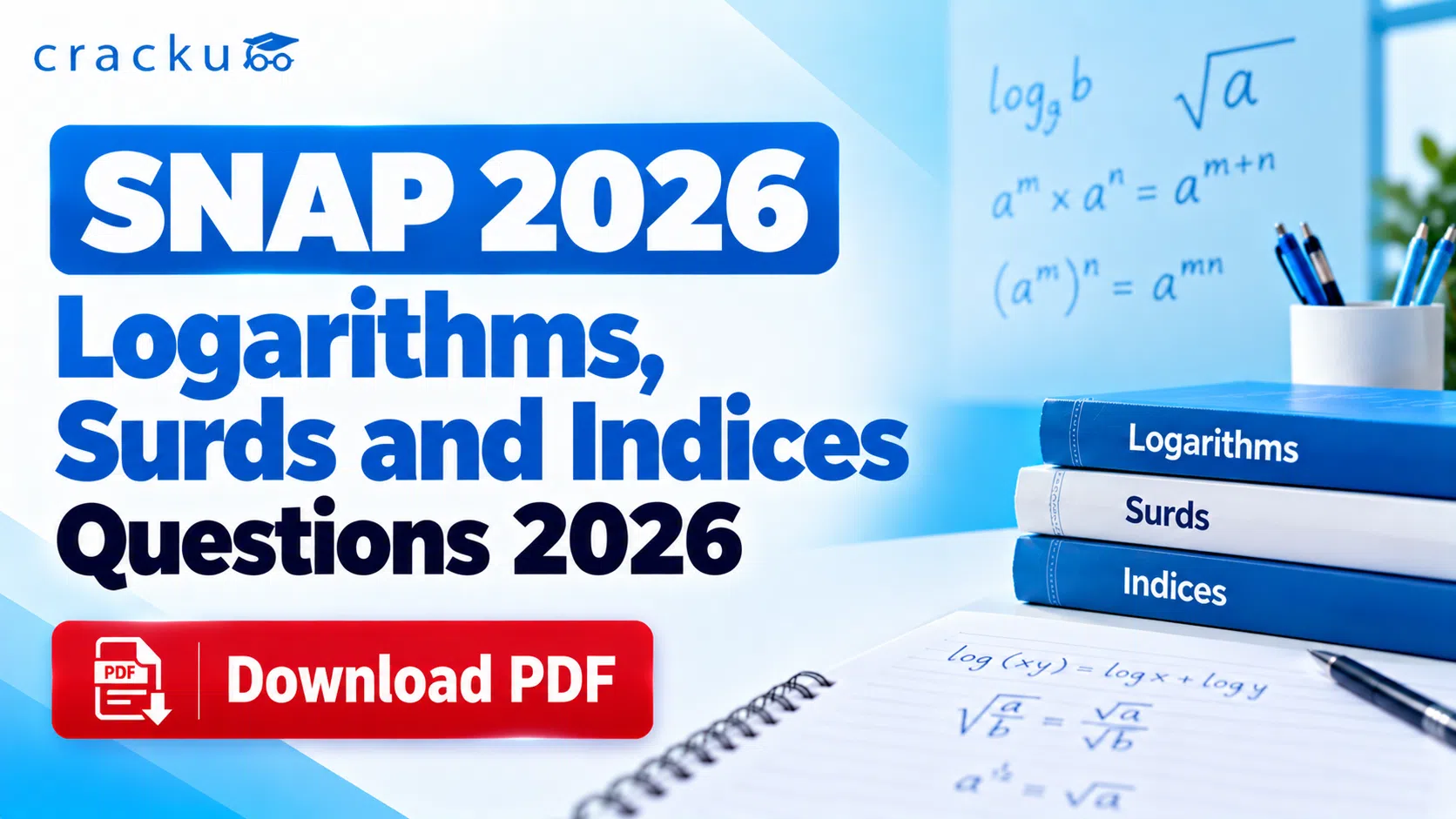
SNAP Logarithms, Surds and Indices Questions 2026
Logarithms, Surds and Indices are among the most scoring algebra topics in the SNAP Quantitative, Data Interpretation and Data Sufficiency section. Under the SNAP 2026 pattern, this section has 20 of the paper's 60 questions, and the full test runs for 60 minutes with no sectional time limit. These topics usually account for 1 to 2 questions directly. Since SNAP deducts 0.25 marks for every wrong answer, a sure-shot method matters more than a lucky guess.
Most SNAP Indices questions rest on one idea: bring every term to the same base before you compare or simplify. Logarithm questions add another: a logarithm is simply an exponent, so log base a of x = n means a^n = x. Surd questions turn on rationalising and on spotting perfect squares hidden inside expressions. Standard patterns include simplifying powers, solving exponential equations, comparing surds, rationalising denominators, square roots of surds, nested and infinite roots, evaluating logarithmic expressions, change of base, solving log equations and finding the number of digits in a large power.
SNAP gives you roughly one minute per question across the paper, and these questions are short and formula-driven, so you can often solve them in under a minute. That makes them ideal questions to bank time for Data Interpretation sets and the trickier Reasoning questions. Indices and logarithms also feed Progressions, Compound Interest and Population Growth, so the time you invest here pays off across the Quant section.
Try to solve 10 to 15 Logarithms, Surds and Indices questions daily. Mix simplification questions, exponential equation questions, surd comparison and rationalisation questions, logarithm evaluation and equation questions and Data Sufficiency questions to build the pattern recognition you need to finish the section on time.
SNAP Logarithms, Surds and Indices Questions PDF
A single SNAP Logarithms, Surds and Indices Questions PDF lets you practise every important pattern in one place instead of searching through books and websites. It also makes last-minute revision quick, since the laws of indices, logarithm properties, standard surd results and solved examples sit together.
This PDF covers laws of indices, simplifying powers with different bases, exponential equations, comparing powers and surds, rationalising denominators, square roots of surds, nested and infinite radicals, laws of logarithms, change of base, logarithmic equations, number of digits using logarithms, and a SNAP-style Data Sufficiency question. Every question comes with a step-by-step solution so you can check both your answer and your method.
Solve the questions in a timed setting, aiming for under 1 minute per question. After each set, go through the solutions and note where a common base, a log property or the conjugate could have saved time. Revisit the questions you got wrong after a few days to make sure the concept has stuck, and keep a count of wrong attempts, since each one costs you 0.25 marks in SNAP.
Download SNAP Logarithms, Surds and Indices Questions PDF
How to Solve SNAP Logarithms, Surds and Indices Questions
Here are some methods that can help you solve SNAP Logarithms, Surds and Indices questions quickly and accurately:
Always bring terms to a common base first: Most indices questions collapse once every term uses the same base. To solve 8^x = 32, write it as 2^(3x) = 2^5, so 3x = 5 and x = 5/3. Before calculating, ask "what prime is hiding in each number?"
Read every logarithm as an exponent: log₂ 8 asks "2 to what power gives 8?", so the answer is 3. Thinking this way lets you evaluate most expressions mentally: log₂ 8 + log₃ 81 = 3 + 4 = 7. Memorise the common values:
- 2^10 = 1,024, 3^5 = 243, 5^4 = 625, 7^3 = 343
- log 2 = 0.3010, log 3 = 0.4771, log 5 = 0.6990, log 7 = 0.8451 (base 10)
- √2 ≈ 1.414, √3 ≈ 1.732, √5 ≈ 2.236
Compare surds by equalising the roots: To compare √2, ∛3 and ⁴√5, raise each to the power 12 (the LCM of 2, 3 and 4). You get 2^6 = 64, 3^4 = 81 and 5^3 = 125, so ⁴√5 is the largest.
Rationalise with the conjugate: Multiply the numerator and denominator by the conjugate to clear surds from the denominator. For example, 1 ÷ (√5 + √3) = (√5 − √3) ÷ (5 − 3) = (√5 − √3) ÷ 2.
Learn the key results by heart:
- a^m × a^n = a^(m + n); a^m ÷ a^n = a^(m − n); (a^m)^n = a^(mn)
- a^0 = 1; a^(−n) = 1 ÷ a^n; a^(1/n) = ⁿ√a; (ab)^n = a^n × b^n
- If a^x = a^y (a > 0, a ≠ 1), then x = y
- log (mn) = log m + log n; log (m ÷ n) = log m − log n; log m^n = n log m
- logₐ a = 1; logₐ 1 = 0; a^(logₐ x) = x
- Change of base: logₐ b = log b ÷ log a, so logₐ b × log_b a = 1
- log of b to the base a^n = (1/n) × logₐ b
- a^(log b) = b^(log a), for any common base of the logarithm
- √(a + 2√b) = √x + √y, where x + y = a and xy = b
- √(x + √(x + √(x + …))) = (1 + √(1 + 4x)) ÷ 2
- √(x − √(x − √(x − …))) = (−1 + √(1 + 4x)) ÷ 2
- √(x √(x √(x …))) = x
- Number of digits in N = (integer part of log₁₀ N) + 1
Use the square-root-of-a-surd shortcut: To find √(7 + 4√3), rewrite it as √(7 + 2√12). Find two numbers that add to 7 and multiply to 12: 4 and 3. So the answer is √4 + √3 = 2 + √3.
Count digits with logarithms: To find the number of digits in 2^50, calculate 50 × log 2 = 50 × 0.3010 = 15.05. The integer part is 15, so 2^50 has 16 digits.
Check the domain in log equations: A logarithm is defined only for a positive number with a positive base other than 1. After solving a log equation, reject any value that makes an argument zero or negative. Many wrong options are exactly these rejected roots.
Eliminate options by substitution: These questions usually have clean answers. Plug each option back into the equation, or use approximate values of √2, √3 and log 2 to strike out options before you calculate fully.
Guess carefully under negative marking: Each wrong answer costs 0.25 marks. If you can eliminate two of the four options, a guess between the remaining two is worth taking on average; if you cannot narrow it down at all, move on and return later.
For Data Sufficiency, do not solve fully: You only need to know whether a unique answer exists. Watch for statements that give x² or |x|, since they allow two values; a log statement often fixes the sign, because the argument must be positive.
Question 1
$$\sqrt{18 + x \sqrt{2}} = \sqrt{12} + \sqrt{6} \Rightarrow x =$$
correct answer:- 3
Question 2
$$3^a = 5^b = 75^c \Rightarrow c(2a + b) =$$
correct answer:- 2
Question 3
If $$\log \frac{a^{2}}{b}+\log \frac{b}{a^{2}}=\log(a+b)$$, then
correct answer:- 3
Question 4
Calculate the value of $$\frac{\sqrt{3}}{(3+\sqrt{3})}$$ if $$\sqrt{3}=1.7320$$
correct answer:- 1
Question 5
The simplest value of $$\frac{3\sqrt{8}-2\sqrt{12}+\sqrt{20}}{3\sqrt{18}-2\sqrt{27}+\sqrt{45}}$$ is
correct answer:- 2

Question 6
If $$\frac{p}{q}=\frac{r}{s}=\frac{t}{u}=\sqrt{5}$$, then what is the value of $$[\frac{(3p^{2} + 4r^{2} + 5t^{2})}{(3q^{2} + 4s^{2} + 5u^{2})}]$$ ?
correct answer:- 2
Question 7
$$\frac{1}{\log_a^b}\times\frac{1}{\log_c^b}\times\frac{1}{\log_a^c}$$ is equal to
correct answer:- 4
Question 8
If $$\log_{18} 24 = p$$, then $$\log_{96} 108$$ equals
correct answer:- 4
Question 9
Given that $$10^{0.48} = x, 10^{0.70} = y$$ and $$x^{z} = y^{2}$$, then the value of z is close to:
correct answer:- 2
Question 10
What is the value of x in the following equation?
$$3 \log \frac{3}{5} - \log \frac{x}{21} + 2 \log \frac{25}{9} = 0$$
correct answer:- 1

Question 11
$$\frac{2}{\sqrt{10 + 2\sqrt{21}}} - \frac{1}{\sqrt{12 + 2\sqrt{35}}} - \frac{1}{\sqrt{8 + 2\sqrt{15}}} =$$
correct answer:- 4
Question 12
If $$a = 2^x, b = 4^y, c = 8^z$$ and $$a^{yz} . b^{zx} . c^{xy} = 4^6$$, then $$xyz = ...........$$
correct answer:- 4
Question 13
Let $$2^{x + y} = 10, 2^{y + z} = 20$$ and $$2^{z + x} = 30$$ where x, y and z are any three real numbers. The value of $$2^x$$ is
correct answer:- 2
Question 14
If $$\log_{10}(1+x)+\log_{10}(1-x)+2=\log_{10}\left(9-4x^2\right)$$ then the value of $$96x^2$$ is:
correct answer:- 91
Question 15
What is the value of a - b if it is known that $$\sqrt{\ \dfrac{7\ +\ 4\sqrt{\ 3}}{3}}\ =\ a\ +\ b\sqrt{\ 3}$$? (where a and b are rational numbers)
correct answer:- 3

Question 16
Find the value of $$y$$ if $$\log_{x^2}\ 576+2\log_{\frac{1}{x}}2+\log_{\frac{1}{x}}3=\frac{1}{\log_yx}$$
correct answer:- 2
Question 17
If $$log x+log (3x-1) = 1$$, then find the value of $$log 5x$$.
correct answer:- 2
Question 18
What is the greatest number among $$3^{51}, 2^{68}, 5^{34}$$ and $$8^{17}$$.
correct answer:- 1
Question 19
If $$(log{64})^2 + 12 log{2} + 1 = (2log{a}+1)^2$$, then a can be
correct answer:- 1
Question 20
If log $$\frac{x}{y}$$ + log $$\frac{y}{x}$$ = log (x+y), then find the value of x+y.
correct answer:- 2