91- 6303239042


 Group
Group


 Preferred Source

 Google Discover
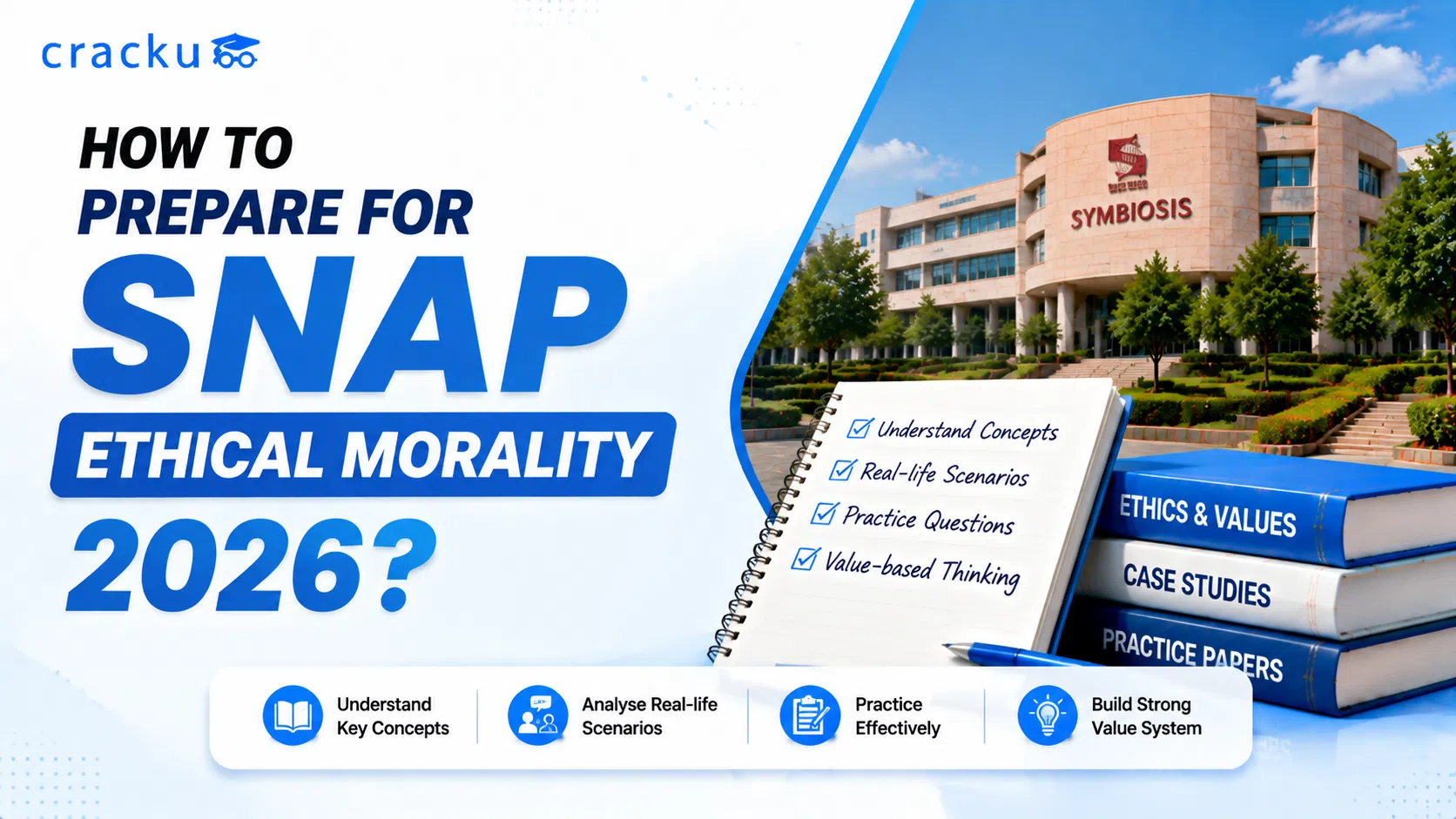
The SNAP 2026 preparation strategy needs to be updated. Along with the existing sections, students will now face 10 questions from Ethics, Morality and Values. SNAP 2026 has become a four-section entrance exam. General English and Ethics, Morality and Values (new section) will carry 10 questions each, while Reasoning and Quantitative sections carry 20 questions each. The addition of this section has created a new preparation challenge for MBA aspirants. This article will help you understand the complete Ethics, Morality and Values section and provide you with an effective preparation plan.
SNAP Ethical Morality Syllabus PDF
How to Prepare for SNAP Ethical Morality 2026?
As the SNAP 2026 exam pattern has been changed, Ethics, Morality and Values has been added as a new section, consisting of 10 questions for one mark each. Students preparing for SNAP have to change their strategy regarding preparation. Ethical Morality 2026 requires a different approach from Quantitative Aptitude or Logical Reasoning. As this section is newly added, students can't rely on any SNAP previous year papers. The good thing is that there is no sectional time limit. Below are a few preparation methods to prepare for SNAP Ethics and Morality.
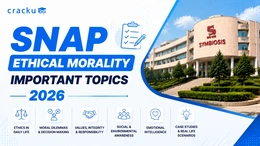
- Make a list of important Ethics, Morality, and Values topics such as Corporate Ethics, Workplace Values & Behavioural Ethics, Personal vs. Professional Morality, Ethical Dilemmas & Decision Making, etc.
- Read newspapers daily to know how to solve ethical dilemmas in daily life with real-life examples.
- Preparation should cover topics such as ethical decision-making, workplace ethics, business values, fairness, integrity, corporate responsibility, sustainability, and data privacy.
- Ethics-based questions can require you to apply a principle to a real-life situation. After reading a concept, think about how it could be used in practical life.
- Read some of the best Indian and Western philosophers' books to know how to make decisions in real life.
SNAP Exam Pattern 2026: Ethical Morality Section
The newly introduced SNAP exam pattern 2026 divides the question paper into 4 sections with a total of 60 questions and a total duration of 60 minutes, with no sectional time limit.
- General English 10 questions of 1 mark each
- Analytical & Logical Reasoning 20 questions of 1 mark each
- Quantitative, Data Interpretation & Data Sufficiency 20 questions of 1 mark each
- Ethics, Morality and Values 20 questions of 1 mark each
With the introduction of the new SNAP exam pattern, Ethics, Morality and Values has been added as a new section. There is no sectional time limit, allowing candidates to decide the order in which they attempt the four sections.
The newly introduced section will carry 10 questions and 10 marks. SNAP 2026 will be conducted as a computer-based test (CBT). The complete test will be 60 minutes, and each question will have four response options.
SNAP 206 Exam Detail | Information |
Exam Mode | Computer-Based Test (CBT) |
Total Duration | 60 minutes |
Ethics, Morality and Values Questions | 10 |
Marks per Question | 1 mark |
Marks from Ethics, Morality and Values | 10 marks |
Question Type | Objective |
Options per Question | 4 |
Negative Marking | 25% for every wrong answer |
SNAP 2026 Syllabus: Ethical Morality
SNAP does not provide any sectional syllabus; students can find the SNAP important topics to prepare from previous years' papers analysis, but in the case of Ethics, Morality and values, it is a newly introduced section in SNAP 2026, and there are no previous-year questions available for reference. However, there are a few expected areas of preparation that can be made, such as ethical principles, honesty and integrity, fairness, accountability, conflicts of interest, social responsibility, workplace ethics, and situation-based decision-making.
SNAP Ethics, Morality and Values Topic | What to Prepare |
Ethics, Morality, Values, and Law | Differences between ethics, morality, values and law |
Ethical Frameworks | Basic approaches used to judge ethical choices |
Corporate Ethics | Ethical conduct and decision-making in organisations |
Workplace Values & Behavioral Ethics | Values, conduct and ethical behaviour at work |
Market & Consumer Ethics | Ethical issues involving markets and consumers |
Sustainability and CSR | Responsible business practices, sustainability and CSR |
Principles of Natural Justice & Fairness | Fairness, justice and impartial decision-making |
Behavioral Ethics | How behaviour can influence ethical choices |
Personal vs. Professional Morality | Differences between personal beliefs and professional duties |
Truth, Lies, and Deception | Ethical questions around honesty, lying and deception |
Freedom, Rights & Responsibility | Relationship between individual freedom, rights and duties |
Society, Culture, Tolerance & Diversity | Ethical behaviour in diverse social and cultural settings |
Civic Duty | Individual responsibilities towards society |
Digital Ethics | Ethical issues related to digital environments |
Ethical Dilemmas & Decision Making | Applying ethical reasoning to difficult situations |
Read More: SNAP Ethical Morality Syllabus 2026 PDF, Important Topics
Important Topics for SNAP Ethical Morality
As the SNAP ethical morality section is newly added, finding the most important topics within the section is challenging. Students should start with the basic concepts such as ethics, morality, values, integrity, honesty, fairness, responsibility and accountability. Then they should move to more advanced topics like ethical decision-making, workplace ethics, business ethics, conflict of interest, corporate governance and stakeholder responsibility. Current areas such as CSR, sustainability, etc.
Section | No. of Questions | Important Topics |
Ethics, Morality and Values | 10 | Ethical dilemma, situational judgement, business ethics, Social situations, Stakeholder management, Whistleblowing, Corporate governance, etc. |
Preparation Tips for SNAP Ethical Morality
Below, in the table, a few tips are given to prepare effectively for the newly introduced section in SNAP 2026.
Tips | What to Do |
1. Understand Ethics, Morality and Values | Learn the basic difference between ethics, morality, and values in simple definitions. |
2. Learn Principles, Not Just Definitions | Focus on how ethical principles apply in real-life situations rather than memorising definitions. |
3. Practise Ethical Dilemmas | Solve 5–10 scenario-based ethical questions regularly. |
4. Use a Stakeholder Approach | Ask who is affected, what their interests are, and what responsibility the decision-maker has. |
5. Avoid Relying Only on Personal Opinion | Base your answer on ethical principles, fairness and responsibility rather than what you personally prefer. |
6. Choose the Most Responsible Option | Look for the option that is fair, responsible, and ethically judged. |
7. Practise Under Time Pressure | Solve Ethics, Morality and Values questions with a timer while preparing for SNAP. |
8. Solve SNAP Mock Tests | Attempt sectional mocks of ethics and morality and analyse why each option was correct or incorrect, instead of focusing only on your score. |
9. Follow Official SNAP Updates | Keep checking official SNAP announcements and preparation material for updates about the new section. |
How to Prepare for SNAP Ethical Morality 2026: Conclusion
SNAP Ethical Morality 2026 introduces a new dimension to MBA entrance preparation by testing candidates beyond traditional aptitude skills. Since this section focuses on ethics, values, and decision-making, students should avoid memorising definitions and instead learn how ethical principles apply to real-life situations. Understanding concepts like integrity, fairness, responsibility, workplace ethics, and corporate values will help candidates approach questions confidently.
A balanced preparation strategy with regular practice of ethical dilemmas, reading about current social and business issues, and analysing different perspectives can help students perform well in this 10-mark section. Since Ethics, Morality and Values is a new addition to SNAP 2026, candidates who prepare early can gain an advantage and improve their overall percentile.