91- 6303239042


 Group


 Preferred Source

 Google Discover
How to Prepare for SNAP Ethics, Morality and Values 2026?
SNAP Ethics, Morality and Values is a new fourth section added to SNAP 2026, carrying 10 questions for 10 marks, with the standard +1 for every correct answer and -0.25 for each incorrect answer. It replaces 5 questions each from General English and Analytical & Logical Reasoning, which is why questions from General English are reduced to 10 and from Analytical and Logical Reasoning questions are reduced to 20 from 25. As it is the first time this section is added, there are no official SNAP PYQs for it. SIU also does not provide any official Ethics syllabus.
- Make a list of important Ethics, Morality, and Values topics such as Corporate Ethics, Workplace Values & Behavioural Ethics, Personal vs. Professional Morality, Ethical Dilemmas & Decision Making, etc and prepare it from popular books or from information available on the internet.
- Read news with an eye for an ethical viewpoint, not just the statistics – workplace policy articles, corporate responsibility cases, and everyday fairness discussions all help to develop the judgement that this section will put to the test.
- Read the question carefully, identify the core issue, followed by listing the stakeholders affected, and then eliminate options that are one-sided or extreme, and choose the most balanced, defensible response.
- Solve Ethics question papers from other competitive exams to improve your understanding of ethical concepts, moral values and situation-based decision-making.
- Ethics-based questions can require you to apply a principle to a real-life situation. After reading a concept, think about how it could be used in practical life.
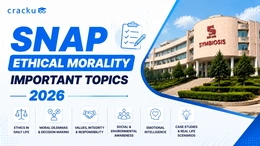
SNAP Ethics, Morality and Values Important Topics 2026
The detailed topic-wise SNAP syllabus is not officially provided; students should use the topics provided below in the table as a preparation guide rather than an exhaustive official syllabus.
SNAP Ethics, Morality and Values Topic | What to Prepare |
Ethics, Morality, Values, and Law | Differences between ethics, morality, values and law |
Ethical Frameworks | Basic approaches used to judge ethical choices |
Corporate Ethics | Ethical conduct and decision-making in organisations |
Workplace Values & Behavioral Ethics | Values, conduct and ethical behaviour at work |
Market & Consumer Ethics | Ethical issues involving markets and consumers |
Sustainability and CSR | Responsible business practices, sustainability and CSR |
Principles of Natural Justice & Fairness | Fairness, justice and impartial decision-making |
Behavioral Ethics | How behaviour can influence ethical choices |
Personal vs. Professional Morality | Differences between personal beliefs and professional duties |
Truth, Lies, and Deception | Ethical questions around honesty, lying and deception |
Freedom, Rights & Responsibility | Relationship between individual freedom, rights and duties |
Society, Culture, Tolerance & Diversity | Ethical behaviour in diverse social and cultural settings |
Civic Duty | Individual responsibilities towards society |
Digital Ethics | Ethical issues related to digital environments |
Ethical Dilemmas & Decision Making | Applying ethical reasoning to difficult situations |
SNAP 2026 Ethics, Morality and Values Preparation Strategy
Ethics, Morality and Values carries 10 marks out of 60 marks. The Ethics, Morality and Values section is a new part of the SNAP 2026 paper. Students should try to cover this section without spending excessive time. Students need to read basic ethics concepts from different sources, such as the internet; secondly, try to solve some of the practice questions based on ethics, morality and values; and at last, try to revise and complete the whole topic. Preparation can involve understanding common ethical principles and dilemmas, practising situation-based questions, and analysing why one option is more suitable than the others in a given situation.
Read More: Top 25 SNAP Ethical Morality Questions PDF, Download Now
How to Solve SNAP Ethics and Morality Questions?
To solve SNAP Ethics and Morality questions, students must have an idea about the core concepts of ethics. Students can understand the situation by reading the question. As there are no PYQs for the Ethics section available, students have to rely on SNAP mock tests to practise questions. They should consider the stakeholders, the possible consequences, and the ethical principles relevant to the situation. Here are some methods that can help you solve SNAP Ethical Morality Questions effectively:
- Understand Basic Values: Understand the meaning of values like honesty, integrity, fairness, empathy and accountability. Knowing the meaning of all important words will help you answer tricky questions more easily.
- Read the Situation Carefully: Read each question properly and find the people involved and the main situation. Understand what is at stake before choosing an answer.
- Choose the Honest and Fair Option: Select the truthful option that follows the rules and principles and treats everyone fairly. Avoid choices that involve cheating, favouritism or hiding facts.
- Avoid Extreme Options: Do not choose options that suggest revenge, sudden quitting or ignoring the main problem. Prefer calm, practical steps like discussing the issue or informing the right authority.
- Think About the Larger Impact: Consider how your decision will affect other people, the organisation and society. Choose an option that is helpful and does not unfairly harm anyone.
- Practise Different Question Types: Solve questions based on values, workplace situations, social responsibility and moral dilemmas. Practising different question types will help you feel more confident.
- Analyse Your Mistakes: Review every wrong answer and understand why you made the mistake. Check whether you misunderstood the value, missed a detail or chose an impractical option.
SNAP Ethics, Morality and Values Practice and Revision Tips
Regular practice and revision for SNAP Ethics, Morality and Values becomes the most essential part of preparation, as most of the topics from this section are of a conceptual nature, where students need to memorise the basic meaning of each concept.
Once students have completed the basic concepts of the Ethics section, they should begin solving mock tests. This will help them improve their speed, accuracy and confidence while learning to manage time effectively.
Before solving a mock test, they should revise all the important and most likely topics. After completing each mock test, they should analyse the mistakes that were made while solving the Ethics section.
Maintaining a notebook to write all the recurring mistakes can help students understand the reasoning behind correct answers. During the final revision phase, students should focus on important ethical principles, situation-based questions and concepts that they frequently confuse.
Read More: SNAP 2026 Exam Timings: Test Dates, Shifts & Reporting Time
How to Score High in SNAP Ethics, Morality and Values 2026?
Scoring high marks in the SNAP Ethics, Morality and Values section requires hard work and dedication towards the subject. Without having conceptual clarity, careful reading and consistent practice, it will be difficult for a student to score good marks. Students should not try to memorise the concept; instead, they should try to understand the core concept.
- While reading the question, try to find the core ethical principle involved.
- After solving a mock test, try to analyse the solution and learn how to reach to the conclusion.
- Avoid extreme or emotionally driven choices.
- Revise all the important concepts related to the SNAP Ethics section before the exam.
- Avoid blind guessing in the actual exam.
- Make an error notebook to write down all the conceptual gaps and topics that require more attention.
SNAP Ethics, Morality and Values 2026: Conclusion
Preparing for SNAP Ethics, Morality and Values 2026 requires a clear understanding of basic ethical principles, moral values and decision-making skills. Since this section has been introduced for the first time in SNAP 2026, students should focus on important topics such as Corporate Ethics, Workplace Values, Ethical Dilemmas and Personal vs. Professional Morality. Understanding these concepts and applying them to real-life situations can help students answer questions more accurately.
Students should practise different types of ethics-based questions, take SNAP mock tests and regularly revise important concepts. Analysing mistakes and learning to identify balanced and practical solutions can improve overall performance. With consistent practice and a proper preparation strategy, students can aim to score well in the 10-mark SNAP Ethics, Morality and Values section.