Match List I with List II.
| List I | List II |
|---|---|
| (A) Torque | (I) Nm s$$^{-1}$$ |
| (B) Stress | (II) J kg$$^{-1}$$ |
| (C) Latent Heat | (III) Nm |
| (D) Power | (IV) Nm$$^{-2}$$ |
Choose the correct answer from the options given below:
Sign in
Please select an account to continue using cracku.in
↓ →

Join Our JEE Preparation Group
Prep with like-minded aspirants; Get access to free daily tests and study material.
Match List I with List II.
| List I | List II |
|---|---|
| (A) Torque | (I) Nm s$$^{-1}$$ |
| (B) Stress | (II) J kg$$^{-1}$$ |
| (C) Latent Heat | (III) Nm |
| (D) Power | (IV) Nm$$^{-2}$$ |
Choose the correct answer from the options given below:
Login to view the detailed solution.
A juggler throws balls vertically upwards with same initial velocity in air. When the first ball reaches its highest position, he throws the next ball. Assuming the juggler throws $$n$$ balls per second, the maximum height the balls can reach is
Login to view the detailed solution.
A ball is released from a height $$h$$. If $$t_1$$ and $$t_2$$ be the time required to complete first half and second half of the distance respectively. Then, choose the correct relation between $$t_1$$ and $$t_2$$.
Login to view the detailed solution.
.webp)
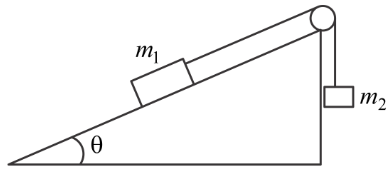
Two bodies of masses $$m_1 = 5$$ kg and $$m_2 = 3$$ kg are connected by a light string going over a smooth light pulley on a smooth inclined plane as shown in the figure. The system is at rest. The force exerted by the inclined plane on the body of mass $$m_1$$ will be: [Take $$g = 10$$ m s$$^{-2}$$]
Login to view the detailed solution.
If momentum of a body is increased by 20%, then its kinetic energy increases by:
Login to view the detailed solution.
The torque of a force $$5\hat{i} + 3\hat{j} - 7\hat{k}$$ about the origin is $$\vec{\tau}$$. If the force acts on a particle whose position vector is $$2\hat{i} + 2\hat{j} + \hat{k}$$, then the value of $$\vec{\tau}$$ will be
Login to view the detailed solution.
.webp)
An object of mass 1 kg is taken to a height from the surface of earth which is equal to three times the radius of earth. The gain in potential energy of the object will be [If, $$g = 10$$ m s$$^{-2}$$ and radius of earth = 6400 km]
Login to view the detailed solution.
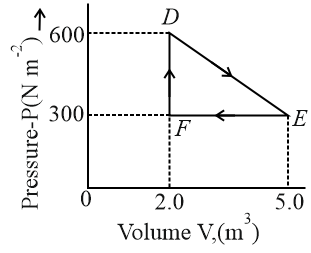
A thermodynamic system is taken from an original state D to an intermediate state E by the linear process shown in the figure. Its volume is then reduced to the original volume from E to F by an isobaric process. The total work done by the gas from D to E to F will be
Login to view the detailed solution.
The root mean square speed of smoke particles of mass $$5 \times 10^{-17}$$ kg in their Brownian motion in air at NTP is approximately. [Given $$k = 1.38 \times 10^{-23}$$ J K$$^{-1}$$]
Login to view the detailed solution.
.webp)
Two identical metallic spheres A and B when placed at certain distance in air repel each other with a force of F. Another identical uncharged sphere C is first placed in contact with A and then in contact with B and finally placed at midpoint between spheres A and B. The force experienced by sphere C will be:
Login to view the detailed solution.
Two identical thin metal plates has charge $$q_1$$ and $$q_2$$ respectively such that $$q_1 > q_2$$. The plates were brought close to each other to form a parallel plate capacitor of capacitance C. The potential difference between them is:
Login to view the detailed solution.
Given below are two statements: one is labelled as Assertion A and the other is labelled as Reason R.
Assertion A: Alloys such as constantan and manganin are used in making standard resistance coils.
Reason R: Constantan and manganin have very small value of temperature coefficient of resistance.
In the light of the above statements, choose the correct answer from the options given below.
Login to view the detailed solution.
.webp)
A 1 m long wire is broken into two unequal parts X and Y. The X part of the wire is stretched into another wire W. Length of W is twice the length of X and the resistance of W is twice that of Y. Find the ratio of length of X and Y.
Login to view the detailed solution.
The vertical component of the earth's magnetic field is $$6 \times 10^{-5}$$ T at any place where the angle of dip is 37°. The earth's resultant magnetic field at that place will be (Given tan 37° = 3/4)
Login to view the detailed solution.
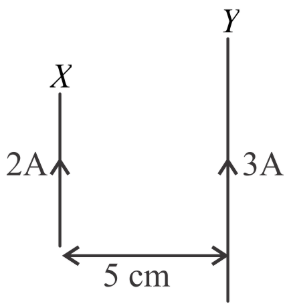
A wire X of length 50 cm carrying, a current of 2 A is placed parallel to a long wire Y of length 5 m. Wire Y carries a current of 3 A. The distance between the two wires is 5 cm and the currents flow in the same direction. The force acting on wire Y is:
Login to view the detailed solution.

A circuit element X when connected to an AC supply of peak voltage 100 V gives a peak current of 5 A which is in phase with the voltage. A second element Y when connected to the same AC supply also gives the same value of peak current which lags behind the voltage by $$\frac{\pi}{2}$$. If X and Y are connected in series to the same supply, what will be the rms value of the current in ampere?
Login to view the detailed solution.
Light enters from air into a given medium at an angle of 45° with interface of the air-medium surface. After refraction, the light ray is deviated through an angle of 15° from its original direction. The refractive index of the medium is:
Login to view the detailed solution.
An unpolarised light beam of intensity $$2I_0$$ is passed through a polaroid P and then through another polaroid Q which is oriented in such a way that its passing axis makes an angle of 30° relative to that of P. The intensity of the emergent light is
Login to view the detailed solution.
_1.webp)
An $$\alpha$$ particle and a proton are accelerated from rest through the same potential difference. The ratio of linear momenta acquired by above two particles will be:
Login to view the detailed solution.
Read the following statements:
(A) Volume of the nucleus is directly proportional to the mass number.
(B) Volume of the nucleus is independent of mass number.
(C) Density of the nucleus is directly proportional to the mass number.
(D) Density of the nucleus is directly proportional to the cube root of the mass number.
(E) Density of the nucleus is independent of the mass number.
Choose the correct option from the following options.
Login to view the detailed solution.
A tube of length 50 cm is filled completely with an incompressible liquid of mass 250 g and closed at both ends. The tube is then rotated in horizontal plane about one of its ends with a uniform angular velocity $$x\sqrt{F}$$ rad s$$^{-1}$$. If F be the force exerted by the liquid at the other end then the value of x will be _____
Login to view the detailed solution.
A metal wire of length 0.5 m and cross-sectional area $$10^{-4}$$ m$$^2$$ has breaking stress $$5 \times 10^8$$ N m$$^{-2}$$. A block of 10 kg is attached at one end of the string and is rotating in a horizontal circle. The maximum linear velocity of block will be _____ m s$$^{-1}$$
Login to view the detailed solution.
The velocity of a small ball of mass 0.3 g and density 8 g cc$$^{-1}$$ when dropped in a container filled with glycerine becomes constant after some time. If the density of glycerine is 1.3 g cc$$^{-1}$$, then the value of viscous force acting on the ball will be $$x \times 10^{-4}$$ N, the value of x is _____ [use $$g = 10$$ m s$$^{-2}$$]
Login to view the detailed solution.
Nearly 10% of the power of a 110 W light bulb is converted to visible radiation. The change in average intensities of visible radiation, at a distance of 1 m from the bulb to a distance of 5 m is $$a \times 10^{-2}$$ W m$$^{-2}$$. The value of 'a' will be
Login to view the detailed solution.
The metallic bob of simple pendulum has the relative density 5. The time period of this pendulum is 10 s. If the metallic bob is immersed in water, then the new time period becomes $$5\sqrt{x}$$ s. The value of x will be _____
Login to view the detailed solution.
The speed of a transverse wave passing through a string of length 50 cm and mass 10 g is 60 m s$$^{-1}$$. The area of cross-section of the wire is 2.0 mm$$^2$$ and its Young's modulus is $$1.2 \times 10^{11}$$ N m$$^{-2}$$. The extension of the wire over its natural length due to its tension will be $$x \times 10^{-5}$$ m. The value of x is _____
Login to view the detailed solution.
A capacitor of capacitance 500 $$\mu$$F is charged completely using a DC supply of 100 V. It is now connected to an inductor of inductance 50 mH to form an LC circuit. The maximum current in LC circuit will be _____ A.
Login to view the detailed solution.
Two radioactive materials A and B have decay constants $$25\lambda$$ and $$16\lambda$$ respectively. If initially they have the same number of nuclei, then the ratio of the number of nuclei of B to that of A will be 'e' after a time $$\frac{1}{a\lambda}$$. The value of a is _____
Login to view the detailed solution.
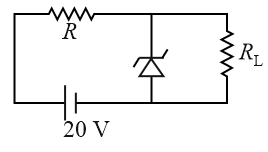
A 8V Zener diode along with a series resistance R is connected across a 20 V supply (as shown in the figure). If the maximum Zener current is 25 mA, then the minimum value of R will be _____ $$\Omega$$.
Login to view the detailed solution.
A modulating signal $$2\sin(6.28 \times 10^6 t)$$ is added to the carrier signal $$4\sin(12.56 \times 10^9 t)$$ for amplitude modulation. The combined signal is passed through a non-linear square law device. The output is then passed through a band pass filter. The bandwidth of the output signal of band pass filter will be _____ MHz.
Login to view the detailed solution.
Educational materials for JEE preparation
 Share
Share