91- 6303239042


 Group


 Preferred Source

 Google Discover
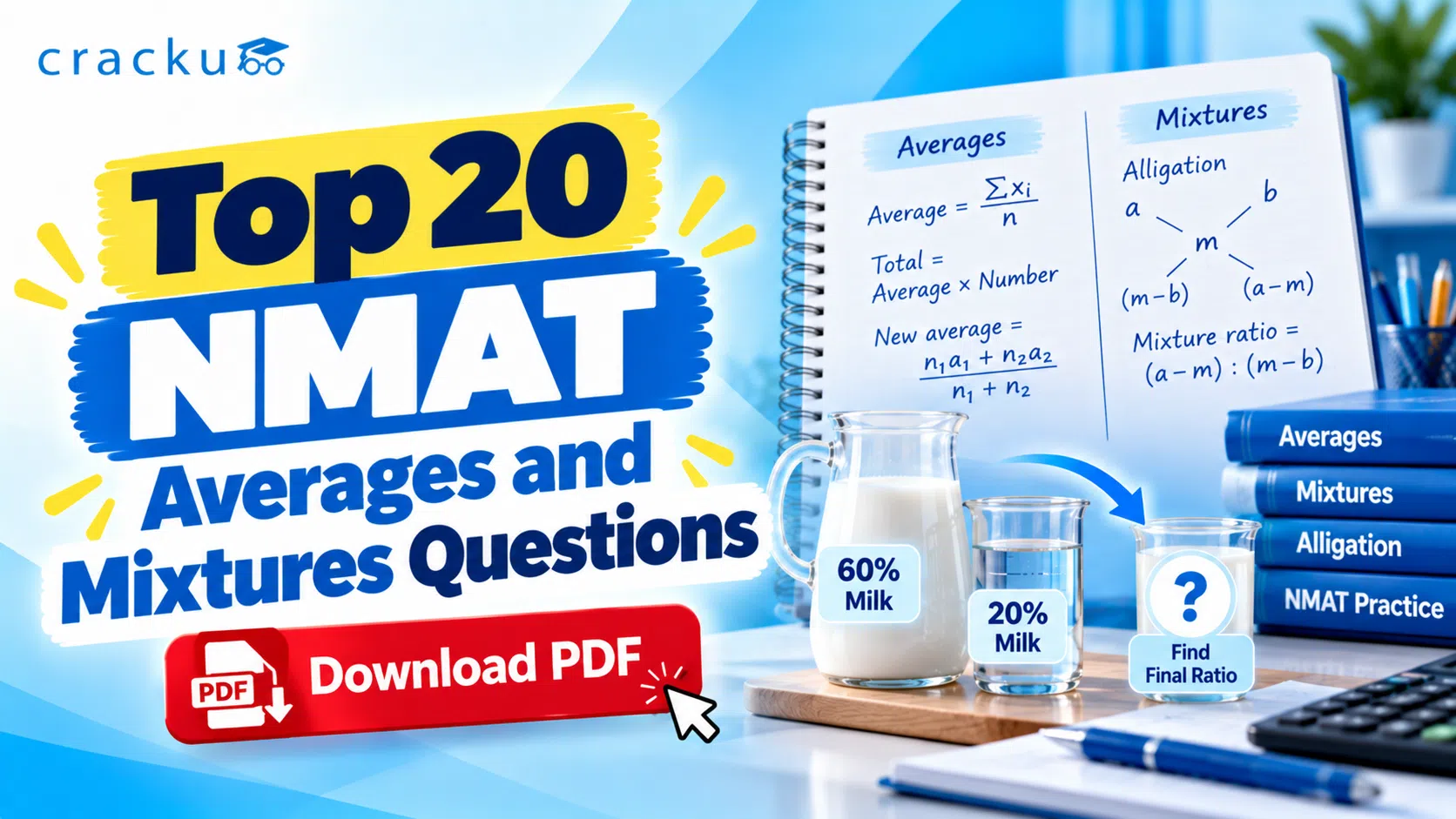
Top 20 NMAT Averages and Mixtures Questions
Averages and Mixtures is one of the most scoring arithmetic areas in the NMAT Quantitative Skills section. The section has 36 questions to be solved in 52 minutes, and Averages, Mixtures and Alligation usually account for 2 to 3 of them. Since NMAT has no negative marking, every question you solve quickly and correctly adds directly to your scaled score.
Most NMAT Averages questions are built on one idea: sum = average × number of items. Mixtures questions add one more: the weighted average, which alligation turns into a quick ratio. Standard patterns include adding or removing a member, replaced values, consecutive numbers, wrong entries corrected later, mixing two grades of a product, and repeated replacement of a liquid.
NMAT is a computer-adaptive test, so a strong start in arithmetic topics like Averages and Mixtures helps you reach higher-difficulty questions. These questions also feed into Data Interpretation, where weighted averages appear often, so the practice pays off twice.
Try to solve 10 to 15 Averages and Mixtures questions daily, mixing direct average questions, alligation questions, replacement questions and Data Sufficiency questions. This builds the pattern recognition you need to finish the Quant section on time.
Top 20 NMAT Averages and Mixtures Questions PDF
A single NMAT Averages and Mixtures Questions PDF lets you practise every important pattern in one place instead of searching through books and websites. It also makes last-minute revision quick, since the formulas and solved examples sit together.
This PDF covers simple and weighted averages, adding or replacing a member, corrected averages, consecutive numbers, age-based averages, alligation of prices and concentrations, mixing in a ratio, repeated replacement of a liquid and an NMAT-style Data Sufficiency question. Every question comes with a step-by-step solution so you can check both your answer and your method.
Solve the questions in a timed setting, aiming for about 1.5 minutes per question. After each set, go through the solutions and note where the deviation method or alligation could have saved time. Revisit the questions you got wrong after a few days to make sure the concept has stuck.
How to Solve These Top 20 NMAT Averages and Mixtures Questions
Here are some methods that can help you solve NMAT Averages and Mixtures questions quickly and accurately:
Work with totals, not averages: Averages cannot be added or subtracted directly, but totals can. Convert every average into a sum (average × count), do the arithmetic on sums, then divide at the end.
Use the deviation method: Pick a convenient base value and track how far each item is above or below it. For 42, 45, 47 and 50, take 45 as the base: deviations are −3, 0, +2, +5, which average +1, so the average is 46.
Learn the key results by heart:
- Average = Sum of observations ÷ Number of observations
- When a member joins and the average rises by d, the new member = old average + (new count × d)
- When a member is replaced and the average rises by d, the new member = old member + (count × d)
- The average of consecutive numbers (or any arithmetic progression) equals the middle term, or (first + last) ÷ 2
- Weighted average = (n1 × a1 + n2 × a2) ÷ (n1 + n2)
- Alligation: Quantity of cheaper ÷ Quantity of dearer = (Dearer price − Mean price) ÷ (Mean price − Cheaper price)
- Repeated replacement: if x litres are drawn from V litres and replaced n times, pure liquid left = V × (1 − x/V)^n
Draw the alligation cross: Write the two values on top, the mean in the middle, and the differences diagonally. The ratio of differences gives the mixing ratio instantly, with no equation to solve.
Track one component in mixtures: When two solutions with different ratios are mixed, follow only the milk (or only the water). It keeps the calculation to one line.
Check where the mean lies: A weighted average always lies between the two values being mixed, and closer to the one with more weight. Use this to eliminate options before you calculate.
For Data Sufficiency, do not solve fully: You only need to know whether a unique answer exists. Stop as soon as you can tell a statement is or is not enough.
Question 1
A vessel contains 100 litres mixture of milk and water in the respective ratio of 22 : 3. 40 litres of the mixture is taken out from the vessel and 4.8 litres of pure milk and pure water each is added to the mixture. By what percent is the quantity of water in the final mixture less than the quantity of milk?
correct answer:- 2
Question 2
Jar A has 60 litres of mixture of milk and water in the respective ratio of 2 : 1. Jar B which had 40 litres of mixture of milk and water was emptied into jar A, as a result in jar A, the respective ratio of milk and water became 13 : 7. What was the quantity of water in jar B?
correct answer:- 2
Question 3
Sharad bought 36 kg of sugar at the rate of Rs. 45 per kg and 24 kg more at the rate of Rs. 40 per kg. He mixed these two varieties and sold the mixture at 20% profit. At what rate per kg did he sell the mixture of sugar ?
correct answer:- 1
Question 4
A vessel contains 60 litres of milk. 6 litres of milk is taken out and 6 litres of water is added to the vessel. Again 6 litres of mixture from the vessel is withdrawn and 6 litres of water is added to the vessel. The ratio of milk and water in the resulting mixture in the vessel is
correct answer:- 1
Question 5
The milk and water in two vessels A and B are in the ratio 4 : 3 and 2 : 3 respectively. In what ratio the liquids in both the vessels be mixed to obtain a new mixture in vessel C consisting half milk and half water?
correct answer:- 2

Question 6
Jar A contains 'X' litre of pure milk only. A 27 litre mixture of milk and water in the respective ratio of 4 : 5, is added to jar A. The new mixture thus formed in jar A contains 70% milk, what is the value of X ?
correct answer:- 1
Question 7
18 litres of pure water was added to a vessel containing 80 litres of pure milk. 49 litres of the resultant mixture was then sold and some more quantity of pure milk and pure water was added to the vessel in the respective ratio of 2 : 1. If the resultant respective ratio of milk and water in the vessel was 4 : 1, what was the quantity of pure milk added in the vessel ? (in litres)
correct answer:- 1
Question 8
Average weight of three boys P, T and R is 54 1/3 kgs while the average weight of three boys, T, F and G is 53 kgs. What is the average weight of P, T, R, F and H?
correct answer:- 4
Question 9
The average of five positive numbers is 213. The average of the first two numbers is 233.5 and the average of last two numbers is 271. What is the third number?
correct answer:- 2
Question 10
The sum of 68 numbers is 3474. The average of first 22 numbers is 61 and that of last 19 numbers is 44. What will be the average of remaining numbers ?
correct answer:- 2

Question 11
There are 40 students in a class. Number of girls is 16 more than number of boys. If the average weight of the girls in the class is 45 kg and the average weight of the overall class (boys + girls) is 47.7 kg, what is the average weight of boys ? (in kg)
correct answer:- 2
Question 12
What will be the average of the following set of scores ?
69, 89, 34, 76, 54, 68, 28, 46
correct answer:- 5
Question 13
The average weight of 21 girls was recorded as 58 kgs. If the teacher’s weight was added, the average increased by one. What was the teacher’s weight ?
correct answer:- 3
Question 14
The average of four consecutive even number is 27. What is the highest number ?
correct answer:- 3
Question 15
In a class 45 students boys and girls are in the ratio of 5 : 4 respectively. Average marks obtained by boys in Mathematics out of 100 were 76 and that of girls were 78. What are average marks of boys and girls together in Mathematics (rounded-off to two decimal points) ?
correct answer:- 1

Question 16
In an enterance examination, Ritu scored 56 percent marks, Smita scored 92 percent marks and Rina scored 634 marks. The maximum marks of the examination is 875. What is the average marks scored by all the three girls together?
correct answer:- 4
Question 17
The average marks in English of a class of 24 students is 56. If the marks of three students were misread as 44, 45 and 61 in lieu of the actual marks 48, 59 and 67 respectively, then what would be the correct average?
correct answer:- 5
Question 18
The average weight of boys in a class is 45 kg while that of girls is 36 kg. The average weight of the whole class is 42.25 kg. What is the respective ratio between the number of boys and girls in the class ?
correct answer:- 2
Question 19
In a class 45 students boys and girls are in the ratio of 5 : 4 respectively. Average marks obtained by boys in Mathematics out of 100 were 76 and that of girls were 78. What are average marks of boys and girls together in Mathematics (rounded-off to two decimal points) ?
correct answer:- 1