91- 6303239042


 Group


 Preferred Source

 Google Discover
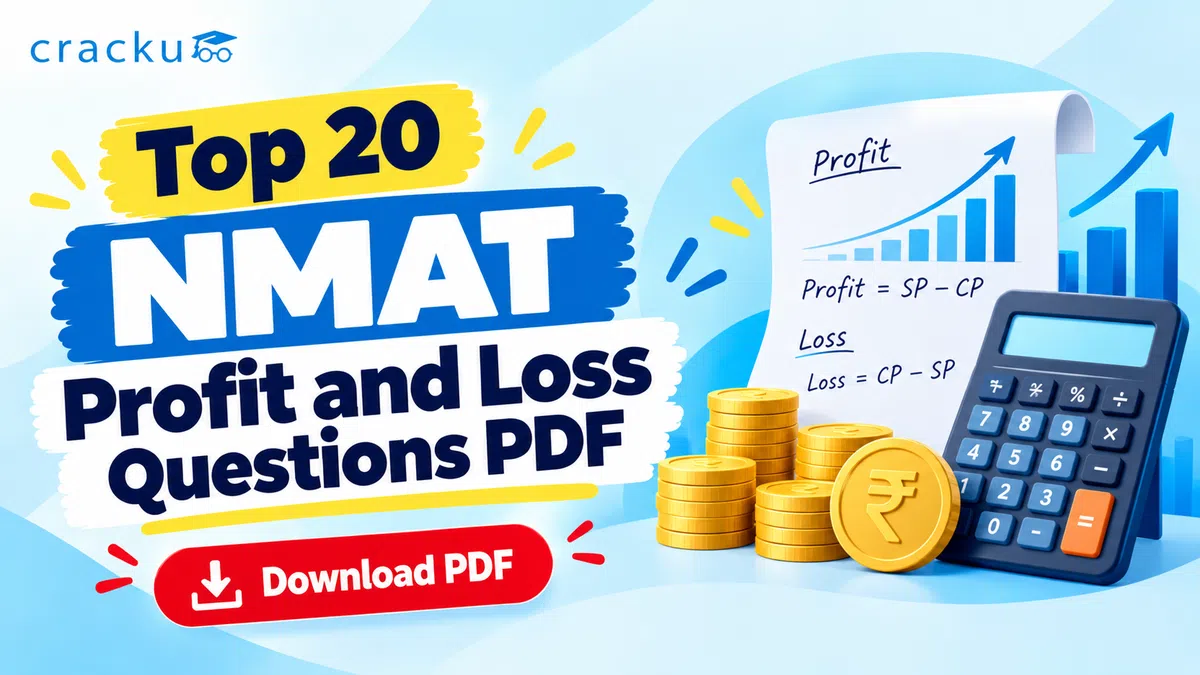
Top 20 NMAT Profit and Loss Questions
Profit and Loss is one of the most scoring topics in the NMAT Quantitative Skills section. The section has 36 questions to be solved in 52 minutes, and Profit, Loss and Discount usually accounts for 2 to 3 of them. Since NMAT has no negative marking, every P&L; question you solve quickly and correctly is a direct boost to your scaled score.
Most NMAT Profit and Loss questions are built on a small set of ideas: cost price and selling price, mark-up and discount, successive percentage changes, dishonest dealers and false weights, and combined transactions. Once these are clear, the questions become a matter of setting up the right equation and calculating fast.
NMAT is a computer-adaptive test, so a strong start in arithmetic topics like P&L; helps you reach higher-difficulty questions. Speed matters as much as accuracy, which is why practising a variety of question types is more useful than solving many questions of one pattern.
Try to solve 10 to 15 Profit and Loss questions daily, mixing direct formula questions, multi-step word problems and Data Sufficiency questions. This builds the pattern recognition you need to finish the Quant section on time.
Top 20 NMAT Profit and Loss Questions PDF
A well-organised NMAT Profit and Loss Questions PDF lets you practise all the important question types in one place instead of searching across books and websites. It also makes revision easy in the final weeks before the exam.
This PDF covers basic cost price and selling price questions, mark-up and discount, successive discounts, false weights, buy-X-get-Y-free offers, combined transactions and a Data Sufficiency question in the NMAT style. Every question comes with a step-by-step solution so you can check both your answer and your method.
Solve the questions in a timed setting, aiming for about 1.5 minutes per question. After each set, go through the solutions and note where a shortcut could have saved time. Revisit the questions you got wrong after a few days to make sure the concept has stuck.
How to Solve These Top 20 NMAT Profit and Loss Questions
Here are some methods that can help you solve NMAT Profit and Loss questions quickly and accurately:
Always fix the base first: Profit and loss percentages are calculated on cost price, while discount is calculated on marked price. Most mistakes happen when students mix up the base. Before calculating, ask yourself: "percentage of what?"
Use multiplying factors: Instead of calculating profit and SP separately, convert percentages into factors. A 20% profit means SP = 1.2 × CP, and a 15% discount means SP = 0.85 × MP. Multiplying factors makes multi-step questions much faster.
Learn the key results by heart:
- Profit % = (Profit ÷ CP) × 100 and Loss % = (Loss ÷ CP) × 100
- If an article is marked up by m% and sold at d% discount, SP = CP × (1 + m/100) × (1 − d/100)
- Two successive discounts of a% and b% equal a single discount of (a + b − ab/100)%
- If two articles are sold at the same SP, one at x% profit and the other at x% loss, there is always a loss of (x²/100)%
- For a dishonest dealer using a false weight, Profit % = (Error ÷ True value given) × 100
Assume convenient values: When no actual price is given, take CP = 100 (or a value that avoids fractions). This turns percentage questions into simple arithmetic.
Treat "free" offers as discounts: "Buy 4, get 1 free" means the customer pays for 4 but receives 5, which is an effective discount of 1/5 = 20%.
Check options smartly: NMAT gives five options. If your calculation is heavy, plug in options or eliminate those that are clearly too high or low.
For Data Sufficiency, do not solve fully: You only need to know whether a unique answer can be found. Stop as soon as you know the statement is or is not enough.
Question 1
Sanket purchased 20 dozen notebooks at Rs 48 per dozen. He sold 8 dozen at 10% profit and the remaining 12 dozen with 20% profit. What is his profit percentage in the transaction?
correct answer:- 2
Question 2
A man bought some oranges at Rs.10 per dozen and bought the same number of oranges at Rs.8 per dozen. He sold these oranges at Rs.11 per dozen and gained Rs.120. The total number of oranges bought by him was?
correct answer:- 4
Question 3
21 articles were bought for ₹ 6531 and sold for ₹ 9954. How much was the approximate profit percentage per article ?
correct answer:- 2
Question 4
A certain number of capsules were purchased for ₹216.15 more capsules could have been purchased in the same amount if each capsule was cheaper by ₹10. What was the number of capsules purchased?
correct answer:- 2
Question 5
The owner of an electronics shop charges his customers 22% more than the cost price .If the customer paid Rs 10,980 for DVD player then the what was the cost price of that DVD?
correct answer:- 5

Question 6
An item was bought at Rs. X and sold at Rs. Y, there by earning a profit of 20%. Had the value of X been 15% less and the value of Y been Rs. 76 less, a profit of 30% would have been earned. What was the value of ‘X’
correct answer:- 4
Question 7
A sum of money was invested for 14 years was in Scheme A which offers simple interest at a rate of 8% p.a. The amount received from Scheme A after 14 years was then invested for two years in Scheme B which offers compound interest (compounded annually) at a rate of 10% p.a. If the interest received from Scheme B was Rs. 6,678, what was the sum invested in Scheme A?
correct answer:- 5
Question 8
A, B and C started a business by investing Rs. 20,000 Rs. 28,000 and Rs. 36,000 respectively. After 6 months, A and B withdrew an amount of Rs. 8,000 each and C invested an additional amount of Rs. 8,000. All of them invested for equal period of time. If at the end of the year. C got Rs. 12,550 as his share of profit, what was the total profit earned ?
correct answer:- 1
Question 9
A starts a business with Rs. 2500. After one month from the start of the business, B joined with Rs. 4500 and A withdrew completely after eleven months from the start of the business. If the difference between A’s and B’s respective shares in the annual profit was Rs. 4800, what was the annual profit earned?
correct answer:- 2
Question 10
Find the compound interest on a sum of Rs. 125000 for- 9 months at the rate of 8 per cent per annum compounded quarterly.
correct answer:- 1

Question 11
Ankur invested a sum of Rs. 16800 for four years in a scheme A. The rate of interest in scheme A is 8% per annum compounded yearly for the first two years and 10% for the third and fourth years compounded yearly. What will be the compound interest at the end of 4 years ?
correct answer:- 2
Question 12
A shopkeeper sold 8 chairs at a profit of 20% and 6 chairs at a profit of 10%. Had he sold all the 14 chairs at a profit of 12%, his profit would have been reduced by 442. What is the cost price of each chair? (cost of each chair is same)
correct answer:- 4
Question 13
Fredrick after spending 20% of his monthly salary in buying electronic goods and 10% of the monthly salary in repair work of furniture, invested 30% of the remaining amount in fixed deposits. If he was left with Rs. 18,963, how much is his monthly salary ?
correct answer:- 1
Question 14
A profit of 25% is earned on goods when a discount of 20% is allowed on the marked price. What profit percentage will be earned when a discount of 10% is allowed on the marked price?
correct answer:- 3
Question 15
A shopkeeper sold first unit of an article to Aria at 20% discount and the second unit of the same article at 40% discount. If the shopkeeper earned an overall profit of 5%, the marked price of the article was what percent of the cost price of the article ?
correct answer:- 2

Question 16
There are two motor cycles' (A and B) of equal cost price. Motorcycle A was sold at a profit of 14% and motorcycle B was sold for Rs.4,290/ more than its cost price. The net profit earned after selling both the motor cycles (A and B) is 20%. What is the cost price of each motorcycle ?
correct answer:- 1
Question 17
The cost price of item B is Rs. 150/- more than the cost price of item A. Item A was sold at a profit of 10% and item B was sold at a loss of 20%. If the respective ratio of selling prices of items A and B is 11 : 12, what is the cost price of item B?
correct answer:- 1
Question 18
Mohan purchased an article and sold it for Rs 2817.50 and earned 15 per cent profit on the cost price. What was the cost price of the article ?
correct answer:- 2
Question 19
Sunetra invested an amount of Rs. 50,000 to start a software business. After six months Nikhil joined her with an amount of Rs. 80,000. At the end of 3 years they earned a profit of Rs. 24,500/-. What is Sunetra’s share in the profit ?
correct answer:- 5