91- 6303239042


 Group
Group
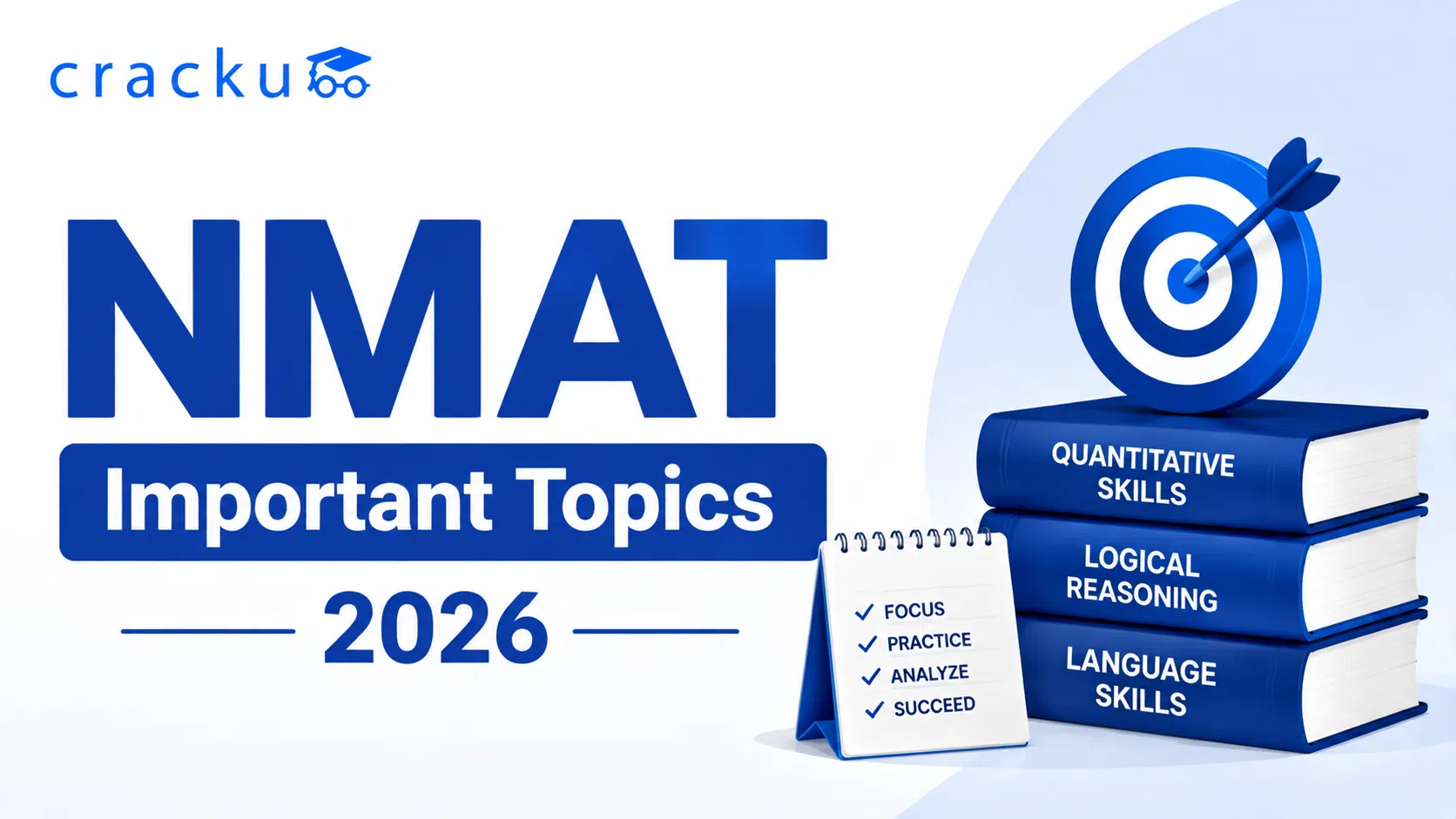
NMAT Important Topics 2026
Identifying the NMAT Important Topics 2026 reveals that the actual test treats syllabus areas differently. Specific topics repeat heavily across the 108 questions, whereas others surface only occasionally. Knowing exactly which concepts dominate each section shapes a highly focused study plan. This specific knowledge gives you confidence and helps you score higher in the exam.
NMAT Topic-wise Weightage
NMAT's 108 questions split evenly across three sections. Each one carries almost identical weight. The NMAT topic-wise weightage divides equally among Quantitative Skills, Logical Reasoning, and Language Skills. Every individual section contains exactly 36 questions. This balanced structure means each third of the paper decides your overall exam result.
Quantitative Skills receives the longest clock at 52 minutes. Logical Reasoning follows directly with 40 minutes. Language Skills gets just 28 minutes. These specific blocks add up to a strict 120-minute total duration for the test. Why the difference? Calculations take significantly longer than reading text.
Each section is scored on an independent scale ranging from 12 to 120. These combine into a final score falling between 36 and 360. Points are awarded for correct answers only. Language Skills packs its questions into the tightest stretch. This requires extreme reading and recall speed alongside basic topic knowledge.
A total score of 360 represents perfect accuracy across all sections. Negative marking does not exist. Guessing on remaining questions makes mathematical sense. Zero penalty. The scaled scoring system automatically adjusts for slight difficulty variations across different testing days.
Section | Questions | Time Allotted | Weightage | Score Range |
Quantitative Skills | 36 | 52 minutes | ~33% | 12–120 |
Logical Reasoning | 36 | 40 minutes | ~33% | 12–120 |
Language Skills | 36 | 28 minutes | ~33% | 12–120 |
Total | 108 | 120 minutes | 100% | 36–360 |
NMAT Important Topics: Quantitative Skills
Quantitative Skills tests speed on calculation-heavy questions drawn from arithmetic, algebra, geometry and data-based problem solving. Every calculation happens by hand. These NMAT important topics: quantitative skills fall into two primary groups. The NMAT Quantitative Skills Syllabus divides strictly into data-based questions and core mathematics. Data topics build around Data Interpretation and Data Sufficiency. Core math covers Arithmetic, Algebra, Modern Math and Number System.
Candidates face exactly 36 questions within a strict 52-minute window. Calculations are executed manually. Speed during the working phases matters just as much as knowing the underlying formula. Most students focus only on concepts. That is why they struggle with the clock. Which specific topics consume the most time? Data Interpretation and Data Sufficiency questions frequently take longer to read than to actually solve.
Practising how to scan a data table saves far more time than redoing basic arithmetic faster. Visual efficiency is necessary for finishing the section. Skip complex charts quickly. Efficient chart scanning directly protects the extremely limited test minutes.
The complete absence of a digital calculator changes the test strategy entirely. Manual arithmetic demands strong mental math skills. You need them for handling percentages and complex fractions. Fast numerical approximation often reveals the correct answer option before the exact calculation finishes. This mathematical efficiency secures significantly higher marks.
Topic Area | Important Topics |
Data-based | Data Interpretation (DI); Data Sufficiency (DS) |
Core Mathematics | Arithmetic; Algebra; Modern Math (Permutations & Combinations, Probability); Number System |
Read More: NMAT Quantitative Skills Syllabus 2026, Important Topics
NMAT Important Topics: Logical Reasoning
Logical Reasoning tests pattern recognition through analytical puzzles and short verbal-reasoning passages. These reward speed. The NMAT important topics: logical reasoning section requires breaking the syllabus into two specific halves. The topics split entirely into analytical reasoning and verbal reasoning categories.
Analytical reasoning includes Input-Output, Syllogisms, Coding-Decoding, Series & Patterns, Arrangements, and Blood Relations. Verbal reasoning covers Critical Reasoning, Decision Making, Course of Action, Inference-Based Questions, and Assumption & Argument. The strict time constraint here is that candidates must solve exactly 36 questions in 40 minutes.
This section leaves slightly more breathing room per question than the language section. The average is just over a single minute each. Arrangement and complex puzzle sets reward whoever visualizes the setup fastest. Timed practice matters equally to knowing the core logical concepts.
Analytical reasoning demands extensive scratchpad work to map out spatial relationships accurately. Verbal reasoning relies heavily on fast reading. You must evaluate logic quickly. Both types require distinct cognitive approaches during the test.
Topic Area | Important Topics |
Analytical Reasoning | Input-Output; Syllogisms; Coding-Decoding; Series & Patterns; Arrangements (Linear/Circular); Blood Relations |
Verbal Reasoning | Critical Reasoning; Decision Making; Course of Action; Inference-Based Questions; Assumption & Argument |
NMAT Important Topics: Language Skills
Language Skills tests vocabulary, grammar and reading comprehension together. It runs on the tightest clock. The NMAT important topics: language skills span across three distinct linguistic categories. These topics cover vocabulary, grammatical rules, and reading comprehension alongside complex sentence structure.
Vocabulary tests include Fill in the Blanks, Synonyms & Antonyms, Idioms & Phrases, and One-Word Substitution. Grammar evaluates Parts of Speech, Sentence Correction, and Tenses. Comprehension areas involve Reading Comprehension, Para Jumbles, and Sentence Rearrangement. Test takers face 36 questions packed into just 28 minutes here. That is fast.
This strict limit allows under a minute per individual question. It offers the absolute least breathing room anywhere in the entire exam. Speed is everything. Key Insight for Students: of everything in the NMAT Language Skills Syllabus, Reading Comprehension and vocabulary questions cost the most time relative to their difficulty. A regular reading habit pays off more than last-minute grammar memorising.
Grammar topics like Parts of Speech and Sentence Correction demand precise technical knowledge. Vocabulary questions check direct word recognition. They rarely rely on broader contextual clues. These two specific areas offer the fastest potential solving times. Quick answers here bank precious seconds for the significantly longer comprehension passages.
Topic Area | Important Topics |
Vocabulary | Fill in the Blanks; Synonyms & Antonyms; Idioms & Phrases; One-Word Substitution |
Grammar | Parts of Speech; Sentence Correction; Tenses |
Comprehension & Sentence Structure | Reading Comprehension; Para Jumbles; Sentence Rearrangement |
Read More: NMAT Language Skills Syllabus 2026, Important Topicss
NMAT Exam 2026
The NMAT exam 2026 runs as a computer-adaptive test. Question difficulty adjusts through the exam based on how earlier questions were answered. Every single candidate faces a tailored testing experience. Accurate early answers matter. They lead directly to harder questions and higher potential scaled scores.
The choice of testing mode provides flexibility for registered applicants. The online-proctored-at-home option allows testing from your own desk. The physical test-centre mode offers a standardized setup. It stays free from home distractions. Both testing modes utilize the exact same adaptive scoring algorithm during the exam.
Exam Format & Mode:
- Candidates choose a test-centre or online-proctored-at-home mode when initially registering.
- You pick your specific section order right before the exam begins.
- The test delivers exactly 108 total questions across three sections.
Important Dates:
- The official exam window runs from November 2 to December 20, 2026.
- Registration remains open from August 20 to October 10.
- Slot-booking stays open continuously through October 22.
- A dedicated retake window operates from November 3 to December 17.
Retakes & Scoring:
- Up to three total attempts are allowed within a single testing cycle.
- A minimum 15-day gap is required between two valid attempts.
- Every question is worth attempting.
- The final score rests on correct answers alone.
- Each attempt's scaled score stays valid for exactly one year from that specific exam date.
NMAT Important Topics 2026: Conclusion
Understanding the NMAT Important Topics 2026 can help candidates build a focused preparation strategy instead of spending equal time on every part of the syllabus. Quantitative Skills requires strong preparation in Arithmetic, Algebra, Data Interpretation and Data Sufficiency, while Logical Reasoning demands regular practice of Critical Reasoning, Arrangements, Coding-Decoding and other analytical topics. For Language Skills, candidates should consistently work on Reading Comprehension, Vocabulary, Grammar and Sentence Rearrangement.
Along with covering the NMAT topic-wise weightage, candidates should practise questions under the actual sectional time limits. Since all three sections contribute equally to the overall paper, ignoring any one section can affect the final NMAT score. Regular revision, timed practice and NMAT mock tests can improve both accuracy and speed and help candidates approach the NMAT exam 2026 with greater confidence.