91- 6303239042


 Group


 Preferred Source

 Google Discover
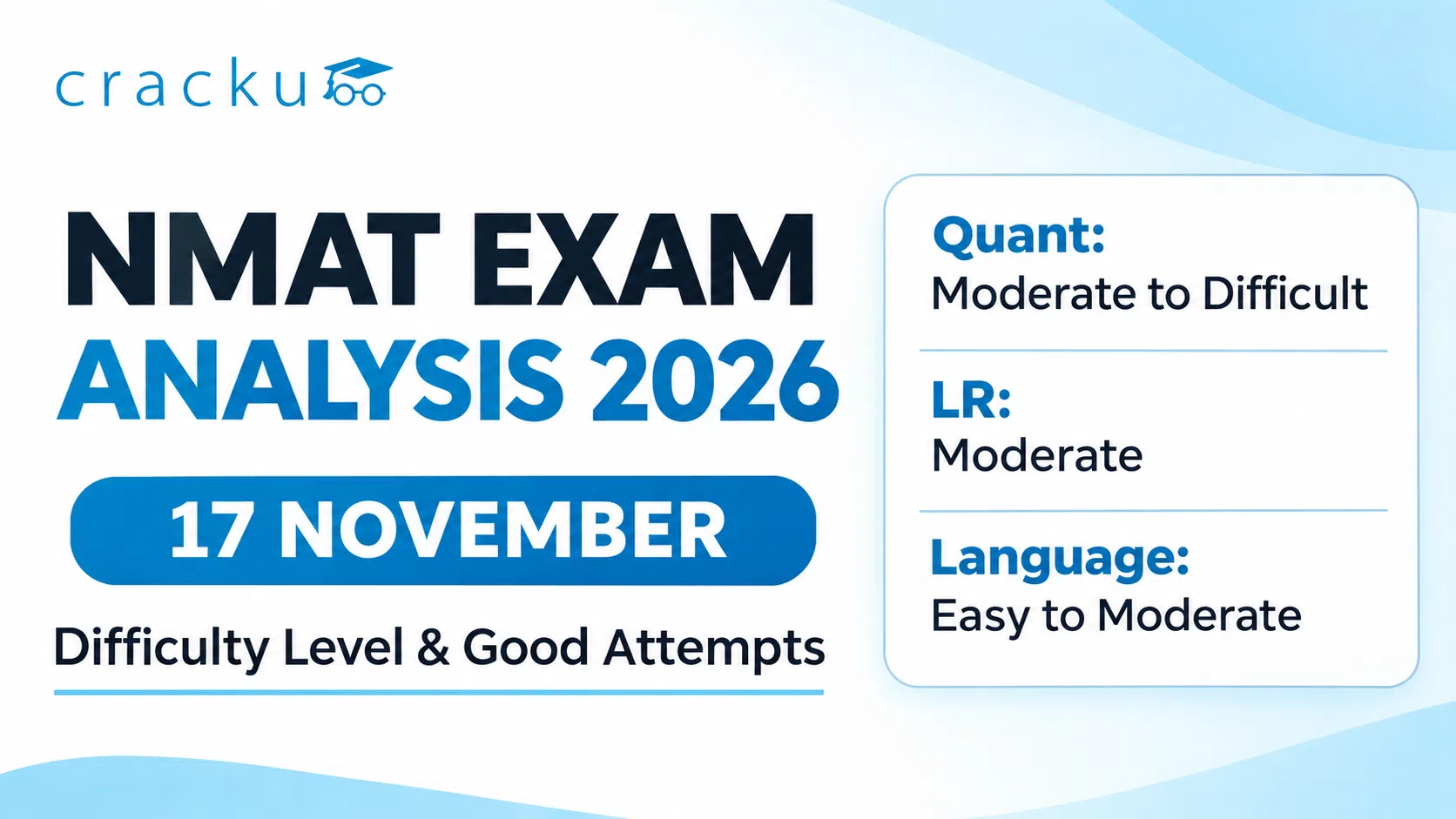
NMAT Exam Analysis 2026 (17th November)
The NMAT 2026 exam on November 17 was moderate in overall difficulty, with a mix of direct questions and calculation-heavy problems. Gaurav Joshi scored 281 out of 360, with 106 in Quantitative Skills, 94 in Logical Reasoning, and 81 in Language Skills. He mentioned that Quantitative Skills required the most calculation effort, while Language Skills was relatively easier.
The paper had 108 questions across three sections, with 120 minutes to complete the exam. This NMAT exam analysis covers the section-wise difficulty, topic distribution, memory-based questions, good attempts, and expected scores.
NMAT Difficulty Level 2026: Section-Wise Analysis
The NMAT 17 November paper was moderate, with no unexpected topics reported. Quantitative Skills was moderate to difficult because of lengthy calculations. Logical Reasoning had a balanced mix of easy, moderate, and difficult questions. Language Skills was the easiest section, although its shorter time limit made speed important.
Section | Questions | Time Limit | Difficulty Level | Key Observation |
Quantitative Skills | 36 | 52 minutes | Moderate to Difficult | Arithmetic and DI required lengthy calculations. |
Logical Reasoning | 36 | 40 minutes | Moderate | Critical Reasoning and analytical questions formed the major part. |
Language Skills | 36 | 28 minutes | Easy to Moderate | Short RC passages and direct grammar questions made it relatively easier. |
Overall | 108 | 120 minutes | Moderate | Speed, accuracy and section-wise time management were important. |
NMAT 2026 Overall Exam Pattern
Exam Parameter | Details |
Exam date | 17 November 2026 |
Total questions | 108 |
Total marks | 360 |
Total duration | 120 minutes |
Quantitative Skills | 36 questions, 52 minutes |
Logical Reasoning | 36 questions, 40 minutes |
Language Skills | 36 questions, 28 minutes |
Exam format | Computer-based adaptive test |
Candidates had to select their section order before starting the examination. They could not return to previous questions or change submitted answers.
NMAT 2026 Topic-Wise Analysis: Quant, LR and Language Skills
The 17 November attempt covered familiar topics from the NMAT syllabus. Arithmetic, Data Interpretation, and Data Sufficiency were important in Quantitative Skills. Critical Reasoning contributed a large share of Logical Reasoning questions, while Reading Comprehension and vocabulary featured prominently in Language Skills.
NMAT Quantitative Skills Topic-Wise Analysis
Quantitative Skills had 36 questions and a time limit of 52 minutes. Around 12 questions came from Arithmetic, while DI and Data Sufficiency together contributed approximately 15 questions.
Topic | Questions | Difficulty Level |
Arithmetic | 12 | Moderate |
Algebra | 4 | Easy to Moderate |
Data Interpretation | 8 | Moderate |
Data Sufficiency | 7 | Easy to Moderate |
Number Systems | 2 | Easy to Moderate |
Modern Mathematics | 3 | Easy to Moderate |
Total | 36 | Moderate to Difficult |
- Arithmetic included percentages, ratio and proportion, profit and loss, and simple and compound interest.
- DI had two sets: one table-based and one chart-based, with four questions each.
- Data Sufficiency had around seven questions, mainly based on number-related concepts.
- Algebra included logarithms and inequalities.
- Number Systems included unit-digit and HCF-LCM questions.
- Modern Mathematics had three probability questions.
The table-based DI set involved lengthy calculations. However, candidates could save time in chart-based questions through careful observation and option elimination.
Read More: NMAT 2026 Score Improvement Strategy: Tips to Score High
NMAT Logical Reasoning Topic-Wise Analysis
Logical Reasoning had 36 questions to be completed in 40 minutes. Around 50% of the questions were easy, 30% moderate, and 20% difficult. Critical Reasoning was the more challenging part of this section.
Topic | Questions | Difficulty Level |
Critical Reasoning | Around 12–16 | Moderate to Difficult |
Arrangements | 1 set (7 people) | Easy to Moderate |
Ranks and Queues | Around 4 | Easy to Moderate |
Input-Output | 1 set (around 4 questions) | Easy |
Series | Around 4 | Easy to Moderate |
Syllogisms | Around 4 | Easy to Moderate |
Figure-based and Missing Number Questions | Reported in the remaining analytical questions | Moderate |
Critical Reasoning included assumptions, conclusions, arguments, and strengthen/weaken questions. The arrangement set involved assigning ages to seven people and was relatively easy. Input-Output was also manageable when candidates followed the steps carefully.
NMAT Language Skills Topic-Wise Analysis
Language Skills was the easiest section in this attempt. However, candidates had only 28 minutes to solve 36 questions, making reading speed and quick option selection important.
Topic | Questions | Difficulty Level |
Reading Comprehension | 12 | Easy to Moderate |
Vocabulary | 8 | Moderate |
Grammar and Sentence Correction | 8 | Easy to Moderate |
Para Jumbles and Fill in the Blanks | 8 | Easy to Moderate |
Total | 36 | Easy to Moderate |
The NMAT question paper had three short RC passages, with four questions each. Most questions focused on the main idea and inference, along with a few direct questions. Vocabulary included synonyms, antonyms, and analogies. Grammar questions covered error spotting and sentence correction.
Read More: How to Prepare for NMAT 2026 Retake: 15-Day Study Plan
NMAT Memory-Based Questions 2026 with Solutions
The NMAT 17 November attempt included questions from familiar topics across all three sections. The following table lists the question types recalled by the candidate. These are memory-based descriptions, not verified verbatim questions from the examination.
Section | Memory-Based Question Type | Topic | Approach |
Quantitative Skills | Finding the unit digit of a large number | Number Systems | Calculate only the unit digits to eliminate options. |
Finding HCF and LCM | Apply prime factorisation or standard HCF-LCM methods. | ||
Simple and compound interest calculations | Arithmetic | Identify the interest formula and substitute the given values. | |
Table-based data interpretation | DI | Read the values carefully and calculate the required comparisons. | |
Chart-based data interpretation | Compare trends and values before attempting lengthy calculations. | ||
Probability-based questions | Modern Mathematics | Identify favourable outcomes and divide by total possible outcomes. | |
Logical Reasoning | Assigning ages to seven people | Arrangements | Use the given conditions to create an order or arrangement. |
Finding the implicit assumption | Critical Reasoning | Identify the unstated condition required for the argument to hold. | |
Strengthening or weakening an argument | Check which option supports or challenges the central argument. | ||
Finding the output after given steps | Input-Output | Follow the sequence of operations carefully. | |
Language Skills | Main idea and inference from short passages | Reading Comprehension | Identify the central point and use passage evidence. |
Synonyms, antonyms and analogies | Vocabulary | Use context and word relationships to eliminate options. |
Read More: NMAT 2026 Colleges Accepting 200-220 Scores, Check Now
NMAT Exam Analysis 2026: Good Attempts and Expected Scores
Gaurav shared an estimated good-attempt range based on his 17 November examination experience. These figures are useful as a reference for upcoming slots, but they are not official NMAT score predictions.
Section | Good Attempts | Expected Accuracy | Speaker's Estimated Score Band |
Quantitative Skills | 28 | 85–90% | 70–80+ |
Logical Reasoning | 26–29 | 80–85% | 78–84+ |
Language Skills | 28–30 | Around 80% | 82–86+ |
Targeting 235+ marks as a good overall score for candidates aiming for NMIMS Mumbai. However, actual admission depends on the institute's official cutoff, sectional requirements, and selection criteria. Candidates should not treat this target as a confirmed cutoff.
NMAT Difficulty Level Trends: 17th November 2026
The 17 November NMAT paper was reported to be at a similar difficulty level to the candidate's previous NMAT slot experiences. Students who had taken a second or third attempt also reported a broadly similar moderate level. The speaker also felt that Cracku mocks were on par with the actual examination, with calculation speed playing an important role.
Area | Observed Trend | What Upcoming Candidates Should Do |
Overall difficulty | Moderate | Prepare for a mix of direct and time-consuming questions. |
Quantitative Skills | Calculation-intensive | Practise Arithmetic, DI and Data Sufficiency regularly. |
Logical Reasoning | Critical Reasoning was challenging | Focus on assumptions, conclusions and argument-based questions. |
Language Skills | Relatively easier | Improve vocabulary and practise short RC passages. |
Adaptive pattern | Difficulty can change based on responses | Maintain accuracy, especially during the initial questions. |
Time management | Different time limits across sections | Practise each section under its actual time limit. |
NMAT Exam Analysis 2026 (17th November): Conclusion
The biggest takeaway from the 17 November NMAT exam attempt is the need to balance speed with accuracy. Candidates should focus on their first 9–10 questions, avoid spending too long on lengthy calculations, and attempt all questions before the section timer ends.