91- 6303239042


 Group
Group


 Preferred Source

 Google Discover
NMAT Syllabus 2026 is necessary for students who want to score well in the exam. It has three sections: Language Skills, Quantitative Skills, and Logical Reasoning. Understanding the latest exam patterns, key topics, and important topics will help you improve your accuracy, manage your time more effectively, and develop a successful preparation plan.
NMAT Syllabus 2026
The Graduate Management Admission Council (GMAC) will set the NMAT question paper in line with the NMAT 2026 syllabus. The NMAT syllabus includes questions from three sections: Language skills, Quantitative skills, and Logical reasoning.
NMAT Syllabus 2026 Download PDF
The NMAT Syllabus 2026 PDF contains full details about each subject, allowing students to arrange their materials and resources in advance. While there is no official syllabus for the NMAT exam, previous years' papers and exam patterns show that the NMAT Syllabus 2026 will be divided into three sections: Language Skills, Logical Reasoning, and Quantitative Skills. NMAT 2026 exam is expected to be held from early November to mid-December 2026.
NMAT Section-Wise Syllabus 2026
NMAT section-wise Syllabus 2026 is categorised into three sections: Language Skills, Logical Reasoning, and Quantitative Skills.
Quantitative Skills: This part evaluates quantitative aptitude in Arithmetic, Algebra, Geometry, Modern Math, and Data Interpretation. Percentages, Ratios, Equations, Inequalities, and graph-based question-solving are among the key topics covered.
Logical Reasoning: This part evaluates both analytical and verbal reasoning abilities, with a focus on topics including Coding-decoding, Blood relations, Seating arrangements, Critical reasoning, and Statement-based logical analysis.
Language Skills: This part evaluates Vocabulary, Grammar, and Reading comprehension skills. Questions include RC passages, Sentence correction, Fill-in-the-blanks, Jumbled sentences, and Word analogies.
Read Also, NMAT 2026 Registration
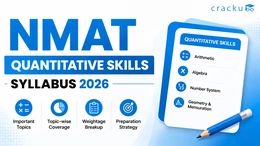
NMAT Quantitative Skills Syllabus
The NMAT Syllabus for Quantitative Skills section is organised into five major topics, each with multiple subtopics. Based on the type of questions that have appeared in previous year papers, NMAT Syllabus for Quantitative Skills section is as follows
Area | Key Topics |
Arithmetic | Percentages, Ratios, Averages, Time & Work, TSD, Mixtures. |
Algebra | Linear and Quadratic Equation, Inequalities, Logs, Modulus, Surds Indices. |
Geometry | Circles, Triangles, Centres, Mensuration Basics |
Modern Math | Permutations & Combinations, Probability |
Data Interpretation | Tables, Bar Graphs, Pie Charts |
NMAT Language Skills Syllabus
The syllabus includes vocabulary and usage, focusing on word relationships and contextual understanding. This is complemented by reading skills, which test comprehension and logical arrangement of ideas. Grammar fundamentals ensure clarity of concepts like tenses and parts of speech, while application-based topics such as sentence correction and error identification help in improving accuracy.
Area | Topics |
Vocabulary & Usage | Analogies, Synonyms, Antonyms, Fill in the Blanks, |
Reading Skills | Reading Comprehension, Critical Reasoning |
Grammar | Tenses, Parts of Speech, Figures of Speech, Idioms. |
Verbal Ability | Sentence Correction, Error Identification, Phrasal Verbs. |
Read Also, NMAT Language Skills Syllabus 2026, Important Topics
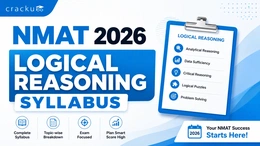
NMAT Logical Reasoning Syllabus
The Logical Reasoning section of the NMAT exam evaluates your analytical and critical thinking abilities, which require you to evaluate arguments, draw conclusions, and make good judgments. NMAT logical reasoning part includes questions on both Verbal Reasoning and Logical Reasoning. Based on the type of questions that have appeared in previous years' papers, NMAT Syllabus for Logical Reasoning section is as follows.
Area | Topics |
Analytical Reasoning | Input Output, Syllogisms, Coding-Decoding, Series & Patterns, Arrangements (Linear/Circular), Blood Relations |
Verbal Reasoning | Critical Reasoning, Decision Making, Course of Action, Inference-Based Questions, Assumption & Argument. |
NMAT Exam Pattern 2026
Here's a summary of the NMAT Exam Pattern, which consists of three sections with their expected sectional weightage and expected score range based on previous trends:
NMAT Exam Pattern 2026 | ||
NMAT Sections | No. of Questions | Score Range |
Language Skills | 36 | 12-120 |
Quantitative Skills | 36 | 12-120 |
Logical Reasoning | 36 | 12-120 |
Total | 108 | 36-360 |
NOTE: Every section has equal weightage, and there is no negative marking. This means that every correctly answered question will increase your score.
Read Also, NMAT Eligibility Criteria 2026
NMAT Important Topics 2026
Prepare for the NMAT 2026 by focusing on important topics in every section. The Graduate Management Admission Council conducts the NMAT, which focuses on speed and accuracy, making topic prioritisation necessary for a good score.
Section | Important Topics |
Language Skills | Vocabulary (Synonyms/Antonyms), Grammar, Error Detection, Fill in the Blanks |
Quantitative Skills | Arithmetic (Percentages, Ratios, TSD, Mixtures), Algebra (Equations, Logs, Surds, Inequalities), Data Interpretation, Data Sufficiency |
Logical Reasoning | Seating Arrangement, Puzzles, Coding-Decoding, Blood Relations, Syllogisms, Series. |
NMAT Syllabus 2026: Conclusion
NMAT Syllabus 2026 is the foundation of effective exam preparation for every MBA aspirant targeting top colleges like NMIMS and other institutes accepting NMAT scores. Understanding the complete section-wise syllabus for Language Skills, Quantitative Skills, and Logical Reasoning helps students focus on the right topics and improve their performance.
Candidates should start preparation early by covering important concepts, practicing mock tests, and improving speed and accuracy. A clear understanding of the NMAT exam pattern along with the latest NMAT syllabus 2026 can make preparation smoother and increase the chances of achieving a high score.