91- 6303239042


 Group
Group


 Preferred Source

 Google Discover
OMET Exams Syllabus 2026
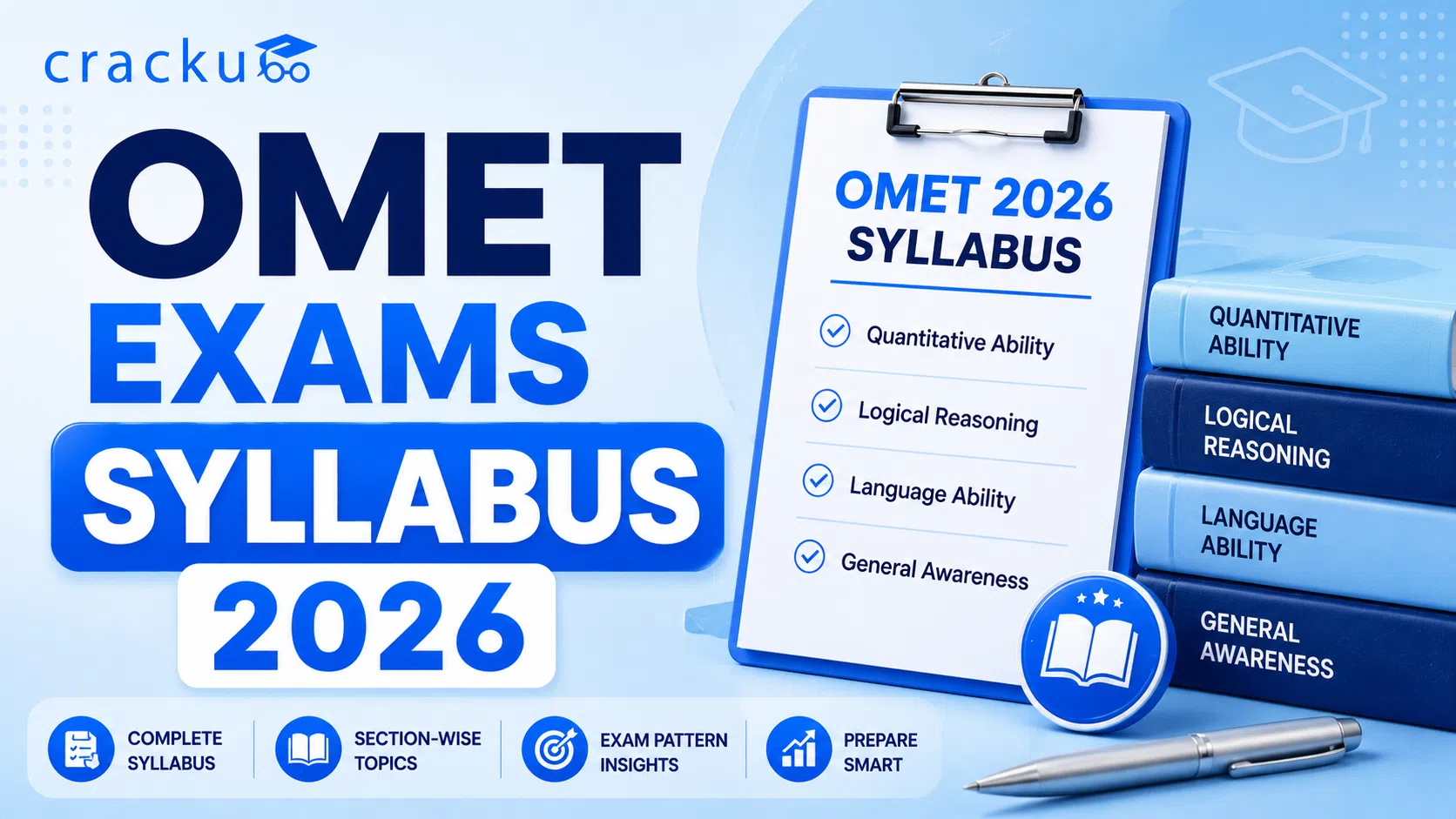
OMET refers to Other Management Entrance Tests such as XAT, SNAP, NMAT, and SRCC. The OMET syllabus covers many topics to measure your readiness for an MBA program. These entrance tests focus on key parts of business education by checking your quantitative aptitude, verbal ability, logical reasoning, and general awareness.
Exam Name | OMET Exam Syllabus PDF |
XAT | |
SNAP | |
NMAT | |
SRCC | |
CMAT |
XAT Exam Syllabus 2027
The XAT exam evaluates your analytical depth and ethical thinking through four main sections designed by XLRI Jamshedpur. It is often cited as the most difficult management entrance test in India because of the decision-making section. Most students think XAT is just like the CAT. It isn't.
The Verbal Ability and Logical Reasoning (VALR) section focuses on your command of English and logical structuring. You must handle abstract reading passages and poems. The Decision Making (DM) section uses business scenarios to test your judgment and ethics. It presents real-world dilemmas. You must choose the most ethical and practical path. The Quantitative Ability and Data Interpretation (QA & DI) section requires strong conceptual clarity in arithmetic and algebra. Accuracy is the goal.
Topic Category | Topics |
Logical Reasoning | Vocabulary-Based Questions Contextual Meaning of Words Correct Usage of Words Cloze Test Completion of Sentences/Paragraph Fill in the blanks Jumbled Paragraphs Poem Synonyms/Antonyms Correction of Errors in Sentences Critical Reasoning Grammar Section |
Verbal Ability | RC passages on various topics The author’s view related questions Inference-based questions Explanation of words or phrases Strengthening and weakening of arguments |
Decision Making | Analytical Reasoning (Decision Making sets) HR-related decision-making sets Ethical decision-making sets Conclusions Premises Assumptions Situational decision making Business issues Social dilemma–based scenarios Recruitment and selection dilemmas Performance evaluation and appraisal Promotions and internal conflicts Workplace policy decisions Handling diversity and inclusion |
Quantitative Ability | Percentages Algebra Number System Geometry Profit and Loss Simple and Compound Interest Speed, Time, and Distance Averages Time and Work Ratio and Proportion Mensuration Linear Equations Logarithm Venn Diagrams Progressions Binomial Theorem Inequalities Trigonometry Probability Functions Permutation and Combination Surds and Indices |
Data Interpretation | Bar Diagrams Pie Charts Data Analysis and Comparison Graphs Data Charts Data Tables |
General Awareness | Business, Finance, and Economics The Indian Constitution and Laws History and Geography Famous Personalities Awards and Winners Books and Authors Science and Technology Important Dates and Events Art and Culture National Current Affairs International Current Affairs Political Developments Business and Economic News Environmental Issues Updated Government Schemes Awards and Achievements Sports News Science and Tech News |
Success in the VALR section requires reading between the lines of dense text. XAT verbal questions often include poetry and visual images. The decision-making part is the hallmark of the XAT. It places you in the role of a manager or stakeholder. You must balance the interests of employees, customers, and the company. The result? A test of your professional character. Decision-making questions, especially the ethical dilemmas, are the hardest part of the paper.
Check Now, India's #1 XAT Online Coaching
NMAT Exam Syllabus 2026
NMAT by GMAC is a computer-adaptive test designed to assess skills essential for modern MBA programs. The difficulty of the questions changes based on your performance in previous ones. Each of the three sections carries equal weightage. You have the flexibility to choose the order in which you attempt the sections before the test begins. 108 questions. No negative marking.
The Language Skills section evaluates reading speed and basic English understanding. The Quantitative Skills section is time-intensive and covers arithmetic and modern mathematics foundations. Logical Reasoning focuses on pattern recognition and critical thinking through puzzles and analytical sets. Speed is the priority. You have under 28 minutes to finish the Language section.
Topic Category | Topics |
Language Skills | Analogies Synonyms Antonyms Fill in the blanks Cloze test Idioms Paragraph summary Para jumbles Jumbled sentences RC Passages Odd one out Tenses Sentence correction Parts of speech Phrasal verbs Choose the correct preposition Identify the error |
Quantitative Skills | Numbers Percentages Ratio and Proportions Averages Time and Work Partnership Simple and Compound Interest Integers HCF and LCM Permutation and Combination Coordinate Geometry Equations Inequalities Absolute Value Quadratic Equations Linear Equations Logarithm Set Theory Circles Quadrilaterals Square and Rectangles Lines, Angles, and Triangles Polygons Cylinders, Cones, and Spheres Cubes and Cuboids Rhombus Trapezium Parallelogram 3D Figures Pythagoras Theorem Base Angle Theorem Longest Side Theorem Probability Line Graphs Bar Charts Pie Charts Tables Venn Diagrams Progressions (Arithmetic, Geometric, Harmonic Relationships) |
Logical Reasoning | Classification Syllogisms Coding and decoding Symbol-based questions Blood relation questions Matrix-type questions Series and addition questions Linear and circular arrangements Alphabet questions Other reasoning questions Critical reasoning Decision making Course of action Statement and inference questions Statement and assumption questions Statement and argument questions |
Arithmetic and modern math form the base of the Quantitative section. Focus on calculation speed and mental math. The Logical Reasoning section tests your thinking through statement-assumption and course of action questions. You must identify logical patterns quickly to score well in the adaptive format. Accuracy in the early questions of each section is vital for achieving a high scaled score.
Check Now, NMAT Online Coaching
SNAP Exam Syllabus 2026
The SNAP Exam Syllabus 2026 focuses on a speed-based evaluation of candidates across three mandatory sections. It is an objective test conducted by Symbiosis International University. The exam is shorter and faster than other management tests. You must solve 60 questions in just 60 minutes. Time management is the biggest hurdle. No shortcut exists.
Analytical and Logical Reasoning is the highest-weighted section in SNAP. It often decides the final percentile. The General English section focuses on verbal ability and grammar rather than long reading passages. This makes it a high-scoring area if your basics are strong. The Quantitative section typically covers mathematics from Class 8 to 10 difficulty levels. It is simple but demands speed.
Topic Category | Topics |
General English | Sentence Completion Idioms and Syllogisms Jumbled Paragraphs Analogy Antonyms and Synonyms Fill in the Blanks One-word Substitution Odd One Out Active and Passive Voice Vocabulary
|
Analytical & Logical Reasoning | Linear and Matrix Arrangements Visual Reasoning Syllogisms Cause and Effect Blood Relations and Family Tree Statement and Conclusion Coding and Decoding Assertion and Reasoning Analogy and Series Clocks and Calendars Direction Sense Critical Reasoning |
Quantitative Ability | Number Systems Geometry Progressions (AP, GP, HP) Algebra Logarithm Series Binomial Theorem Graphs (Pie Chart) Bar Graphs Probability Mixtures and Allegations Arithmetic Inequalities Permutation and Combination Set Theory Coordinate Geometry Trigonometry Mensuration Surds and Indices Linear and Quadratic Equations Tables |
In SNAP, you cannot afford to get stuck on difficult questions. Move fast. Practice elimination techniques for the reasoning section. The General English section often contains straightforward questions on antonyms and phrasal verbs. There is no sectional time limit. This allows you to finish English quickly and save more time for the logic and math sections.
Check Now, SNAP Online Coaching
CMAT Exam Syllabus 2027
The CMAT Exam Syllabus 2027consists of five equally weighted sections prescribed by the National Testing Agency. It is a national-level test that evaluates candidates on standard aptitude and business awareness. The addition of the Innovation and Entrepreneurship section makes this test unique compared to the CAT or XAT. 180 minutes for 100 questions. This gives you enough time to think.
Quantitative Techniques and Data Interpretation mostly covers arithmetic and number systems. Logical Reasoning includes both analytical and verbal reasoning tasks. The Language Comprehension section tests grammar and vocabulary through short passages. The General Awareness section covers both static GK and recent current affairs.
Topic Category | Important Topics |
Quantitative Techniques & Data Interpretation | Percentages, Profit and Loss, Simple and Compound Interest, Time and Work, Time-Speed-Distance, Ratio and Proportion, Averages, Mixtures and Alligations, Partnership Linear Equations, Quadratic Equations, Inequalities, Number Systems Triangles, Circles, Mensuration, Coordinate Geometry, Lines and Angles, Polygons, Trigonometry Tables, Bar Graphs, Pie Charts, Line Graphs, Mixed Charts HCF, LCM, Indices, Surds, Remainders, Last Digit Permutations and Combinations, Probability, Set Theory |
Logical Reasoning | Statements and Arguments, Statements and Assumptions, Statements and Conclusions, Cause and Effect, Inferences, Strong and Weak Arguments, Odd One Out, Analogy Series Completion (Number, Alphabet, Letter/Symbol), Sequencing, Blood Relations, Direction Sense, Coding-Decoding, Linear and Circular Arrangements, Matrix Arrangements, Venn Diagrams, Clocks and Calendars, Puzzles, Symbol-Based Problems Syllogisms, Statement and Conclusion, Assumption–Premise–Conclusion, Data Sufficiency, Statement and Argument Various puzzles, including seating, ranking, and arrangement problems |
Language Comprehension | Passages of about 300–600 words from management, economics, and business, with questions on tone, inference, facts, and vocabulary Parts of Speech, Subject-Verb Agreement, Tenses, Articles, Prepositions, Sentence Correction, Error Spotting, Usage Errors Synonyms, Antonyms, One-Word Substitutions, Idioms and Phrases, Word Meanings Para Jumbles (rearranging sentences and paragraphs), Sentence Completion, Fill in the Blanks Assertion-Reason, Correct Sentence Identification, Match the Following (Pronouns and others) |
General Awareness | National and International Events, Government Schemes, Economy, Politics, Awards and Honors, Sports, Business News Indian History (Ancient, Medieval, Modern), Indian Geography, Indian Polity and Constitution, Indian Economy (Basics, Budget, RBI), Science and Technology, Art and Culture, Heritage, Sports Tournaments Companies, CEOs, Brand Ambassadors, Mergers and Acquisitions, Startups and Unicorns Important Books and Authors, Nobel and other Literary Awards, Media Personalities Important Days and Themes, Environmental Issues, Science in Daily Life, Cultural Events, Famous Personalities, Defence and Security |
Innovation & Entrepreneurship | Meaning, qualities of an entrepreneur, types of entrepreneurs Writing business plans, understanding business models Types of innovation, life cycle of innovation, technological and non-technological innovation Startup culture, incubators, accelerators, venture capital, funding options Intellectual Property Rights (IPR), patents, legal considerations, and business ethics Development theories, role in economic growth, social entrepreneurship, rural and women entrepreneurship Risk management, failure coping, crisis management, and competitive strategies Schemes, policies, and funding support for startups and innovation |
Innovation and Entrepreneurship is a scoring section if you know basic business terminology. Learn terms like MVP, Lean Startup, and Unicorns. The Quant section in CMAT is often easier than in other OMETs. However, accuracy is paramount because of the -1 penalty for every wrong answer. Spending 4-5 months on preparation ensures you cover all five subjects thoroughly. The math, especially the arithmetic, is where you can score the most. Accuracy and speed decide your rank. Consistency is what gets you there.
Check Now, CMAT Online Coaching
OMET Exams Syllabus 2026: Conclusion
The OMET Exams Syllabus 2026 gives MBA aspirants a clear roadmap for preparing for exams like XAT, SNAP, NMAT, and CMAT. While the core areas remain Quantitative Aptitude, Logical Reasoning, and Verbal Ability, each exam has its own unique focus areas and difficulty levels that require targeted preparation.
Understanding the section-wise OMET syllabus early helps candidates create an effective preparation strategy and improve their overall performance. Consistent practice, mock tests, and strong conceptual clarity are the key factors that can help students score well and secure admission into top MBA colleges in India.