91- 6303239042


 Group
Group
MBA Entrance Exam Syllabus: Your MBA entrance exam syllabus is the starting point of any serious preparation plan, since it tells you exactly where to put your hours. This article walks through the updated syllabus for all the major OMET exams - XAT, SNAP, NMAT, CMAT, MAH CET, MICAT, SRCC GBO, and more - along with CAT itself. Every one of these tests leans on a similar core (quant, reasoning, verbal ability, and general awareness), but the weightage, question count, and a few specialised sections differ from exam to exam, so it pays to know the differences before you start prepping.
MBA Entrance Exam Syllabus 2026-27
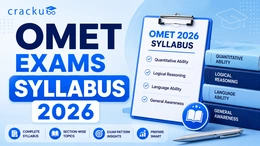
Every MBA entrance test builds its paper around a mix of Quantitative Aptitude, Verbal/Language Ability, Logical/Analytical Reasoning, Data Interpretation, and (for a few exams) General Awareness or Decision Making. Here's a quick snapshot of which sections show up in each of the major exams before we get into the topic-level breakdown.
MBA Entrance Exam | Sections |
Verbal Ability & Reading Comprehension (VARC) , Data Interpretation & Logical Reasoning (DILR) , Quantitative Aptitude (QA) | |
Verbal Ability & Logical Reasoning (VALR) , Decision Making , Quantitative Aptitude & Data Interpretation (QADI) , General Knowledge | |
Quantitative Skills , Language Skills , Logical Reasoning | |
Analytical & Logical Reasoning , General English , Quantitative, DI & Data Sufficiency | |
Quantitative Aptitude , Verbal Ability & Reading Comprehension , Abstract Reasoning , Logical Reasoning | |
Language Comprehension , Quantitative Techniques & DI , General Awareness , Logical Reasoning , Innovation & Entrepreneurship | |
MICAT Syllabus | Psychometric Test , Aptitude Test , Descriptive Test |
Logical Ability , Data Interpretation , Quantitative Ability , English Comprehension & Language Ability |
Clearing one or more of these exams is the gateway to a seat at an IIM or another top B-school, so use the table above as a map and dive into the section-wise details below to build a focused study plan.
CAT Exam Syllabus
CAT exam remains the most widely written MBA entrance test in the country and is the primary route into the IIMs as well as several other reputed institutes. The paper is split into Quantitative Aptitude (QA), Data Interpretation & Logical Reasoning (DILR), and Verbal Ability & Reading Comprehension (VARC).
Section | Topics Covered |
Verbal Ability & Reading Comprehension (VARC) | Reading Comprehension passages (history & culture, business & economics, science & tech, society, philosophy, etc.), Para Summary, Para Jumbles, Odd One Out, Para Completion |
Data Interpretation & Logical Reasoning (DILR) | Caselets, Tables, Pie/scatter/line/bar charts, Logical DI, Puzzles & Venn diagrams, Arrangements (linear/circular), Games & tournaments, Routes & networks, Binary logic |
Quantitative Aptitude (QA) | Arithmetic, Algebra, Geometry & Mensuration, Number Systems, Modern Math (Probability, P&C;) |
CAT Exam Overview:
- Duration: 120 minutes (40 minutes per section, no switching between sections)
- Number of Questions: 68 (204 marks total)
- Sections: VARC, DILR, QA
- Marking: +3 for every correct MCQ, -1 for a wrong MCQ; TITA questions get +3 for correct and 0 for wrong. No negative marking for unattempted questions.
- Mode: Online, computer-based test
XAT Exam Syllabus
XAT is conducted by XLRI Jamshedpur and feeds into several other top B-schools as well. What sets it apart from CAT is the dedicated Decision Making section, sitting alongside Verbal Ability & Logical Reasoning, Quant & DI, and a separate General Knowledge segment.
Section | Topics Covered |
Decision Making (DM) | Business situations, Ethical dilemmas, Case studies, HR-based sets, Conclusions/Premises/Assumptions |
Verbal Ability & Logical Reasoning (VALR) | Vocabulary & Grammar, Jumbled paragraphs, Cloze tests, Critical reasoning, RC-based Inference and Argument questions |
Quantitative Aptitude & Data Interpretation (QADI) | Arithmetic, Algebra, Number system, Modern maths (Trigonometry), Bar/Pie charts and Data tables |
General Knowledge | Static GK (Business, Economy, Constitution, History, Geography, Personalities) and Current affairs |
XAT Overview:
- Duration: 180 minutes total (170 minutes for the core sections, 10 minutes for GK)
- Number of Questions: 95 (75 core MCQs + 20 GK questions)
- Sections: VALR, Decision Making, QADI, General Knowledge
- Marking: -0.25 for every wrong answer in Part 1, -0.1 for unattempted questions beyond the first 8; no negative marking on GK
- Mode: Online, computer-based test
NMAT Exam Syllabus
NMAT, run by GMAC, gives candidates flexibility in choosing their own exam slot within a window. It checks proficiency in Quantitative Skills, Language Skills, and Logical Reasoning, with no penalty for wrong attempts.
Section | Topics Covered |
Quantitative Skills (QS) | Number systems, Arithmetic, Algebra, Geometry, Data interpretation, Data sufficiency |
Language Skills (LS) | Vocabulary (analogies, fill-ups, cloze), Grammar, Reading comprehension, Para jumbles |
Logical Reasoning (LR) | Analytical reasoning (arrangements, syllogisms, coding, blood relations) and Verbal reasoning (critical reasoning, course of action, statement-based questions) |
NMAT Overview:
- Duration: 120 minutes (QS: 52 min, LR: 40 min, LS: 28 min)
- Number of Questions: 108 (36 per section)
- Sections: Quantitative Skills, Language Skills, Logical Reasoning
- Marking: No negative marking
- Mode: Online, computer-based test
SNAP Exam Syllabus
SNAP is the speed-focused gateway exam to Symbiosis International University's member institutes. It tests Analytical & Logical Reasoning, General English, and Quant/DI within a short 60-minute window.
Section | Topics Covered |
Analytical & Logical Reasoning | Clocks & Calendars, Binary logic, Syllogisms, Coding-Decoding, Blood relations, Course of action, Critical reasoning |
General English | Vocabulary, Idioms, Grammar, Error detection, Fill in the blanks |
Quantitative, DI & Data Sufficiency | Arithmetic, Algebra, Geometry, Number systems, Modern math (Heights & Distance), Line/Bar/Pie Chart interpretation |
SNAP Overview:
- Duration: 60 minutes (no sectional time limits)
- Number of Questions: 60
- Sections: Analytical & Logical Reasoning, General English, QA-DI
- Marking: +1 for a correct answer, -0.25 for an incorrect one
- Other features: Up to three attempts allowed, with the best score considered for SIU admissions; there are no sectional cutoffs and the test is conducted only in English
MAH CET Exam Syllabus
MAH CET is a state-level exam for Maharashtra's MBA programmes, and it stands out for having the largest question count among the major OMETs along with a dedicated Abstract Reasoning section.
Section | Topics Covered |
Logical Reasoning | Linear/circular/grid/box arrangements, Coding & sequences, Blood relations, Syllogisms, Critical reasoning |
Abstract Reasoning | Mirror & water images, Image rotation, Embedded figures, Pattern completion, Paper folding |
Quantitative Aptitude | Arithmetic (Percentages, Ratios, Mixtures, Profit Loss), Algebra, Geometry, Data Interpretation |
Verbal Ability & Reading Comprehension | Reading passages, Para jumbles, Cloze tests, Sentence correction, Vocabulary |
MAH CET Overview:
- Duration: 150 minutes (2.5 hours)
- Number of Questions: 200
- Sections: Logical Reasoning (75 Qs), Quantitative Aptitude (50 Qs), Verbal Ability & RC (50 Qs), Abstract Reasoning (25 Qs)
- Marking: +1 for every correct answer, no negative marking
- Mode: Online, computer-based test
CMAT Exam Syllabus
CMAT, conducted by the National Testing Agency, spreads its 100 questions evenly across five sections, including the somewhat unusual Innovation & Entrepreneurship segment that doesn't appear in most other OMETs.
Section | Topics Covered |
Innovation & Entrepreneurship | Entrepreneurship theories, Startup legal structures, Business terminology, Government schemes, Marketing & growth strategy |
Quantitative Techniques & Data Interpretation | Arithmetic, Algebra, Geometry, Number system, Pie charts/Bar graphs/Tabulation |
Logical Reasoning | Analytical & Verbal reasoning (Assumptions, Blood relations, Coding), Non-verbal reasoning, Number series |
Language Comprehension | Reading Comprehension, Vocabulary, Grammar, Sentence correction |
General Awareness | Current affairs, Static GK, Sports, Politics, Awards, Books & Authors |
CMAT Overview:
- Duration: 180 minutes (3 hours, no sectional time limits)
- Number of Questions: 100 (20 per section, 400 marks total)
- Sections: Language Comprehension, Quantitative Techniques & DI, Logical Reasoning, General Awareness, Innovation & Entrepreneurship
- Marking: +4 for a correct answer, -1 for a wrong one
- Mode: Online, computer-based test
MICAT Exam Syllabus
MICAT, conducted for admission to MICA, is structured quite differently from the other OMETs - it adds a Psychometric Test and a Descriptive Test on top of the regular Aptitude section.
Section | Topics Covered |
Psychometric Test | Behavioural patterns, Personality factors, Situational judgement, Life goals |
Descriptive Test | Picture-based story writing, for-and-against passage writing |
Aptitude Test | Verbal ability, Quantitative aptitude & DI, General awareness (Brand knowledge, Current affairs, Static GK), Divergent & Convergent thinking (logical/critical/verbal reasoning) |
MICAT Overview:
- Duration: 130 minutes total (Psychometric: 25 min, Descriptive: 25 min, Aptitude: 80 min)
- Number of Questions: 142 (68 psychometric + 4 descriptive + 70 aptitude)
- Sections: Psychometric Test, Descriptive Test, Aptitude Test (VA, QA-DI, GA, Reasoning)
- Mode: Online, computer-based test
SRCC GBO Exam Syllabus
SRCC GBO is the entrance test for the Global Business Operations programme at Shri Ram College of Commerce, and it's followed by a Group Discussion and Personal Interview round.
Section | Topics Covered |
Data Interpretation | Data tables, Pie charts, Bar/line/mixed graphs, Caselets, Logic-based DI |
Quantitative Ability | Arithmetic, Algebra, Number system, Geometry, Data sufficiency |
Logical Ability / Reasoning | Analytical reasoning (blood relations, puzzles, scheduling), Syllogisms, Binary logic, Critical reasoning, Visual reasoning |
English Comprehension & Language Ability | Reading comprehension, Grammar, Vocabulary, Critical reasoning, Fill in the blanks |
SRCC GBO Overview:
- Duration: 120 minutes
- Number of Questions: 100 (25 per section)
- Sections: Data Interpretation, Quantitative Ability, Logical Ability, English Comprehension & Language Ability
- Marking: +4 for a correct answer, -1 for an incorrect one
- Selection Process: Online Test (75% weightage) → Group Discussion (10%) → Personal Interview (15%)
MAT, ATMA, and CUET PG - A Quick Comparison
A few other MBA-track exams worth keeping on your radar are MAT, ATMA, and CUET PG. Here's how their structure stacks up:
Exam | Total Questions | Duration | Sections | Marking Scheme |
MAT | 150 | 120 minutes | Language Comprehension, Intelligence & Critical Reasoning, Data Analysis & Sufficiency, Mathematical Skills, Economic & Business Environment | +1 correct, -0.25 wrong |
ATMA | 180 | 180 minutes | Verbal Skills, Quantitative Skills, Analytical Reasoning Skills (each split into two sub-sections of 30 Qs) | +1 correct, -0.25 wrong |
CUET PG | 75 | 90 minutes | Language Comprehension (English/Hindi), Quantitative Ability, Logical Reasoning, Data Interpretation | +4 correct, -1 wrong |
MBA Entrance Exam Syllabus Conclusion
Each of these exams has its own personality on paper, but underneath the differences sits the same core skill set: Quantitative Aptitude, Logical Reasoning, and Verbal Ability. Build strength in these three pillars first, then layer in exam-specific elements like Decision Making for XAT, Abstract Reasoning for MAH CET, or the Psychometric round for MICAT. Pairing structured topic-wise study with regular full-length mocks across CAT, XAT, SNAP, NMAT, CMAT, MAH CET, and the rest is what ultimately moves the needle on test day.