91- 6303239042


 Group


 Preferred Source

 Google Discover

NMAT Quant Revision Strategy 2026
The Quantitative Skills section will make or break your NMAT by GMAC percentile. It's only 36 questions in 52 minutes, but the Quantitative Skills section can be a big time-sink or it can give you your biggest boost in overall percentile. It's not about how many questions you can solve but about how well you can brush up with a strategic revision. This article takes you through a useful NMAT Quant Revision Strategy 2026: where to start revising, the formulas and shortcuts to make revision easy, the single page of content, how to aim at 36 questions in 52 minutes, and how to build test scores.
Most Important Quant Topics to Revise for NMAT 2026
Knowing the weighting of topics will allow you to make your revision time count equally. Here is a list of the topic distribution and their significance that have been seen in NMAT Quantitative Skills previously:
Topic Domain | Expected Questions | High-Yield Sub-Concepts | Preparation Priority |
Arithmetic | 10 -12 | Percentages, Profit & Loss, Simple & Compound Interest, Time-Speed-Distance, Time & Work, Mixtures & Alligations | Critical |
Data Interpretation (DI) | 8 -12 (2–4 Sets) | Tables, Bar Graphs, Pie Charts, Combined/Dual-Axis Charts, Caselets | Critical |
Modern Math | 4 -6 | Fundamental Counting Principle, Permutations & Combinations, Probability, Set Theory (Venn Diagrams) | High |
Algebra & Numbers | 4 -6 | Linear & Quadratic Equations, AP/GP/HP, Logarithms, Exponents, Divisibility Rules, Unit Digits, Remainders | High |
Data Sufficiency (DS) | 3 -5 | Value vs. Feasibility questions, Number Properties, Inequalities | Moderate |
Geometry & Mensuration | 1 -3 | Circles, Triangles, Basic Coordinate Geometry, 2D/3D Mensuration | Low -Moderate |
Read More: NMAT Quant Important Topics, Check Topic-Wise Weightage
NMAT Quant Formulas and Shortcuts for Quick Revision
You don't need a hundred formulas. You need the right thirty so well memorised you never need to think about how to use them. Keep it on just one page and revise it every single day in the final month.
Topic | Formula or rule |
Percentage change | (Change ÷ Original) × 100 |
Profit % | (Profit ÷ Cost price) × 100 |
Successive discounts | Net = a + b + (ab/100) |
Compound interest | A = P(1 + r/100)^n |
Average speed (equal distances) | 2xy ÷ (x + y) |
Work | Work = Rate × Time; combined rate = sum of individual rates |
Quadratic equation | Roots = [−b ± √(b² − 4ac)] ÷ 2a |
AP, nth term and sum | a + (n−1)d; n/2 × [2a + (n−1)d] |
GP sum | a(r^n − 1) ÷ (r − 1) |
Permutation and combination | nPr = n!/(n−r)!; nCr = n!/[r!(n−r)!] |
Area of triangle | ½ × base × height; Heron's formula for three sides |
Circle | Area = πr²; circumference = 2πr |
Set theory | n(A∪B) = n(A) + n(B) − n(A∩B) |
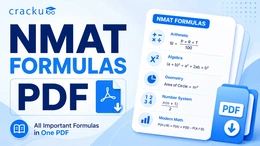
Here's Cracku's Quant Formulas is a useful resource that gathers all of the important formulas in one place, making preparation easier and increasing chances of success.
Shortcuts That Save Seconds
Small time savings compound across 36 questions.
- Show percentage-fraction equivalents. This removes calculation steps as 12.5% is 1/8 and 16.67% is 1/6.
- Use alligation for mixture questions. It is faster than setting up equations.
- Use answer-option substitution: For example, avoid solving algebra and number problems. Instead, try plugging in answer options.
- Estimated in data interpretation. Use rounded numbers where reasonable. Test choices are spaced apart frequently enough that best guesses are usually safe.
- Check the unit digit and test on divisibility to discard wrong answer choices at short-speed.
- Use successive percentages logic rather than converting back to original amounts.
- Make a quick diagram for geometry and Venn problems. A ten-second diagram saves a two-minute error.
How to Attempt 36 NMAT Quant Questions in 52 Minutes?
Time management can be learned. I have never seen a candidate fail in Quant because they were incapable. I have seen many fail because they had not worked out how to use 52 minutes to demonstrate their ability.
Step 1: Determine Your Aim Range
No reward for trying all 36 questions at the expense of accuracy. A practical strong-attempt range is a function of your current level, and you should set and adjust it through mock exams. As there is no set level of difficulty of NMAT questions, the correctness of the questions you attempt is as important as their number. Refer to the official candidate bulletin for scoring and marking.
Step 2: Implement a three pass strategy into the test
Pass | Time window | What to do |
Pass 1 | Minutes 0-34 | Solve every question you can finish in under 75-80 seconds. Skip anything that feels long or unclear. |
Pass 2 | Minutes 34-48 | Return to medium-difficulty questions you skipped. Give each a fixed cap of about two minutes. |
Pass 3 | Minutes 48-52 | Make educated guesses on what remains and re-check any risky calculations. |
Familiarize yourself with the functionality of the test interface so that you will be able to navigate between questions on the GMAC's official practice test.
Step 3: Adhere to Smart Question-Selection Rules
- Focus first on your strongest sections, such as math (including math science) and easy algebra.
- Handle data interpretation sets early if you are happy with them, as each data interpretation set is worth multiple marks.
- Jump over any problem where you do not see a starting place within 20 seconds.
- Don't waste five minutes on one problem with lots of calculations.
Step 4: Maintain Correctness
- Read the last sentence of the question twice. Lots of mistakes occur when you solve for the incorrect variable.
- Verify units, e.g., hours to minutes and percent to value absolute.
- Double check your final answer with rough estimation.
Step 5: Take Control of Your Mindset
A tough question so soon into a section is not a sign that the section is getting off track. Mark it and move on. Remain calm and keep faith in the process. An unflappable student typically emerges with a high score.
Read More: NMAT Quantitative Skills Syllabus 2026, Important Topics
How to Improve NMAT Quant Scores Through Mock Tests?
NMAT Mock Tests are the most important revision aid, but only if you use them as diagnostics rather than score-orientated experiments.
The following table gives a realistic NMAT mock schedule
Stage | Mock frequency | Focus |
First 3 weeks | 1 sectional Quant test per week | Identify weak topics |
Weeks 4-6 | 2 sectional tests plus 1 full mock per week | Build speed and consistency |
Final 2-3 weeks | 2-3 full mocks per week | Simulate test-day conditions |
Take NMAT mock test as much as you can, as it directly simulates the actual interface, question type and actual level of NMAT.
Analyse Every Mock Within 24 Hours
Devote just as much time analyzing a practice test as you did taking it. Develop an Error Log with the Following Columns:
- Question number and topic
- Error type: concept gap, calculation slip, misread question, time pressure or guess
- Time spent
- Correct method and shortcut
- Action: change the heading, practise ten questions of a similar nature OR introduce a formula into the sheet
Spot Patterns, Not Just Mistakes
After five or six mocks, you'll be able to see patterns in your error log. Perhaps you'll notice that 40% of your lost marks are from data interpretation calculations, or that you're wasting time in geometry. Make the next revision week target that one pattern.
Track the Right Metrics
- Attempts: how many questions you answered
- Accuracy: correct answers as a proportion of tries
- Time per question: Relevant for questions skipped and abandoned.
- Topic-wise accuracy: to guide revision
- A good trend in progress is rising accuracy then rising attempts. Rising attempts before accuracy generally ends poorly.
Common Mock Test Mistakes to Avoid
- Doing too many mocks, without any analysis.
- Forget the questions you knew the answer to, for a lucky guess conceals a feeble idea.
- Switch to a new tactic each week rather than try it out one at a time
- Focussing on new topics in the last three days at the expense of revision
NMAT Quant Revision Strategy 2026: Conclusion
A proper NMAT Quant Revision Strategy 2026 can help you improve your speed, accuracy, and confidence before the exam. Focus on important NMAT Quant topics such as arithmetic, data interpretation, algebra, and modern maths. Revise important formulas and shortcuts regularly, and practise different question types to strengthen your understanding. Since the NMAT Quantitative Skills section contains 36 questions to be completed in 52 minutes, effective time management is essential for better performance.
Along with daily revision, take regular NMAT mock tests to track your progress and identify areas that need improvement. Analyse your mistakes, revise weaker topics, and practise questions under timed conditions. Following a consistent NMAT 2026 Quant preparation strategy will help you approach the exam with better accuracy and confidence.