JEE WhatsApp Group



JEE Simple Harmonic Motion PYQs
JEE Simple Harmonic Motion PYQs are an important part of JEE Physics preparation because they show you how questions from oscillations are actually asked in the exam. By practising previous-year questions, you can strengthen concepts such as displacement, velocity, acceleration, angular frequency, phase, time period, spring systems, simple pendulums, and energy in SHM.
Simple Harmonic Motion may feel confusing in the beginning because the chapter includes formulas, graphs, signs, and different stages of motion. However, it becomes much easier once you understand how displacement, velocity, and acceleration are connected.
You do not need to memorise every formula separately. Instead, try to understand what happens to a particle as it moves from the mean position to the extreme position and back again. Once this basic picture is clear, many numerical and graph-based questions become easier to solve.
This chapter is also connected with waves, energy conservation, circular motion, and mechanics. A strong understanding of SHM can therefore help you in several other parts of JEE Physics.
In this blog, you will find important previous-year questions, useful formulas, preparation tips, common mistakes, and practice problems. You will also learn how to use mock tests and study material more effectively.
JEE Simple Harmonic Motion Questions PDF
The JEE Simple Harmonic Motion Questions can include important previous-year problems and jee exam-level practice questions from this chapter.
The questions may cover topics such as:
- Equation of SHM
- Angular frequency and phase
- Displacement, velocity, and acceleration
- Time period and frequency
- Energy in SHM
- Spring-mass systems
- Simple pendulums
- Combination of springs
- Graphs related to oscillatory motion
Solving these questions will help you understand which concepts are asked most often. It will also improve your ability to identify the correct method quickly during the exam.
While practising, do not check the solution immediately. First, note the given values, identify the concept being tested, and write the formula you think is relevant. Even if you cannot complete the question, this approach will help you learn more effectively when you later study the solution.
Important Formulas for JEE Mains Formula Sheet
A well-prepared JEE Mains Formula Sheet can help you revise much faster, especially during the last few weeks before the examination.
Simple Harmonic Motion contains several formulas, but most of them are connected to a few basic ideas. If you understand those relationships, remembering the formulas becomes much easier.
| Concept | Formula |
|---|---|
| Displacement in SHM | x = A sin(ωt + ϕ) |
| Alternative displacement equation | x = A cos(ωt + ϕ) |
| Angular frequency | ω = 2π/T = 2πf |
| Velocity at displacement x | v = ±ω√(A² − x²) |
| Maximum velocity | vmax = Aω |
| Acceleration in SHM | a = −ω²x |
| Maximum acceleration | amax = Aω² |
| Time period of spring-mass system | T = 2π√(m/k) |
| Time period of simple pendulum | T = 2π√(l/g) |
| Total energy in SHM | E = ½mω²A² |
| Potential energy | U = ½mω²x² |
| Kinetic energy | K = ½mω²(A² − x²) |
| Frequency | f = 1/T |
These formulas are commonly used in questions based on springs, pendulums, particle motion, energy, and SHM graphs.
While revising, do not focus only on the formula itself. Also remember where each quantity becomes maximum or minimum. For example, velocity is maximum at the mean position, while acceleration is maximum at the extreme positions.
How to Use JEE Study Material for SHM
Good JEE Study material should help you build the chapter gradually instead of giving you only a long list of formulas.
Start by understanding periodic motion and the conditions required for a motion to be simple harmonic. After that, study the relationship between restoring force, displacement, velocity, and acceleration.
Once the basics are clear, solve simple questions on:
- Displacement
- Time period
- Frequency
- Velocity
- Acceleration
Then move to more advanced problems involving energy, spring combinations, pendulums, and multi-concept situations.
You should also practise displacement-time, velocity-time, and acceleration-time graphs. Many students are comfortable with formulas but get confused when the same idea is asked through a graph.
A good study routine is to read the concept, solve a few basic examples, attempt previous-year questions, and then revise your mistakes. This method is more effective than simply reading theory repeatedly.
Why You Should Solve JEE Advanced PYQ Problems
A JEE Advanced PYQ often tests more than one concept in the same question. A problem may combine Simple Harmonic Motion with energy conservation, circular motion, rotational motion, fluids, or spring constraints.
These questions are useful because they teach you how to think beyond direct formula substitution. They also help you identify whether a motion is actually simple harmonic or only periodic.
Before solving an advanced question, try to locate the equilibrium position. Then find the restoring force acting on the particle.
The basic condition for SHM is:
F = −kx
This means the restoring force must be directly proportional to displacement and directed towards the equilibrium position.
If this condition is satisfied, the motion can be treated as simple harmonic.
While attempting JEE Advanced questions, break the problem into smaller steps. Do not try to solve the entire question in one go. First identify the physical situation, then write the governing equation, and finally perform the calculation.
Top 5 Common Mistakes to Avoid in SHM PYQs
Students often lose marks in SHM because of small conceptual or sign-related errors. Here are some common mistakes you should avoid.
Confusing Periodic Motion With SHM
Every simple harmonic motion is periodic, but every periodic motion is not simple harmonic.
For a motion to be SHM, the restoring acceleration must be directly proportional to displacement and directed towards the mean position.
Choosing the Wrong SHM Equation
The equation of motion depends on the starting position of the particle.
If the particle starts from the mean position, the sine form is often convenient. If it starts from an extreme position, the cosine form may be easier to use.
Always check the initial condition before selecting the equation.
Forgetting the Negative Sign in Acceleration
The acceleration equation is:
a = −ω²x
The negative sign shows that acceleration is always directed towards the equilibrium position. Ignoring this sign can lead to mistakes in direction-based questions.
Applying the Pendulum Formula at Large Angles
The standard formula for the time period of a simple pendulum is valid only for small angular oscillations.
For large angles, the motion is not exactly simple harmonic, and the usual formula may not give an accurate result.
Mixing Up Maximum and Instantaneous Values
Maximum velocity occurs at the mean position because the restoring force is zero there.
Maximum acceleration occurs at the extreme positions because displacement is maximum there.
Students often interchange these conditions, especially in graph-based and energy-based questions.
Practice With a JEE Mock Test
After completing the theory and solving chapter-wise questions, attempt a JEE Mock Test under timed conditions.
A mock test will help you check whether you can:
- Recognise SHM questions quickly
- Select the correct formula
- Read graphs accurately
- Manage signs and directions
- Complete calculations within the available time
During the test, read the question carefully before applying a formula. Some questions may describe oscillatory motion, but the motion may not satisfy the conditions of SHM.
After the test, review every incorrect answer. Check whether the mistake happened because of a weak concept, a wrong sign, an incorrect formula, a graph-reading error, or a calculation mistake.
This analysis is extremely important. Simply attempting more questions without reviewing your mistakes will not improve your performance as quickly.
List of JEE Simple Harmonic Motion Practice Questions
A good practice set should include direct numerical questions as well as concept-based and graph-based problems.
The questions may cover:
- Displacement equations
- Phase difference
- Angular frequency
- Spring-mass systems
- Simple pendulums
- Energy distribution
- Velocity and acceleration
- SHM graphs
- Combination of springs
- Oscillations in different physical systems
Start with basic questions and gradually move to multi-concept problems.
Try to solve each question on your own before checking the answer. If you get stuck, revise the related concept, return to the problem, and attempt it again.
Regular practice will help you recognise common question patterns, improve your calculation speed, and reduce unnecessary mistakes. With clear concepts and consistent revision, Simple Harmonic Motion can become a reliable and scoring chapter in JEE Physics.
Question 1
The displacement time graph of a particle executing SHM is given in figure: (sketch is schematic and not to scale)
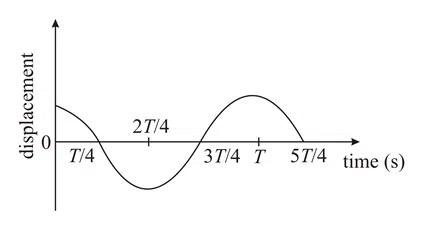
Which of the following statements is/are true for this motion?
(A) The force is zero at $$t = \frac{3T}{4}$$
(B) The magnitude of acceleration is maximum at $$t = T$$
(C) The speed is maximum at $$t = \frac{T}{4}$$
(D) The P.E. is equal to K.E. of the oscillation at $$t = \frac{T}{2}$$
correct answer:- 1
Question 2
A particle at the end of a spring executes simple harmonic motion with a period $$t_1$$, while the corresponding period for another spring is $$t_2$$. If the period of oscillation with the two springs in series is $$t$$, then
correct answer:- 2
Question 3
The displacement of a particle, executing simple harmonic motion with time period T, is expressed as $$x(t) = A\sin \omega t$$, where A is the amplitude. The maximum value of potential energy of this oscillator is found at $$t=T/2\beta$$. The value of $$\beta$$ is_____.
correct answer:- 2
Question 4
A block of mass m attached to a massless spring is performing oscillatory motion of amplitude 'A' on a frictionless horizontal plane. If half of the mass of the block breaks off when it is passing through its equilibrium point, the amplitude of oscillation for the remaining system become $$fA$$. The value of $$f$$ is:
correct answer:- 4
Question 5
A block is fastened to a horizontal spring. The block is pulled to a distance $$x = 10$$ cm from its equilibrium position (at $$x = 0$$) on a frictionless surface from rest. The energy of the block at $$x = 5$$ cm is $$0.25$$ J. The spring constant of the spring is ______ N m$$^{-1}$$.
correct answer:- 50

Question 6
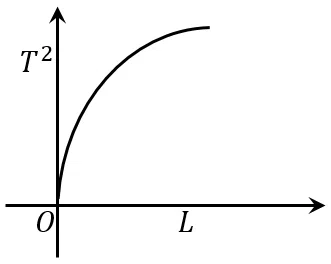
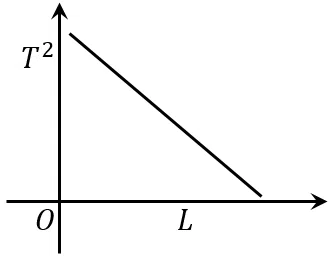
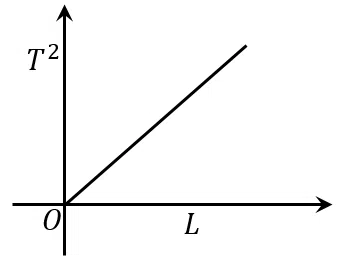
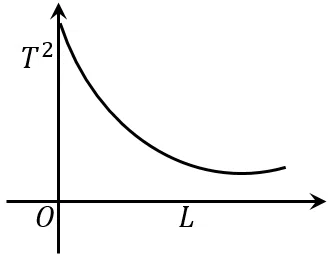
Choose the correct length ($$L$$) versus square of time period ($$T^2$$) graph for a simple pendulum executing simple harmonic motion.
correct answer:- 3
Question 7
A particle of mass $$m$$ executes simple harmonic motion along the x-axis about the origin ($$x = 0$$) with an amplitude$$A$$and angular frequency$$\omega$$. During its motion, at a specific position $$x = x_1$$, the kinetic energy of the particle is found to be exactly three times its potential energy ($$K = 3U$$), assuming potential energy is zero at the mean position.Find the absolute magnitude of the velocity ($$v$$) of the particle when it passes through this position $$x_1$$:
correct answer:- 2
Question 8
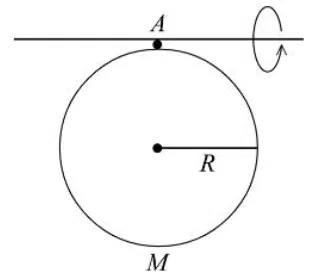
A uniform disc of radius R and mass M is free to oscillate about the axis A as shown in the figure. For small oscillations the time period is ______. ( g is acceleration due to gravity)
correct answer:- 1
Question 9
A damped harmonic oscillator has a frequency of 5 oscillations per second. The amplitude drops to half its value for every 10 oscillations. The time it will take to drop to $$\frac{1}{1000}$$ of the original amplitude is close to:
correct answer:- 3
Question 10
A particle executes simple harmonic motion with an amplitude of 5 cm. When the particle is at 4 cm from the mean position, the magnitude of its velocity in SI units is equal to that of its acceleration. Then, its periodic time in seconds is:
correct answer:- 1

Question 11
A spring whose unstretched length is $$l$$ has a force constant k. The spring is cut into two pieces of unstretched lengths $$l_1$$ and $$l_2$$ where, $$l_1 = nl_2$$ and n is an integer. The ratio $$k_1/k_2$$ of the corresponding force constants, k$$_1$$ and k$$_2$$ will be:
correct answer:- 4
Question 12
A ball suspended by a thread swings in a vertical plane so that its magnitude of acceleration in the extreme position and lowest position are equal. The angle ($$\theta$$) of thread deflection in the extreme position will be :
correct answer:- 2
Question 13
A mass $$0.9 \text{ kg}$$, attached to a horizontal spring, executes SHM with an amplitude $$A_1$$. When this mass passes through its mean position, then a smaller mass of $$124 \text{ g}$$ is placed over it and both masses move together with amplitude $$A_2$$. If the ratio $$\dfrac{A_1}{A_2}$$ is $$\dfrac{\alpha}{\alpha - 1}$$, then the value of $$\alpha$$ will be ______.
correct answer:- 16
Question 14
A particle executes simple harmonic motion represented by displacement function as $$x(t) = A\sin(\omega t + \phi)$$. If the position and velocity of the particle at $$t = 0$$ s are 2 cm and 2$$\omega$$ cm s$$^{-1}$$ respectively, then its amplitude is $$x\sqrt{2}$$ cm where the value of $$x$$ is _________
correct answer:- 2
Question 15
$$x$$ and $$y$$ are displacements of a particle are given as $$x(t) = a \sin \omega t$$ and $$y(t) = a \sin 2\omega t$$. Its trajectory will look like:
correct answer:- 3

Question 16
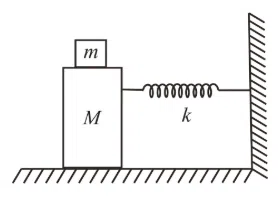
In the given figure, a mass $$M$$ is attached to a horizontal spring which is fixed on one side to a rigid support. The spring constant of the spring is $$k$$. The mass oscillates on a frictionless surface with time period $$T$$ and amplitude $$A$$. When the mass is in equilibrium position, as shown in the figure, another mass $$m$$ is gently fixed upon it. The new amplitude of oscillation will be:
correct answer:- 4
Question 17
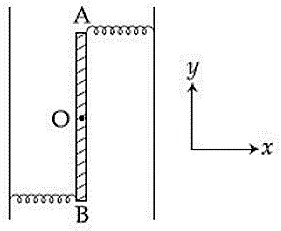
Two light identical springs of spring constant k are attached horizontally at the two ends of a uniform horizontal rod AB of length l and mass m. The rod is pivoted at its center 'O' and can rotate freely in horizontal plane. The other ends of the two springs are fixed to rigid supports as shown in figure. The rod is gently pushed through a small angle and released. The frequency of resulting oscillation is:
correct answer:- 3
Question 18
A particle executes S.H.M., the graph of velocity as a function of displacement is:
correct answer:- 4
Question 19
A particle executes S.H.M. with amplitude $$A$$ and time period $$T$$. The displacement of the particle when its speed is half of maximum speed is $$\frac{\sqrt{x}A}{2}$$. The value of $$x$$ is
correct answer:- 3
Question 20
A particle executing linear simple harmonic motion has a total mechanical energy $$E$$. When the displacement of the particle from its mean position is one-third of its amplitude ($$x = \frac{A}{3}$$), the ratio of its kinetic energy to its potential energy ($$K : U$$) is:
correct answer:- 2

Question 21
If $$\vec{L}$$ and $$\vec{P}$$ represent the angular momentum and linear momentum respectively of a particle of mass 'm' having position vector $$\vec{r} = a(\hat{i}\cos\omega t + \hat{j}\sin\omega t)$$. The direction of force is
correct answer:- 1
Question 22
A particle is executing simple harmonic motion. Its amplitude is $$A$$ and time period is 5 sec. The time required by it to move from $$x = A$$ to $$x = \frac{A}{\sqrt{2}}$$ is _______ sec.
correct answer:- 3
Question 23
The function of time representing a simple harmonic motion with a period of $$\frac{\pi}{\omega}$$ is :
correct answer:- 4
Question 24
Which of the following expressions corresponds to simple harmonic motion along a straight line, where x is the displacement and a, b, c are positive constants?
correct answer:- 4
Question 25
A 1 kg block attached to a spring vibrates with a frequency of 1 Hz on a frictionless horizontal table. Two springs identical to the original spring are attached in parallel to a 8 kg block placed on the same table. So, the frequency of vibration of the 8 kg block is:
correct answer:- 4

Question 26
A simple pendulum made of a bob of mass m and a metallic wire of a negligible mass has a time period of 2 s at $$T = 0°C$$. If the temperature of the wire is increased, and the corresponding change in its time period is plotted against its temperature, the resulting graph is a line of slope $$S$$. If the coefficient of linear expansion of metal is $$\alpha$$, then the value of $$S$$ is
correct answer:- 3
Question 27
A pendulum clock loses 12 s a day if the temperature is 40°C and gains 4 s a day if the temperature is 20°C. The temperature at which the clock will show correct time, and the co-efficient of linear expansion ($$\alpha$$) of the metal of the pendulum shaft are respectively:
correct answer:- 3
Question 28
A particle performs simple harmonic motion with amplitude A. Its speed is tripled at the instant that it is at a distance $$\frac{2A}{3}$$ from equilibrium position. The new amplitude of the motion is:
correct answer:- 2
Question 29
The displacement $$y(t) = A\sin(\omega t + \phi)$$ of a pendulum for $$\phi = \frac{2\pi}{3}$$ is correctly represented by
correct answer:- 1
Question 30
A particle undergoing simple harmonic motion has time dependent displacement given by $$x(t) = A \sin\frac{\pi t}{90}$$. The ratio of kinetic to potential energy of this particle at $$t = 210$$ s will be
correct answer:- 4
.webp)