
Join Our JEE Preparation Group
Prep with like-minded aspirants; Get access to free daily tests and study material.
Sign in
Please select an account to continue using cracku.in
↓ →
Join Our JEE Preparation Group
Prep with like-minded aspirants; Get access to free daily tests and study material.
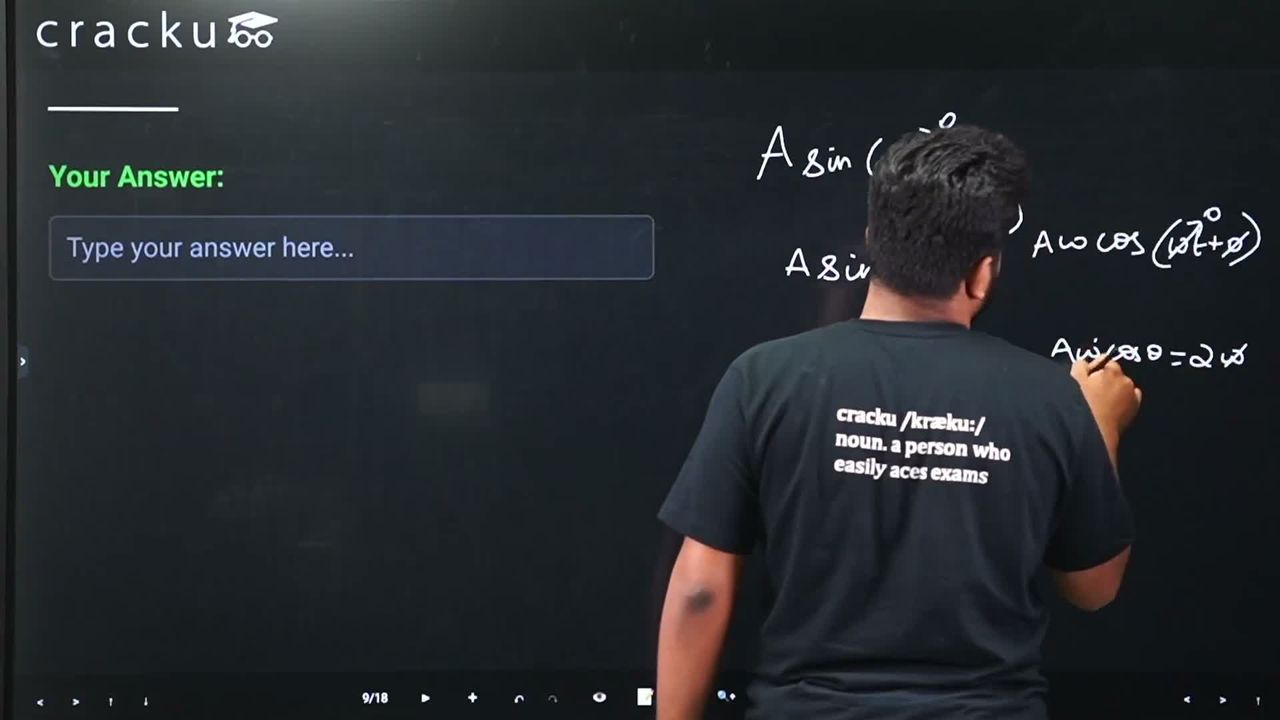
A particle executes simple harmonic motion represented by displacement function as $$x(t) = A\sin(\omega t + \phi)$$. If the position and velocity of the particle at $$t = 0$$ s are 2 cm and 2$$\omega$$ cm s$$^{-1}$$ respectively, then its amplitude is $$x\sqrt{2}$$ cm where the value of $$x$$ is _________
Correct Answer: 2
We are told that the motion is simple harmonic and is expressed as $$x(t)=A\sin(\omega t+\phi)$$, where $$A$$ is the amplitude, $$\omega$$ is the angular frequency and $$\phi$$ is the initial phase.
At the initial instant $$t = 0\ \text{s}$$, the displacement is given to be 2 cm. Substituting $$t = 0$$ in the displacement equation we obtain
$$x(0)=A\sin(\omega\cdot 0+\phi)=A\sin\phi=2\ \text{cm}$$
So,
$$A\sin\phi=2\qquad (1)$$
The velocity in SHM is the time derivative of displacement. The standard derivative formula is
$$v(t)=\frac{dx}{dt}.$$
Differentiating $$x(t)=A\sin(\omega t+\phi)$$ with respect to $$t$$, we get
$$v(t)=A\omega\cos(\omega t+\phi).$$
Again taking $$t = 0\ \text{s}$$, and using the given initial velocity of $$2\omega\ \text{cm s}^{-1}$$, we write
$$v(0)=A\omega\cos(\omega\cdot 0+\phi)=A\omega\cos\phi=2\omega\ \text{cm s}^{-1}.$$
Dividing by $$\omega$$ (since $$\omega\neq 0$$), we get
$$A\cos\phi=2\qquad (2)$$
Now we have two simultaneous relations:
$$A\sin\phi=2\ \text{and}\ A\cos\phi=2.$$
To find the amplitude $$A$$ we recall the Pythagorean identity $$\sin^{2}\phi+\cos^{2}\phi=1$$. Squaring equations (1) and (2) and adding them uses this identity neatly:
$$\bigl(A\sin\phi\bigr)^{2}+\bigl(A\cos\phi\bigr)^{2}=2^{2}+2^{2}.$$
This gives
$$A^{2}\bigl(\sin^{2}\phi+\cos^{2}\phi\bigr)=4+4.$$
Using $$\sin^{2}\phi+\cos^{2}\phi=1$$, the left side becomes simply $$A^{2}$$. Hence,
$$A^{2}=8,$$
and taking the positive square root (amplitude is always positive),
$$A=\sqrt{8}=2\sqrt{2}\ \text{cm}.$$
The problem statement says the amplitude can be written as $$x\sqrt{2} \ \text{cm}$$. Comparing this with $$A=2\sqrt{2}\ \text{cm}$$ we clearly see
$$x=2.$$
So, the answer is $$2$$.
Was this solution helpful?
Click on the Email ☝️ to Watch the Video Solution
Create a FREE account and get:
_1.webp)

Educational materials for JEE preparation

Ask our AI anything

AI can make mistakes. Please verify important information.
AI can make mistakes. Please verify important information.
