91- 6303239042

Amide linkage formed between the $$\text{--COOH}$$ group of one amino acid and the $$\text{--NH}_2$$ group of another:
$$\text{--COOH} + \text{H}_2\text{N--} \to \text{--CO--NH--} + \text{H}_2\text{O}$$
Sign in
Please select an account to continue using cracku.in
↓ →
Amide linkage formed between the $$\text{--COOH}$$ group of one amino acid and the $$\text{--NH}_2$$ group of another:
$$\text{--COOH} + \text{H}_2\text{N--} \to \text{--CO--NH--} + \text{H}_2\text{O}$$
In the following reaction sequence, major products X and Y are acyclic monomers.
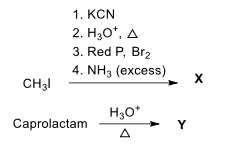
500 mol of X completely reacts with 500 mol of Y to give 1 mol of a single biodegradable acyclic copolymer Z as the only product. The amount of Z formed in grams is ___.
Given: Atomic mass (in amu): H : 1, C : 12, N : 14, O : 16, Br : 80
Start your IIM journey with the right preparation and crack CAT 2026.

Educational materials for CAT preparation