Sucrose is $$\alpha$$-D-glucopyranosyl$$(1\rightarrow 2)$$$$\beta$$-D-fructofuranoside.
In its Haworth form:
• the glucopyranose unit is in the $$\alpha$$-configuration (the anomeric -O-CH2 of glucose lies trans to the CH2OH group).
• the fructofuranose unit is in the $$\beta$$-configuration (the anomeric -O- of fructose lies cis to the CH2OH group).
• the two rings are connected through C-1 of glucose and C-2 of fructose, i.e. a $$1\rightarrow 2$$ glycosidic linkage.
To obtain the artificial sweetener X (commercial name : sucralose) three specific changes are made to sucrose:
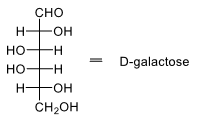
1. Epimerise the glucose unit at C-4 to convert it into D-galactose (-OH at C-4 changes from down to up in the Haworth projection).
2. Replace the -OH at C-4 of this galactose by Cl → 4-chloro-4-deoxy-$$\alpha$$-D-galactose.
3. Replace the -OH groups at C-1 and C-6 of the fructose unit by Cl → 1,6-dichloro-1,6-dideoxy-$$\beta$$-D-fructose.
4. Keep the original $$\alpha(1\rightarrow 2)\beta$$ glycosidic bridge unchanged.
Therefore, in the correct diagram we must see:
• a six-membered $$\alpha$$-D-galactopyranose ring with Cl at C-4 (up position).
• a five-membered $$\beta$$-D-fructofuranose ring with Cl at C-1 (down position) and Cl at C-6 (exocyclic CH2Cl).
• the inter-unit oxygen joining C-1 of galactose to C-2 of fructose.
Inspecting the four given drawings, only Option A shows all of the following simultaneously:
• Cl on C-4 of the pyranose ring (up).
• Cl on the anomeric carbon (C-1) of the furanose ring (down) giving the $$\beta$$ arrangement.
• Cl on C-6 of the fructose side chain.
• The $$\alpha(1\rightarrow 2)\beta$$ glycosidic linkage between the two rings.
Hence, the structure that matches 4-chloro-4-deoxy-$$\alpha$$-D-galactose-(1→2)-1,6-dichloro-1,6-dideoxy-$$\beta$$-D-fructose is
Option A which is: sucralose.
 91- 6303239042