August 29, 2026: Prepare for CAT 2026 with Arithmetic questions from the live session by Maruti Sir and Sayali Ma’am, featuring expert video solutions, shortcuts, and practice.Read More
August 28, 2026: Here we have discussed Bhaskar's CAT 100 percentile journey, preparation strategy, mock analysis, daily targets & lessons from his preparation.Read More
CAT Arithmetic Questions 2026 with Video Solutions
CAT Arithmetic is an important part of the Quantitative Aptitude section. To help CAT 2026 aspirants improve their concepts, speed, and accuracy, Cracku brings the CAT Arithmetic Marathon 2026.
The session by Maruti Sir (5-time CAT 100%iler) and Sayali Ma’am (2-time CAT 99.97%iler) covers important and expected Arithmetic questions with detailed video solutions and effective shortcuts.
Topics include Percentages, Profit & Loss, SI & CI, Ratio & Proportion, Averages, Mixtures, Time & Work, Time-Speed-Distance, Boats & Streams, Races, Trains, Partnerships, and Ages.
Attempt the questions yourself first and then watch the video solutions to improve your approach and strengthen your CAT 2026 Quant preparation.
CAT Arithmetic Questions 2026 PDF
The CAT Arithmetic Questions 2026 PDF can be used to practise the questions covered in the Arithmetic Marathon, Download the CAT Arithmetic Questions PDF and attempt the questions within a fixed time limit. Once you have completed your attempt, watch the video solutions to understand the most efficient approach and identify the mistakes in your method.
These topics form an important part of Arithmetic preparation for CAT. Solving a variety of questions from these areas can help you develop the ability to identify the right concept and apply it quickly.
What You'll Learn from CAT Arithmetic Marathon 2026
The CAT Arithmetic Marathon is not only about solving questions. It is designed to help students develop a structured approach to solving CAT-level Quantitative Aptitude problems.
By following the session, you can improve:
Conceptual clarity: Understand the fundamental concepts behind important Arithmetic topics.
Problem-solving approach: Learn how to identify the right method for different types of questions.
Calculation speed: Practise techniques that can help reduce unnecessary calculations.
Accuracy: Identify common mistakes and learn how to avoid them.
Question selection: Understand which questions can be solved quickly and which may require more time.
CAT preparation: Practise important Arithmetic questions relevant to the CAT 2026 Quant section.
The CAT Arithmetic Marathon 2026 is a comprehensive practice session covering important and expected Arithmetic questions for CAT 2026.
Maruti Sir and Sayali Ma’am solve questions from key topics such as Percentages, Profit & Loss, Ratio & Proportion, Averages, Mixtures, Time & Work, Time-Speed-Distance, Trains, Partnerships, and Ages, while explaining effective methods and shortcuts.
Watch the complete session below to practise important questions, learn efficient solving approaches, and improve your speed and accuracy in CAT 2026 Quantitative Aptitude.
Before watching the solution, try to solve each question yourself. Pause the video whenever a new question appears and attempt it within a fixed time.
Regularly practising CAT Arithmetic questions can help you become more comfortable with calculations, identify patterns faster and improve your ability to solve questions under time pressure.
Question 1
A bus travels at an average speed of $$60$$ km/h when it is moving continuously without any stoppages. However, including stoppages, its average speed reduces to $$45$$ km/h. For every hour that the bus is running, how much time does it spend at stoppages?
Show Answer
Solution
We are given that the bus travels at an average speed of $$60$$ km/h when it is moving continuously without any stoppages but including stoppages, its average speed reduces to $$45$$ km/h.
Let's assume the bus travels for $$1$$ hour.
Now, considering the stoppages, the bus will travel $$45$$ km in 1 hour.
Without stoppages, the bus would have covered $$45$$ km in time $$ = \dfrac {45}{60}=0.75$$ hours.
Now, the travel time with stoppages is nothing but the sum of the bus's actual travel time and the stoppage time.
$$\therefore 1=\text{stoppage time}+0.75$$
$$\text{stoppage time}=0.25$$ hours or $$15$$ min.
This means bus stop for $$15$$ min after running for $$45$$ min.
Thus, the stoppage time is $$\dfrac{1}{3}$$ of the running time.
Therefore, for every $$1$$ hour ($$60$$ minutes) of actual running:
Stoppage time per hour of running time$$=\dfrac{1}{3}*60=20$$ minutes.
Hence, Option B is correct.
correct answer:-
2
Question 2
A person travels a certain distance at his usual speed. If he were to travel $$6$$ km/h slower than his usual speed, he would take $$4$$ hours more to complete the journey. If he were to travel $$4$$ km/h faster than his usual speed, he would take $$1$$ hour less than the usual time. What is the person's usual speed?
Show Answer
Solution
Let us assume that the person's usual speed is $$v$$ km/hr and the usual time he takes to cover the distance is $$t$$ hours.
Therefore, the distance travelled by the person will be $$=vt$$ km
Now, we are given that if he were to travel at $$6$$ km/h slower than his usual speed, he would take $$4$$ hours longer to complete the same distance.
Therefore, the distance travelled by the person can be written as $$=(v-6)(t+4)$$ km
Also, we are given that if he were to travel at $$4$$ km/h faster than his usual speed, he would take $$1$$ hour less than the usual time.
Therefore, the distance travelled by the person can be written as $$=(v+4)(t-1)$$ km
We know that the distance travelled by the person in each case is the same.
$$\therefore vt=(v-6)(t+4)=(v+4)(t-1)$$
Now firstly, we have
$$vt=(v-6)(t+4)$$
or $$vt=vt+4v-6t-24$$
or $$4v=6t+24$$
or $$2v=3t+12$$....(1)
Secondly, we have,
$$ vt=(v+4)(t-1)$$
$$vt=vt-v+4t-4$$
$$v=4t-4$$..........(2)
From 1 and 2, we get
$$3t+12=2(4t-4)$$
$$3t+12=8t-8$$
$$5t=20$$
$$t=4$$ hours
Also, $$v=4t-4=4(4)-4=12$$ km/hr
Hence, the usual speed of the person is $$12$$ km/hr
Hence, Option A is correct.
correct answer:-
1
Question 3
Two cars start from point A at the same time. The faster car reaches the point B after $$1$$ hour $$2$$ minutes and $$30$$ seconds. After reaching the destination, the car turns around and meets the slower car after $$20$$ minutes and $$50$$ seconds. If the speed of the slower car is $$24$$ kmph, find the distance between A and B.
Show Answer
Solution
Let the speed of the faster car be $$v$$ kmph and the distance between point A and B be $$x$$ km. The time taken in hours is
A person walks up a moving escalator and reaches the top in 20 seconds. If he stands still on the same escalator, he is carried to the top in 60 seconds. How long will he take to reach the top if he walks up at the same speed while the escalator moves downward at the same speed as before?
Show Answer
Solution
Let $$N$$ be the total visible steps when the escalator is off.
Let $$p$$ be the person’s speed (steps/sec).
Let $$e$$ be the escalator’s speed (steps/sec).
Let $$t$$ be the time taken.
When the escalator moves upward and the person walks upward, both move in the same direction: $$N=(p+e)t $$
Given time (=20) sec, $$N=(p+e)\cdot 20 \quad ...(1) $$
When the person stands still, only the escalator moves: $$N=et $$
Given time (=60) sec, $$N=e\cdot 60 \quad ...(2) $$
From (2), $$e=\dfrac{N}{60} $$
Substitute in (1): $$N=\left(p+\dfrac{N}{60}\right)20 $$
Amal and Bimal are running on a circular track in the same direction, with their speeds in the ratio 4:7. Chetan joins them by running in the opposite direction at twice Amal’s speed. If all three begin their runs simultaneously from the same point, at how many distinct points on the track will any of them meet each other?
Show Answer
Solution
Amal and Bimal are running in the same direction with their speeds in the ratio 4:7. So, they will meet at |4 - 7|, i.e., 3 distinct points.
Chetan is running in the opposite direction of Amal but twice his speed, which means that the ratio of their speeds is 2:1. This implies that they will meet at (2 + 1) = 3 distinct points.
Now, as Chetan runs at twice the speed of Amal and the ratio of speeds of Amal and Bimal is 4:7, the ratio of speeds of Chetan and Bimal is 8:7. This implies that they will meet at (8 + 7) = 15 distinct points.
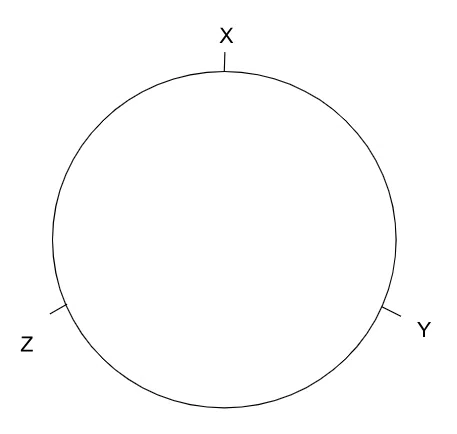
As all the meeting points are equidistant, we can divide the track into 15 and 3 equal areas:
X, Y and Z are the 3 points on the track that will be common in all the pairwise meeting points.
Since they are counted thrice (in 3 pairs), we must subtract them twice, giving a total of (3 + 3 + 15 - 2*3) = 15 distinct meeting points.
correct answer:-
3
Question 6
Ram and Shyam run between A and B with their speeds in the ratio 1:7, with Ram starting from A and Shyam from B. They run towards each other and meet for the first time after five minutes. If the distance between A and B was 20% larger, the point they would have met would've been 840 meters from B. Find the time taken (in seconds) for them to meet if the speed of Shyam increases to twice what it is now.
Show Answer
Solution
Since the ratios are preserved, the distance between the current meeting point to B would also increase by 20% if the track length increases by 20%. Thus, the distance between the meeting point to be should be $$\dfrac{840}{1.2}=700$$ meters. This point is in the ratio 1:7 away from A and B respectively. Thus, we get that, $$7k=700$$, and hence $$(1+7)k=800$$, is the total length AB.
Let the speeds of the two runners be $$x$$ and $$7x$$ meters/min respectively. If they run in opposite directions, the time taken for them to meet will be
$$\Rightarrow \dfrac{800}{x+7x} = \dfrac{100}{x}$$ minutes. This is provided as $$\dfrac{100}{x}=5$$ giving us $$x=20$$ meters/min.
If the speed of Shyam was twice of what it is now, the two speeds would've been $$x$$ and $$14x$$, giving us the meeting time,
Manoj and Rushi are taking part in a hop race, where the distances covered by them in each hop are in the ratio 3:5. Rushi completes the race in 60 hops. If both of them take 1 second to complete each hop, after how many hops of Manoj should Rushi start hopping so that they finish the race at the same time?
Show Answer
Solution
Let us assume Manoj and Rushi cover 3x and 5x metres per hop.
The length of the race is equal to 60 hops of Rushi, i.e., $$60\times\ 5$$x = 300x.
Now, assume Manoj hopped N times before Rushi started, and the race ended in a dead heat.
This implies that in the time Rushi covered the full 300x distance, Manoj covered only 300x - N*3x.
As they both took an equal amount of time to cover these distances, the ratio of distance covered will be equal to the ratio of their speeds.
$$\dfrac{300x}{300x\ -\ 3Nx}=\dfrac{5}{3}$$
$$900x\ =\ 1500x-15Nx$$
$$15Nx\ =\ 600x$$
N = 40 hops.
So, the correct answer is 40.
correct answer:-
40
Question 8
The speed of a boat in still water is 10 km/hr, and the speed of the river current is 2 km/hr. The boat travels a certain distance downstream in 2 hours. What is the time taken by the boat to cover double the previous distance while travelling upstream?
Show Answer
Solution
Speed of the boat in still water (B) = 10 km/hr
Speed of the stream/river current (S) = 2 km/hr
$$\Rightarrow$$ Downstream speed of the boat = B + S = 10 + 2 = 12 km/hr
The boat covers the downstream distance in 2 hours. Let the distance be D.
$$\Rightarrow$$ D = 12 $$\times$$ 2 = 24 km
Now the boat has to travel double the distance upstream.
$$\Rightarrow$$ New distance = 2D = 2 $$\times$$ 24 = 48 km
$$\Rightarrow$$ Upstream speed of the boat = B - S = 10 - 2 = 8 km/hr
$$\Rightarrow$$ Time taken = 48 / 8 = 6 hours
Hence, option C is the correct choice.
correct answer:-
3
Question 9
Two trains, A and B, running at a speed of 108 kmph and 90 kmph, respectively, cross a tunnel. The length of A and B is 200 metres and 250 metres, respectively. The time it takes for the rear end of train A to enter the tunnel, after its engine has just exited the tunnel is $$x$$ seconds. Similarly, this time for train B is $$y$$ seconds. If $$x+y=5\dfrac{2}{3}$$ seconds, find the length of the tunnel.
Show Answer
Solution
Let the length of the tunnel be $$d$$ meters.
The time it takes for train A's last carriage to pass the tunnel after the engine has already passed is $$=\dfrac{\text{length of train A - length of tunnel}}{\text{speed of train A}}$$ seconds
The speed of train A in metres per second is $$\dfrac{5}{18}\times 108 = 30$$ metres per second.
Thus, we have, $$x=\dfrac{200-d}{30}$$ seconds
Similarly, the speed of train B in metres per second is $$\dfrac{5}{18}\times 90= 25$$ metres per second.
Thus, we further have, $$y=\dfrac{250-d}{25}$$ seconds
We are provided that $$x+y=5\dfrac{2}{3}$$ or $$x+y= \dfrac{17}{3}$$
10 men can complete a job in 12 days. 20 women can complete the same job in 8 days. If a man and a woman work together to complete 175% of the total work, in how many days will the job get completed?
Show Answer
Solution
10 men can complete the work in 12 days. Therefore, the total work is equal to 120 man days.
The same work can be completed by 20 women in 8 days. Therefore, the total work is equal to 160 women days.
120m = 160w
=> m = 4w/3.
If a man and woman work together, then 1.75m units of work will be completed in a day.
Total work = 120m*1.75
Time taken = 120*1.75/1.75 = 120 days. Therefore, option B is the right answer.
correct answer:-
2
Question 11
20 men can complete a work in 15 days. 35 women can complete the same work in 10 days. 13 persons completed the work in 25 days. The number of women among the 13 persons is
Show Answer
Solution
Work = 20m*15 = 300m
Also, work = 35w*10 = 350w.
300 man days = 350 woman days.
6m = 7w
Therefore, the work completed by a man in 6 days is equal to the work completed by a woman in 7 days.
13 persons can complete the work in 25 days. Let the number of women be ‘x’ and the number of men be 13-x.
A, B and C can do a piece of work individually in 10, 15 and 20 days respectively. They started the work together but after 3 days, A left. Then in how many days will the total work be completed?
Show Answer
Solution
Let the total work be 60 units (LCM of 10, 15 and 20)
Efficiency of A = 60/10 = 6 units/day
Efficiency of B = 60/15 = 4 units/day
Efficiency of C = 60/20 = 3 units/day
They all can do 13 units of work together.
Then, Work done in 3 days = 13*3 = 39 units
Remaining work = 60-39 = 21 units.
21 units of work will be finished by B and C together in 21/7 = 3 days
Hence, Total work will be completed in 3+3 = 6 days.
correct answer:-
2
Question 13
A tank is filled by three pipes together P, Q and R in 8 hours. After 6 hours pipe R is closed, the remaining pipes fill the tank in next 6 hours. In how much time can R fill the tank alone?
Show Answer
Solution
Let P, Q and R alone fill the tank in p, q and r hours respectively.
Thus, $$\frac{8}{p} + \frac{8}{q} + \frac{8}{r} = 1$$
Also,
$$\frac{12}{p} + \frac{12}{q} + \frac{6}{r} = 1$$
$$\frac{12}{8} - \frac{12}{r} + \frac{6}{r} = 1$$
0.5 = $$\frac{6}{r}$$
r = 12 hours
Hence, option D is the correct choice.
correct answer:-
4
Question 14
A shopkeeper bought 3 units of an article and sold one at a 25% loss due to damage. He marks up the second article by 60% over cost price and offers successive discounts of 20% and 12.5%. He also charges a 10% service fee on the selling price of this article. The customer pays ₹1,386 for the article. The cost price is the same for every unit of article. If the total profit on all 3 units combined is to be at least 20%, what should be the minimum selling price of the third unit(in ₹)?
Show Answer
Solution
Let the cost price of one unit of the article be $$100x$$.
He marks up the second article by 60% over cost price and offers successive discounts of 20% and 12.5%.
So, Selling price = $$100x\times1.6\times0.8\times0.875=112x\ $$
He also charges a 10% service fee on the selling price.
So, final selling price $$=112x\times1.1=123.2x\ \ $$
We are given that customer pays Rs. 1386 for this article.
So, $$123.2x=1386\ \ $$
So, $$x=11.25$$
Cost price of each unit$$=100x=1125$$
Cost price of all three units$$=3*1125=₹3375$$
Total profit on all 3 units combined is to be at least 20%.
Let the total selling price be $$y$$.
So, $$y\ge1.2\times3375\ \ $$
$$y\ge4050$$
The selling price of the damaged unit$$=0.75\times1125=843.75\ $$
The selling price of the second unit$$=1386\ $$
So, the minimum selling price of the third unit$$=4050-\left(1386+843.75\right)=1820.25\ $$
Option D.
correct answer:-
4
Question 15
A shopkeeper sells $$15$$ cars at a $$10$$% profit and $$5$$ cars at a $$10$$% loss, earning an overall profit of Rs $$100$$. He then sells another $$20$$ cars to a wholesaler, with some at a $$10$$% profit and the remainder at a $$10$$% loss. The wholesaler sells all $$20$$ cars for Rs $$2332$$, making an overall $$10$$% profit. Find the ratio of the number of cars sold at a profit by the shopkeeper in the first transaction to the second transaction.
Show Answer
Solution
Let the cost price of each car be $$x$$.
Profit of $$10$$% on the cost price would imply a selling price of $$1.1x$$ and a loss of $$10%$$ would imply a selling price of $$0.9x$$.
From the first transaction, $$15(1.1x) + 5(0.9x) - 20x = 100 \implies 21x - 20x = 100 \implies x = 100.$$
Thus, the cost price of each car is $$100$$.
Since the wholesaler sells the $$20$$ cars for $$2332$$ at a $$10\%$$ profit, his cost price is $$\dfrac{2332}{1.1} = 2120.$$
Hence, the shopkeeper sold the $$20$$ cars to the wholesaler for $$2120$$.
Since $$100$$ is the cost price, the selling prices of the cars would be $$1.1\times 100 = 110$$ and $$0.9\times 100 = 90$$
Let $$a$$ be the number of cars sold at a $$10\%$$ profit by the shopkeeper in the second transaction. Then,
A, B and C entered into a partnership. Initially A invested ₹5000, B invested ₹10,000, C invested ₹7000. After 3 months, B withdrew an amount of ₹2000. After 6 months, C added ₹3000. If the profit at the end of the year is ₹13,200, then the profit earned by C?
Show Answer
Solution
The profit ratio A, B and C is
5000 x 12 : (10000 x 3) + (8000 x 9) : (7000 x 6) + (10000 x 6)
60 : (30 + 72) : (42 + 60)
60 : 102 : 102
10 : 17 : 17
Total profit at the end of year = ₹13,200
$$\therefore$$ Profit earned by C = $$\frac{17}{10+17+17}\times$$13200 = $$\frac{17}{44}\times$$13200 = ₹5100
Hence, the correct answer is Option C
correct answer:-
3
Question 17
A dishonest shopkeeper uses a faulty balance that measures 1200 g for a kilogram while buying goods and 800 g for a kilogram while selling them. In transit, 10% of his goods are damaged and are discarded. He marks up the goods by 25% above the original cost price, offers a 20% discount on the marked price, and sells the remaining goods. What is his overall profit percentage?
Show Answer
Solution
Shopkeeper pays for 1000 g but actually receives 1200 g.
Let the original cost price be 1000 Rs per 1000 gm.
Thus, the cost incurred by the shopkeeper = Rs 1000.
Now 10% of the goods are wasted.
Remaining goods = 1200 ( 1 - 10%) = 1080 gm.
Marked price = 1000 ( 1 + 25%) = Rs 1250
Discount = 1250 $$\times$$ 20% = Rs 250
Stated selling price = 1250 - 250 = Rs 1000
He claims to sell at Rs 1000 per 1000 gm but gives only 800 g per transaction.
$$\Rightarrow$$ Revenue per 800 gm = Rs 1000
$$\Rightarrow$$ Total revenue from 1080 gm = 1080 $$\times$$ (1000/800) = Rs 1350
Overall profit = Total revenue - Total investment = 1350 - 1000 = Rs 350
% profit = 350 / 1000 $$\times$$ 100 = 35%
Hence, option B is the correct choice.
correct answer:-
2
Question 18
A milkman purchases 20% extra pure milk from his supplier while paying for 1 Litre. He dilutes the milk with water (available at no cost) such that the final mixture has a milk-to-water ratio of 3 : 1. While selling, he gives 20% less milk for every 1 Litre. He marks up the cost price of pure milk by 25% but also offers a 10% discount. What is his actual profit percentage?
Show Answer
Solution
Let 1000 mL (1 litre) of milk originally cost Rs. 1200.
Now, the milkman pays for 1000 mL but actually gets 20% extra.
$$\Rightarrow$$ Milkman receives 1200 mL for Rs. 1200
$$\Rightarrow$$ Cost incurred by the milkman = Rs 1200 / 1200 mL = Rs 1/mL
Now, he replaces the milk with water, so the final mixture has a milk-to-water ratio of 3:1.
He also cheats while selling by giving 20% less. Thus, for every 1 litre, he is actually selling only 800 mL.
In this 800 mL mixture, the actual milk is 75% of the total (3:1 ratio).
Thus, for the price of 1000 mL of mixture, he is actually selling (800 $$\times$$ 0.75) = 600 mL
He marks up the cost price of pure milk by 25% and gives a discount of 10%
A shopkeeper earns twice as much of a profit he would have made after selling an domestic rose, on an imported rose. A customer places an order for 100 roses, a certain percentage of which he wants to be of the imported quality.The shopkeeper misheard him and sends him the asked percentage of domestic roses by mistake.In the transaction ends up making 12.5% less profit than he would have made had he given the customer what he had asked for. How many domestic roses did the customer want?
Show Answer
Solution
Let the profit earned on a domestic rose be 100p. Therefore the profit earned on International rose will be 200p.
Let "x" be the number of imported roses the shopkeeper mistakenly delivers.Therefore the number of domestic roses delivered will be (100-x)
Therefore the profit he earns will be equal to 100p(100-x)+200px.
Now we know that this is 12.5% less than what he would have earned had he delivered the right number of roses in which case since the number of roses delivered is exchanged profit will be 100px+ 200(100-x).
Since that is the number of roses the shopkeeper accidentally delivered, the number of imported roses he should have delivered will be equal to 60.Therefore the number of domestic roses he should have delivered will be equal to 40.
correct answer:-
40
Question 20
Ms. Debjani after her MBA graduation wants to have start-up of her own. For this, she uses ₹ 8,00,000 of her own savings and borrows ₹ 12,00,000 from a public sector bank under MUDRA Scheme. As per the agreement with the bank, she is supposed to repay the principal of this loan equally over the period of the loan, which is 25 years. Two years after taking the first loan, she borrowed an additional loan of ₹ 8,00,000 to finance the expansion plan of her start-up. If Ms Debjani clears all her loans in 25 years from the date of taking the first loan, how much total interest does she have to pay on her initial borrowing? Assume simple interest rate at 8 per cent per annum and interest is calculated on only the outstanding principal.
An investor lent-out a certain sum on simple interest and the same sum on compound interest at the same rate of interest per annum. He noticed that the ratio of the difference of the compound interest and the simple interest for 4 years to the difference of the compound interest and the simple interest for 3 years is 20:8. The approximate rate of interest per annum is given by,
A shopkeeper buys a smartphone for ₹$$9,000$$ and marks it up by $$40$$%. He then offers a discount of $$10$$%. The customer purchases the smartphone through a $$3$$-year EMI scheme with equal annual instalments at $$10$$% compound interest per annum. Find the approximate net profit percent earned by the shopkeeper.
Show Answer
Solution
The cost price of a smartphone is ₹ $$9,000$$
Now the shopkeeper marks the cost price by $$40$$% and also offers a discount of $$10$$ %
So, the selling price of the smartphone is $$=1.4*0.9*9000=$$Rs $$11,340$$
Now, let us assume that the yearly instalment is Rs $$i$$
$$11,340(1.1)^3=i(1.1)^2+i(1.1)+i$$
$$11,340*1.331=1.21i+1.1i+i$$
$$11,340*1.331=3.31i$$
$$i=$$ Rs $$4,559.98$$
Hence, the total amount paid by the customer is $$=3*4559.98=$$ Rs $$13679.94$$
The profit percent made by the shopkeeper is$$=\dfrac{(13679.94-9000)*100}{9000}=51.99$$%
Hence, Option C is correct.
correct answer:-
3
Question 23
In 25 consecutive natural numbers, the average of last 13 numbers is 39. What is the average of all 25 numbers?
Sonali applied for a job of Science teacher in a school. In the test for job, she scored 8 in Physics, 8 in Chemistry, 6 in Biology, and 6.5 in the interview. For calculating the final score, weightage of 2, 3, 3, and 4 were assigned to Physics, Chemistry, Biology and interview, respectively. What is the weighted average score of Sonali?
Three candidates "A", "B", "C" participated in an election. "A" gets 40% of the votes more than "B". "C" gets 20% votes more than "B". "A" also overtakes "C" by 4000 votes. If 90% voters voted and no invalid or illegal votes were cast, then what will be the number of voters in the voting list?
The total number of students in class A and B is 92. The number of students in A is 30% more than that in B. The average weight (in kg) of students in B is 50% more than that of students in A. If the average weight of all the students in A and B is 56 kg, then what is the average weight (in kg) of students in B?
The agricultural yield (Y) of a particular crop depends directly on the product of the amount of fertilizer applied (F) and the square root of the annual rainfall (√R). In a year when a farmer applies 50 kg of fertilizer and receives 64 cm of rainfall, the crop yield is 2400 kg. If the rainfall in the following year is expected to be 81 cm and the farmer aims for a yield of 3240 kg, how much fertilizer should be applied?
Show Answer
Solution
The joint variation relationship: $$Y = k \cdot F \cdot \sqrt{R}$$
First, find the constant of proportionality ($$k$$) using the initial conditions ($$Y = 2400$$, $$F = 50$$, $$R = 64$$):
$$2400 = k \cdot 50 \cdot \sqrt{64}$$
$$2400 = k \cdot 50 \cdot 8$$
$$2400 = 400k \Rightarrow k = 6$$
Now, use the formula $$Y = 6 \cdot F \cdot \sqrt{R}$$ to find the new fertilizer requirement ($$Y = 3240$$, $$R = 81$$):
The monetary value of a rare gemstone varies directly as the square of its weight. Unfortunately, a large gemstone is accidentally dropped and breaks into three distinct pieces whose weights are in the ratio 1 : 2 : 3. If the value of the original, unbroken gemstone was Rs. 72,000, what is the total financial loss incurred due to the breakage?
Show Answer
Solution
Let the weights of the three pieces be $$x$$, $$2x$$, and $$3x$$.
The original total weight of the gemstone was $$x + 2x + 3x = 6x$$.
The value formula is $$V = k \cdot (\text{Weight})^2$$.
Original Value: $$V_{\text{original}} = k \cdot (6x)^2 = 36kx^2$$
We are given that the original value is Rs. 72,000:
$$36kx^2 = 72000 \Rightarrow kx^2 = 2000$$
Combined value of the three broken pieces:
$$V_{\text{piece1}} = k(x)^2 = kx^2$$
$$V_{\text{piece2}} = k(2x)^2 = 4kx^2$$
$$V_{\text{piece3}} = k(3x)^2 = 9kx^2$$
$$\text{Total New Value} = kx^2 + 4kx^2 + 9kx^2 = 14kx^2$$
$$\text{Loss} = 36kx^2 - 14kx^2 = 22kx^2$$
Since we know $$kx^2 = 2000$$:
$$\text{Loss} = 22 \times 2000 = 44,000$$
correct answer:-
2
Question 29
The speed of a bus with just the driver sitting in it is 60 Kmph. The decrease in speed is directly proportional to the number of people sitting in it. With 9 passengers and a driver, its speed is 54 Kmph. What is maximum number of passengers it can carry and still continue to move forward?
Show Answer
Solution
Let a be the speed with no passengers. Let t be the reduction in speed with each person.
Hence, a-t=60 and a-10t=54.
Hence, 9t=6.
So the bus decelerates by 6/9 kmph per passenger. Hence, with 90 passengers the bus will come to a stand-still.
Max number of passengers = 90-1=89.
correct answer:-
1
Question 30
The profit made by selling a block of wood is proportional to the surface area of the wood. A seller earns Rs. 10,000 when he sells a block of wood with dimensions 2m x 2m x 2m. If the block is broken into five pieces, one with dimensions 2m x 2m x 1m and another four cubes with sides 1m each. How much does the seller earn now by selling the five pieces?
Show Answer
Solution
The surface area of 2m x 2m x 2m cube is $$6a^2$$ or $$6a^2=6\times\left(2\right)^2=24\ m^2$$
As the profit is proportional to the surface area, assume the constant of proportionality to be $$k$$
So, $$24k=10000$$
or $$k=\dfrac{10000}{24}=\dfrac{1250}{3}$$
Now, the combined area of the five blocks of wood is calculated as,
The surface area of cuboid is $$2\left(lb+bh+hl\right)$$
i.e. $$2\left(lb+bh+hl\right)=2\left(4+2+2\right)=16\ m^2$$
The surface area of the four cubes is $$4\times\left(6\times1^2\right)=24$$
So, the combined area now is 16+24 = 40
Hence, the profit now will be $$40k=40\times\dfrac{1250}{3}=16667$$
Hence, the answer is Rs. 16667
correct answer:-
4
Question 31
A mixture contains alcohol and water in the ratio 4 : 3. If 5 liters of water is added to the mixture, the ratio becomes 4 : 5. The quantity of alcohol in the given mixture (in liters) is :
The ratio of ‘metal 1’ and ‘metal 2’ in alloy ‘A’ is 3 :4. In alloy ‘B’ same metals are mixed in the ratio 5:8. If 26 kg of alloy ‘B’ and 14 kg of alloy ‘A’ are mixed then find out the ratio of ‘metal 1’ and ‘metal 2’ in the new alloy.
A trader purchases 80 kg of imported coffee powder at ₹220 per kg. To earn a profit of 20%, he mixes it with a certain quantity of local coffee powder costing ₹50 per kg and sells the mixture at ₹220 per kg, claiming that it is pure imported coffee. How many kilograms of local coffee powder did he mix with the imported coffee?
Show Answer
Solution
Let us assume the quantity of Local coffee mixed is X kg.
Total mixture sold = 80 kgs + X kgs.
Cost Price of imported coffee = 80*220 = 17600 Rs.
Cost Price of local coffee = 50*X = 50X.
Total Cost Price = Rs. 17600 + 50X.
Total Selling Price = 220*(80 + X) = Rs. 17600 + 220X.
Profit Earned = (17600 + 220X) - (17600 + 50X) = Rs. 170X.
Profit Percentage = $$\frac{170X}{1760+50X}\times\ 100$$
==> $$\frac{170X}{17600+50X}\times\ 100\ =\ 20$$
==> 850X = 17600 + 50X
==> 800X = 17600
==> X = 22.
The quantity of local coffee used in the mixture is 22 Kgs.
correct answer:-
3
Question 34
A man has a 1 L bottle of pure alcohol and 4 sons. He pours 200 mL into his own glass, then refills the bottle with 200 mL of water. For each son, oldest to youngest, he pours a drink from the bottle, refilling the bottle with water after each pour, such that every son receives exactly 200 mL of pure alcohol. How much water is in the youngest son’s drink?
Show Answer
Solution
The man first pours 200 mL of pure alcohol into his glass, then refills the bottle with 200 mL of water. The bottle now contains 800 mL of alcohol and 200 mL of water, giving an alcohol-to-water ratio of 4:1.
When serving the eldest son, the man pours enough of this mixture so that the son receives exactly 200 mL of alcohol. Since the mixture is in a 4:1 ratio, the eldest son receives 200 mL of alcohol and 50 mL of water.
The same process continues for each subsequent son. Although the amount of water in each drink changes, every son receives exactly 200 mL of pure alcohol.
Before serving the youngest son, the man has already distributed drinks to himself and the three older sons. Since each of those four glasses contains 200 mL of alcohol, a total of 4 × 200 = 800 mL of alcohol has been removed from the bottle. Therefore, only 200 mL of alcohol remains.
Because the bottle is refilled with water after each serving, the bottle still contains 1 litre of solution when the youngest son is served. To receive the remaining 200 mL of alcohol, he must be given the entire contents of the bottle: 1,000 mL of solution containing 200 mL of alcohol and 800 mL of water.
Therefore, the youngest son receives 800 mL of water.
correct answer:-
4
Question 35
A cunning vendor sells a drink- Taaza, such that he is able to sell only 100 ml the first day, 150 ml the next day and so on. He increases his sales by exactly 50 ml everyday. He had 10 L of Taaza initially, which remains the same everyday as he replaces the amount of drink sold with water at the end of that day. At the end of the drink, approximately what percentage was Taaza out of the mixture sold in all the days combined?
Show Answer
Free CAT 2026 Preparation Resources
Cracku provides several free resources to help students prepare for CAT 2026.
Using these resources along with regular mock-test practice can help you build a consistent preparation strategy for CAT 2026.
Solution
On the first day, drink sold= 100 ml. And on every subsequent day, sale increases by 50 ml.
So, sales of drink follows an A.P with first term= 100 ml and ends on the day when sales= 10L or 10000 ml.
With common difference= 50 ml,
the nth day when the entire drink will be sold can be found using a+ (n-1)d= 10000
=> 100+ 50(n-1)= 10000
=> 10+ 5n-5= 1000
=> 5n= 995
.'. n= 995/5= 199 days.
Total drinks sold= Sum of A.P. with n= 199, first term= 100 ml and last term= 10000 ml= $$\ \frac{\ n}{2}\left[a+l\right]=\ \frac{\ 199}{2}\left[100+10000\right]=199\left[50+5000\right]=199\times5050=1004950\ ml\ \ $$ or 1004.95 L.
Therefore, % of Taaza sold= $$\ \frac{\ 10}{1004.95}\times100\%=\ 0.995\%\ $$
correct answer:-
1
Thank you for your response! We truly value your feedback.
Our Success Stories
Adhiraj Joshi
CAT 2025
99.99%ile
After joining Cracku, my routine became structured. My task was to complete the videos and finish the daily targets on weekdays, and every weekend I aimed to give two DashCAT mocks. While analyzing m…
Vivek
CAT 2025
99.88%ile
I’m Vivek, and I scored 99.88 percentile in CAT 2025. I would like to sincerely thank Cracku for playing a key role in helping me achieve this result. The daily targets helped me maintain consistency…
Naman
CAT 2025
99.53%ile
I prepared through Cracku’s course, which was a one-stop solution for all my requirements, including detailed concept videos, quick revision videos, extensive practice questions in the Study Room,…
Sahil
CAT 2025
99.89%ile
I joined Cracku 2025 batch for preparation. There mocks really helped to practice and become comfortable with CAT syllabus and pattern. Also the doubt solving approach felt really useful as it was ve…
Amish Kakru
CAT 2025
99.98%ile
Cracku has been central to how I’ve structured my CAT preparation. Solving previous year papers and DashCAT mocks here feels close to the real exam, both in difficulty and in how mistakes are analyse…
Ojas Jain
CAT 2025
99.97%ile
My experience with Cracku was phenomenal. Right from their interface, everything was just the way a CAT student wants it to be. The difficulty was challenging which helped me to tackle CAT 2025. The …
Pudhuyugan
CAT 2025
99.95%ile
I secured a 99.95 percentile in CAT’25. I was enrolled in Cracku’s daily targets and mock test series. Cracku was my only source of preparation, and I relied solely on the daily targets to build cons…
Tarun
CAT 2025
99.95%ile
Joining Cracku provided me with a structured study plan to prepare for cat. The daily targets kept me motivated to keep practicing each day and the live classes were a wonderful doubt solving tool. T…
Arjun
CAT 2025
99.82%ile
Coming from an engineering background, I did not need much help with understanding concepts, but practice was a major challenge. Cracku mocks offered a wide variety of questions along with detailed, …
Jegadheep
CAT 2025
99.72%ile
I got 99.72 percentile with a raw score of 102 in CAT 2025. This wouldn’t have been possible without Cracku. I have been using Cracku’s Daily Targets, Question Bank and Mock Series. The Daily Targets…
Harsh Khudania
CAT 2025
99.93%ile
Hi, Thanks a lot for your support and guidance during my preparation journey. Mocks were very helpful. I regularly attempted DashCAT's and analysed my mistakes and shortcomings. over-time it helped m…
Prasenjit
CAT 2024
99.98%ile
Joining Cracku was one of the best decisions I made for my exam preparation. The experienced faculty and structured course material helped me strengthen my concepts and boost my confidence. The regul…
Prasanna Telawane
CAT 2024
99.93%ile
Cracku has helped me a lot in my journey to ace CAT 2024. It played a significant role by emphasizing on the basics and problem solving skills by engaging us in marathons and many exam oriented video…
Rushikesh Nikam
CAT 2024
99.92%ile
Cracku has been very important for my journey. Last year, although I scored 99.5%ile, I had no calls as I only scored 8 marks in DILR, missing sectional cutoffs. This year, Sayali mam's lectures have…
Swaraj Pal Kesari
CAT 2024
99.95%ile
I've scored 133 in the CAT 2024 exam. Sayali Ma'am's explanations helped me a lot. LRDI section again had very challenging sets which prepared me for the worst. And that was the best part of it. Maru…
Virajitha Vajha
CAT 2024
99.93%ile
I started my CAT preparation in September with the help of Cracku's crash course. Cracku played a key role in helping me brush up on my quant basics and overcome my fear of RCs. The unlimited resourc…
Mohit Dalmia
CAT 2024
99.60%ile
I was able to get 99.6 percentile in 3 months due to Sayali Mam's concept videos and Maruti Sir's Guidance. Moreover the mocks are very high quality mocks, and it really prepares you for CAT. Real…
Varun Reddy
CAT 2024
99.12%ile
At first, I only prepared by taking mock exams. This unstructured approach left significant gaps in my understanding of some concepts. To address this, I enrolled in the Crash Course. The brief conce…
Parth Bohra
CAT 2024
99.55%ile
Cracku is one of the best CAT Coaching out there. It is a complete package with daily targets, video lectures, live classes and mocks. Maruti sir, Sayali ma'am and the entire Cracku team have done a …
Vivek Singh
CAT 2024
99.56%ile
When it comes to CAT & OMET's, I feel that no one does it better than Cracku. The dynamic duo of Maruti Sir and Sayali Ma'am alongside the other team members leave no stone unturned in delivering the…
Revant Madnani
CAT 2024
99.43%ile
Cracku has helped me immensly in my CAT preferation with a question bank full of the toughest, most asked questions helping me develop proficiency in each section. The VARC sectionals made me complet…
Shrey Srivastava
CAT 2024
99.24%ile
Cracku prepared me for the worst. The mocks were challenging and always taught me new concepts or efficient ideas. As Maruti Sir says, it is better to give a tough mock and learn, than to give an eas…
Vishesh Garg
CAT 2024
99.81%ile
I bought Cracku's test series for my CAT preparation for the CAT 2024 examination. The mock tests were really helpful for the preparation because they actually prepare you for all the adversities tha…
A Sai Priya
CAT 2024
99.01%ile
I had taken Cracku Course and Mocks, the Live video classes helped me to revise all the topics and i could clear my concepts with them. The daily targets which are available for free on the cracku ar…
Mridul Tiwari
CAT 2024
99.98%ile
During my CAT'23 and CAT'24 season I enrolled for the Dashcats test series and Daily targets which proved of immense help during the final exam day. In 2023 the quant paper was almost a replica of a …
Unnat Akhouri
CAT 2023
99.96%ile
I am writing this message to inform students of one of the most underrated yet excellent resources for CAT. The concept videos at Cracku dealt with everything from absolute fundamentals, and it was a…
Om Adarsh
CAT 2022
99.98%ile
Cracku was my first step to CAT coaching. I had no clue where to start, but with the regular daily tests, sectional tests and full length mock tests I assessed my strengths and weaknesses and worked …
Vikram Aditya Sharma
CAT
99.95%ile
As a working professional in a busy job who had not taken the CAT before, Cracku's offerings were just what I needed. The bite-sized lessons were concise yet easy to follow, and the daily targets ens…
Siddhant Samyak
CAT 2023
99.75%ile
Cracku is best for CAT preparation. The Dashcat mocks level was at par with the CAT. The mocks were very well designed by the faculty keeping it up to date with the CAT's trend. Difficulty level of q…
Nitin Mangla
CAT
99.95%ile
Dashcats and video lectures quite helpful in preparation. And difficulty of QA practice questions helped me to score well in Quants.
Amal C Sivan
CAT 2023
99.93%ile
I enrolled for Cracku cat course in Jan 2023. I followed the daily schedule of the course as well as the booster classes. Daily targets were a great help. I completed all of them. DashCATs were amazi…
K T S Sai Teja
CAT
100%iler
My initial preparation was solely based on taking mocks. Not preparing in a structured manner meant that there were glaring gaps in my understanding of a few concepts. So, I signed up for the CAT Cra…
Deveshwar Mandava
CAT 2023
99.92%ile
The extensive question bank based on difficulty level helped me practice a lot based on the areas where I was struggling and what level of questions were those.
Bhumika Mittal
CAT 2022
99.99%ile
Cracku sectional and full length mocks are really helpful. It gives an idea about attempt strategy and time management.
Priyadarshini Das
CAT 2023
99.91%ile
Cracku helped me to maintain regularity with their daily tests. The materials and sectional tests helped to brush up my concepts. The mock tests are also at par with the level of questions in the act…
Rishab Ram
CAT 2023
99.89%ile
Cracku had some of the best test material and the dash cat test series was the most accurate to the actual cat and prepared me in the best way, and not to mention the daily target question quality wa…
Aravind Muralidharan
CAT
99.87%le
Cracku is definitely one of the best when it comes to CAT. Maruti and Sayali have done a wonderful job with the video series and the DashCAT solutions are very well made. When it comes to preparation…
Vaisakh PJ
CAT 2023
99.84%ile
I did my CAT preparation while i was working. It was extremely challenging for me to balance my cat preparation along with my work under limited time available. The structured learning material curat…
Uttank Jha
CAT 2023
99.65%ile
When I first started preparing for CAT, I was completely unaware of the exam pattern as well as the syllabus. But Cracku's well-curated 125-day crash course provided a very targeted approach for my p…
Tirtharaj Choudhury
CAT 2023
99.64%ile
Cracku is basically a one-stop shop for CAT. And is by far the most inexpensive coaching out there. And it gets better, because the mocks are the closest to the real exam among all other major coachi…
Anirudh Suresh
CAT 2023
99.51%ile
Cracku helped me get done with my basics initially, then it was helpful in providing me with sectionals and most importantly study room which was very helpful throughout my cat journey, as I could pi…
Trisha Awari
CAT 2023
99.33%ile
I am very grateful for Sayali ma'am and Maruti sir's course videos and livestreams; they helped me strengthen my concepts and build confidence. Dashcats, daily targets and the extensive study materia…
Ubaidullah Kazi
CAT 2023
99.27%ile
Cracku splits its content into doable daily tasks, which motivated me to log in and build upon my existing knowledge base or learn something new every day.
Vaishnavi Patil
CAT 2023
99.25%ile
I had completely relied on Cracku for my CAT preparations. Their video lectures, study room problems and DashCAT mocks really helped me in my journey for CAT preparation.
Sajal Swapnil
CAT 2023
99.23%ile
Cracku has been really helpful in providing the most structured and optimised study plan for CAT according to me. The Daily Targets and the Study Rooms have really helped maximise productivity in sol…
The CAT Arithmetic Marathon 2026 is a practice session covering important CAT Arithmetic questions with detailed video solutions, shortcuts, and strategies to improve speed and accuracy.
The session covers Percentages, Profit & Loss, Simple & Compound Interest, Ratio & Proportion, Averages, Mixtures, Time & Work, Time-Speed-Distance, Boats & Streams, Races, Trains, Partnerships, and Ages.
You can download the CAT Arithmetic Questions 2026 PDF and attempt the questions before watching the detailed video solutions.
The CAT Arithmetic Marathon 2026 is conducted by Maruti Sir, a 5-time CAT 100%iler, and Sayali Ma’am, a 2-time CAT 99.97%iler.
Practising CAT Arithmetic questions helps strengthen concepts, improve calculation speed and accuracy, and develop efficient approaches for the Quantitative Aptitude section.
Yes, the CAT Arithmetic Marathon can help CAT 2026 aspirants practise important Arithmetic concepts, improve problem-solving skills, and become more confident with different question types.
Try solving each question from the PDF within a fixed time before watching the solutions. Then compare your approach with the methods and shortcuts explained by Maruti Sir and Sayali Ma’am.
You can watch the CAT 2026 Arithmetic Marathon Live Session online and follow the detailed solutions, shortcuts, and preparation strategies shared by Maruti Sir and Sayali Ma’am.
Book Free CAT Mentorship
Get personalized CAT strategy from a 99%iler
500+ students mentored
OTP Verification
Enter the 6-digit code sent to your phone
Booking Summary
Session:Free CAT Mentorship
Phone:
Date:
Time:
Enter OTP
Didn't receive the OTP?
Almost there!
Tell us where to send your session details
Verifying OTP...
Booking confirmed!
Booking confirmed!
You already have an upcoming free mentorship session.
Booking Summary
Session:Free CAT Mentorship
Phone:
Date:
Time:
You'll receive a calendar invite with your Google Meet link on your email.
 91- 6303239042
 CAT WhatsApp Group