91- 6303239042
The proportion of the sheet area that remains after punching is:
Sign in
Please select an account to continue using cracku.in
↓ →
 CAT WhatsApp Group
A punching machine is used to punch a circular hole of diameter two Units from a square sheet of aluminium of width 2 units, as shown below. The hole is punched such that the circular hole touches one corner P of the square sheet and the diameter of the hole originating at P is in line with a diagonal of the square:
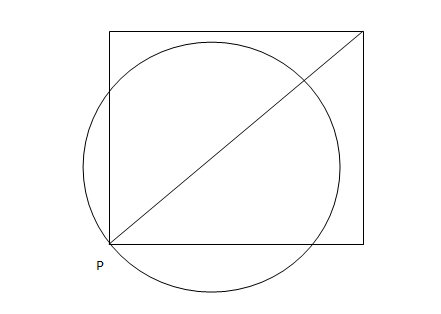
The proportion of the sheet area that remains after punching is:
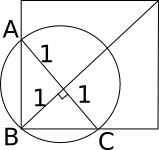
The area of triangle ABC is 1/2 * $$\sqrt2$$ * $$\sqrt2$$ = 1
Area of semi-circle ABC = $$\pi/2$$
So, area of circle outside the square = $$\pi/2$$ - 1 = ($$\pi$$ -2)/2
So, area of circle inside the sheet = $$\pi$$ - ($$\pi/2$$ - 1) = 1 + $$\pi/2$$
Area of original square = 2*2 = 4
So, area of the sheet after punching = 4 - 1 - $$\pi/2$$ = 3 - $$\pi/2$$
So, proportion of sheet that remains after punching = (3 - $$\pi/2$$)/4 = (6 - $$\pi$$)/8
Find the area of the part of the circle (round punch) falling outside the square sheet.
Loading solution...
An airline has a certain free luggage allowance and charges for excess luggage at a fixed rate per kg. Two passengers, Raja and Praja have 60 kg of luggage between them, and are charged Rs 1200 and Rs 2400 respectively for excess luggage. Had the entire luggage belonged to one of them, the excess luggage charge would have been Rs 5400.
What is the weight of Praja’s luggage?
Loading solution...

What is the free luggage allowance?
Loading solution...
If x = -0.5, then which of the following has the smallest value?
Loading solution...
Which among $$2^{1/2}, 3^{1/3}, 4^{1/4}, 6^{1/6}$$, and $$12^{1/12}$$ is the largest?
Loading solution...

If a/b = 1/3, b/c = 2, c/d = 1/2 , d/e = 3 and e/f = 1/4, then what is the value of abc/def ?
Loading solution...
The length, breadth and height of a room are in the ratio 3:2:1. If the breadth and height are halved while the length is doubled, then the total area of the four walls of the room will
Loading solution...
Consider a sequence where the $$n^{th}$$ term, $$t_n = n/(n+2), n =1, 2, ....$$ The value of $$t_3 * t_4 * t_5 * …..* t_{53}$$ equals.
Loading solution...

A group of 630 children is arranged in rows for a group photograph session. Each row contains three fewer children than the row in front of it. What number of rows is not possible?
Loading solution...
What are the values of x and y that satisfy both the equations?
$$2^{0.7x} * 3^{-1.25y} = 8\sqrt{6}/27$$
$$4^{0.3x} * 9^{0.2y} = 8*81^{1/5}$$
Loading solution...
The number of solutions of the equation 2x + y = 40 where both x and y are positive integers and x <= y is:
Loading solution...

A survey was conducted of 100 people to find out whether they had read recent issues of Golmal, a monthly magazine. The summarized information regarding readership in 3 months is given below:
Only September: 18;
September but not August: 23;
September and July: 8;
September:28;
July: 48;
July and August: 10;
none of the three months: 24
What is the number of surveyed people who have read exactly two consecutive issues (out of the three)?
Loading solution...
The sum of four consecutive two-digit odd numbers, when divided by 10, becomes a perfect square. Which of the following can possibly be one of these four numbers?
Loading solution...
The graph of y - x (on the y axis) against y + x (on the x axis) is as shown below. (All graphs in this question are drawn to scale and the same scale and the same scale has been used on each axis.)
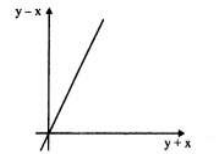
Which of the following shows the graph of y against x?
Loading solution...

Consider the set S = { 1, 2, 3, .., 1000 }. How many arithmetic progressions can be formed from the elements of S that start with l and end with 1000 and have at least 3 elements?
Loading solution...
What values of x satisfy $$x^{2/3} + x^{1/3} - 2 <= 0$$?
Loading solution...
Let $$f(x) = \text{max }(2x + 1, 3 - 4x)$$, where $$x$$ is a real number. Then the minimum possible value of $$f(x)$$ is:
Loading solution...

Arun, Barun and Kiranmala start from the same place and travel in the same direction at speeds of 30, 40 and 60 km per hour respectively. Barun starts two hours after Arun. If Barun and Kiranmala overtake Arun at the same instant, how many hours after Arun did Kiranmala start?
Loading solution...
When you reverse the digits of the number 13, the number increases by 18. How many other two-digit numbers increase by 18 when their digits are reversed?
Loading solution...
A semi-circle is drawn with AB as its diameter. From C, a point on AB, a line perpendicular to AB is drawn meeting the circumference of the semi-circle at D. Given that AC = 2 cm and CD = 6 cm, the area of the semi-circle (in sq. cm) will be:
Loading solution...

There are 6 tasks and 6 persons. Task 1 cannot be assigned either to person 1 or to person 2; task 2 must be assigned to either person 3 or person 4. Every person is to be assigned one task. In how many ways can the assignment be done?
Loading solution...
The number of employees in Obelix Menhir Co. is a prime number and is less than 300. The ratio of the number of employees who are graduates and above, to that of employees who are not, can possibly be:
Loading solution...
If $$log_y x = (a*log_z y) = (b*log_x z) = ab$$, then which of the following pairs of values for (a, b) is not possible?
Loading solution...

An equilateral triangle DOC is drawn inside a square ABCD. What is the value of the angle AOB in degrees?
Loading solution...
In a Class X Board examination, ten papers are distributed over five Groups - PCB, Mathematics, Social Science, Vernacular and English. Each of the ten papers is evaluated out of 100. The final score of a student is calculated in the following manner. First, the Group Scores are obtained by averaging marks in the papers within the Group. The final score is the simple average of the Group Scores. The data for the top ten students are presented below. (Dipan's score in English Paper II has been intentionally removed in the table.)

Note: B or G against the name of a student respectively indicates whether the student is a boy or a girl.
How much did Dipan get in English Paper II?
Loading solution...
Students who obtained Group Scores of at least 95 in every group are eligible to apply for a prize. Among those who are eligible, the student obtaining the highest Group Score in Social Science Group is awarded this prize. The prize was awarded to:
Loading solution...

Among the top ten students, how many boys scored at least 95 in at least one paper from each of the groups?
Loading solution...
Each of the ten students was allowed to improve his/her score in exactly one paper of choice with the objective of maximizing his /her final score. Everyone scored 100 in the paper in which he or she chose to improve. After that, the topper among the ten students was:
Loading solution...
Had Joseph, Agni, Pritam and Tirna each obtained Group Score of 100 in the Social Science Group,then their standing in decreasing order of final score would be;
Loading solution...

Mathematicians are assigned a number called Erdos number (named after the famous mathematician, Paul Erdos). Only Paul Erdos himself has an Erdos number of zero. Any mathematician who has written a research paper with Erdos has an Erdos number of 1.For other mathematicians, the calculation of his/her Erdos number is illustrated below:
Suppose that a mathematician X has co-authored papers with several other mathematicians. 'From among them, mathematician Y has the smallest Erdos number. Let the Erdos number of Y be y. Then X has an Erdos number of y+1. Hence any mathematician with no co-authorship chain connected to Erdos has an Erdos number of infinity. :
In a seven day long mini-conference organized in memory of Paul Erdos, a close group of eight mathematicians, call them A, B, C, D, E, F, G and H, discussed some research problems. At the beginning of the conference, A was the only participant who had an infinite Erdos number. Nobody had an Erdos number less than that of F.
On the third day of the conference F co-authored a paper jointly with A and C. This reduced the average Erdos number of the group of eight mathematicians to 3. The Erdos numbers of B, D, E, G and H remained unchanged with the writing of this paper. Further, no other co-authorship among any three members would have reduced the average Erdos number of the group of eight to as low as 3.
• At the end of the third day, five members of this group had identical Erdos numbers while the other three had Erdos numbers distinct from each other.
• On the fifth day, E co-authored a paper with F which reduced the group's average Erdos number by 0.5. The Erdos numbers of the remaining six were unchanged with the writing of this paper.
• No other paper was written during the conference.
The person having the largest Erdos number at the end of the conference must have had Erdos number (at that time):
Loading solution...
How many participants in the conference did not change their Erdos number during the conference?
Loading solution...
The Erdos number of C at the end of the conference was:
Loading solution...

The Erdos number of E at the beginning of the conference was:
Loading solution...
How many participants had the same Erdos number at the beginning of the conference?
Loading solution...
Two traders, Chetan and Michael, were involved in the buying and selling Of MCS shares over five trading days. At the beginning of the first day, the MCS share was priced at Rs 100, while at the end of the fifth day it was priced at Rs 110. At the end of each day, the MCS share price either went up by Rs 10, or else, it came down by Rs 10. Both Chetan and Michael took buying and selling decisions at the end of each trading day. The beginning price of MCS share on a given day was the same as the ending price of the previous day. Chetan and Michael started with the same number of shares and amount of cash, and had enough of both. Below are some additional facts about how Chetan and Michael traded over the five trading days.
• Each day if the price went up, Chetan sold 10 shares of MCS at the closing price. On the other hand, each day if the price went down, he bought 10 shares at the closing price.
• If on any day, the closing price was above Rs 110, then Michael sold 10 shares of MCS, while if it was below Rs 90, he bought 10 shares, all at the closing price.
If Chetan sold 10 shares of MCS on three consecutive days, while Michael sold 10 shares only once during the five days, what was the price of MCS at the end of day 3?
Loading solution...

If Michael ended up with Rs 100 less cash than Chetan at the end of day 5, what was the difference in the number of shares possessed by Michael and Chetan (at the end of day 5)?
Loading solution...
If Chetan ended up with Rs 1300 more cash than Michael at the end of day 5, what was the price of MCS share at the end of day 4?
Loading solution...
What could have been the maximum possible increase in combined cash balance of Chetan and Michael at the end of the fifth day?
Loading solution...

If Michael ended up with 20 more shares than Chetan at the end of day 5, what was the price of the share at the end of day 3?
Loading solution...
A significant amount of traffic flows from point S to point T in the one-way street network shown below. Points A, B, C, and D are junctions in the network, and the arrows mark the direction of traffic flow. The fuel cost in rupees for travelling along a street is indicated by the number adjacent to the arrow representing the street. –
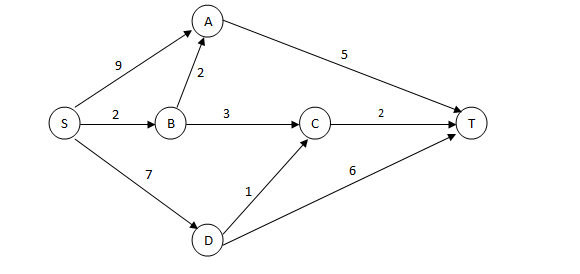
Motorists traveling from point S to point T would obviously take the route for which the total cost of traveling is the minimum. If two or more routes have the same least travel cost, then motorists are indifferent between them. Hence, the traffic gets evenly distributed among all the least cost routes.
The government can control the flow of traffic only by levying appropriate toll at each junction. For example, if a motorist takes the route S-A-T (using junction A alone), then the total cost of travel would be Rs 14 (i.e., Rs 9 + Rs 5) plus the toll charged at junction A.
If the government wants to ensure that all motorists travelling from S to T pay the same amount (fuel costs and toll combined) regardless of the route they choose and the street from B to C is under repairs (and hence unusable), then a feasible set of toll charged (in rupees) at junctions A, B, C, and D respectively to achieve this goal is:
Loading solution...
If the government wants to ensure that no traffic flows on the street from D to T, while equal amount of traffic flows through junctions A and C, then a feasible set of toll charged (in rupees) at junctions A, B, C,and D respectively to achieve this goal is:
Loading solution...

If the government wants to ensure that all routes from S to T get the same amount of traffic, then a feasible set of toll charged (in rupees) at junctions A, B, C, and D respectively to achieve this goal is:
Loading solution...
If the government wants to ensure that the traffic at S gets evenly distributed along streets from S to A, from S to B, and from S to D, then a feasible set of toll charged (in rupees) at junctions A, B, C, and D respectively to achieve this goal is:
Loading solution...
The government wants to devise a toll policy such that the total cost to the commuters per trip is minimized. The policy should also ensure that not more than 70 per cent of the total traffic passes through junction B. The cost incurred by the commuter travelling from point S to point T under this policy will be:
Loading solution...

K, L, M, N, P, Q, R, S, U and W are the only ten members in a department. There is a proposal to form a team from within the members of the department, subject to the following conditions:
The size of a team is defined as the number of members in the team.
What could be the size of a team that includes K?
Loading solution...
In how many ways a team can be constituted so that the team includes N?
Loading solution...
What would be the size of the largest possible team?
Loading solution...

Who can be a member of a team of size 5?
Loading solution...
Who cannot be a member of a team of size 3?
Loading solution...
Fifteen years after communism was officially pronounced dead, its spectre seems once again to be haunting Europe. Last month, the Council of Europe’s parliamentary assembly voted to condemn the “crimes of totalitarian communist regimes,” linking them with Nazism and complaining that communist parties are still “legal and active in some countries.” Now Goran Lindblad, the conservative Swedish MP behind the resolution, wants to go further. Demands that European Ministers launch a continent-wide anti-communist campaign – including school textbook revisions, official memorial days, and museums – only narrowly missed the necessary two-thirds majority. Mr. Lindblad pledged to bring the wider plans back to the Council of Europe in the coming months:
He has chosen a good year for his ideological offensive: this is the 50’h anniversary of Nikita Khrushchev’s denunciation of Josef Stalin and the subsequent Hungarian uprising, which will doubtless be the cue for further excoriation of the communist record. Paradoxically, given that there is no communist government left in Europe outside Moldova, the attacks have if anything, become more extreme as time has gone on. A clue as to why that might be can be found in the rambling report by Mr. Lindblad that led to the Council of Europe declaration. Blaming class struggle and public ownership, he explained “different elements of communist ideology such as equality or social justice still seduce many” and “a sort of nostalgia for communism is still alive.” Perhaps the real problem for Mr. Lindblad and his right-wing allies in Eastern Europe is that communism is not dead enough – and they will only be content when they have driven a stake through its heart.
The fashionable attempt to equate communism and Nazism is in reality a moral and historical nonsense. Despite the cruelties of the Stalin terror, there was no Soviet Treblinka or Sorbibor, no extermination camps built to murder millions. Nor did the Soviet Union launch the most devastating war in history at a cost of more than 50 million lives – in fact it played the decisive role in the defeat of the German war machine. Mr. Lindblad and the Council of Europe adopt as fact the wildest estimates of those “killed by communist regimes” (mostly in famines) from the fiercely contested Black Book of Communism, which also underplays the number of deaths attributable to Hitler. But, in any case, none of this explains why anyone might be nostalgic in former communist states, now enjoying the delights of capitalist restoration.
The dominant account gives no sense of how communist regimes renewed themselves after 1956 or why Western leaders feared they might overtake the capitalist world well into the 1960s. For all its brutalities and failures, communism in the Soviet Union, Eastern Europe, and elsewhere delivered rapid industrialization, mass education, job security, and huge advances in social and gender equality. Its existence helped to drive up welfare standards in the west, and provided a powerful counterweight to western global domination.
It would be easier to take the Council of Europe’s condemnation of communist state crimes seriously if it had also seen fit to denounce the far bloodier record of European colonialism – which only finally came to an end in the 1970s. This was a system of racist despotism, which dominated the globe in Stalin’s time. And while there is precious little connection between the ideas of fascism and communism, there is an intimate link between colonialism and Nazism. The terms lebensraum and konzentrationslager were both first used by the German colonial regime in South-West Africa (now Namibia), which committed genocide against the Herero and Nama peoples and bequeathed its ideas and personnel directly to the Nazi parry.
Around 10 million Congolese died as a result of Belgian forced labor and mass murder in the early twentieth century; tens of millions perished in avoidable or enforced famines in British-ruled India; up to a million Algerians died in their war for independence, while controversy now rages in France about a new law requiring teachers to put a positive spin on colonial history. Comparable atrocities were carried out by all European colonialists, but not a word of condemnation from the Council of Europe. Presumably, European lives count for more.
No major twentieth century political tradition is without blood on its hands, but battles over history are more about the future than the past. Part of the current enthusiasm in official Western circles for dancing on the grave of communism is no doubt about relations with today’s Russia and China. But it also reflects a determination to prove there is no alternative to the new global capitalist order – and that any attempt to find one is bound to lead to suffering. With the new imperialism now being resisted in the Muslim world and Latin America, growing international demands for social justice and ever greater doubts about whether the environmental crisis can be solved within the existing economic system, the pressure for alternatives will increase.
Among all the apprehensions that Mr. Goran Lindblad expresses against communism, which one gets admitted, although indirectly, by the author?
Loading solution...

What, according to the author, is the real reason for a renewed attack against communism?
Loading solution...
The author cites examples of atrocities perpetrated by European colonial regimes in order to
Loading solution...
Why, according to the author, is Nazism closer to colonialism than it is to communism?
Loading solution...

Which of the following cannot be inferred as a compelling reason for the silence of the Council of Europe on colonial atrocities?
Loading solution...
My aim is to present a conception of justice which generalizes and carries to a higher level of abstraction the familiar theory of the social contract. In order to do this we are not to think of the original contract as one to enter a particular society or to set up a particular form of government. Rather, the idea is that the principles of justice for the basic structure of society are the object of the original agreement. They are the principles that free and rational persons concerned to further their own interests would accept in an initial position of equality. These principles are to regulate all further agreements; they specify the kinds of social cooperation that can be entered into and the forms of government that can be established. This way of regarding the principles of justice, I shall call justice as fairness. Thus, we are to imagine that those who engage in social cooperation choose together, in one joint act, the principles which are to assign basic rights and duties and to determine the division of social benefits. Just as each person must decide by rational reflection what constitutes his good, that is, the system of ends which it is rational for him to pursue, so a group of persons must decide once and for all what is to count among them as just and unjust. The choice which rational men would make in this hypothetical situation of equal liberty determines the principles of justice.
In ‘justice as fairness’, the original position is not an actual historical state of affairs. It is understood as a purely hypothetical situation characterized so as to lead to a certain conception of justice. Among the essential features of this situation is that no one knows his place in society, his class position or social status, nor does anyone know his fortune in the distribution of natural assets and abilities, his intelligence, strength, and the like. I shall even assume that the parties do not know their conceptions of the good or their special psychological propensities. The principles of justice are chosen behind a veil of ignorance. This ensures that no one is advantaged or disadvantaged in the choice of principles by the outcome of natural chance or the contingency of social circumstances. Since all are similarly situated and no one is able to design principles to favor his particular condition, the principles of justice are the result of a fair agreement or bargain.
Justice as fairness begins with one of the most general of all choices which persons might make together, namely, with the choice of the first principles of a conception of justice which is to regulate all subsequent criticism and reform of institutions. Then, having chosen a conception of justice, we can suppose that they are to choose a constitution and a legislature to enact laws, and so on, all in accordance with the principles of justice initially agreed upon. Our social situation is just if it is such that by this sequence of hypothetical agreements we would have contracted into the general system of rules which defines it. Moreover, assuming that the original position does determine a set of principles, it will then be true that whenever social institutions satisfy these principles, those engaged in them can say to one another that they are cooperating on terms to which they would agree if they were free and equal persons whose relations with respect to one another were fair. They could all view their arrangements as meeting the stipulations which they would acknowledge in an initial situation that embodies widely accepted and reasonable constraints on the choice of principles. The general recognition of this fact would provide the basis for a public acceptance of the corresponding principles of justice. No society can, of course, be a scheme of cooperation which men enter voluntarily in a literal sense; each person finds himself placed at birth in some particular position in some particular society, and the nature of this position materially affects his life prospects. Yet a society satisfying the principles of justice as fairness comes as close as a society can to being a voluntary scheme, for it meets the principles which free and equal persons would assent to under circumstances that are fair.
A just society, as conceptualized in the passage, can be best described as:
Loading solution...
The original agreement or original position in the passage has been used by the author as:
Loading solution...

Which of the following best illustrates the situation that is equivalent to choosing 'the principles of justice' behind a 'veil of ignorance'?
Loading solution...
Why, according to the passage, do principles of justice need to be based on an original agreement?
Loading solution...
Which of the following situations best represents the idea of justice as fairness, as argued in the passage?
Loading solution...

Our propensity to look out for regularities, and to impose laws upon nature, leads to the psychological phenomenon of dogmatic thinking or, more generally, dogmatic behaviour: we expect regularities everywhere and attempt to find them even where there are none; events which do not yield to these attempts we are inclined to treat as a kind of `background noise’; and we stick to our expectations even when they are inadequate and we ought to accept defeat. This dogmatism is to some extent necessary. It is demanded by a situation which can only be dealt with by forcing our conjectures upon the world. Moreover, this dogmatism allows us to approach a good theory in stages, by way of approximations: if we accept defeat too easily, we may prevent ourselves from finding that we were very nearly right.
It is clear that this dogmatic attitude; which makes us stick to our first impressions, is indicative of a strong belief; while a critical attitude, which is ready to modify its tenets, which admits doubt and demands tests, is indicative of a weaker belief. Now according to Hume’s theory, and to the popular theory, the strength of a belief should be a product of repetition; thus it should always grow with experience, and always be greater in less primitive persons. But dogmatic thinking, an uncontrolled wish to impose regularities, a manifest pleasure in rites and in repetition as such, is characteristic of primitives and children; and increasing experience and maturity sometimes create an attitude of caution and criticism rather than of dogmatism.
My logical criticism of Hume’s psychological theory, and the considerations connected with it, may seem a little removed from the field of the philosophy of science. But the distinction between dogmatic and critical thinking, or the dogmatic and the critical attitude, brings us right back to our central problem. For the dogmatic attitude is clearly related to the tendency to verify our laws and schemata by seeking to apply them and to confirm them, even to the point of neglecting refutations, whereas the critical attitude is one of readiness to change them - to test them; to refute them; to falsify them, if possible. This suggests that we may identify the critical attitude with the scientific attitude, and the dogmatic attitude with the one which we have described as pseudo-scientific. It further suggests that genetically speaking the pseudo-scientific attitude is more primitive than, and prior to, the scientific attitude: that it is a pre-scientific attitude. And this primitivity or priority also has its logical aspect. For the critical attitude is not so much opposed to the dogmatic attitude as super-imposed upon it: criticism must be directed against existing and influential beliefs in need of critical revision – in other words, dogmatic beliefs. A critical attitude needs for its raw material, as it were, theories or beliefs which are held more or less dogmatically.
Thus, science must begin with myths, and with the criticism of myths; neither with the collection of observations, nor with the invention of experiments, but with the critical discussion of myths, and of magical techniques and practices. The scientific tradition is distinguished from the pre-scientific tradition in having two layers. Like the latter, it passes on its theories; but it also passes on a critical attitude towards them. The theories are passed on, not as dogmas, but rather with the challenge to discuss them and improve upon them.
The critical attitude, the tradition of free discussion of theories with the aim of discovering their weak spots so that they may be improved upon, is the attitude of reasonableness, of rationality. From the point of view here developed, all laws, all theories, remain essentially tentative, or conjectural, or hypothetical, even when we feel unable to doubt them any longer. Before a theory has been refuted we can never know in what way it may have to be modified.
In the context of science, according to the passage, the interaction of dogmatic beliefs and critical attitude can be best described as:
Loading solution...
According to the passage, the role of a dogmatic attitude of dogmatic behaviour in the development of science is
Loading solution...
Dogmatic behaviour, in this passage, has been associated with primitives and children. Which of the following best describes the reason why the author compares primitives with children?
Loading solution...
Which of the following statements best supports the argument in the passage that a critical attitude leads to a weaker belief than a dogmatic attitude does?
Loading solution...
According to the passage, which of the following statements best describes the difference between science and pseudo-science? :
Loading solution...
Facts, which deal with pieces of information that one has heard, seen or read, and which are open to discovery or verification (the answer option indicates such a statement with an `F’).
Inferences,which are conclusions drawn about the unknown, on the basis of the known (the answer option indicates such a statement with an `I’).
Judgements which are opinions that imply approval or disapproval of persons, objects, situations and occurrences in the past, the present or the future (the answer option indicates such a statement with a J)
Select the answer option that best describes the set of four statements.
1.So much of our day-to-day focus seems to be on getting things done, trudging our way through the tasks of living - it can feel like a treadmill that gets you nowhere; where is the childlike joy?
2.We are not doing the things that make us happy; that which brings us joy; the things that we cannot wait to do because we enjoy them so much.
3.This is the stuff that joyful living is made of - identifying your calling and committing yourself wholeheartedly to it.
4.When this happens, each moment becomes a celebration of you; there is a rush of energy that comes with feeling completely immersed in doing what you love most.
Loading solution...
Facts, which deal with pieces of information that one has heard, seen or read, and which are open to discovery or verification (the answer option indicates such a statement with an `F’).
Inferences,which are conclusions drawn about the unknown, on the basis of the known (the answer option indicates such a statement with an `I’).
Judgements which are opinions that imply approval or disapproval of persons, objects, situations and occurrences in the past, the present or the future (the answer option indicates such a statement with a J)
Select the answer option that best describes the set of four statements.
1.Given the poor quality of service in the public sector, the HIV/AIDS affected should be switching to private initiatives that supply anti-retroviral drugs (ARVs) at a low cost.
2.The government has been supplying free drugs since 2004, and 35000 have benefited up to now - though the size of the affected population is 150 times this number.
3.The recent initiatives of networks and companies like AIDSCare Network, Emcure, Reliance-Cipla-CII, would lead to availability of much-needed drugs to a larger number of affected people.
4.But how ironic it is that we should face a perennial shortage of drugs when India is one of the world’s largest suppliers of generic drugs to the developing world.
Loading solution...
Facts, which deal with pieces of information that one has heard, seen or read, and which are open to discovery or verification (the answer option indicates such a statement with an `F’).
Inferences,which are conclusions drawn about the unknown, on the basis of the known (the answer option indicates such a statement with an `I’).
Judgements which are opinions that imply approval or disapproval of persons, objects, situations and occurrences in the past, the present or the future (the answer option indicates such a statement with a J)
Select the answer option that best describes the set of four statements.
1.According to all statistical indications, the Sarva Shiksha Abhiyan has managed to keep pace with its ambitious goals.
2.The Mid-day Meal Scheme has been a significant incentive for the poor to send their little ones to school, thus establishing the vital link between healthy bodies and healthy minds.
3.Only about 13 million children in the age group of 6 to 14 years are out of school.
4.The goal of universalisation of elementary education has to be a pre-requisite for the evolution and development of our country.
Loading solution...
Facts, which deal with pieces of information that one has heard, seen or read, and which are open to discovery or verification (the answer option indicates such a statement with an `F’).
Inferences,which are conclusions drawn about the unknown, on the basis of the known (the answer option indicates such a statement with an `I’).
Judgements which are opinions that imply approval or disapproval of persons, objects, situations and occurrences in the past, the present or the future (the answer option indicates such a statement with a J)
Select the answer option that best describes the set of four statements.
1.We should not be hopelessly addicted to an erroneous belief that corruption in India is caused by the crookedness of Indians.
2.The truth is that we have more red tape - we take eighty-nine days to start a small business, Australians take two.
3.Red tape leads to corruption and distorts a people’s character.
4.Every red tape procedure is a point of contact with an official, and such contacts have the potential to become opportunities for money to change hands.
Loading solution...
Facts, which deal with pieces of information that one has heard, seen or read, and which are open to discovery or verification (the answer option indicates such a statement with an `F’).
Inferences,which are conclusions drawn about the unknown, on the basis of the known (the answer option indicates such a statement with an `I’).
Judgements which are opinions that imply approval or disapproval of persons, objects, situations and occurrences in the past, the present or the future (the answer option indicates such a statement with a J)
Select the answer option that best describes the set of four statements.
1.Inequitable distribution of all kinds of resources is certainly one of the strongest and most sinister sources of conflict.
2.Even without war, we know that conflicts continue to trouble us - they only change in character.
3.Extensive disarmament is the only insurance for our future; imagine the amount of resources that can be released and redeployed.
4.The economies of the industrialized western world derive 20% of their income from the sale of all kinds of arms.
Loading solution...
From the given options, choose the sentence that completes the paragraph in the most appropriate way.
I am sometimes attacked for imposing `rules’. Nothing could be further from the truth: I hate rules. All I do is report on how consumers react to different stimuli. I may say to a copywriter, “Research shows that commercials with celebrities are below average in persuading people to buy products. Are you sure you want to use a celebrity?” Call that a rule? Or I may say to an art director, “Research suggests that if you set the copy in black type on a white background, more people will read it than if you set it in white type on a black background.”
Loading solution...
From the given options, choose the sentence that completes the paragraph in the most appropriate way.
Relations between the factory and the dealer are distant and usually strained as the factory tries to force cars on the dealers to smooth out production. Relations between the dealer and the customer are equally strained because dealers continuously adjust prices - make deals - to adjust demand with supply while maximizing profits. This becomes a system marked by ‘a lack of long-term commitment’ on either side, which maximizes feelings of mistrust. In order to maximize their bargaining positions, everyone holds back information - the dealer about the product and the consumer about his true desires.
Loading solution...
From the given options, choose the sentence that completes the paragraph in the most appropriate way.
In the evolving world order, the comparative advantage of the United States lies in its military force: Diplomacy and international law have always been regarded as annoying encumbrances, unless they can be used to advantage against an enemy. Every active player in world affairs professes to seek only peace and to prefer negotiation to violence and coercion.
Loading solution...
From the given options, choose the sentence that completes the paragraph in the most appropriate way.
Age has a curvilinear relationship with the exploitation of opportunity. Initially, age will increase the likelihood that a person will exploit an entrepreneurial opportunity because people gather much of the knowledge necessary to exploit opportunities over the course of their lives, and because age provides credibility in transmitting that information to others. However, as people become older, their willingness to bear risks declines, their opportunity costs rise, and they become less receptive to new information.
[CAT 2006]
Loading solution...
From the given options, choose the sentence that completes the paragraph in the most appropriate way.
We can usefully think of theoretical models as maps, which help us navigate unfamiliar territory. The most accurate map that it is possible to construct would be of no practical use whatsoever, for it would be an exact replica, on exactly the same scale, of the place where we were. Good maps pull out the most important features and throw away a huge amount of much less valuable information. Of course, maps can be bad as well as good - witness the attempts by medieval Europe to produce a map of the world. In the same way, a bad theory, no matter how impressive it may seem in principle, does little or nothing to help us understand a problem.
Loading solution...
Start your IIM journey with the right preparation and crack CAT 2026.

Educational materials for CAT preparation
 Share
Share