CAT Functions, Graphs and Statistics questions are very important to practice while preparing for the CAT exam. Every year these questions frequently appear in the CAT question papers. Check out the below-given practice questions from this topic (functions, graphs and statistics). All these questions are taken from CAT's previous papers and separated year-wise. Take free CAT mocks to understand the latest exam pattern and also you'll get a fair idea of how questions are asked. You can check out the important functions questions for CAT Quant. These are a good source for practice; If you want to practice these questions, you can download this CAT functions questions PDF below, which is completely Free.
We check where $$f(x)=\frac{x}{2x-1}$$ or $$g(x)=\frac{x}{x-1}$$, or their compositions, become undefined.
First, f(x) is undefined at $$x=\tfrac12$$ and g(x) is undefined at $$x=1$$.
Next, for $$f(g(x)) = \frac{x}{x+1}$$
Since, the denominator can't be zero, x=-1 must also be excluded.
For $$g(f(x)) = \frac{x}{1-x}$$
$$\Rightarrow x=1$$ is not possible, which is already excluded.
So the values at which $$h(x)=f(g(x))+g(f(x))$$ is undefined are $${-1,\ \tfrac12,\ 1}$$
Question 1
Consider two sets $$A = \left\{2, 3, 5, 7, 11, 13 \right\}$$ and $$B = \left\{1, 8, 27 \right\}$$. Let f be a function from A to B such that for every element in B, there is at least one element a in A such that $$f(a) = b$$. Then, the total number of such functions f is
Set A={2,3,5,7,11,13} so |A|=6 Set B={1, 8, 27} so |B|=3
Without any restrictions, each element in A can map to any of the 3 elements in B. Thus, the total number of functions is: $$3^6=729$$
Excluding Functions That Miss One Element in B: If a function does not map to an element in B, there are 2 elements in B left for mapping. The total number of such functions (for each specific element not mapped) is: $$2^6=64$$
Since there are 3 elements in B, the total number of such functions is:3x64=192
Adding Back Functions That Miss Two Elements in B:
If a function misses two elements in B, there is only 1 element left for mapping. The total number of such functions is: 1^6=1.
Since there are $$^3C_2$$ ways to choose which two elements are missed, the total number of such functions is: 3
Using the inclusion-exclusion principle, the number of functions where all elements of B are mapped by at least one element of A is: 729-192+3=540.
Question 2
A function f maps the set of natural numbers to whole numbers, such that f(xy) = f(x)f(y) + f(x) + f(y) for all x, y and f(p) = 1 for every prime number p. Then, the value of f(160000) is
Looking at the additional information about the prime numbers should make one realise that they are the key to solving the question. f(16000) can be written as $$f\left(2^8\times\ 5^4\right)$$
Now, we can try to find these individual values:
For any prime p: f(p)=1 $$f\left(p^2\right)=f\left(p\right)f\left(p\right)+f\left(p\right)+f\left(p\right)=1+1+1=3$$ $$f\left(p^3\right)=f\left(p^2\right)f\left(p\right)+f\left(p^2\right)+f\left(p\right)=3+3+1=7$$
This way, we can find the function output for any prime number raised to a power.
We can see that each new exponent is twice the previous output +1, solving this way till prime raised to power 8 $$f\left(p^4\right)=7+7+1=15$$ $$f\left(p^5\right)=15+15+1=31$$ $$f\left(p^6\right)=31+31+1=63$$ $$f\left(p^7\right)=63+63+1=127$$ $$f\left(p^8\right)=127+127+1=255$$
Using these values in the original expression of $$f\left(2^8\times\ 5^4\right)=f\left(2^8\right)f\left(5^4\right)+f\left(2^8\right)+f\left(5^4\right)$$ we get $$f\left(2^8\times\ 5^4\right)=\left(255\times\ 15\right)+255+15=4095$$
Therefore, Option A is the correct answer.
Question 3
The number of distinct real values of x, satisfying the equation $$max \left\{x, 2\right\} - min\left\{x, 2\right\} = \mid x + 2 \mid - \mid x - 2 \mid$$, is
The expression on the right-hand side will have two critical points: 2 and -2
For any value of x greater than equal to 2, the equation changes to x+2-(x-2) = 4
the value of min{x,2} would be 2, so we would want max{x,2} to be 4+2 = 6
Therefore, x=6 works.
For any value of x less than equal to -2, the equation changes to -(x+2)+(x-2) = -4 the value of max{x,2} would be 2, so we would want min{x,2} to be 6 again; this cannot be the case. In general, subtracting the smaller (min) of the two values from the bigger (max) can not lead to a negative number. The max it can lead to is a 0
When x lies between -2 and 2, the equation becomes 2x The maximum function will give back 2, and the minimum function will give back x, with the right-hand side giving 2x Solving this we would get 2-x = 2x which is x=2/3
Therefore, there are two real values of x for which the given equation holds.
Hence, 2 is the correct answer.
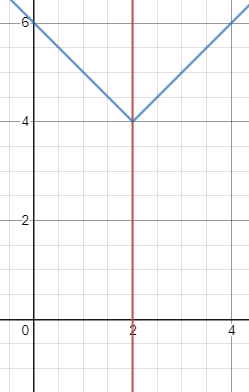
The graph of the function on the right hand side can be visualised as:
Hence, 2 is the correct answer.
Question 4
For any non-zero real number x, let $$f(x) + 2f \left(\cfrac{1}{x}\right) = 3x$$. Then, the sum of all possible values of x for which $$f(x) = 3$$, is
Subtracting the first equation from the second equation we have,
$$3f\left(x\right)=\frac{6}{x}-3x$$
$$f\left(x\right)=\frac{2}{x}-x$$ We want the sum of values when this function equals 3,
$$\frac{2}{x}-x=3$$ $$x^2+3x-2=0$$ Since the discriminant is greater than zero, both values of x will be real, and we can directly take the sum of values of $$x$$ to be, $$-\frac{3}{1}$$
Answer is -3.
Question 1
The area of the quadrilateral bounded by the Y-axis, the line x = 5, and the lines $$\mid x-y\mid-\mid x-5\mid=2$$, is
From the inequality and nature of x, and y, we get the given diagram:
We need to find the area of the quadrilateral ABDE = area of rectangle ABCD + area of triangle CDE
=> Area of ABCD = (7-3)*5 = 20 units, and the area of triangle CDE = (1/2)*10*5 = 25 units.
Hence, the area of the quadrilateral ABDE = (20+25) = 45 units.
Question 2
Suppose f(x, y) is a real-valued function such that f(3x + 2y, 2x - 5y) = 19x, for all real numbers x and y. The value of x for which f(x, 2x) = 27, is
Let us assume the function f(a,b) is a linear combination of a and b.
=> f(3x+2y, 2x-5y) = m(3x+2y) + n(2x-5y) = 19x
=> 3m + 2n = 19 and 2m - 5n = 0
Solving we get m = 5 and n = 2
=> f(a,b) = 5a+2b
=> f(x,2x) = 5x + 2(2x) = 9x = 27 => x = 3.
Question 1
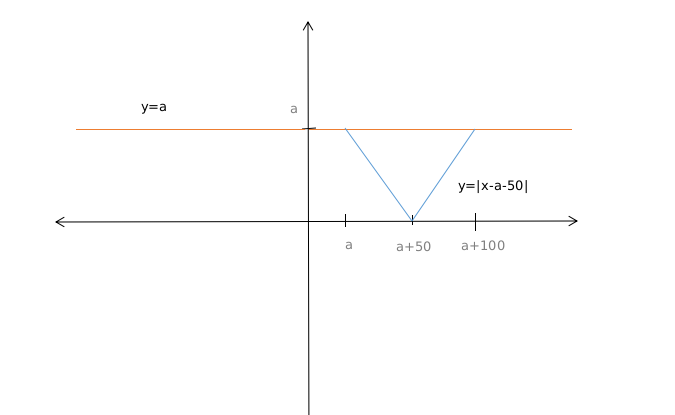
Let $$0 \leq a \leq x \leq 100$$ and $$f(x) = \mid x - a \mid + \mid x - 100 \mid + \mid x - a - 50\mid$$. Then the maximum value of f(x) becomes 100 when a is equal to
Let $$f(x)$$ be a quadratic polynomial in $$x$$ such that $$f(x) \geq 0$$ for all real numbers $$x$$. If f(2) = 0 and f( 4) = 6, then f(-2) is equal to
Suppose for all integers x, there are two functions f and g such that $$f(x) + f (x - 1) - 1 = 0$$ and $$g(x ) = x^{2}$$. If $$f\left(x^{2} - x \right) = 5$$, then the value of the sum f(g(5)) + g(f(5)) is
Let r be a real number and $$f(x) = \begin{cases}2x -r & ifx \geq r\\ r &ifx < r\end{cases}$$. Then, the equation $$f(x) = f(f(x))$$ holds for all real values of $$x$$ where
For any real number x, let [x] be the largest integer less than or equal to x. If $$\sum_{n=1}^N \left[\dfrac{1}{5} + \dfrac{n}{25}\right] = 25$$ then N is
Now we have : $$f(g(x))-3x$$ so we get f(x+3)-3x = $$\left(x+3\right)^2-7\left(x+3\right)-3x$$ =$$x^2-4x-12$$ Now minimum value of expression = $$-\frac{D}{4a}$$ $$ \frac{\left(4ac-b^2\right)}{4a}$$ We get - (16+48)/4 = -16
Question 1
Let $$f(x)=x^{2}+ax+b$$ and $$g(x)=f(x+1)-f(x-1)$$. If $$f(x)\geq0$$ for all real x, and $$g(20)=72$$. then the smallest possible value of b is
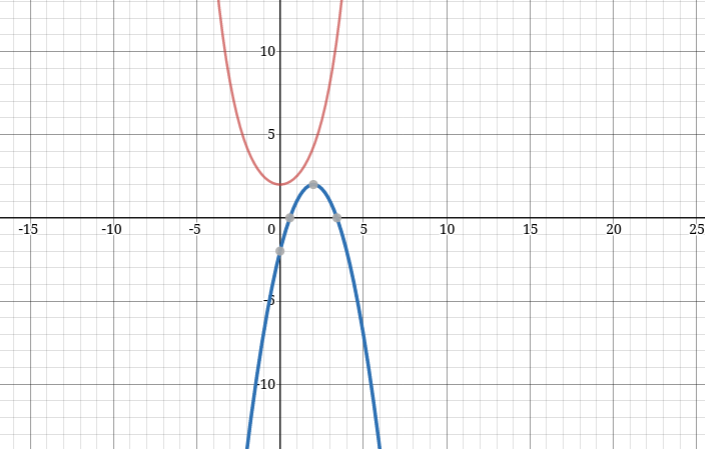
The graphs of $$2^{x}+2^{-x} and 2-(x-2)^{2}$$ never intersect. So, number of solutions=0.
Alternate method:
We notice that the minimum value of the term in the LHS will be greater than or equal to 2 {at x=0; LHS = 2}. However, the term in the RHS is less than or equal to 2 {at x=2; RHS = 2}. The values of x at which both the sides become 2 are distinct; hence, there are zero real-valued solutions to the above equation.
Question 3
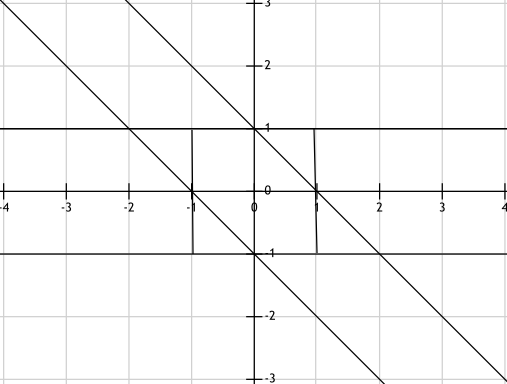
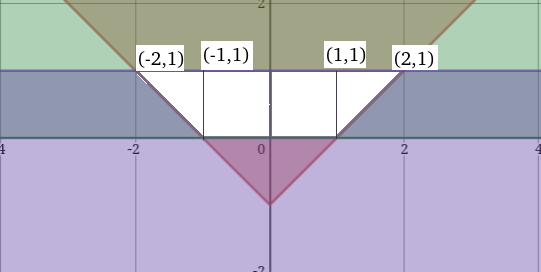
The area of the region satisfying the inequalities $$\mid x\mid-y\leq1,y\geq0$$ and $$y\leq1$$ is
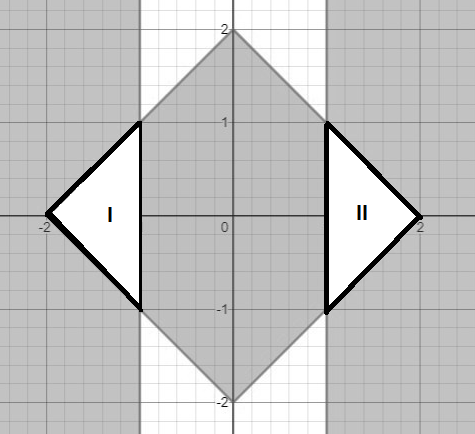
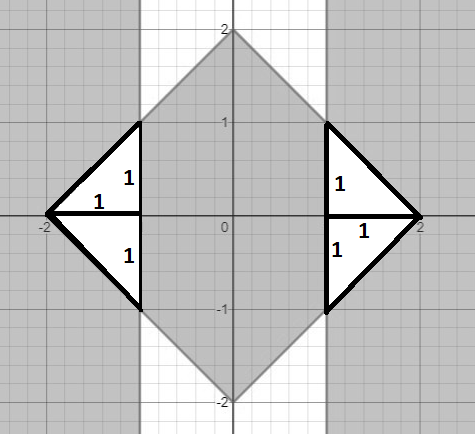
The area of the region contained by the lines $$\mid x\mid-y\leq1,y\geq0$$ and $$y\leq1$$ is the white region.
Total area = Area of rectangle + 2 * Area of triangle = $$2+\left(\frac{1}{2}\times\ 2\times\ 1\right)\ =3$$
Hence, 3 is the correct answer.
Question 4
In a group of 10 students, the mean of the lowest 9 scores is 42 while the mean of the highest 9 scores is 47. For the entire group of 10 students, the maximum possible mean exceeds the minimum possible mean by
Let 'r' be the root of the function. It follows that f(r) = 0. We can represent this as $$f\left(r\right)=f\left\{5-\left(5-r\right)\right\}$$
Based on the relation: $$f\left(5-x\right)=f\left(5+x\right)$$; $$f\left(r\right)=f\left\{5-\left(5-r\right)\right\}=f\left\{5+\left(5-r\right)\right\}$$
Thus, every root 'r' is associated with another root '(10-r)' [these form a pair]. For even distinct roots, in this case four, let us assume the roots to be as follows: $$r_1,\ \left(10-r_1\right),\ r_2,\ \left(10-r_2\right)$$
The sum of these roots = $$r_1\ +\left(10-r_1\right)+\ r_2+\ \left(10-r_2\right)\ =\ 20$$
Hence, Option D is the correct answer.
Question 8
In how many ways can a pair of integers (x , a) be chosen such that $$x^{2}-2\mid x\mid+\mid a-2\mid=0$$ ?
$$x^2-2x+a-2\ =0$$ Using quadratic equation we have $$x=\ 1+\sqrt{\ 3-a}\ and\ x=1-\sqrt{\ 3-a}$$ Only two integer values are possible
a=2 and a=3. So corresponding "x" values are x=1 and a=3, x=2 and a=2, x=0 and a=2
where x>=0 and x<2
Applying the above process we get x=1 and a=1
where x<0 and x>=2 we get a=3 and x=-1 , a=2 and x=-2
where x<0 and x<2 we get a=1 and x=-1
Hence there are total 7 values possible
Question 1
Consider a function f satisfying f (x + y) = f (x) f (y) where x,y are positive integers, and f(1) = 2. If f(a + 1) +f (a + 2) + ... + f(a + n) = 16 (2$$^n$$ - 1) then a is equal to
On putting n=1 in the equation we get, f(a+1)=16 => f(a)*f(1)=16 (It is given that f (x + y) = f (x) f (y))
=> $$2^a$$*2=16
=> a=3
Question 2
For any positive integer n, let f(n) = n(n + 1) if n is even, and f(n) = n + 3 if n is odd. If m is a positive integer such that 8f(m + 1) - f(m) = 2, then m equals
The maximum value of LHS is 2 when $$\cos (x(x + 1))$$ is 1 and the minimum value of RHS is 2 using AM $$\geq$$ GM
Hence LHS and RHS can only be equal when both sides are 2. For LHS, cosx(x+1)=1 => x(x+1)=0 => x=0,-1
For RHS minimum value, x=0
Hence only one solution x=0
Question 4
Let S be the set of all points (x, y) in the x-y plane such that $$\mid x \mid + \mid y \mid \leq 2$$ and $$\mid x \mid \geq 1.$$ Then, the area, in square units, of the region represented by S equals
Let f be a function such that f (mn) = f (m) f (n) for every positive integers m and n. If f (1), f (2) and f (3) are positive integers, f (1) < f (2), and f (24) = 54, then f (18) equals
The minimum value of the function will occur when the expressions inside the function are equal. So, 5$$x$$ = $$52 - 2x^2$$ or, $$2x^2 + 5x - 52$$ = 0 On solving, we get $$x$$ = 4 or $$-\dfrac{13}{2}$$ But, it is given that $$x$$ is a positive number. So, $$x$$ = 4 And the minimum value = 5*4 = 20 Hence, 20 is the correct answer.
Question 2
Let f(x) = min ($${2x^{2},52-5x}$$) where x is any positive real number. Then the maximum possible value of f(x) is
f(x) = min ($${2x^{2},52-5x}$$) The maximum possible value of this function will be attained at the point in which $$2x^2$$ is equal to $$52-5x$$.
$$2x^2 = 52-5x$$ $$2x^2+5x-52=0$$ $$(2x+13)(x-4)=0$$ => $$x=\frac{-13}{2}$$ or $$x = 4$$ It has been given that $$x$$ is a positive real number. Therefore, we can eliminate the case $$x=\frac{-13}{2}$$. $$x=4$$ is the point at which the function attains the maximum value. $$4$$ is not the maximum value of the function. Substituting $$x=4$$ in the original function, we get, $$2x^2 = 2*4^2= 32$$. f(x) = $$32$$. Therefore, 32 is the right answer.
Question 3
If $$f(x + 2) = f(x) + f(x + 1)$$ for all positive integers x, and $$f(11) = 91, f(15) = 617$$, then $$f(10)$$ equals
$$f(x + 2) = f(x) + f(x + 1)$$ As we can see, the value of a term is the sum of the 2 terms preceding it.
It has been given that $$f(11) = 91$$ and $$f(15) = 617$$. We have to find the value of $$f(10)$$.
Let $$f(10)$$ = b $$f(12)$$ = b + 91 $$f(13)$$ = 91 + b + 91 = 182 + b $$f(14)$$ = 182+b+91+b = 273+2b $$f(15)$$ = 273+2b+182+b = 455+3b It has been given that 455+3b = 617 3b = 162 => b = 54
Therefore, 54 is the correct answer.
Question 1
Let $$f(x) = x^{2}$$ and $$g(x) = 2^{x}$$, for all real x. Then the value of f[f(g(x)) + g(f(x))] at x = 1 is
If $$f_{1}(x)=x^{2}+11x+n$$ and $$f_{2}(x)=x$$, then the largest positive integer n for which the equation $$f_{1}(x)=f_{2}(x)$$ has two distinct real roots is
$$f_{1}(x)=x^{2}+11x+n$$ and $$f_{2}(x) = x$$ $$f_{1}(x)=f_{2}(x)$$ => $$x^{2}+11x+n = x$$ => $$ x^2 + 10x + n = 0 $$ => For this equation to have distinct real roots, b$$^2$$-4ac>0 $$ 10^2 > 4n$$ => n < 100/4 => n < 25 Thus, largest integral value that n can take is 24.
Question 3
If f(ab) = f(a)f(b) for all positive integers a and b,
Let $$f(x)\neq0$$ for any 'x' be a function satisfying $$f(x)f(y) = f(xy)$$ for all real x, y. If $$f(2) = 4$$, then what is the value of $$f(\frac{1}{2})$$?
f(3) = 9a + 3b + c = 0 f(5) = 25a + 5b + c
f(2) = 4a + 2b + c
f(5) = -3f(2) => 25a + 5b + c = -12a -6b -3c
=> 37a + 11b + 4c = 0 --> (1)
4(9a + 3b + c) = 36a + 12b + 4c = 0 --> (2)
From (1) and (2), a - b = 0 => a = b
=> c = -12a
The equation is, therefore, $$ax^2 + ax - 12a = 0 => x^2 + x - 12 = 0$$
a + b + c = a + a - 12a = -10a.
But the value of a is not given. Therefore, the value cannot be determined.
Question 1
A function $$f (x)$$ satisfies $$f(1) = 3600$$, and $$f (1) + f(2) + ... + f(n) =n^2f(n)$$, for all positive integers $$n > 1$$. What is the value of $$f (9)$$ ?
According to given conditions we get f(2)=f(1)/3 , then f(3)=f(1)/6, then f(4)=f(1)/10 , then f(5)=f(1)/15 .
We can see the pattern here that the denominator goes on increasing from 3,3+3,6+4,10+5,15+6,.. so for the f(9) the denominator will be same as 15+6+7+8+9=45 .
So f(9)=3600/45 = 80
Instructions
Directions for the following two questions:
Let $$a_1= p$$ and $$b_1 = q$$, where p and q are positive quantities.
Define $$a_n = pb_{n-1} , b_n = qb_{n-1}$$ , for even n > 1. and $$a_n = pa_{n-1} , b_n = qa_{n-1}$$ , for odd n > 1.
Question 2
Which of the following best describes $$a_n + b_n$$ for even n?
Let S be the set of all pairs (i, j) where 1 <= i < j <= n , and n >= 4 (i and j are natural numbers). Any two distinct members of S are called “friends” if they have one constituent of the pairs in common and “enemies” otherwise.
For example, if n = 4, then S = {(1, 2), (1, 3), (1, 4), (2, 3), (2, 4), (3, 4)}. Here, (1, 2) and (1, 3) are friends, (1,2) and (2, 3) are also friends, but (1,4) and (2, 3) are enemies.
Question 4
For general n, consider any two members of S that are friends. How many other members of S will be common friends of both these members?
For n, the number of elements in set S is $$^nC_2$$.
Lets say the 2 friends are (x,a) and (y,a)
These two friends have 3 numbers in total and 1 common element(say a) (as both elements cannot be exactly same)
They have 2 non common elements(x, y)
The number of common friends is formed by the non-common elements of the friends (x,y) + the number of elements in the set which have the common element other than the two friends (a,c), (a,d) and so on = 1 + (n-1 - 2) = n-2.
For the example in question, if the friends are (1,2) and (1,3), then common friends are (2,3) and all other elements with 1
All elements with 1 = n-1= 3 which are (1,2) (1,3) (1,4) excluding the friends (1,2) and (1,3) only 1 other friend is common. Hence it is 1+(n-1)-2=n-2
Question 5
For general n, how many enemies will each member of S have?
Any ordered pair has 2 elements => There are n-2 elements that are not present in the ordered pair.
The number of enemies of any ordered pair is all the ordered pairs in the set formed using the numbers other than these two elements = $$^{n-2}C_2$$ = $$1/2 * (n^2 - 5n + 6)$$.
Question 1
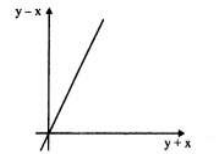
The graph of y - x (on the y axis) against y + x (on the x axis) is as shown below. (All graphs in this question are drawn to scale and the same scale and the same scale has been used on each axis.)
Which of the following shows the graph of y against x?
For a normal graph with y and x-axis, the equation of the line passing through the origin is y =mx where m is the slope of the line.
m is +ve if the angle made by the line with the x-axis is < $$90^{\circ\ }$$
$$\therefore\ $$ The equation of the line in the given graph would be y-x = k( y+ x) since the axes are y-x and y+x and the line is passing through the origin.
k > 1 because the angle is greater than 45$$^{\circ\ }$$
$$y=\dfrac{x\left(k+1\right)}{1-k}$$
Since k>1
Therefore y<0 for x>-1 and y>0 for x<-1
Option d correctly satisfy this condition
Question 2
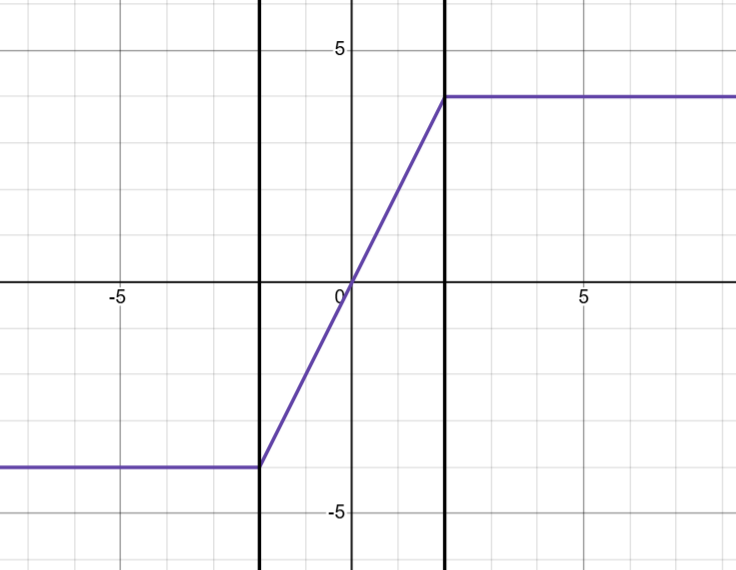
Let $$f(x) = \text{max }(2x + 1, 3 - 4x)$$, where $$x$$ is a real number. Then the minimum possible value of $$f(x)$$ is:
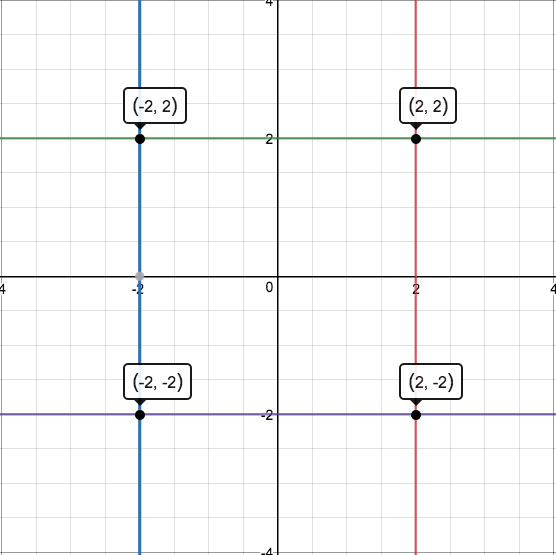
If the moduli are removed, the equations formed are
x+y+x-y = 4 => x=2
x+y-x+y = 4 => y =2
-x-y+x-y = 4 => y=-2
-x-y-x+y = 4 => x=-2
The area enclosed by these equations is a square with vertices at (2,2), (-2,2), (-2,-2), (2,-2) as shown in figure.
The required area = 4*4 = 16
Question 3
Let g(x) be a function such that g(x+1) + g(x-1) = g(x) for every real x. Then for what value of p is the relation g(x+p) = g(x) necessarily true for every real x?
$$f(x) = ax^2 - b|x|$$. When $$x=0, f(x) = 0$$ When $$a > 0$$ and $$b < 0$$, For x > 0, $$f(x) = ax^2 - bx$$, will be greater than 0 as $$ax^2 > 0$$ and $$bx<0$$ as $$b$$ is negative and $$x$$ is positive.
For x < 0, $$f(x) = ax^2 + bx$$ will again be greater than 0 as $$ax^2 >0$$ and $$bx>0$$ as both $$b$$ and $$x$$ are negative.
Therefore, the function $$f(x)$$ is positive when $$x<0$$ and when $$x>0$$ but becomes 0 when $$x=0$$.
Therefore, for $$a > 0$$ and $$b < 0$$, f(x) will attain its minimum value at $$x = 0$$.
Question 4
If $$\frac{a}{b+c}=\frac{b}{a+c} =\frac{c}{b+a} =r$$, then r cannot take any value except
$$2^x - x - 1 = 0$$ for this equation only 0 and 1 i.e 2 non-negative solutions are possible. Or we can plot the graph of $$2^x$$ and x+1 and determine the number of points of intersection and hence the solutin.
Question 2
When the curves $$y = log_{10}x$$ and $$y = x^{-1}$$ are drawn in the x-y plane, how many times do they intersect for values $$x \geq 1$$ ?
Equate the 2 equations we get value of x = 1 and -1 . Also we notice that there is intersection at x=0 . hence D
Question 1
Suppose for any real number x, [x] denotes the greatest integer less than or equal to x. Let L(x, y) = [x] + [y] + [x + y] and R(x, y) = [2x] + [2y]. Then it is impossible to find any two positive real numbers x and y for which
x = -1.5 and y = -1.5; x = 1.5 and y = -1.5; x = -1.5 and y = 1.5; x = 1.5 and y = 1.5.
For these possibilities, options A,B and C gets satisfied , but it is impossible to find any two positive real numbers x and y for which L(x, y) > R(x, y).
Question 1
In the above table, for suitably chosen constants a, b and c, which one of the following best describes the relation between y and x?
As all the three also satisfy the numbers given in the table, it can be inferred that the relationship between x and y is quadratic and the correct option is option (b)
Question 2
The area bounded by the three curves |x+y| = 1, |x| = 1, and |y| = 1, is equal to:
The union of the two sets is the set of positive integers. Also, given the increasing nature of elements, either f(1) or g(1) must be equal to 1. If g(1) = 1, then f(f(1)) =0 which cannot be under the given conditions.
Hence, f(1) = 1
g(1) = f(f(1))+1 = 2
Question 4
For all non-negative integers x and y, f(x, y) is defined as below:
For f(1,2). First consider x=0 and y=1 and use 3rd given equation, we get f(0,f(1,1)) now for f(1,1) take x=0 and y=0 we get f(0,f(1,0)), for f(1,0) which we use 2nd equation we get f(0,1) whose value is 2. So we have f(0,f(1,0))= f(0,2) whose value is 3 then put this in f(0,f(1,1)) we get f(0,3) we get as 4
Instructions
Directions for the next 2 questions:
For a real number x, let
$$f(x) = 1/(1+x),$$ if $$x$$ is non-negative
$$f(x) = 1+x,$$ if $$x$$ is negative
$$f^n(x) = f(f^{n-1}(x)), n = 2, 3.....$$
Question 5
What is the value of the product, $$f(2) f^2(2)f^3(2) f^4(2)f^5(2)$$?
f(x,y) is always non-negative because $$(x+y)^2$$ is always positive
g(x, y) = $$(x + y)^2$$, if $$\sqrt{(x + y)}$$ is real = Always positive
g(x, y) = $$- (x + y)$$ otherwise = Always positive because this happen when (x+y)<0 and -(x+y) is always greater than zero.
f(x,y)+g(x,y) = Always positive
Question 8
Under which of the following conditions is f(x, y) necessarily greater than g(x, y)?
From the given functions we can make out that function h and m give max value , function n and j give min value , function f and g give middle value. From this equation (f(x, y, z) + h(x, y, z)-g(x, y, z))/j(x, y, z) , numerator is always max value and denominator is min value . So this will always be greater than 1 .
Suppose x>y>z
f(x,y,z) = y
g(x,y,z) = y
h(x,y,z) = x
j(x,y,z) = z
Option d = x/z >1
Question 13
Which of the following expressions is necessarily equal to 1?
From the given functions we can make out that function h and m give max value , function n and j give min value , function f and g give middle value. So according to equation (f(x, y, z)- m(x, y, z))/(g(x, y, z)-h(x,y, z)) , value of numerator and denominator is equal and hence ratio is equal to 1.
Suppose x>y>z
f(x,y,z) = y
g(x,y,z) = y
h(x,y,z) = x
j(x,y,z) = z
Option a = (y-x)/(y-x) = 1
Question 14
Which of the following expressions is indeterminate?
From the given functions we can make out that function h and m give max value , function n and j give min value , function f and g give middle value.So in option B , j cancels out n and h cancels out m . So the denominator becomes 0 and value is indeterminable.
Suppose x>y>z
f(x,y,z) = y
g(x,y,z) = y
h(x,y,z) = x
j(x,y,z) = z
m(x,y,z) = x
n(x,y,z) = z
The denominator of the second option becomes 0, hence making it indeterminate.
Question 1
For two positive integers a and b define the function h(a,b):as the greatest common factor (G.C.F) of a, b. Let A be a set of n positive integers. G(A), the GCF of the elements of set A is computed by repeatedly using the function h.
The minimum number of times h is required to be used to compute G is:
Let p and q be any two elements of the set A.
For the computation of the GCF of elements of the set A, we can replace both p and q by just the GCF(p,q) and the result is unchanged.
So, for every application of the function h, we are reducing the number of elements of the set A by 1. (In this case two numbers p and q are replaced by one number GCF(p,q)).
Expanding this concept further, the minimum number of times the function h should be called is n-1
Instructions
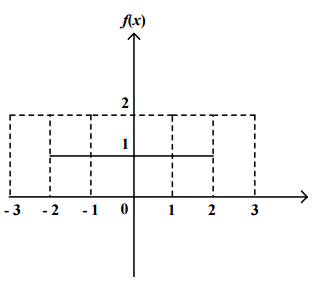
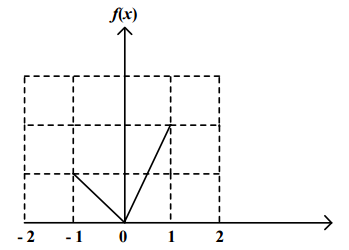
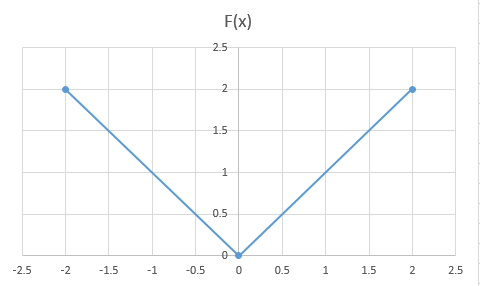
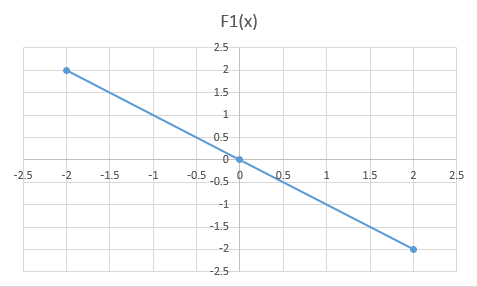
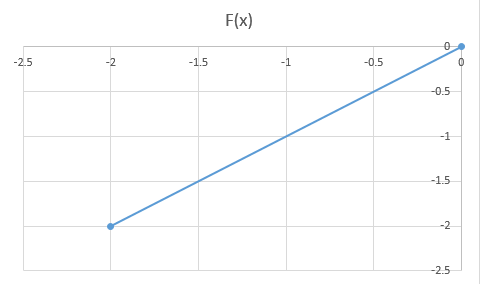
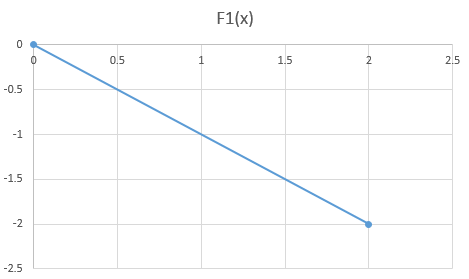
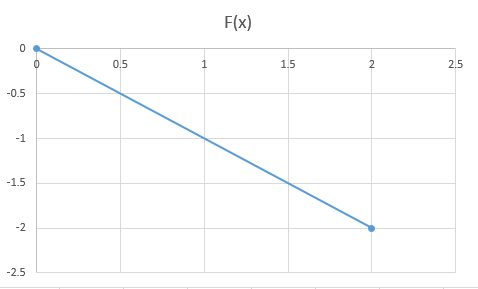
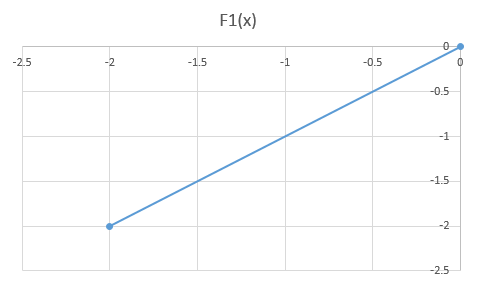
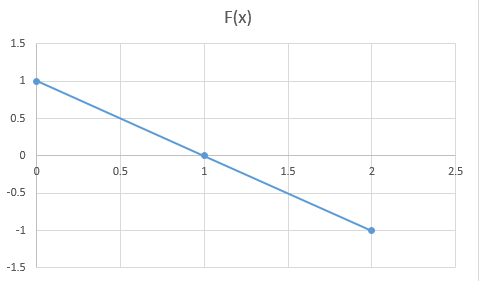
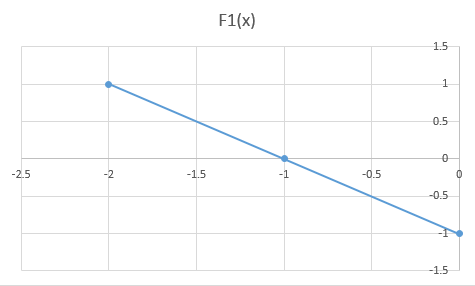
DIRECTIONS for the following questions: These questions are based on the situation given below: In each of the questions a pair of graphs F(x) and F1(x) is given. These are composed of straight-line segments, shown as solid lines, in the domain $$x\epsilon (-2, 2)$$.
These questions are based on the situation given below: A robot moves on a graph sheet with x and y-axes. The robot is moved by feeding it with a sequence of instructions. The different instructions that can be used in moving it, and their meanings are: Instruction Meaning GOTO(x,y) move to point with coordinates (x, y) no matter where you are currently WALKX(P) Move parallel to the x-axis through a distance of p, in the positive direction if p is positive, and in the negative direction if p is negative WALKY(P) Move parallel to the y-axis through a distance of p, in the positive direction if p is positive, and in the negative direction if p is negative.
Question 6
The robot reaches point (6, 6) when a sequence of three instructions is executed, the first of which is a GOTO(x, y) instruction, the second is WALKX(2) and the third is WALKY(4). What are the values of x and y?
Before, the third instruction, the point on which the robot is present is (6,2).
Before, the second instruction, the point on which the robot is present is (4,2).
Hence, the values of x and y are 4 and 2 respectively.
Question 7
The robot is initially at (x, y), x > 0 and y < 0. The minimum number of instructions needed to be executed to bring it to the origin (0,0) if you are prohibited from using the GOTO instruction is:
A function can sometimes reflect on itself, i.e. if y = f(x), then x = f(y). Both of them retain the same structure and form. Which of the following functions has this property?
Among all options only D satisfies the given equations as follows:
$$f(y) = \frac{1-y}{1+y}$$
and for x:
$$y + xy = 1-x$$
$$x(1+y) = 1-y$$
$$x= \frac{1-y}{1+y}$$
Hence $$x=f(y)$$
Question 4
Let Y = minimum of {(x+2), (3-x)}. What is the maximum value of Y for 0 <= x <=1?
For individuals preparing for the CAT quant section formulas related to Functions, Graphs, and Statistics, essential topics. This resource helps you to understand and mastering key concepts, providing a quick and efficient way to review and reinforce their knowledge in these areas. This PDF can be a helpful to understanding of CAT Functions, Graphs, and statistics formulas concepts relevant to the test. To know similar other important topics checking with CAT exam syllabus will help you know other important topics.
Functions, Graphs and Statistics - Algebra Identities Formulas:
$$\displaystyle (a^3+b^3+c^3-3abc)$$ = $$\displaystyle (a+b+c) * (a^2+b^2+c^2 - ab - bc - ca)$$
If $$(a+b+c)=0$$ => $$\displaystyle a^3+b^3+c^3=3abc$$
$$(a+b)^2$$ = $$\displaystyle (a^2+b^2+2ab)$$
$$(a-b)^2$$ = $$\displaystyle (a^2+b^2-2ab)$$
$$(a+b)^3$$ = $$\displaystyle a^3+b^3+3ab(a+b)$$
$$(a-b)^3$$ = $$\displaystyle a^3-b^3-3ab(a-b)$$
To have a better understanding and a better conceptual clarity getting yourself enrolled in a CAT online coaching is advised. One can practice these questions in a test format or can also download these questions in a PDF format along with the detailed video solutions for every question explained by the CAT toppers. Functions, Graphs and statistics is the one of the topic in CAT quant section, where the questions are mostly tricky. We have provided one solved set of questions on functions and graphs topic. Functions are one of the important topics in the Quantitative section of the CAT exam. It is an easy topic and so one must not avoid this topic. Every year 1-2 questions are asked on Functions. You can check out these Functions questions from CAT previous year papers. Practice a good number of questions on CAT Functions questions so that you don't miss out on the easy questions from this topic.
Yes, Functions and Graphs are key topics in CAT 2026 Quant. They test conceptual clarity, interpretation skills, and application of mathematical relationships.
For CAT 2026, focus on domain and range, types of functions, graphs of standard functions, and transformations.
Questions are usually moderate but can become tricky when combined with graphs or real-life data interpretation scenarios.
Focus on understanding graph behaviour, practice sketching functions, and solve mixed problems regularly to build confidence.
Yes, mock tests are essential for CAT 2026 as they help improve time management, accuracy, and familiarity with exam patterns.
Cracku is a reliable platform offering topic-wise practice, previous year questions, and mock tests tailored for CAT 2026 aspirants.
Typically, 1-3 questions may appear in CAT 2026 from Functions, Graphs, or Statistics, either standalone or mixed with other topics.
 91- 6303239042
 CAT WhatsApp Group



 In the above table, for suitably chosen constants a, b and c, which one of the following best describes the relation between y and x?