The mean of six positive integers is 15. The median is 18, and the only mode of the integers is less than 18. The maximum possible value of the largest of the six integers is
Sign in
Please select an account to continue using cracku.in
↓ →
The mean of six positive integers is 15. The median is 18, and the only mode of the integers is less than 18. The maximum possible value of the largest of the six integers is
Mean of the six numbers = 15
So, the sum of the numbers = 15 * 6 = 90
As the median is 18, the mean of middle two numbers must be 18 and thus, their sum must be 36.
Also, the mode is a number less than 18. So, the mode must be appearing as the first and the second number of the six given integers, when arranged in ascending order. To maximize the largest integers, the mode must be equal to 1.
Therefore, out of the six integers, two are 1 and 1.
For the middle two numbers whose sum is 36, we cannot have 18 and 18 because then we will have two modes which is inappropriate as per the question.
So, the middle numbers must be 17 and 19.
The fifth integer can be 20.
Maximum possible value of the largest integer = 90 - (1 + 1 + 17 + 19 + 20) = 32
Hence, option D is the correct answer.
Ramesh bought a total of 6 fruits (apples and oranges) from the market. He found that he required one orange less to extract the same quantity of juice as extracted from apples. If Ramesh had used the same number of apples and oranges to make the blend, then which of the following correctly represents the percentage of apple juice in the blend?
We know that Ramesh bought 6 fruits in total.
If the number of apples is 1, then the number of oranges required to get an equal amount of juice will be 0. Therefore, we can eliminate this case.
If the number of apples is 2, then the number of oranges required to get an equal amount of juice will be 1. We know that Ramesh had 1 more orange than needed. The total number of fruits in this case is 2+1+1 = 4. Therefore, we can eliminate this case too.
If the number of apples is 3, then the number of oranges required to get an equal amount of juice will be 2. We know that Ramesh had 1 more orange than needed. The total number of fruits in this case is 3+2+1 = 6. This satisfies the condition.
The quantity of juice from 3 apples is equal to the quantity of juice from 2 oranges.
Therefore, the proportion of apple juice in the initial mixture is 2/(2+3) = 2/5 = 40%. (2+3 is used since we are finding the quantity of juice. 2 denotes the quantity of juice obtained from 3 apples)
Therefore, option E is the right answer.
Sara has just joined Facebook. She has 5 friends. Each of her five friends has twenty five friends. It is found that at least two of Sara's friends are connected with each other. On her birthday, Sara decides to invite her friends and the friends of her friends. How many people did she invite for her birthday party?
Sarah has 5 friends and each of her 5 friends have 25 friends.
The 5 friends of Sarah have Sarah as one of their 25 friends. Therefore, apart from Sarah the five friends will have 24 friends each.
If no 2 friends know each other, then Sarah will have to invite 5*24 + 5 = 120 + 5 = 125 persons.
Sarah knows that at least 2 of her friends are connected to each other.
Let the 5 friends be A, B, C, D, and E. Let us consider that A and B are friends.
A will be counted twice (first as one among the 5 persons and second as one of the friends of B).
B will also be counted twice (first as one among the 5 persons and second as one of the friends of A).
Subtracting these 2 friends, we can infer that the maximum number of persons that Sarah could have invited to the party is 123.
The minimum number of friends that Sarah could have invited is obtained when all the friends are connected to each other and their friends are also the same. In this case, the five friends will have 20 common friends, will be friends with each other (4) and Sarah (1).
The minimum number of persons Sarah could have invited to the party = 20+5 = 25.
Option B is more appropriate that option C.
Therefore, option B is the right answer.
Prof. Mandal walks to the market and comes back in an auto. It takes him 90 minutes to make the round trip. If he takes an auto both ways it takes him 30 minutes. On a Sunday, he decides to walk both ways. How long would it take him?
As it took Prof. Mandal 30 minutes for round trip to the market by auto, we can infer that the auto takes 15 minutes for one way trip.
When he walks one way and return by auto, it took him 90 minutes.
We know the auto would have taken 15 minutes while returning.
So, the professor takes (90 - 15) = 75 minutes one way while walking to the market.
So, for a round trip by walking, he will take 2 * 75 minutes = 150 minutes.
Hence, option D is the correct.
At the centre of a city's municipal park there is a large circular pool. A fish is released in the water at the edge of the pool. The fish swims north for 300 feet before it hits the edge of the pool. It then turns east and swims for 400 feet before hitting the edge again. What is the area of the pool?
The fish travels North for 300 m and on hitting the edge, travels East for 400 m. The directions North and East are perpendicular to each other. On connecting the initial and final positions of the fish in the tank, we get a right-angled triangle.
The line AC subtends an angle of 90 degree on the circumference. Therefore, AC must be the diameter of the pond.
Applying Pythagoras theorem, we get,
$$AB^2 + BC^2$$ = $$AC^2$$
$$AC^2 = 300^2 + 400^2$$
$$AC = 500$$ m.
=> Radius of the pond = $$250$$ m.
Area of the pond = $$\pi*r^2$$
=> Area = $$62500\pi m^2$$.
Therefore, option A is the right answer.
Mr. Mehra is planning for higher education expenses of his two sons aged 15 and 12. He plans to divide Rs 15 lakhs in two equal parts and invest in two different plans such that his sons may have access to Rs 21 lakhs each when they reach the age of 21. He is looking for plans that will give him a simple interest per annum. The rates of interest of the plans for his younger son and his elder son should be
Rs. 15 lakhs is to be divided equally.
In the case of the younger son,
Principal = Rs. 750000, time = 9 years and Interest = Rs. 1350000
Rate of interest = $$\dfrac{1350000 * 100}{750000 * 9}$$ = 20%
In the case of the elder son,
Principal = Rs. 750000, time = 6 years and Interest = Rs. 1350000
Rate of interest = $$\dfrac{1350000 * 100}{750000 * 6}$$ = 30%
Hence, option E is the correct answer.
Albela, Bob and Chulbul have to read a document of seventy eight pages and make a presentation next day. They realize that the article is difficult to understand and they would require teamwork to finish the assignment. Albela can read a page in 2 minutes, Bob in 3 minutes, and Chulbul in 4 minutes. If they divide the article into 3 parts so that all three of them spend the equal amount of time on the article, the number of pages that Bob should read is
Let the total time required be 12T (LCM of 2, 3 and 4 for the ease of calculation)
No. of pages read by Albela in 12T minutes at 2 minute per page = 6T
No. of pages read by Bob in 12T minutes at 3 minute per page = 4T
No. of pages read by Chulbul in 12T minutes at 4 minute per page = 3T
Total no. of pages read by all three of them = (6T + 4T + 3T) = 13T
According to the question, total pages = 78
So, 13T = 78
Or, T = 6
Therefore, no. of pages read by Bob = 4T = 24
Hence, option A is the correct answer.
The taxis plying in Wasseypur have the following fare structure: Rs 20 for the first two kilometers, Rs 5 for every km in excess of 2 km and up to 10 km, and Rs 8 for every km in excess of 10 km. Bullock carts on the other hand charge Rs 2 per km. Sardar Khan takes a taxi from the Wasseypur railway station to his home. On the way, at a distance of 14 km from the railway station, he meets Faizal Khan, and gets down from the taxi to talk to him. Later he takes a bullock cart to reach his home. He spends a total of Rs 102 to reach his home from the railway station. How far is his home from the railway station (in kilometers)?
For the first 2 km, fare = Rs. 20
For the next 8 km, fare = Rs. 5 * 8 = Rs. 40
For the next 4 km, fare = Rs. 8 * 4 = Rs. 32
Total fare up to 14 km = Rs. 20 + Rs. 40 + Rs. 32 = Rs. 92
Total fare paid by Sardar Khan = Rs. 102
Money spent on bullock cart = Rs. 102 - Rs. 92 = Rs. 10
Charge for bullock cart = Rs. 2/km
Distance travelled by bullock cart = 5 km
Total distance travelled by Sardar Khan = (14 + 5) km = 19 km
Hence, option C is the correct answer.
Consider the expression $$\frac{(a^2+a+1)(b^2+b+1)(c^2+c+1)(d^2+d+1)(e^2+e+1)}{abcde}$$, where a,b,c,d and e are positive numbers. The minimum value of the expression is
The given expression can be written as $$\frac{a^2+a+1}{a}*\frac{b^2+b+1}{b}*\frac{c^2+c+1}{c}*\frac{d^2+d+1}{d}*\frac{e^2+e+1}{e}$$.
$$\frac{a^2+a+1}{a}=a+\frac{1}{a}+1$$
We know that for positive values, AM $$\geq$$ GM.
$$\frac{a+\frac{1}{a}}{2} \geq \sqrt{a*\frac{1}{a}}$$
$$a+\frac{1}{a} \geq 2$$
The least value that $$a+\frac{1}{a}$$ can take is $$2$$.
Therefore, the least value that the term $$a+\frac{1}{a}+1$$ can take is $$3$$.
Similarly, the least value that the other terms can take is also $$3$$.
=> The least value of the given expression = $$3*3*3*3*3$$ = $$243$$.
Therefore, option E is the right answer.
In a square PQRS, A and B are two points on PS and SR such that PA =2AS, and RB = 2BS If PQ = 6, the area of the triangle ABQ is (in sq. cm)
PQ = QR = RS = SP = 6 cm
PA = 2AS and PA + AS = 6cm
=> PA = 4 cm and AS = 2 cm
Similarly, RB = 2BS and RB + BS = 6 cm
=> RB = 4 cm and BS = 2cm
Area of △ ABQ = area of PQRS - area of △APQ - area of △RBQ - area of △ASB
= (36 - 12 - 12 - 2) sq. cm
= 10 sq. cm
Hence, option C is the correct answer.
How many whole numbers between 100 and 800 contain the digit 2?
Let us analyse all numbers from 100 to 200 (both excluded).
Total numbers when unit digit is 2 = 10 {102,112,122, ..., 192}
Total numbers when tens digit is 2 = 10 {120,121,121, ..., 129}
We can see that the there is exactly one number{122} which have both tens and unit digit as 1. So total unique numbers from 100 to 200 (both excluded) which contain at least one 2 digit = 10 + 10 - 1 = 19
From 200 to 299 (both included), all numbers have at least one digit as 2. Total such number = 100.
From 300 to 400, 400 to 500, 500 to 600, 600 to 700 and 700 to 800 we will have 19 number for each pair with at least one 2 digit.
Therefore, total whole numbers between 100 and 800 contain the digit 2 = 100 + 19*6 = 214.
p, q and r are three non-negative integers such that p + q + r = 10. The maximum value of pq + qr + pr + pqr is
The product of 2 numbers A and B is maximum when A = B.
If we cannot equate the numbers, then we have to try to minimize the difference between the numbers as much as possible.
pq will be maximum when p=q.
qr will be maximum when q=r.
qr will be maximum when r=p.
Therefore, p, q, and r should be as close to each other as possible.
We know that p,q,and r are integers and p+q+r=10.
=> p,q, and r should be 3,3, and 4 in any order.
Substituting the values in the expression, we get,
pq+qr+pr+pqr = 3*3 + 3*4 + 3*4 + 3*3*4
= 9 + 12 + 12 + 36
= 69
Therefore, option C is the right answer.
A number is interesting if on adding the sum of the digits of the number and the product of the digits of the number, the result is equal to the number. What fraction of numbers between 10 and 100 (both 10 and 100 included) is interesting?
As the number is between 10 and 100 and 100 cannot be the number we are looking for, we can assume the number to be of two-digits.
Let the number be xy.
According to the question, for the number to be interesting
x + y + xy = 10x + y
On solving, we get
xy = 9x
or, x (9 - y) = 0
x cannot be 0, because we need a number greater than or equal to 10.
So, 9 - y = 0
=> y = 9
For all the numbers whose unit digit is 9 will be an interesting number.
So, the numbers are 19, 29, 39, 49, .....99
There are 9 such numbers out of 91 total numbers between 10 and 100 including both.
Required fraction = $$\dfrac{9}{91}$$ = 0.0989
As this is not given in any of the options, the answer will be "none of the above".
Hence, option E is the correct answer.
70% of the students who joined XCRI last year play football, 75% play cricket, 80% play basketball and 85% play carrom. The minimum percentage of students who play all four games is:
Let '100x' be the number of students who joined XCRI last year.
Let 'a', 'b', 'c' and d be the number of students who play 1 game, 2 games, 3 games and 4 games respectively.
Therefore,
a+b+c+d = 100x ... (1)
a+2b+3c+4d = 70x+75x+80x+85x
a+2b+3c+4d = 310x ... (2)
By equation (2) - (1)
b+2c+3d = 210x ....(3)
To minimise d, we have to maximise c, as c has the highest coefficient in the above equation, and in order to maximise c, we need to minimise all a,b and d.
So let's put a=b=0 inorder to minimize a, b and d in equations 1 and 3
c+d = 100x
2c+3d = 210x
Solving the above equations yields c = 90x and d = 10x.
Therefore, we can say that the minimum percentage of students who play all four games = 10%.
p and q are positive numbers such that $$p^q = q^p$$, and $$q = 9p$$. The value of p is
$$p^q = q^p$$.
It has been given that $$q = 9p$$.
Substituting, we get,
$$p^{9p}=(9p)^p$$
$$(p^p)^9 = 9^p*p^p$$
=> $$(p^p)^8 = 9^p$$
$$p^{8p}=9^p$$
Raising the power to $$\frac{1}{p}$$ on both sides, we get,
$$p^8=9$$
$$p=\sqrt[8]{9}$$.
Therefore, option D is the right answer.
Ram, Shyam and Hari went out for a 100 km journey. Ram and Hari started the journey in Ram's car at the rate of 25 kmph, while Shyam walked at 5 kmph. After sometime, Hari got off and started walking at the rate of 5kmph and Ram went back to pick up Shyam. All three reached the destination simultaneously. The number of hours required for the trip was:
Let 'A' be the point from where all started and D is the destination. At 'x' hours both Ram and Hari reached point C, Hari got off and Ram turned back to pick up Shyam. At the same instant, Shyam was at point B.
Let 'T' is the total amount of time taken by all three to reach point D.
For Hari,
T = $$x+\dfrac{100-25x}{5}$$ ... (1)
For Ram,
T = $$x+\dfrac{20x*5/6}{25}$$ + $$\dfrac{20x*5/6+100-25x}{25}$$ ... (2)
By equating (1) and (2),
$$x+\dfrac{100-25x}{5}$$ = $$x+\dfrac{20x*5/6}{25}$$ + $$\dfrac{20x*5/6+100-25x}{25}$$
$$\Rightarrow$$ $$x = 3$$ hours.
Therefore, time taken by all to reach destination = $$x+\dfrac{100-25x}{5}$$
$$\Rightarrow$$ 3 + $$\dfrac{100-25*3}{5}$$
$$\Rightarrow$$ 3 + 5
$$\Rightarrow$$ 8 hours
Hence, we can say that option A is the correct answer.
The central park of the city is 40 metres long and 30 metres wide. The mayor wants to construct two roads of equal width in the park such that the roads intersect each other at right angles and the center of the rectangle co-incides with the center of the rectangle formed by the intersection of the two roads . Further, the mayor wants that the area of the two roads to be equal to the remaining area of the park. What should be the width of the roads?
Let us draw the diagram according to the information given in the questions.
Let us assume that 'T' is the width of the road as shown in the diagram.
Total area covered by road = $$30*T+40*T-T^2$$
Also it is given that the mayor wants that the area of the two roads to be equal to the remaining area of the park.
$$\Rightarrow$$ $$30*T+40*T-T^2$$ = $$\dfrac{30*40}{2}$$
$$\Rightarrow$$ $$T^2-70T+600$$ = $$0$$
$$\Rightarrow$$ $$(T-10)(T-60)$$ = $$0$$
$$\Rightarrow$$ $$T$$ = $$10$$ or $$60$$ m. T $$\neq$$ 60 m as the width of park is 30 m only.
Therefore, we can say that T = 10 meters. Hence, option A is the correct answer.
Arun has to go to the country of Ten to work on a series of tasks for which he must get a permit from the Government of Ten. Once the permit is issued, Arun can enter the country within ten days of the date of issuance of the permit. Once Arun enters Ten, he can stay for a maximum of ten days. Each of the tasks has a priority, and takes a certain number of days to complete. Arun cannot work on more than one task at a time. The following table gives the details of the priority and the number of days required for each task.
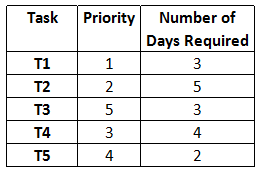
Arun's first priority is to complete as many tasks as possible, and then try to complete the higher priority tasks. His last priority is to go back as soon as possible.
The tasks that Arun should try to complete are:
It has been given that Arun's task is to complete as many tasks as possible and then to focus on completing tasks based on their priority.
Arun has 10 days with him. Except 1 task, all other tasks require at least 3 days to be completed. Therefore, Arun can complete a maximum of 3 tasks.
Arun can complete T1, T2, and T5 or T1, T3, and T4 or T1, T3, and T5 or T2, T3, and T5 or T1, T4, and T5.
In all these combinations, Arun would have completed 2 higher priority tasks in the combination T1, T2, and T5.
Therefore, Arun should complete T1, T2, and T5 and hence, option B is the right answer.
Arun has to go to the country of Ten to work on a series of tasks for which he must get a permit from the Government of Ten. Once the permit is issued, Arun can enter the country within ten days of the date of issuance of the permit. Once Arun enters Ten, he can stay for a maximum of ten days. Each of the tasks has a priority, and takes a certain number of days to complete. Arun cannot work on more than one task at a time.
However, Arun's manager has told him to do some background research on the tasks before leaving for Ten. At the same time, there is no guarantee that the Government of Ten will give the permit to Arun. Background research involves substantial costs, and therefore Arun has decided that he will not start his background research without getting the permit.
The following table gives the details of the priority, the number of days required for each task and the number of days required for background research on each task.
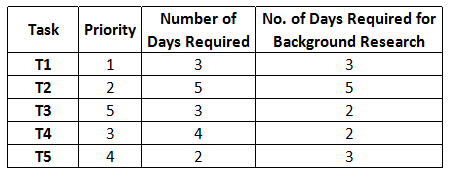
According to the data given in previous question, Arun have 10 days to do a background check, as he have to enter within 10 days of receiving permit.
The number of tasks that can be completed in this case is also 3.
Arun can complete T1, T2, and T5 or T1, T3, and T4 or T1, T3, and T5 or T2, T3, and T5 or T1, T4, and T5.
In this case, the time required to complete T1, T2, and T5 exceeds 10 days. The same is the case with T1, T2, and T3.
Among the given options, both options D and E are possible cases.
T5 is a higher priority task than T3. Therefore, Arun should try to complete T1, T4, and T5.
Therefore, option E is the right answer.
The radius of a circle with centre O is $$\sqrt{50}$$cm. A and C are two points on the circle, and B is a point inside the circle. The length of AB is 6 cm, and the length of BC is 2 cm. The angle ABC is a right angle. Find the square of the distance OB.
We know that ABC is a right angled triangle.
=> $$AC=\sqrt{6^2+2^2}$$
$$AC=\sqrt{40}$$
$$AC=2*\sqrt{10}$$
Let the coordinates of A be (0,0)
We know that the radius of the circle, OA = $$\sqrt{50}$$cm
Let OD be the height of the triangle AOC.
$$AC/2=*\sqrt{10}$$
By applying Pythagoras theorem, we get,
=>The height(y) of the point O $$= \sqrt{50-10}$$
The height(y) of the point O$$=\sqrt{40}$$cm
=> Coordinates of point O = $$(\sqrt{10},\sqrt{40})$$
Area of triangle ABC = $$0.5*6*2$$ = $$6$$ square units.
Let the height of triangle ABC be h.
0.5*h*AC=6
h*AC = 12
h*$$2*\sqrt{10}$$ = $$12$$
h = $$\frac{6}{\sqrt{10}}$$
X-coordinate of point B =$$\sqrt{6^2-\frac{36}{10}}$$
= $$\sqrt{32.4}$$ cm
Distance between points O and B = $$\sqrt{(\sqrt{10}-\sqrt{32.4})^2+({\sqrt{40}-\frac{6}{\sqrt{10}})^2}}$$
Expanding, we get,
Square of the distance between points O and B = $$26$$ cm.
Therefore, option A is the right answer.
Six playing cards are lying face down on a table, two of them are kings. Two cards are drawn at random. Let a denote the probability that at least one of the cards drawn is a king, and b denote the probability of not drawing a king. The ratio a/b is
There are 6 cards and 2 out of the 6 cards are kings.
Number of ways of selecting 2 cards = 6C2 = 15 ways.
Number of ways in which 2 cards can be selected such that both of them are King = 2C2 = 1
Number of ways in which 2 cards can be selected such that exactly one of them is a King = 2C1*4C1 = 8
=> a = (1+8)/15 = 9/15
b = 1-(9/15) = 6/15
a/b = 9/6 = 1.5
1.5 > 1.25
Therefore, option E is the right answer.
In the country of Four, there are four cities, A, B, C and D. B is to the East of A, C is to the South of B, D is to the West of C, and A is to the North of D. The Government of Four is planning to connect these four cities by road such that it is possible for a person to go from a city to any of the other three cities. At the same time, the Government wants to ensure that the total road length is minimum. The distances between A to B, B to C, C to D and D to A are all equal to 10 km. What should be the total length of the road?
We can draw the towns as shown in the diagram below.
For the minimum length the Government should diagonal roads. The length of road will be same as the length of a diagonal of a square whose side length is 10 km.
Length of one diagonal = $$\sqrt{2}*10$$ = 1.414*10 = 14.14 km
Therefore, total length of both the roads = 2*14.14 $$\approx$$ 28.30 km.
Consider the expression $$(xxx)_{b}=x^3$$, where b is the base, and x is any digit of base b. Find the value of b:
$$(xxx)_{b}=x^3$$
=> $$xb^2+xb+x = x^3$$
=> $$b^2+b+1=x^2$$
On substituting b=1,and b=2, we get $$x^2$$ as $$3$$, and $$7$$. Since $$3$$ and $$7$$ are not perfect squares, we can infer that no number satisfies the given condition. Therefore, option E is the right answer.
Consider a function $$f(x) = x^4 + x^3 + x^2 + x + 1$$, where x is a positive integer greater than 1. What will be the remainder if $$f(x^5)$$ is divided by f(x)?
$$x^5-1 = (x-1)(x^4+x^3+x^2+x+1)$$
$$x^5-1=(x-1)f(x)$$
$$x^5 = 1+(x-1)f(x)$$
$$f(x^5) = (1+(x-1)f(x))^4+(1+(x-1)f(x))^3+(1+(x-1)f(x))^2+(1+(x-1)f(x))+1$$
On dividing by $$f(x)$$, every term will leave $$1$$ as the remainder. Therefore, the remainder when $$f(x^5)$$ is divided by $$f(x)$$ is $$1+1+1+1+1=5$$.
Therefore, option A is the right answer.
Please read the following sentences carefully:
I — 103 and 7 are the only prime factors of 1000027
II — $$\sqrt[6]{6!}>\sqrt[7]{7!}$$
III — If I travel one half of my journey at an average speed of x km/h, it will be impossible for me to attain an average speed of 2x km/h for the entire journey.
Let us evaluate the statements one by one:
I: 103 and 7 are the only prime factors of 1000027
On successively dividing 1000027 by 103 and 7, we get 1387 as the answer.
1387 is divisible by 19.
Therefore, statement I is false.
II: $$\sqrt[6]{6!}>\sqrt[7]{7!}$$
Raising the power to 42 on both sides, we get,
$$[6!]^7>[7!]^6$$
$$6!*[6!]^6 > 7^6*[6!]^6$$
$$7^6$$ is greater than $$6!$$.
Therefore, statement II is false.
III:It has been given that the person travels one-half of the journey at x kmph.
Let us assume the distance to be '2d'.
Let us assume the average speed to be 2d and check for the feasibility.
Let the speed at which the person travels the other half of the journey be y.
d/x + d/y = 2d/2x
d/x + d/y = d/x
=> d/y = 0 or y tends to infinity.
Therefore, such a scenario is not possible and hence, statement III is true.
Only statement III is true. Therefore, option C is the right answer.
The figure below shows the graph of a function f(x). How many solutions does the equation f(f(x)) = 15 have?

It has been given that f(f(x)) = 15.
From the graph, we can see that the value of f(4) = 15 and f(12) = 15
Therefore, f(x) can be 4 or 12.
When f(x) = 4, x can take 4 values
When f(x) = 12, x can take 3 values.
Therefore, there are 4+3 = 7 solutions in total.
Therefore, option C is the right answer.
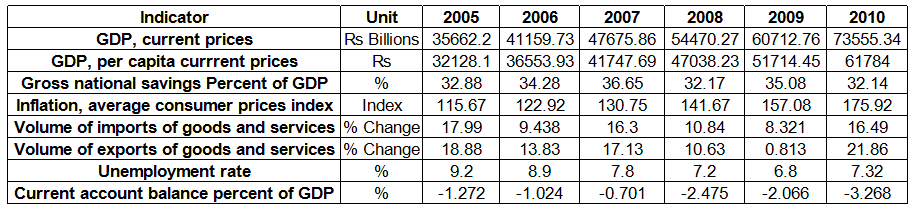
What is the ratio of the current account balance in 2010 to the current account balance in 2005?
Current account balance = Current account balance percentage of GDP*GDP
Current account balance in 2010 = 3.268% of 73555.34 = 2403.7885
Current account balance in 2005 = 1.272% of 35662.2 = 453.623
Ratio = 2403.7885/453.623 = 5.3 (approximately).
Therefore, option E is the right answer.
Read the statements given below:
l.Exports were more than imports in 2006
2.Imports were more than exports in 2009
3.Exports increased at faster rate than imports during the period 2005 to 2010
Which of the above statements is necessarily true?
The table provides details only regarding the % change in the imports and exports. We do not have any detail regarding the base value. Therefore, we cannot find out the absolute values and hence, statements 1 and 2 cannot be verified.
The percentage change of exports and imports over the given period can be found out. Among the given options, option C is the only viable option now. Since none of the above is not present among the options, option C must be the right answer.
To actually compare the growth rate of export and import. we can multiply the rates to find the net change and then compare.
What was the approximate number of unemployed persons in 2006?
Population = GDP/GDP per capita
In 2006, GDP = Rs.41159.73 billion
GDP per capita = Rs. 36,553.93
=> Population = 41159.73*1000/36553.93
= 1126 million.
From the table, we can see that 8.9% of the total population was unemployed in 2006.
=> Number of unemployed people = 0.089*1126 = 100 million (approx)
Therefore, option A is the right answer.
Analyze the railway train chart below:
Which is the fastest train between HHH and NNN?
Except 7777, all other trains take at least 2 hours to cover the distance between the stations HHH and NNN. Therefore, option D is the right answer.
Which is the fastest train between AAA and NNN?
In the graph, the line with the steepest slope should be preferred to travel in the shortest possible time.
The line representing 8800 completes within 2 hour slot and has the steepest slope among the given options. Therefore, option A is the right answer.
If you have to travel from AAA and reach HHH at around 9:00 AM, and then further travel to NNN at around 6:00 PM, which is the best combination of trains for you?
Only 3 trains - 4444, 5555, and 8888 reach HHH before 9 AM. Among these 3 trains, 8888 reaches just before 9 AM and hence, it is the best train to reach HHH from AAA. 8800 reaches HHH at 6 PM exactly. Therefore, it is the best train to travel from HHH to NNN. Therefore, option D is the right answer.
Answer questions based on the following information:
Data on an ongoing football league of a country is given below. 20 teams are playing in the league. The rules of the league are as follows:
1. Each team plays all the other teams twice, once in its home ground, and once in the opponent's home ground. These matches are known as the "Home" match and the "Away" match respectively.
2. A win results in 3 points, a draw in 1 point, and a loss in 0 point for the team.
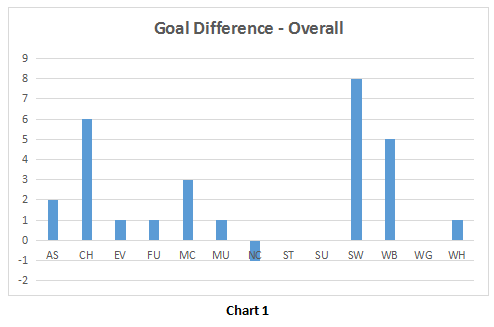
3. The number of goals a team scores is termed as "Goals For" and the number of goals it concedes is termed as "Goals Against". We get the "Goal Difference" by subtracting "Goals Against" from "Goals For".
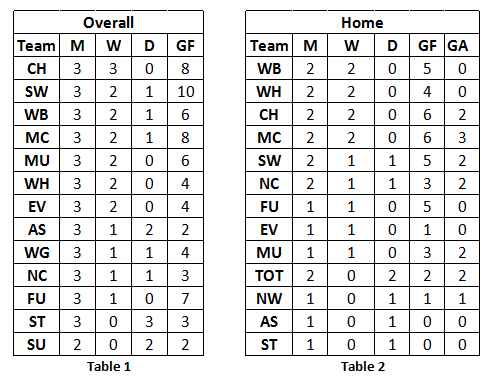
Considering away matches only, which of the following teams is the second ranking team?
Using the data from both the tables available, we can create the table for away matches as given below:
Thus, the team with rank 2 is SW.
Hence, option D is the answer.
Considering away matches only, the least number of teams with either 0 or 1 point is:
Using the data from both the tables available, we can create the table for away matches as given below:
We have to find the number of teams with 0 or 1 point. From the table, we can see that there are 5 such teams.
Thus, option D is the answer.
Let us define a term pos as the difference between "home rank" and "away rank". Which of the following has the maximum value of pos?
Using the data from both the tables available, we can create the table for away matches as given below:
We have to find the team with the highest difference between home and away rank.
AS: pos = |12 - 1| = 11
WB: pos = |1 - 7| = 6
WH: pos = |2 - 10| = 8
MC: pos = |4 - 7| = 3
SW: pos = |5 - 2| = 3
Thus, the team with the highest value of pos is AS
Thus, option A is the correct answer.
How many unique values of goal difference are there for away matches?
Using the data from both the tables available, we can create the table for away matches as given below:
From the above table, we can see 6 such values: 0, 2, 5, -2, -3 and -4.
Thus, option B is the answer.
Educational materials for CAT preparation