NTA JEE Main 22nd April 2013 Online
For the following questions answer them individually
NTA JEE Main 22nd April 2013 Online - Question 11
A certain amount of gas is taken through a cyclic process (A B C D A) that has two isobars, one isochore and one isothermal. The cycle can be represented on a P - V indicator diagram as :
NTA JEE Main 22nd April 2013 Online - Question 12
A mass $$m = 1.0$$ kg is put on a flat pan attached to a vertical spring fixed on the ground. The mass of the spring and the pan is negligible. When pressed slightly and released, the mass executes simple harmonic motion. The spring constant is 500 N/m. What is the amplitude A of the motion, so that the mass m tends to get detached from the pan? (Take $$g = 10$$ m/s$$^2$$). The spring is stiff enough so that it does not get distorted during the motion.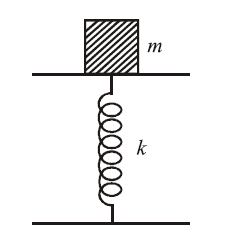
NTA JEE Main 22nd April 2013 Online - Question 13
A and B are two sources generating sound waves. A listener is situated at C. The frequency of the source at A is 500 Hz. A, now, moves towards C with a speed 4 m/s. The number of beats heard at C is 6. When A moves away from C with speed 4 m/s, the number of beats heard at C is 18. The speed of sound is 340 m/s. The frequency of the source at B is :


NTA JEE Main 22nd April 2013 Online - Question 14
A point charge of magnitude $$+1\mu C$$ is fixed at (0, 0, 0). An isolated uncharged spherical conductor, is fixed with its center at (4, 0, 0). The potential and the induced electric field at the centre of the sphere is :
NTA JEE Main 22nd April 2013 Online - Question 15
Two small equal point charges of magnitude $$q$$ are suspended from a common point on the ceiling by insulating mass less strings of equal lengths. They come to equilibrium with each string making angle $$\theta$$ from the vertical. If the mass of each charge is $$m$$, then the electrostatic potential at the centre of line joining them will be $$\left(\frac{1}{4\pi\epsilon_0} = k\right)$$.
NTA JEE Main 22nd April 2013 Online - Question 16
To establish an instantaneous current of 2 A through a 1$$\mu$$F capacitor; the potential difference across the capacitor plates should be changed at the rate of:
NTA JEE Main 22nd April 2013 Online - Question 17
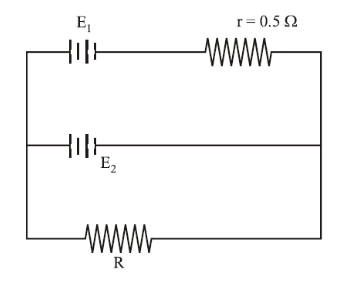
A dc source of emf $$E_1 = 100$$ V and internal resistance $$r = 0.5\Omega$$, a storage battery of emf $$E_2 = 90$$ V and an external resistance R are connected as shown in figure. For what value of R no current will pass through the battery?
NTA JEE Main 22nd April 2013 Online - Question 18
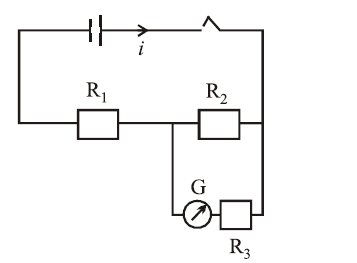
To find the resistance of a galvanometer by the half deflection method the following circuit is used with resistances $$R_1 = 9970$$ W, $$R_2 = 30$$ W and $$R_3 = 0$$. The deflection in the galvanometer is d. With $$R_3 = 107$$ W the deflection changed to $$\frac{d}{2}$$. The galvanometer resistance is approximately:
NTA JEE Main 22nd April 2013 Online - Question 19
Choose the correct sketch of the magnetic field lines of a circular current loop shown by the dot and the cross $$\otimes$$.
NTA JEE Main 22nd April 2013 Online - Question 20
A current $$i$$ is flowing in a straight conductor of length $$L$$. The magnetic induction at a point on its axis at a distance $$\frac{L}{4}$$ from its centre will be :