
Join Our JEE Preparation Group
Prep with like-minded aspirants; Get access to free daily tests and study material.
Sign in
Please select an account to continue using cracku.in
↓ →
Join Our JEE Preparation Group
Prep with like-minded aspirants; Get access to free daily tests and study material.
A tennis ball (treated as hollow spherical shell) starting from O rolls down a hill. At point A, the ball becomes air borne leaving at an angle of 30° with the horizontal. The ball strikes the ground at B. What is the value of the distance AB? (Moment of inertia of a spherical shell of mass m and radius R about its diameter = $$\frac{2}{3}mR^2$$)
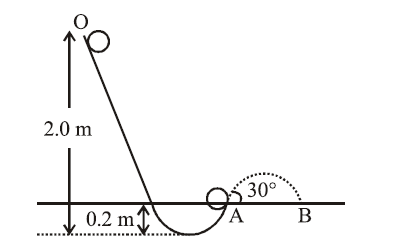
Total energy at O is potential, and at A it is a mix of translational and rotational kinetic energy:
$$mgh = \frac{1}{2}mv^2 + \frac{1}{2}I\omega^2$$
$$mgh = \frac{1}{2}mv^2 + \frac{1}{2}\left(\frac{2}{3}mR^2\right)\left(\frac{v}{R}\right)^2$$
$$mgh = \frac{1}{2}mv^2 + \frac{1}{3}mv^2 = \frac{5}{6}mv^2$$
$$v^2 = \frac{6gh}{5} = \frac{6 \times 10 \times 1.8}{5} = \frac{108}{5} = 21.6$$
$$v = \sqrt{21.6} \approx 4.65\text{ m/s}$$
$$R_{range} = \frac{v^2 \sin(2\theta)}{g}$$
$$AB = \frac{21.6 \times \sin(60^\circ)}{10}$$
$$AB = 2.16 \times 0.866 \approx 1.87\text{ m}$$
Was this solution helpful?
Create a FREE account and get:
_1.webp)

Educational materials for JEE preparation

Ask our AI anything

AI can make mistakes. Please verify important information.
AI can make mistakes. Please verify important information.


