
Join Our JEE Preparation Group
Prep with like-minded aspirants; Get access to free daily tests and study material.
Sign in
Please select an account to continue using cracku.in
↓ →
Join Our JEE Preparation Group
Prep with like-minded aspirants; Get access to free daily tests and study material.
A mass $$m = 1.0$$ kg is put on a flat pan attached to a vertical spring fixed on the ground. The mass of the spring and the pan is negligible. When pressed slightly and released, the mass executes simple harmonic motion. The spring constant is 500 N/m. What is the amplitude A of the motion, so that the mass m tends to get detached from the pan? (Take $$g = 10$$ m/s$$^2$$). The spring is stiff enough so that it does not get distorted during the motion.
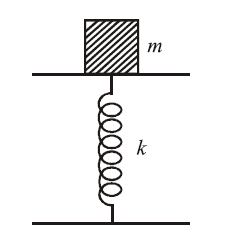
The mass $$m$$ tends to get detached from the pan when the normal force between them becomes zero. In simple harmonic motion (SHM), this occurs at the highest point of the oscillation where the downward acceleration of the pan exceeds the acceleration due to gravity $$g$$.
$$a_{max} = \omega^2 A$$
$$a_{max} \geq g \implies \omega^2 A \geq g$$
$$\omega^2 = \frac{k}{m}$$
$$\omega^2 = \frac{500}{1.0} = 500 \text{ rad}^2/\text{s}^2$$
$$500 \times A \geq 10$$
$$A \geq \frac{10}{500} \text{ m}$$
$$A \geq 0.02 \text{ m} = 2.0 \text{ cm}$$
Was this solution helpful?
Click on the Email ☝️ to Watch the Video Solution
Create a FREE account and get:
_1.webp)

Educational materials for JEE preparation

Ask our AI anything

AI can make mistakes. Please verify important information.
AI can make mistakes. Please verify important information.


