
Join Our JEE Preparation Group
Prep with like-minded aspirants; Get access to free daily tests and study material.
Sign in
Please select an account to continue using cracku.in
↓ →
Join Our JEE Preparation Group
Prep with like-minded aspirants; Get access to free daily tests and study material.
Given sum of the first $$n$$ terms of an A.P. is $$2n + 3n^2$$. Another A.P. is formed with the same first term and double of the common difference, the sum of $$n$$ terms of the new A.P. is :
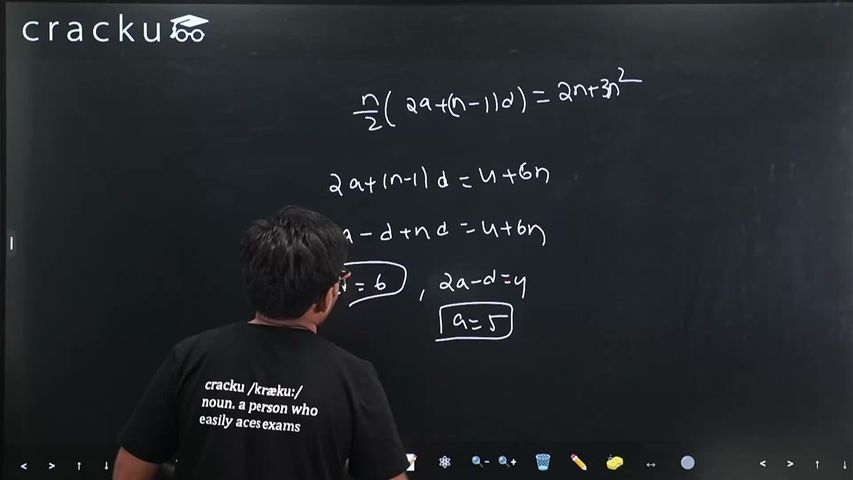
Given that the sum of the first $$n$$ terms of an A.P. is $$S_n = 2n + 3n^2$$. The general formula for the sum of the first $$n$$ terms of an A.P. is $$S_n = \frac{n}{2} [2a + (n-1)d]$$, where $$a$$ is the first term and $$d$$ is the common difference.
Set the given sum equal to the formula:
$$$ \frac{n}{2} [2a + (n-1)d] = 2n + 3n^2 $$$
Multiply both sides by 2 to eliminate the denominator:
$$$ n [2a + (n-1)d] = 2 \times (2n + 3n^2) $$$
$$$ n [2a + (n-1)d] = 4n + 6n^2 $$$
Divide both sides by $$n$$ (since $$n \neq 0$$):
$$$ 2a + (n-1)d = \frac{4n + 6n^2}{n} $$$
$$$ 2a + (n-1)d = 4 + 6n $$$
Expand the left side:
$$$ 2a + n d - d = 6n + 4 $$$
Rearrange to group like terms:
$$$ (2a - d) + n d = 6n + 4 $$$
Since this equation holds for all $$n$$, equate the coefficients of $$n$$ and the constant terms:
Coefficient of $$n$$:
$$$ d = 6 $$$
Constant term:
$$$ 2a - d = 4 $$$
Substitute $$d = 6$$ into the constant equation:
$$$ 2a - 6 = 4 $$$
$$$ 2a = 10 $$$
$$$ a = 5 $$$
So, the first term $$a = 5$$ and common difference $$d = 6$$.
Now, form a new A.P. with the same first term $$a' = a = 5$$ and double the common difference, so $$d' = 2d = 2 \times 6 = 12$$.
The sum of the first $$n$$ terms of the new A.P. is given by:
$$$ S'_n = \frac{n}{2} [2a' + (n-1)d'] $$$
Substitute $$a' = 5$$ and $$d' = 12$$:
$$$ S'_n = \frac{n}{2} [2 \times 5 + (n-1) \times 12] $$$
$$$ S'_n = \frac{n}{2} [10 + 12(n-1)] $$$
Expand inside the brackets:
$$$ 10 + 12(n-1) = 10 + 12n - 12 = 12n - 2 $$$
So:
$$$ S'_n = \frac{n}{2} \times (12n - 2) $$$
$$$ S'_n = \frac{n}{2} \times 2(6n - 1) $$$
$$$ S'_n = n \times (6n - 1) $$$
$$$ S'_n = 6n^2 - n $$$
Comparing with the options:
A. $$n + 4n^2$$
B. $$6n^2 - n$$
C. $$n^2 + 4n$$
D. $$3n + 2n^2$$
The expression $$6n^2 - n$$ matches option B.
Hence, the correct answer is Option B.
Was this solution helpful?
Click on the Email ☝️ to Watch the Video Solution
Create a FREE account and get:
_1.webp)

Educational materials for JEE preparation

Ask our AI anything

AI can make mistakes. Please verify important information.
AI can make mistakes. Please verify important information.


