
Join Our JEE Preparation Group
Prep with like-minded aspirants; Get access to free daily tests and study material.
Sign in
Please select an account to continue using cracku.in
↓ →
Join Our JEE Preparation Group
Prep with like-minded aspirants; Get access to free daily tests and study material.
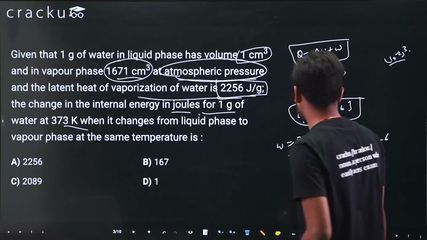
Given that 1 g of water in liquid phase has volume 1 cm$$^3$$ and in vapour phase 1671 cm$$^3$$ at atmospheric pressure and the latent heat of vaporization of water is 2256 J/g; the change in the internal energy in joules for 1 g of water at 373 K when it changes from liquid phase to vapour phase at the same temperature is :
To find the change in internal energy for 1 gram of water vaporizing at 373 K, we use the first law of thermodynamics. The first law states that the change in internal energy, denoted as $$\Delta U$$, is equal to the heat absorbed by the system, $$Q$$, minus the work done by the system, $$W$$. This is expressed as:
$$\Delta U = Q - W$$
In this process, water changes from liquid to vapor at constant temperature (373 K) and constant atmospheric pressure. The heat absorbed, $$Q$$, is the latent heat of vaporization. Given that the latent heat is 2256 J per gram and we have 1 gram of water, we have:
$$Q = 2256 \text{J}$$
Next, we calculate the work done by the system, $$W$$. When water vaporizes, it expands against the constant atmospheric pressure. The work done in an expansion at constant pressure is given by:
$$W = P \Delta V$$
where $$P$$ is the pressure and $$\Delta V$$ is the change in volume. The volume of 1 gram of water in the liquid phase is given as 1 cm³, and in the vapor phase, it is 1671 cm³. The change in volume is:
$$\Delta V = V_{\text{vapour}} - V_{\text{liquid}} = 1671 \text{cm}^3 - 1 \text{cm}^3 = 1670 \text{cm}^3$$
We need consistent SI units for the calculation. Convert volume from cm³ to m³. Since 1 m³ = 10^6 cm³, we have:
$$\Delta V = 1670 \text{cm}^3 = 1670 \times 10^{-6} \text{m}^3 = 1.670 \times 10^{-3} \text{m}^3$$
The pressure is atmospheric pressure. For simplicity in such problems, we often take 1 atmosphere as exactly $$10^5$$ Pa (Pascals). So,
$$P = 10^5 \text{Pa}$$
Now, calculate the work done:
$$W = P \Delta V = (10^5 \text{Pa}) \times (1.670 \times 10^{-3} \text{m}^3)$$
Multiply the numbers:
$$10^5 \times 1.670 \times 10^{-3} = 1.670 \times 10^{5 - 3} = 1.670 \times 10^2 = 167 \text{J}$$
So, the work done by the system is 167 J.
Now, substitute the values of $$Q$$ and $$W$$ into the first law equation to find the change in internal energy:
$$\Delta U = Q - W = 2256 \text{J} - 167 \text{J} = 2089 \text{J}$$
Hence, the change in internal energy for 1 gram of water vaporizing at 373 K is 2089 J.
Comparing with the options, 2089 J corresponds to option C.
Hence, the correct answer is Option C.
Was this solution helpful?
Click on the Email ☝️ to Watch the Video Solution
Create a FREE account and get:
_1.webp)

Educational materials for JEE preparation

Ask our AI anything

AI can make mistakes. Please verify important information.
AI can make mistakes. Please verify important information.


