
Join Our JEE Preparation Group
Prep with like-minded aspirants; Get access to free daily tests and study material.
Sign in
Please select an account to continue using cracku.in
↓ →
Join Our JEE Preparation Group
Prep with like-minded aspirants; Get access to free daily tests and study material.
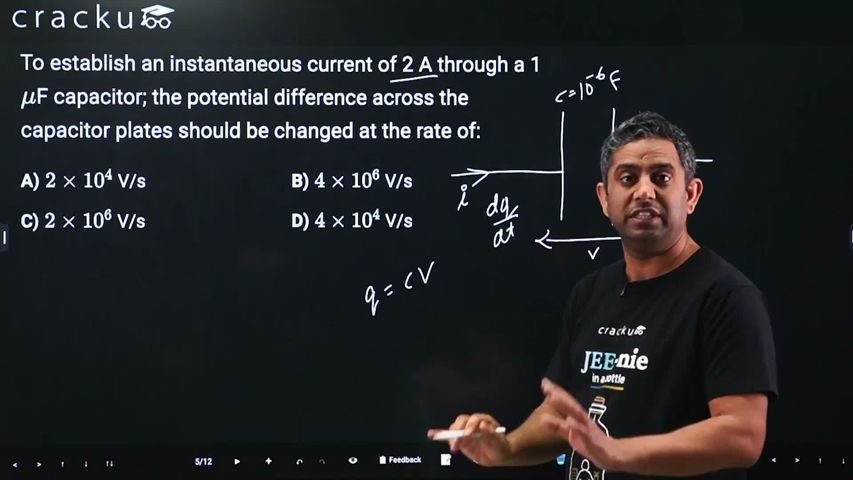
To establish an instantaneous current of 2 A through a 1$$\mu$$F capacitor; the potential difference across the capacitor plates should be changed at the rate of:
The relationship between the current through a capacitor and the rate of change of the potential difference across its plates is given by the formula:
$$i = C \frac{dV}{dt}$$
where:
Given in the question:
Substitute these values into the formula:
$$2 = (1 \times 10^{-6}) \times \frac{dV}{dt}$$
To solve for $$\frac{dV}{dt}$$, rearrange the equation:
$$\frac{dV}{dt} = \frac{2}{1 \times 10^{-6}}$$
Dividing by $$10^{-6}$$ is equivalent to multiplying by $$10^6$$:
$$\frac{dV}{dt} = 2 \times 10^6$$
Therefore, the potential difference across the capacitor plates must be changed at the rate of $$2 \times 10^6$$ V/s.
Comparing with the options:
Hence, the correct answer is Option C.
Was this solution helpful?
Click on the Email ☝️ to Watch the Video Solution
Create a FREE account and get:
_1.webp)

Educational materials for JEE preparation

Ask our AI anything

AI can make mistakes. Please verify important information.
AI can make mistakes. Please verify important information.


