Join WhatsApp Icon JEE WhatsApp Group

NTA JEE Main 11th April 2015 Online - Physics

For the following questions answer them individually

A vector $$\vec{A}$$ is rotated by a small angle $$\Delta\theta$$ radians $$(\Delta\theta \ll 1)$$ to get a new vector $$\vec{B}$$. In that case $$\left|\vec{B} - \vec{A}\right|$$ is:

A beaker contains a fluid of density $$\rho$$ $$\frac{kg}{m^3}$$, specific heat $$S$$ $$\frac{J}{kg \cdot ^\circ C}$$ and viscosity $$\eta$$. The beaker is filled up to height h. To estimate the rate of heat transfer per unit area $$\left(\frac{Q}{A}\right)$$ by convection when beaker is put on a hot plate, a student proposes that it should depend on $$\eta$$, $$\left(\frac{S\Delta\theta}{h}\right)$$ and $$\left(\frac{1}{\rho g}\right)$$ when $$\Delta\theta$$ (in $$^\circ C$$) is the difference in the temperature between the bottom and top of the fluid. In that situation the correct option for $$\left(\frac{Q}{A}\right)$$ is:

If electronic charge $$e$$, electron mass $$m$$, speed of light in vacuum $$c$$ and Planck's constant $$h$$ are taken as fundamental quantities, the permeability of vacuum $$\mu_0$$ can be expressed in units of:

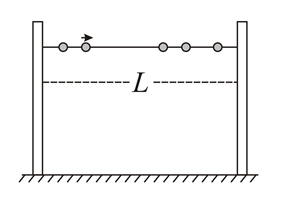
A large number $$(n)$$ of identical beads, each of mass $$m$$ and radius $$r$$ are strung on a thin smooth rigid horizontal rod of length $$L(L \gg r)$$ and are at rest at random positions. The rod is mounted between two rigid supports (see the figure below). If one of the beads is now given a speed $$v$$, the average force experienced by each support after a long time is (assume all collisions are elastic):

A particle is moving in a circle of radius $$r$$ under the action of a force $$F = \alpha r^2$$ which is directed towards centre of the circle. Total mechanical energy (kinetic energy + potential energy) of the particle is (take potential energy = 0 for $$r = 0$$):

A uniform thin rod AB of length $$L$$ has linear mass density $$\mu(x) = a + \frac{bx}{L}$$, where $$x$$ is measured from A. If the CM of the rod lies at a distance of $$\left(\frac{7}{12}L\right)$$ from A, then $$a$$ and $$b$$ are related as:

A particle of mass 2 kg is on a smooth horizontal table and moves in a circular path of radius 0.6 m. The height of the table from the ground is 0.8 m. If the angular speed of the particle is 12 rad s$$^{-1}$$, the magnitude of its angular momentum about a point on the ground right under the center of the circle is:

Which of the following most closely depicts the correct variation of the gravitation potential, $$V(r)$$ with distance $$r$$ due to a large planet of radius $$R$$ and uniform mass density? (figures are not drawn to scale)

An experiment takes 10 min to raise the temperature of water in a container from 0$$^\circ$$C to 100$$^\circ$$C and another 55 min to convert it totally into steam by a heater supplying heat at a uniform rate. Neglecting the specific heat of the container and taking specific heat of the water to be 1 cal (g$$^\circ$$C)$$^{-1}$$, the heat of vaporization according to this experiment will come out to be:

A pendulum with the time period of 1 s is losing energy due to damping. At a certain time, its energy is 45 J. If after completing 15 oscillations its energy has become 15 J, then its damping constant (in s$$^{-1}$$) will be

A cylindrical block of wood (density = 650 kg m$$^{-3}$$), of base area 30 cm$$^2$$ and height 54 cm, floats in a liquid of density 900 kg m$$^{-3}$$. The block is depressed slightly and then released. The time period of the resulting oscillations of the block would be equal to that of a simple pendulum of length (nearly):

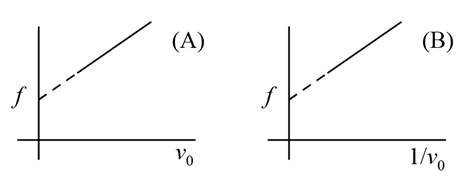
A source of sound emits sound waves at frequency $$f_0$$. It is moving towards an observer with fixed speed $$v_s$$ $$(v_s < v)$$, where $$v$$ is the speed of sound in air. If the observer were to move towards the source with speed $$v_0$$, one of the following two graphs (A and B) will give the correct variation of the frequency $$f$$ heard by the observer as $$v_0$$ is changed.

The variation of $$f$$ with $$v_0$$ is given correctly by:

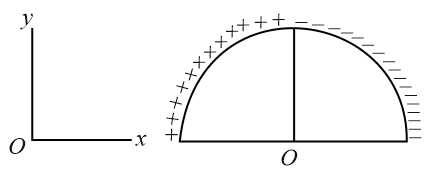
A wire of length $$L = 20$$ cm is bent into a semi-circular arc and the two equal halves of the arc are uniformly charged with charges $$+Q$$ and $$-Q$$ as shown in the figure. The magnitude of the charge on each half is $$|Q| = 10^3\varepsilon_0$$, where $$\varepsilon_0$$ is the permittivity of free space. The net electric field at the centre $$O$$ is

An electric field $$\vec{E} = \left(25\hat{i} + 30\hat{j}\right)$$ N C$$^{-1}$$ exists in a region of space. If the potential at the origin is taken to be zero then the potential at $$x = 2$$ m, $$y = 2$$ m is:

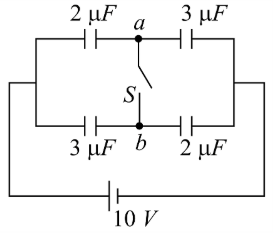
In the figure is shown a system of four capacitors connected across a 10 V battery. The charge that will flow from switch S when it is closed is:

image

A short bar magnet is placed in the magnetic meridian of the earth with North Pole pointing north. Neutral points are found at a distance of 30 cm from the magnet on the East-West line, drawn through the middle point of the magnet. The magnetic moment of the magnet in Am$$^2$$ is close to: (Given $$\frac{\mu_0}{4\pi} = 10^{-7}$$ in SI units and $$B_H$$ = Horizontal component of earth's magnetic field = $$3.6 \times 10^{-5}$$ Tesla.)

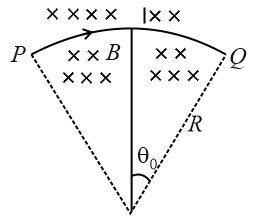
A wire carrying current $$I$$ is tied between points $$P$$ and $$Q$$ and is in the shape of a circular arc of radius $$R$$ due to a uniform magnetic field $$B$$ (perpendicular to the plane of the paper, as shown in the figure) in the vicinity of the wire. If the wire subtends an angle $$2\theta_0$$ at the center of the circle (of which it forms an arch) then the tension in the wire is:

Two long straight parallel wires, carrying (adjustable) currents $$I_1$$ and $$I_2$$, are kept at a distance $$d$$ apart. If the force $$F$$ between the two wires is taken as 'positive' when the wires repel each other and 'negative' when the wires attract each other, the graph showing the dependence of $$F$$, on the product $$I_1 I_2$$, would be:

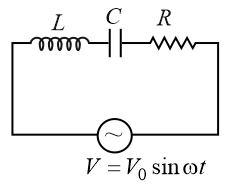
For the LCR circuit, shown here, the current is observed to lead the applied voltage. An additional capacitor $$C'$$, when joined with the capacitor C present in the circuit, makes the power factor of the circuit unity. The capacitor $$C'$$, must have been connected in:

For plane electromagnetic waves propagating in the $$+z$$-direction, which one of the following combinations gives the correct possible direction for $$\vec{E}$$ and $$\vec{B}$$ field respectively?

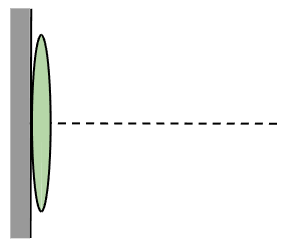
A thin convex lens of focal length $$f$$ is put on a plane mirror as shown in the figure. When an object is kept at a distance $$a$$ from the lens-mirror combination, its image is formed at a distance $$\dfrac{a}{3}$$ in front of the combination. The value of $$a$$ is:

image

In a Young's double slit experiment with light of wavelength $$\lambda$$, the separation of slits is $$d$$ and distance of screen is $$D$$ such that $$D \gg d \gg \lambda$$. If the Fringe width is $$\beta$$, the distance from point of maximum intensity to the point where intensity falls to half of the maximum intensity on either side is:

Unpolarized light of intensity $$I_0$$ is incident on surface of a block of glass at Brewster's angle. In that case, which one of the following statements is true?

The de-Broglie wavelength associated with the electron in the $$n = 4$$ level is:

Let $$N_\beta$$ be the number of $$\beta$$ particle emitted by 1 gram of Na$$^{24}$$ radioactive nuclei having a half life of 15 h. In 7.5 h, the number $$N_\beta$$ is close to $$[N_A = 6.023 \times 10^{23}$$ mole$$^{-1}]$$

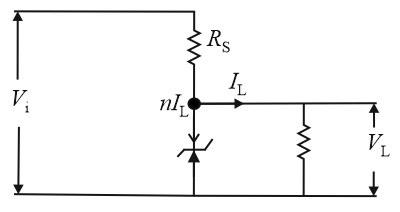
The value of the resistor, $$R_S$$, needed in the DC voltage regulator circuit shown here, equals: