For the following questions answer them individually
If $$\alpha$$ and $$\beta$$ are the roots of the quadratic equation $$x^2 + x\sin\theta - 2\sin\theta = 0$$, $$\theta \in \left(0, \frac{\pi}{2}\right)$$, then $$\frac{\alpha^{12} + \beta^{12}}{(\alpha^{-12} + \beta^{-12})\cdot(\alpha - \beta)^{24}}$$ is equal to:
If $$a > 0$$ and $$z = \frac{(1+i)^2}{a-i}$$, has magnitude $$\sqrt{\frac{2}{5}}$$, then $$\bar{z}$$ is equal to:
The number of 6 digit numbers that can be formed using the digits 0, 1, 2, 5, 7 and 9 which are divisible by 11 and no digit is repeated is:
If $$a_1, a_2, a_3, \ldots, a_n$$ are in A.P. and $$a_1 + a_4 + a_7 + \ldots + a_{16} = 114$$, then $$a_1 + a_6 + a_{11} + a_{16}$$ is equal to:
The sum $$\frac{3 \times 1^3}{1^2} + \frac{5 \times (1^3 + 2^3)}{1^2 + 2^2} + \frac{7 \times (1^3 + 2^3 + 3^3)}{1^2 + 2^2 + 3^2} + \ldots$$ upto 10$$^{th}$$ term is
If the coefficients of $$x^2$$ and $$x^3$$ are both zero, in the expansion of the expression $$(1 + ax + bx^2)(1 - 3x)^{15}$$, in powers of x, then the ordered pair (a, b) is equal to
All the pairs (x, y), that satisfy the inequality $$2^{\sqrt{\sin^2 x - 2\sin x + 5}} \cdot \frac{1}{4^{\sin^2 y}} \leq 1$$ also satisfy the equation:
The line $$x = y$$ touches a circle at the point (1, 1). If the circle also passes through the point (1, -3), then its radius is
If the circles $$x^2 + y^2 + 5Kx + 2y + K = 0$$ and $$2(x^2 + y^2) + 2Kx + 3y - 1 = 0$$, (K ∈ R), intersect at the points P and Q, then the line $$4x + 5y - K = 0$$, passes through P and Q, for:
If the line $$x - 2y = 12$$ is a tangent to the ellipse $$\frac{x^2}{a^2} + \frac{y^2}{b^2} = 1$$ at the point $$\left(3, -\frac{9}{2}\right)$$, then the length of the latus rectum of the ellipse is
If a directrix of a hyperbola centered at the origin and passing through the point $$(4, -2\sqrt{3})$$ is $$5x = 4\sqrt{5}$$ and its eccentricity is e, then:
If $$\lim_{x \to 1}\frac{x^4 - 1}{x - 1} = \lim_{x \to k}\frac{x^3 - k^3}{x^2 - k^2}$$, then k is
Which one of the following Boolean expression is a tautology?
If for some $$x \in$$ R, the frequency distribution of the marks obtained by 20 students in a test is:

Then the mean of the marks is:
ABC is a triangular park with AB = AC = 100 metres. A vertical tower is situated at the mid-point of BC. If the angles of elevation of the top of the tower at A and B are $$\cot^{-1}(3\sqrt{2})$$ and $$\text{cosec}^{-1}(2\sqrt{2})$$ respectively, then the height of the tower (in metres) is
If the system of linear equations $$x + y + z = 5$$, $$x + 2y + 2z = 6$$, $$x + 3y + \lambda z = \mu$$, ($$\lambda, \mu \in$$ R), has infinitely many solutions, then the value of $$\lambda + \mu$$ is:
If $$\Delta_1 = \begin{vmatrix} x & \sin\theta & \cos\theta \\ -\sin\theta & -x & 1 \\ \cos\theta & 1 & x \end{vmatrix}$$ and $$\Delta_2 = \begin{vmatrix} x & \sin 2\theta & \cos 2\theta \\ -\sin 2\theta & -x & 1 \\ \cos 2\theta & 1 & x \end{vmatrix}$$, $$x \neq 0$$; then for all $$\theta \in \left(0, \frac{\pi}{2}\right)$$:
Let $$f(x) = x^2$$, $$x \in R$$. For any $$A \subseteq R$$, define $$g(A) = \{x \in R : f(x) \in A\}$$. If $$S = [0, 4]$$, then which one of the following statements is not true?
Let $$f : R \to R$$ be differentiable at $$c \in R$$ and $$f(c) = 0$$. If $$g(x) = |f(x)|$$, then at $$x = c$$, g is:
If $$f(x) = \begin{cases} \frac{\sin(p+1)x + \sin x}{x}, & x < 0 \\ q, & x = 0 \\ \frac{\sqrt{x + x^2} - \sqrt{x}}{x^{3/2}}, & x > 0 \end{cases}$$ is continuous at $$x = 0$$, then the ordered pair (p, q) is equal to:
Let $$f(x) = e^x - x$$ and $$g(x) = x^2 - x$$, $$\forall$$ x ∈ R. Then the set of all x ∈ R, where the function $$h(x) = (f \circ g)(x)$$ is increasing, is:
If $$\int \frac{dx}{(x^2 - 2x + 10)^2} = A\left(\tan^{-1}\left(\frac{x-1}{3}\right) + \frac{f(x)}{x^2 - 2x + 10}\right) + C$$, then (where C is a constant of integration)
The value of $$\int_0^{2\pi} [\sin 2x(1 + \cos 3x)]dx$$, where [t] denotes the greatest integer function is
$$\lim_{n \to \infty}\left(\frac{(n+1)^{1/3}}{n^{4/3}} + \frac{(n+2)^{1/3}}{n^{4/3}} + \ldots + \frac{(2n)^{1/3}}{n^{4/3}}\right)$$ is equal to
The region represented by $$|x - y| \leq 2$$ and $$|x + y| \leq 2$$ is bounded by a
If $$y = y(x)$$ is the solution of the differential equation $$\frac{dy}{dx} = (\tan x - y)\sec^2 x$$, $$x \in \left(-\frac{\pi}{2}, \frac{\pi}{2}\right)$$, such that $$y(0) = 0$$, then $$y\left(-\frac{\pi}{4}\right)$$ is equal to:
Let A(3, 0, -1), B(2, 10, 6) and C(1, 2, 1) be the vertices of a triangle and M be the mid-point of AC. If G divides BM in the ratio, 2 : 1, then $$\cos(\angle GOA)$$ (O being the origin) is equal to
If the length of the perpendicular from the point $$(\beta, 0, \beta)$$, ($$\beta \neq 0$$) to the line, $$\frac{x}{1} = \frac{y-1}{0} = \frac{z+1}{-1}$$ is $$\sqrt{\frac{3}{2}}$$, then $$\beta$$ is equal to
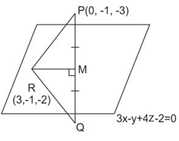
If Q(0, -1, -3) is the image of the point P in the plane $$3x - y + 4z = 2$$ and R is the point (3, -1, -2), then the area (in sq. units) of $$\triangle PQR$$ is
Assume that each born child is equally likely to be a boy or girl. If two families have two children each, then the conditional probability that all children are girls given that at least two are girls is: