
Join Our JEE Preparation Group
Prep with like-minded aspirants; Get access to free daily tests and study material.
Sign in
Please select an account to continue using cracku.in
↓ →
Join Our JEE Preparation Group
Prep with like-minded aspirants; Get access to free daily tests and study material.
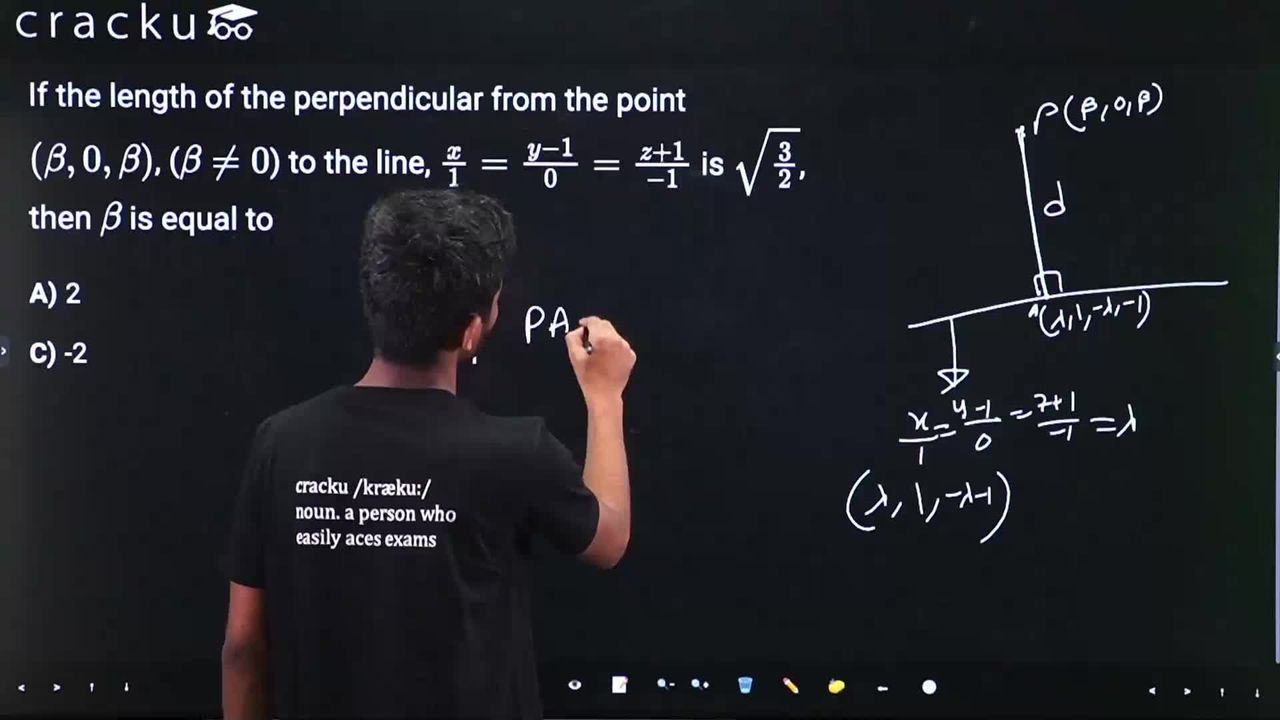
If the length of the perpendicular from the point $$(\beta, 0, \beta)$$, ($$\beta \neq 0$$) to the line, $$\frac{x}{1} = \frac{y-1}{0} = \frac{z+1}{-1}$$ is $$\sqrt{\frac{3}{2}}$$, then $$\beta$$ is equal to
First, we translate the given symmetric form of the line into a more convenient vector form.
The line is written as $$\dfrac{x}{1}= \dfrac{y-1}{0}= \dfrac{z+1}{-1}\,.$$
Because the middle denominator is $$0,$$ the only way the three ratios can be equal is when $$y-1 = 0.$$ Thus every point on the line has $$y = 1.$$
Let the common ratio be denoted by $$t.$$ From the first and the third ratios we then have
$$x = t, \qquad \dfrac{z+1}{-1}=t \Longrightarrow z = -1-t.$$
Hence a general point $$A$$ on the line can be written in parametric form as
$$A(t)\;:\;(x,y,z)=(t,\;1,\;-1-t).$$
From this description we read the direction vector of the line:
$$\vec d = (1,\,0,\,-1).$$
Its magnitude is
$$|\vec d| = \sqrt{1^{2}+0^{2}+(-1)^{2}} = \sqrt2.$$
The fixed external point is $$P(\beta,\,0,\,\beta).$$ A convenient point on the line is obtained by taking $$t=0,$$ giving
$$A(0)\;:\;(0,\,1,\,-1).$$
The vector from this point on the line to the external point is
$$\vec{AP}=P-A = (\beta-0,\;0-1,\;\beta-(-1)) = (\beta,\,-1,\;\beta+1).$$
To find the perpendicular distance from $$P$$ to the line, we use the vector formula
$$\text{Distance} \;=\; \dfrac{\bigl|\,\vec{AP}\times\vec d\,\bigr|}{|\vec d|}\,.$$
We therefore compute the cross-product $$\vec{AP}\times\vec d$$. Using the determinant rule,
$$\vec{AP}\times\vec d \;=\; \begin{vmatrix} \mathbf i & \mathbf j & \mathbf k\\[2pt] \beta & -1 & \beta+1\\[2pt] 1 & 0 & -1 \end{vmatrix} = \mathbf i\bigl((-1)(-1) - (\beta+1)(0)\bigr) - \mathbf j\bigl(\beta(-1)-(\beta+1)(1)\bigr) + \mathbf k\bigl(\beta(0)-(-1)(1)\bigr).$$
Simplifying each component step by step,
$$\begin{aligned} \mathbf i\text{-component}&:;; (-1)(-1)-(\beta+1)0 = 1,\\[4pt] \mathbf j\text{-component}&:;; -\bigl(\beta(-1)-(\beta+1)\bigr) = -\bigl(-\beta-\beta-1\bigr)=2\beta+1,\\[4pt] \mathbf k\text{-component}&:;; \beta\cdot0-(-1)\cdot1 = 1. \end{aligned}$$
Thus
$$\vec{AP}\times\vec d = (\,1,\;2\beta+1,\;1\,).$$
The squared magnitude of this vector is
$$\bigl|\,\vec{AP}\times\vec d\,\bigr|^{2} =1^{2}+(2\beta+1)^{2}+1^{2} =1+\bigl(4\beta^{2}+4\beta+1\bigr)+1 =4\beta^{2}+4\beta+3.$$
Consequently,
$$ \bigl|\,\vec{AP}\times\vec d\,\bigr| =\sqrt{4\beta^{2}+4\beta+3}. $$
Putting everything into the distance formula gives
$$ \text{Distance} =\dfrac{\sqrt{4\beta^{2}+4\beta+3}}{\sqrt2}. $$
The problem states that this distance equals $$\sqrt{\dfrac32}\,.$$ Equating and squaring,
$$\left(\dfrac{\sqrt{4\beta^{2}+4\beta+3}}{\sqrt2}\right)^{2} =\left(\sqrt{\dfrac32}\right)^{2} \;\Longrightarrow\; \dfrac{4\beta^{2}+4\beta+3}{2} =\dfrac32.$$
Multiplying both sides by $$2$$,
$$4\beta^{2}+4\beta+3 = 3.$$
Subtracting $$3$$ from both sides,
$$4\beta^{2}+4\beta = 0.$$
Now factorising out the common term $$4\beta$$,
$$4\beta(\beta+1)=0.$$
This yields the roots
$$\beta = 0 \quad\text{or}\quad \beta = -1.$$
The condition in the question specifically states $$\beta\neq 0,$$ so the admissible value is
$$\beta = -1.$$
Looking at the options, $$-1$$ corresponds to Option B.
Hence, the correct answer is Option B.
Was this solution helpful?
Click on the Email ☝️ to Watch the Video Solution
Create a FREE account and get:
_1.webp)

Educational materials for JEE preparation

Ask our AI anything

AI can make mistakes. Please verify important information.
AI can make mistakes. Please verify important information.
