
Join Our JEE Preparation Group
Prep with like-minded aspirants; Get access to free daily tests and study material.
Sign in
Please select an account to continue using cracku.in
↓ →
Join Our JEE Preparation Group
Prep with like-minded aspirants; Get access to free daily tests and study material.
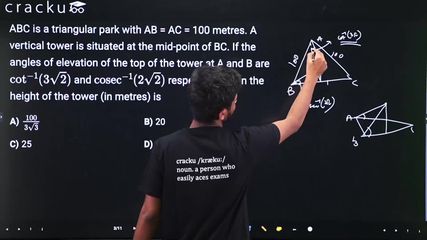
ABC is a triangular park with AB = AC = 100 metres. A vertical tower is situated at the mid-point of BC. If the angles of elevation of the top of the tower at A and B are $$\cot^{-1}(3\sqrt{2})$$ and $$\text{cosec}^{-1}(2\sqrt{2})$$ respectively, then the height of the tower (in metres) is
We are told that the park is the isosceles triangle $$\triangle ABC$$ with $$AB = AC = 100\text{ m}$$. Let $$D$$ be the mid-point of the base $$BC$$ and let the vertical tower stand on $$D$$. Denote the top of the tower by $$T$$ and its height by $$h$$, so $$TD = h$$.
Because $$AB = AC$$, the median $$AD$$ is also the altitude and perpendicular bisector of $$BC$$. Hence $$AD \perp BC$$ and $$BD = DC$$. Write
$$BD = DC = x,\qquad AD = y.$$
The right triangle $$\triangle ABD$$ therefore has
$$AB = 100,\; BD = x,\; AD = y.$$
From the statement of the problem the angle of elevation of $$T$$ as seen from $$A$$ is $$\alpha = \cot^{-1}(3\sqrt2)$$. First convert that to a tangent value:
$$\cot\alpha = 3\sqrt2 \;\Longrightarrow\; \tan\alpha = \frac1{3\sqrt2}.$$
By the definition of the tangent in the right triangle $$\triangle ADT$$,
$$\tan\alpha = \frac{\text{opposite}}{\text{adjacent}} = \frac{TD}{AD} = \frac{h}{y}.$$
So
$$\frac{h}{y} = \frac1{3\sqrt2}\;\Longrightarrow\; h = \frac{y}{3\sqrt2}. \quad -(1)$$
Next, the angle of elevation of $$T$$ as seen from $$B$$ is $$\beta = \csc^{-1}(2\sqrt2)$$. That gives
$$\csc\beta = 2\sqrt2 \;\Longrightarrow\; \sin\beta = \frac1{2\sqrt2}.$$
Compute $$\cos\beta$$ using $$\sin^2\beta + \cos^2\beta = 1$$:
$$\sin^2\beta = \frac1{(2\sqrt2)^2} = \frac1{8},\qquad \cos^2\beta = 1 - \frac18 = \frac78.$$
Hence
$$\cos\beta = \sqrt{\frac78} = \frac{\sqrt7}{2\sqrt2}.$$
Now obtain $$\tan\beta$$:
$$\tan\beta = \frac{\sin\beta}{\cos\beta} = \frac{1/(2\sqrt2)}{\sqrt7/(2\sqrt2)} = \frac1{\sqrt7}.$$
In the right triangle $$\triangle BDT$$ we again apply the tangent definition:
$$\tan\beta = \frac{\text{opposite}}{\text{adjacent}} = \frac{TD}{BD} = \frac{h}{x}.$$
Therefore
$$\frac{h}{x} = \frac1{\sqrt7}\;\Longrightarrow\; h = \frac{x}{\sqrt7}. \quad -(2)$$
Both equations (1) and (2) give the same quantity $$h$$, so equate them:
$$\frac{y}{3\sqrt2} = \frac{x}{\sqrt7} \;\Longrightarrow\; y = \frac{3\sqrt2}{\sqrt7}\,x. \quad -(3)$$
Now use the Pythagorean theorem in right triangle $$\triangle ABD$$:
$$AD^2 + BD^2 = AB^2.$$ That is, $$y^2 + x^2 = 100^2 = 10000. \quad -(4)$$
Substitute the value of $$y$$ from (3) into (4):
$$\left(\frac{3\sqrt2}{\sqrt7}x\right)^2 + x^2 = 10000$$ $$\frac{9\cdot2}{7}x^2 + x^2 = 10000$$ $$\frac{18}{7}x^2 + x^2 = 10000$$ $$\left(\frac{18}{7} + 1\right)x^2 = 10000$$ $$\frac{25}{7}x^2 = 10000$$ $$x^2 = 10000 \times \frac{7}{25} = 2800.$$
Thus
$$x = \sqrt{2800} = \sqrt{28 \times 100} = 10\sqrt{28} = 10 \times 2\sqrt7 = 20\sqrt7\text{ m}. \quad -(5)$$
Finally compute $$h$$ from (2):
$$h = \frac{x}{\sqrt7} = \frac{20\sqrt7}{\sqrt7} = 20\text{ m}.$$
Hence, the correct answer is Option B.
Was this solution helpful?
Click on the Email ☝️ to Watch the Video Solution
Create a FREE account and get:
_1.webp)

Educational materials for JEE preparation

Ask our AI anything

AI can make mistakes. Please verify important information.
AI can make mistakes. Please verify important information.
