
Join Our JEE Preparation Group
Prep with like-minded aspirants; Get access to free daily tests and study material.
Sign in
Please select an account to continue using cracku.in
↓ →
Join Our JEE Preparation Group
Prep with like-minded aspirants; Get access to free daily tests and study material.
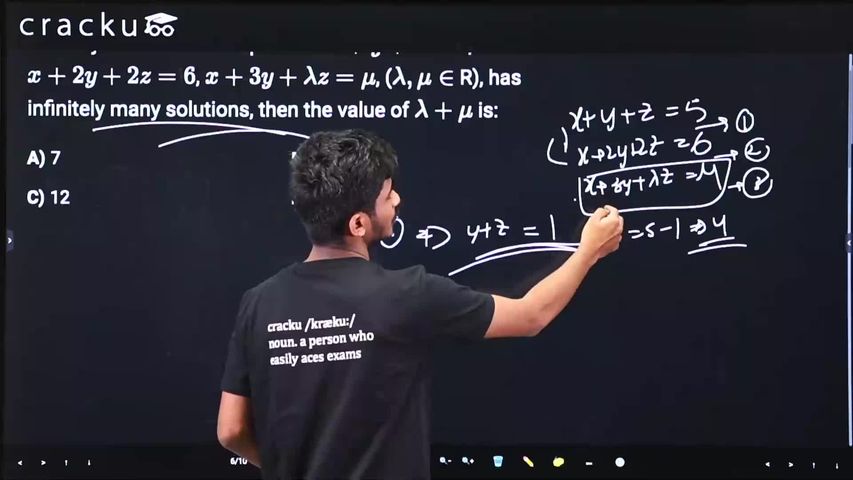
If the system of linear equations $$x + y + z = 5$$, $$x + 2y + 2z = 6$$, $$x + 3y + \lambda z = \mu$$, ($$\lambda, \mu \in$$ R), has infinitely many solutions, then the value of $$\lambda + \mu$$ is:
We are given the three equations
$$x + y + z = 5$$
$$x + 2y + 2z = 6$$
$$x + 3y + \lambda z = \mu.$$
For a system of three linear equations in the three variables $$x,y,z$$ to possess infinitely many solutions, the three equations must be consistent and linearly dependent, which means the third equation must be expressible as a linear combination of the first two. Equivalently, every solution of the first two equations must automatically satisfy the third one.
Start by eliminating $$x$$ using the first equation. From
$$x + y + z = 5$$
we have
$$x = 5 - y - z.$$
Next, subtract the first equation from the second:
$$\bigl(x + 2y + 2z\bigr) - \bigl(x + y + z\bigr) = 6 - 5,$$
which simplifies term-by-term to
$$y + z = 1.$$
This relation can be rewritten as
$$z = 1 - y.$$
Now substitute $$x = 5 - y - z$$ into the third equation:
$$x + 3y + \lambda z = \mu$$
$$\Downarrow$$
$$(5 - y - z) + 3y + \lambda z = \mu.$$
Combine like terms carefully:
$$5 - y - z + 3y + \lambda z = 5 + 2y + (\lambda - 1)z.$$
Because every solution of the first two equations satisfies $$z = 1 - y$$, we substitute $$z = 1 - y$$ into this expression:
$$5 + 2y + (\lambda - 1)(1 - y) = \mu.$$
Expand the last term:
$$5 + 2y + (\lambda - 1) - (\lambda - 1)y = \mu.$$
Group constant and $$y$$ terms:
$$\bigl[5 + (\lambda - 1)\bigr] \;+\; y\bigl[2 - (\lambda - 1)\bigr] = \mu.$$
Simplify the coefficient of $$y$$:
$$2 - (\lambda - 1) = 2 - \lambda + 1 = 3 - \lambda.$$
Hence the left side is
$$5 + (\lambda - 1) + y(3 - \lambda).$$
For the expression to be independent of the free parameter $$y$$—and thus for the third equation to hold for every solution of the first two—the coefficient of $$y$$ must vanish. Therefore, we must impose
$$3 - \lambda = 0,$$
which yields
$$\lambda = 3.$$
With $$\lambda = 3$$, the entire left-hand side becomes purely constant:
$$5 + (3 - 1) = 5 + 2 = 7.$$
Thus we must have
$$\mu = 7.$$
Finally, compute the required sum:
$$\lambda + \mu = 3 + 7 = 10.$$
Hence, the correct answer is Option B.
Was this solution helpful?
Click on the Email ☝️ to Watch the Video Solution
Create a FREE account and get:
_1.webp)

Educational materials for JEE preparation

Ask our AI anything

AI can make mistakes. Please verify important information.
AI can make mistakes. Please verify important information.
