
Join Our JEE Preparation Group
Prep with like-minded aspirants; Get access to free daily tests and study material.
Sign in
Please select an account to continue using cracku.in
↓ →
Join Our JEE Preparation Group
Prep with like-minded aspirants; Get access to free daily tests and study material.
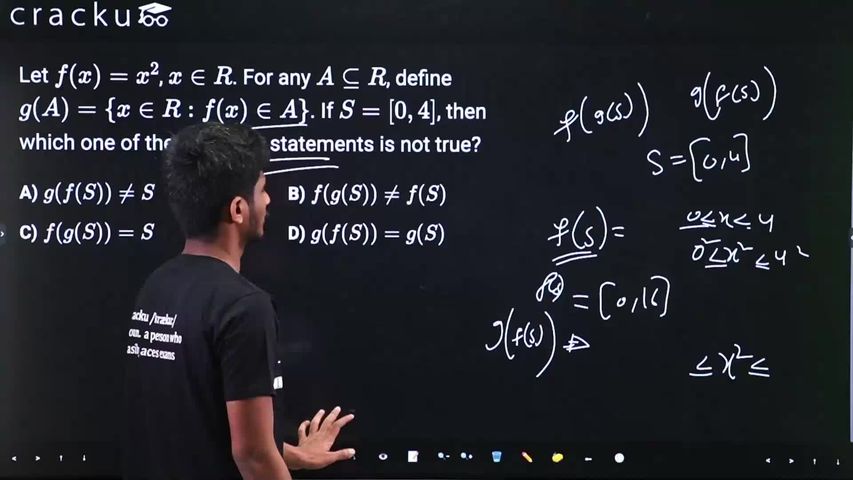
Let $$f(x) = x^2$$, $$x \in R$$. For any $$A \subseteq R$$, define $$g(A) = \{x \in R : f(x) \in A\}$$. If $$S = [0, 4]$$, then which one of the following statements is not true?
We have the function $$f(x)=x^{2}$$ defined for every real number $$x$$.
For any subset $$A\subseteq \mathbb R$$, we are told to define
$$g(A)=\{x\in\mathbb R: f(x)\in A\}.$$
This means $$g(A)$$ is the set of all real numbers whose squares belong to the set $$A$$; in other words, $$g(A)$$ is the pre-image of $$A$$ under the squaring function.
Now let us fix the set $$S=[0,4].$$ We shall compute the four quantities that occur in the options one by one.
First we find $$f(S).$$
Every number in $$S$$ satisfies $$0\le x\le 4$$. Squaring preserves order for non-negative numbers, so
$$0^{2}\le x^{2}\le 4^{2}\quad\Longrightarrow\quad 0\le x^{2}\le16.$$
Hence
$$f(S)=\{x^{2}:x\in[0,4]\}=[0,16].$$
Next we find $$g(S).$$
By definition,
$$g(S)=\{x\in\mathbb R:f(x)\in S\}=\{x\in\mathbb R:x^{2}\in[0,4]\}.$$
The condition $$x^{2}\in[0,4]$$ means
$$0\le x^{2}\le4.$$
Taking square roots gives $$|x|\le2,$$ which is equivalent to
$$-2\le x\le2.$$
Therefore
$$g(S)=[-2,2].$$
Now we compute $$f(g(S)).$$
We already know $$g(S)=[-2,2].$$ Applying $$f(x)=x^{2}$$ to every number in this interval, we obtain
$$f(g(S))=\{x^{2}:x\in[-2,2]\}.$$
The smallest value of $$x^{2}$$ on $$[-2,2]$$ is $$0^{2}=0,$$ and the largest value is $$2^{2}=4.$$ Hence
$$f(g(S))=[0,4].$$
Observe that $$[0,4]=S,$$ so
$$f(g(S))=S.$$
Next we compute $$g(f(S)).$$
We already showed $$f(S)=[0,16].$$ By definition,
$$g(f(S))=\{x\in\mathbb R:x^{2}\in[0,16]\}.$$
The condition $$x^{2}\le16$$ is equivalent to $$|x|\le4,$$ that is
$$-4\le x\le4.$$
Hence
$$g(f(S))=[-4,4].$$
Finally we compare the sets obtained so far.
We have
$$S=[0,4],\qquad f(S)=[0,16],\qquad g(S)=[-2,2],\qquad f(g(S))=[0,4],\qquad g(f(S))=[-4,4].$$
Let us examine each option.
Option A states $$g(f(S))\neq S.$$ Since $$g(f(S))=[-4,4]$$ and $$S=[0,4],$$ the two intervals differ (for example, $$-2\in[-4,4]$$ but $$-2\notin[0,4]$$). Therefore the inequality is correct; Option A is a true statement.
Option B states $$f(g(S))\neq f(S).$$ We found $$f(g(S))=[0,4]$$ whereas $$f(S)=[0,16]$$, so they are indeed unequal. Thus Option B is also true.
Option C asserts $$f(g(S))=S.$$ We have already proved $$f(g(S))=[0,4]=S,$$ so Option C is true.
Option D asserts $$g(f(S))=g(S).$$ But $$g(f(S))=[-4,4]$$ while $$g(S)=[-2,2];$$ these two sets are not equal because, for instance, $$3\in[-4,4]$$ but $$3\notin[-2,2].$$ Hence Option D is false.
Because the question asks for the statement that is not true, we conclude that Option D is the required choice.
Hence, the correct answer is Option D.
Was this solution helpful?
Click on the Email ☝️ to Watch the Video Solution
Create a FREE account and get:
_1.webp)

Educational materials for JEE preparation

Ask our AI anything

AI can make mistakes. Please verify important information.
AI can make mistakes. Please verify important information.
