
Join Our JEE Preparation Group
Prep with like-minded aspirants; Get access to free daily tests and study material.
Sign in
Please select an account to continue using cracku.in
↓ →
Join Our JEE Preparation Group
Prep with like-minded aspirants; Get access to free daily tests and study material.
Let $$f : R \to R$$ be differentiable at $$c \in R$$ and $$f(c) = 0$$. If $$g(x) = |f(x)|$$, then at $$x = c$$, g is:
We wish to investigate the differentiability of the function $$g(x)=|f(x)|$$ at the point $$x=c$$, given that $$f:\mathbb R \to \mathbb R$$ is differentiable at $$c$$ and $$f(c)=0$$.
Since $$f$$ is differentiable at $$c$$, by definition we have the expansion
$$f(c+h)=f(c)+h\,f'(c)+o(h) \quad\text{as }h\to 0,$$
where $$o(h)$$ denotes a quantity that tends to $$0$$ faster than $$h$$ itself.
Because $$f(c)=0$$, this simplifies to
$$f(c+h)=h\,f'(c)+o(h).$$
Now we examine $$g(c+h)=|f(c+h)|$$. Substituting the above expression, we get
$$g(c+h)=\bigl|\,h\,f'(c)+o(h)\bigr|.$$
We must look at the difference-quotient that defines $$g'(c)$$:
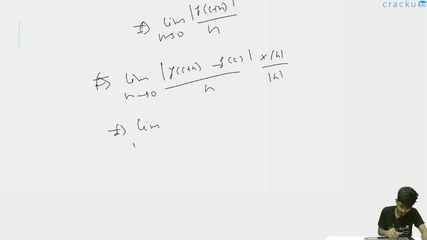
$$\frac{g(c+h)-g(c)}{h} \;=\; \frac{|f(c+h)|-0}{h} \;=\; \frac{\bigl|\,h\,f'(c)+o(h)\bigr|}{h}.$$
Rewrite the numerator by factoring out $$|h|$$:
$$\frac{|h|\,\bigl|f'(c)+o(1)\bigr|}{h} \;=\; \frac{|h|}{h}\;\bigl|f'(c)+o(1)\bigr|,$$
where $$o(1)\to 0$$ as $$h\to 0$$.
Notice that
$$\frac{|h|}{h} = \begin{cases} +1, & h>0,\\[4pt] -1, & h<0. \end{cases}$$
We now distinguish two cases, depending on the value of $$f'(c)$$.
Case 1: $$f'(c)\neq 0$$. Then $$\bigl|f'(c)+o(1)\bigr|\to|f'(c)|\neq 0$$. For $$h>0$$ the quotient tends to $$+|f'(c)|$$, whereas for $$h<0$$ it tends to $$-|f'(c)|$$. Since the right-hand and left-hand limits are unequal, the limit does not exist. Hence $$g$$ is not differentiable at $$x=c$$ when $$f'(c)\neq 0$$.
Case 2: $$f'(c)=0$$. Our expansion becomes $$f(c+h)=o(h)$$, so
$$\bigl|f(c+h)\bigr|=|o(h)|=o(h).$$
Therefore
$$\frac{|f(c+h)|}{h}=\frac{o(h)}{h}=o(1)\to 0\quad\text{as }h\to 0.$$
The limit from both sides equals $$0$$, so $$g'(c)=0$$ exists. Thus $$g$$ is differentiable at $$x=c$$ when $$f'(c)=0$$.
Combining the two cases, we conclude that $$g$$ is differentiable at $$x=c$$ if and only if $$f'(c)=0$$.
Hence, the correct answer is Option C.
Was this solution helpful?
Click on the Email ☝️ to Watch the Video Solution
Create a FREE account and get:
_1.webp)

Educational materials for JEE preparation

Ask our AI anything

AI can make mistakes. Please verify important information.
AI can make mistakes. Please verify important information.
