
Join Our JEE Preparation Group
Prep with like-minded aspirants; Get access to free daily tests and study material.
Sign in
Please select an account to continue using cracku.in
↓ →
Join Our JEE Preparation Group
Prep with like-minded aspirants; Get access to free daily tests and study material.
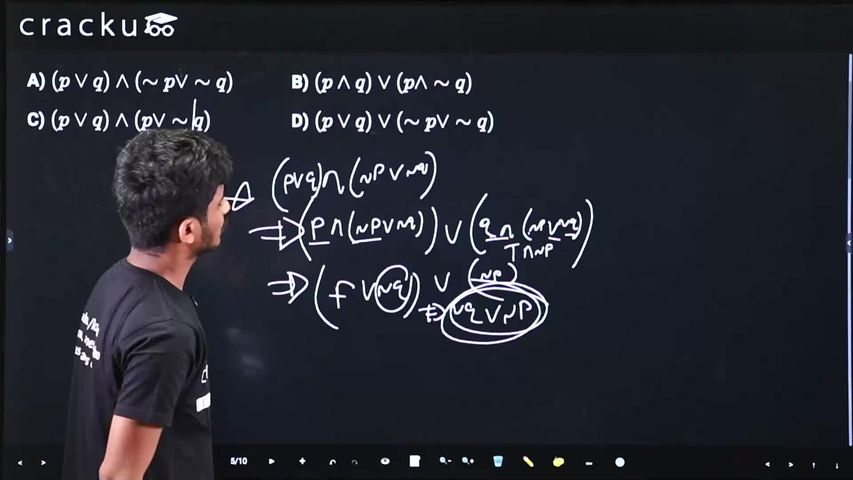
Which one of the following Boolean expression is a tautology?
First, remember that a Boolean expression is called a tautology if it is always true, no matter whether the simple propositions $$p$$ and $$q$$ are true (T) or false (F). To decide which option is a tautology, we shall simplify every given expression algebraically, employing these standard Boolean laws:
$$\begin{aligned} &\text{(1) Distributive law:}&\; a\wedge(b\vee c)= (a\wedge b)\vee(a\wedge c),\\ &\text{(2) Distributive law:}&\; a\vee(b\wedge c)= (a\vee b)\wedge(a\vee c),\\ &\text{(3) Complement law:}&\; a\vee\neg a = \text{T},\; a\wedge\neg a = \text{F},\\ &\text{(4) Identity law:}&\; a\vee\text{F}=a,\; a\wedge\text{T}=a,\\ &\text{(5) Domination law:}&\; a\vee\text{T}=\text{T},\; a\wedge\text{F}= \text{F}. \end{aligned}$$
Now we analyse each option one by one.
Option A: $$ (p \vee q)\wedge (\neg p \vee \neg q) $$
We notice that $$\neg p\vee\neg q$$ is the negation of $$p\wedge q$$ by De Morgan’s law, so we may write
$$ (p\vee q)\wedge\neg(p\wedge q). $$
This is exactly the exclusive-or (“one but not both”) condition. For example, if both $$p$$ and $$q$$ are true, then $$p\wedge q$$ is true, its negation is false, and the whole expression becomes false. Hence Option A is not always true, so it is not a tautology.
Option B: $$ (p\wedge q)\vee(p\wedge\neg q) $$
We factor out the common literal $$p$$ using the distributive law (1):
$$ (p\wedge q)\vee(p\wedge\neg q)= p\wedge (q\vee\neg q). $$
By the complement law (3), $$q\vee\neg q=\text{T}$$, so
$$ p\wedge \text{T}=p. $$
Since $$p$$ can be true or false, the whole expression can also be true or false; therefore it is not a tautology.
Option C: $$ (p\vee q)\wedge(p\vee\neg q) $$
Here we use the distributive law (2) in reverse, pulling out the common literal $$p\vee$$:
$$ (p\vee q)\wedge(p\vee\neg q)= p\vee(q\wedge\neg q). $$
Again by the complement law (3), $$q\wedge\neg q=\text{F}$$, so we get
$$ p\vee \text{F}=p. $$
This reduces to the single variable $$p$$, which is not always true, so Option C is also not a tautology.
Option D: $$ (p \vee q)\vee(\neg p \vee \neg q) $$
Using associativity and commutativity of $$\vee$$, we simply collect all the literals:
$$ (p\vee q)\vee(\neg p\vee \neg q)= p\vee\neg p\vee q\vee\neg q. $$
Now group the complementary pairs:
$$ p\vee\neg p = \text{T}, \quad q\vee\neg q = \text{T}. $$
So the entire expression becomes
$$ \text{T}\vee\text{T}=\text{T}, $$
which is true for every possible truth‐value combination of $$p$$ and $$q$$. Therefore Option D is a tautology.
After examining all four choices, we see that only Option 4 (that is, Option D) is always true.
Hence, the correct answer is Option 4.
Was this solution helpful?
Click on the Email ☝️ to Watch the Video Solution
Create a FREE account and get:
_1.webp)

Educational materials for JEE preparation

Ask our AI anything

AI can make mistakes. Please verify important information.
AI can make mistakes. Please verify important information.
