
Join Our JEE Preparation Group
Prep with like-minded aspirants; Get access to free daily tests and study material.
Sign in
Please select an account to continue using cracku.in
↓ →
Join Our JEE Preparation Group
Prep with like-minded aspirants; Get access to free daily tests and study material.
Let $$f(x) = e^x - x$$ and $$g(x) = x^2 - x$$, $$\forall$$ x ∈ R. Then the set of all x ∈ R, where the function $$h(x) = (f \circ g)(x)$$ is increasing, is:
We are given two real-valued functions
$$f(x)=e^{x}-x \qquad\text{and}\qquad g(x)=x^{2}-x,\; \forall\,x\in\mathbb R.$$
To form the composition we write
$$h(x)= (f\circ g)(x)=f\!\bigl(g(x)\bigr).$$
First we substitute $$g(x)$$ into $$f$$:
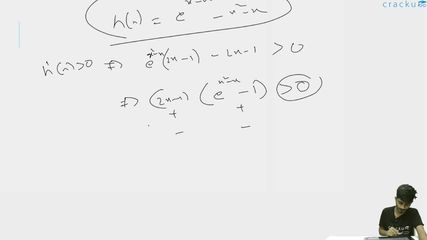
$$h(x)=e^{\,g(x)}-g(x)=e^{\,x^{2}-x}-\bigl(x^{2}-x\bigr).$$
To know where $$h(x)$$ is increasing we examine its derivative. By the standard rule
If $$h(x)$$ is differentiable, it is increasing wherever $$h'(x)\ge 0$$.
So we differentiate.
The derivative of the first term $$e^{\,x^{2}-x}$$ is obtained by the chain rule: “derivative of $$e^{u}$$ is $$e^{u}\,u'$$.” Here $$u=x^{2}-x$$, so $$u'=2x-1$$. Therefore
$$\frac{d}{dx}\bigl[e^{\,x^{2}-x}\bigr]=(2x-1)\,e^{\,x^{2}-x}.$$
The derivative of the second term $$-\bigl(x^{2}-x\bigr)$$ is
$$-\frac{d}{dx}\bigl(x^{2}-x\bigr)=-(2x-1).$$
Adding these two pieces gives
$$h'(x)=(2x-1)\,e^{\,x^{2}-x}-(2x-1).$$
Now we factor the common term $$(2x-1)$$:
$$h'(x)=(2x-1)\Bigl(e^{\,x^{2}-x}-1\Bigr).$$
The sign of $$h'(x)$$, and hence whether $$h(x)$$ is increasing, depends on the sign of each factor.
1. The factor $$(2x-1)$$
$$2x-1=0\;\Longrightarrow\;x=\dfrac12.$$
Therefore
$$2x-1\lt 0\;\text{ when }\;x\lt \dfrac12,\qquad 2x-1\gt 0\;\text{ when }\;x\gt \dfrac12.$$
2. The factor $$e^{\,x^{2}-x}-1$$
Because the exponential function is always positive, $$e^{\,x^{2}-x}-1$$ changes sign exactly where its exponent is $$0$$:
$$x^{2}-x=0\;\Longrightarrow\;x(x-1)=0\;\Longrightarrow\;x=0\;\text{ or }\;x=1.$$
We examine the inequality $$x^{2}-x\ge 0$$:
$$x^{2}-x\ge 0\;\Longrightarrow\;x(x-1)\ge 0,$$ $$\text{which holds for }x\le 0\;\text{ or }\;x\ge 1.$$
Hence
$$e^{\,x^{2}-x}-1\ge 0\quad\text{for }x\in(-\infty,0]\cup[1,\infty),$$
and it is negative for $$x\in(0,1)$$.
3. Combining the signs
We list the critical points $$x=0,\;x=\dfrac12,\;x=1$$ and test each interval.
(a) For $$x\lt 0$$ we have $$(2x-1)\lt 0$$ and $$e^{\,x^{2}-x}-1\gt 0$$, so their product is negative. Thus $$h'(x)\lt 0$$.
(b) For $$0\lt x\lt \dfrac12$$ we have $$(2x-1)\lt 0$$ and $$e^{\,x^{2}-x}-1\lt 0$$, so the product is positive. Thus $$h'(x)\gt 0$$.
(c) At $$x=\dfrac12$$ the first factor is $$0$$, so $$h'(\tfrac12)=0$$.
(d) For $$\dfrac12\lt x\lt 1$$ we have $$(2x-1)\gt 0$$ and $$e^{\,x^{2}-x}-1\lt 0$$, giving a negative product, hence $$h'(x)\lt 0$$.
(e) For $$x\gt 1$$ both factors are positive, so $$h'(x)\gt 0$$.
We also note the exact values
$$h'(0)=(2\cdot0-1)\bigl(e^{0}-1\bigr)=(-1)\cdot0=0,$$
$$h'(1)=(2\cdot1-1)\bigl(e^{0}-1\bigr)=1\cdot0=0.$$
Therefore $$h'(x)\ge 0$$ on the closed intervals where we found positivity and on the isolated points where it equals $$0$$.
4. Final increasing set
Collecting every $$x$$ for which $$h'(x)\ge 0$$, we obtain
$$x\in\bigl[0,\tfrac12\bigr]\;\cup\;[1,\infty).$$
Thus the function $$h(x)$$ is increasing exactly on the set $$\left[0,\frac{1}{2}\right]\cup[1,\infty).$$
Looking at the options, this matches Option C.
Hence, the correct answer is Option C.
Was this solution helpful?
Click on the Email ☝️ to Watch the Video Solution
Create a FREE account and get:
_1.webp)

Educational materials for JEE preparation

Ask our AI anything

AI can make mistakes. Please verify important information.
AI can make mistakes. Please verify important information.
