
Join Our JEE Preparation Group
Prep with like-minded aspirants; Get access to free daily tests and study material.
Sign in
Please select an account to continue using cracku.in
↓ →
Join Our JEE Preparation Group
Prep with like-minded aspirants; Get access to free daily tests and study material.
$$\lim_{n \to \infty}\left(\frac{(n+1)^{1/3}}{n^{4/3}} + \frac{(n+2)^{1/3}}{n^{4/3}} + \ldots + \frac{(2n)^{1/3}}{n^{4/3}}\right)$$ is equal to
We have to compute the limit
$$\lim_{n\to\infty}\left(\frac{(n+1)^{1/3}}{n^{4/3}}+\frac{(n+2)^{1/3}}{n^{4/3}}+\ldots+\frac{(2n)^{1/3}}{n^{4/3}}\right).$$
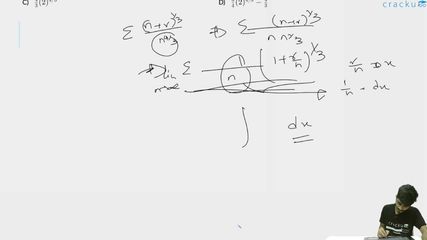
Observe that the summation index $$k$$ can run from $$1$$ to $$n$$ if we write the general term in the compact form
$$\sum_{k=1}^{n}\frac{(n+k)^{1/3}}{n^{4/3}}.$$
Now we separate the factor $$n$$ inside the power of the numerator. We write
$$ (n+k)^{1/3}=n^{1/3}\left(1+\frac{k}{n}\right)^{1/3}.$$
Substituting this expression into every fraction we get
$$\frac{(n+k)^{1/3}}{n^{4/3}} \;=\; \frac{n^{1/3}\left(1+\dfrac{k}{n}\right)^{1/3}}{n^{4/3}}.$$
Because powers of the same base add their exponents, $$n^{1/3}/n^{4/3}=n^{(1/3-4/3)}=n^{-1}=1/n$$. Therefore
$$\frac{(n+k)^{1/3}}{n^{4/3}}=\frac{1}{n}\left(1+\frac{k}{n}\right)^{1/3}.$$
Hence the entire sum becomes
$$\sum_{k=1}^{n}\frac{(n+k)^{1/3}}{n^{4/3}} \;=\;\sum_{k=1}^{n}\frac{1}{n}\left(1+\frac{k}{n}\right)^{1/3}.$$
The factor $$1/n$$ suggests a Riemann sum. Set
$$x_k=\frac{k}{n},\quad \Delta x=\frac{1}{n}.$$
As $$n\to\infty$$, the points $$x_k$$ fill the interval $$[0,1]$$, and we recognise
$$\sum_{k=1}^{n}\frac{1}{n}\left(1+\frac{k}{n}\right)^{1/3} \;\longrightarrow\; \int_{0}^{1}(1+x)^{1/3}\,dx.$$
Now we evaluate this definite integral. We first state the power rule for integration:
$$\int u^{m}\,du=\frac{u^{m+1}}{m+1}+C,\qquad\text{provided }m\neq-1.$$
In our case $$m=\dfrac{1}{3}$$ and $$u=1+x$$. Making the substitution $$u=1+x\Longrightarrow du=dx$$, we have
$$\int_{0}^{1}(1+x)^{1/3}\,dx=\int_{u=1}^{2}u^{1/3}\,du.$$
Applying the power rule,
$$\int u^{1/3}\,du=\frac{u^{1/3+1}}{1/3+1}=\frac{u^{4/3}}{4/3}=\frac{3}{4}u^{4/3}.$$
Therefore
$$\int_{1}^{2}u^{1/3}\,du=\left.\frac{3}{4}u^{4/3}\right|_{1}^{2} =\frac{3}{4}\left(2^{4/3}-1^{4/3}\right) =\frac{3}{4}\left(2^{4/3}-1\right).$$
Thus the limit that we were asked to find equals
$$\frac{3}{4}\left(2^{4/3}-1\right)=\frac{3}{4}\,2^{4/3}-\frac{3}{4}.$$
This exact value matches Option A, written as $$\frac{3}{4}(2)^{4/3}-\frac{3}{4}.$$
Hence, the correct answer is Option A.
Was this solution helpful?
Click on the Email ☝️ to Watch the Video Solution
Create a FREE account and get:
_1.webp)

Educational materials for JEE preparation

Ask our AI anything

AI can make mistakes. Please verify important information.
AI can make mistakes. Please verify important information.
