
Join Our JEE Preparation Group
Prep with like-minded aspirants; Get access to free daily tests and study material.
Sign in
Please select an account to continue using cracku.in
↓ →
Join Our JEE Preparation Group
Prep with like-minded aspirants; Get access to free daily tests and study material.
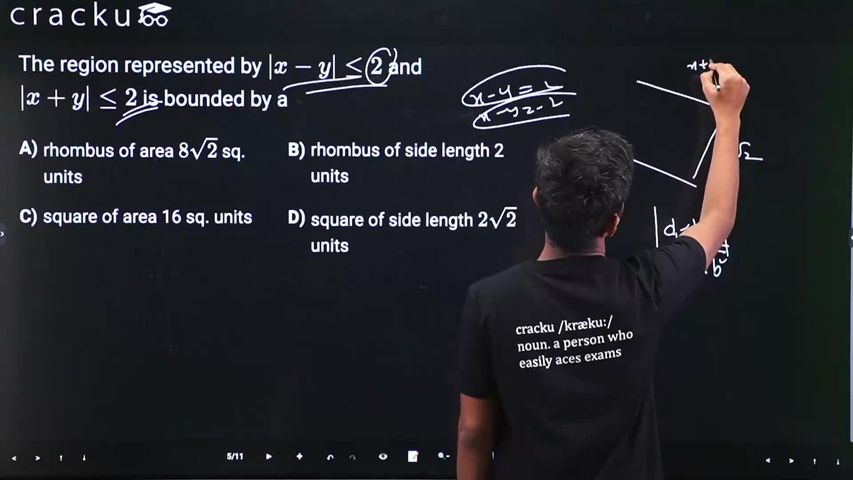
The region represented by $$|x - y| \leq 2$$ and $$|x + y| \leq 2$$ is bounded by a
We are given two simultaneous inequalities $$|x-y|\le 2$$ and $$|x+y|\le 2.$$ To understand the common region, we first convert each absolute-value inequality into two separate linear inequalities.
For $$|x-y|\le 2$$ we write
$$-(2)\le x-y\le 2\; \Longrightarrow\; x-y=-2 \quad\text{and}\quad x-y=2$$
For $$|x+y|\le 2$$ we write
$$-(2)\le x+y\le 2\; \Longrightarrow\; x+y=-2 \quad\text{and}\quad x+y=2$$
Thus the boundary of the region consists of the four straight lines
$$x-y=2,\qquad x-y=-2,\qquad x+y=2,\qquad x+y=-2.$$
Next, we find the points where these lines intersect pairwise. Each intersection of one line from the first pair with one line from the second pair will be a vertex of the enclosed figure.
1. Taking $$x-y=2$$ and $$x+y=2:$$
Adding, we get $$2x=4\;\Longrightarrow\;x=2.$$ Substituting $$x=2$$ into $$x+y=2$$ gives $$y=0.$$ So one vertex is $$(2,0).$$
2. Taking $$x-y=2$$ and $$x+y=-2:$$
Adding, we get $$2x=0\;\Longrightarrow\;x=0.$$ Substituting into $$x-y=2$$ gives $$y=-2.$$ So another vertex is $$(0,-2).$$
3. Taking $$x-y=-2$$ and $$x+y=2:$$
Adding, we get $$2x=0\;\Longrightarrow\;x=0.$$ Substituting into $$x-y=-2$$ gives $$y=2.$$ So the third vertex is $$(0,2).$$
4. Taking $$x-y=-2$$ and $$x+y=-2:$$
Adding, we get $$2x=-4\;\Longrightarrow\;x=-2.$$ Substituting into $$x+y=-2$$ gives $$y=0.$$ So the fourth vertex is $$(-2,0).$$
The four vertices are therefore
$$(2,0),\;(0,2),\;(-2,0),\;(0,-2).$$
Because the vertices are equally spaced and each side joins consecutive vertices, we expect a quadrilateral. To see whether it is a square, we compute one side length using the distance formula.
Formula (distance between two points) $$\bigl(x_1,y_1\bigr),\bigl(x_2,y_2\bigr):\;d=\sqrt{(x_2-x_1)^2+(y_2-y_1)^2}.$$
Take consecutive vertices $$(2,0)$$ and $$(0,2)$$:
$$d=\sqrt{(0-2)^2+(2-0)^2}=\sqrt{(-2)^2+2^2}=\sqrt{4+4}=\sqrt{8}=2\sqrt{2}.$$
Thus each side has length $$2\sqrt{2}.$$ Since all four sides are equal and the adjacent sides are at right angles (you can verify the slopes are negative reciprocals: slope of $$x-y=2$$ is $$1$$, slope of $$x+y=2$$ is $$-1$$), the figure is a square.
Because the side length is $$2\sqrt{2},$$ the area would be $$(2\sqrt{2})^2=8,$$ but the option list asks only for the side length.
Therefore the region is bounded by a square whose side length is $$2\sqrt{2}$$ units.
Hence, the correct answer is Option D.
Was this solution helpful?
Click on the Email ☝️ to Watch the Video Solution
Create a FREE account and get:
_1.webp)

Educational materials for JEE preparation

Ask our AI anything

AI can make mistakes. Please verify important information.
AI can make mistakes. Please verify important information.
