Join WhatsApp Icon JEE WhatsApp Group

NTA JEE Main 10th April 2019 Shift 1 - Chemistry

For the following questions answer them individually

Consider the following table:

Gas    a/(kPa dm$$^6$$ mol$$^{-1}$$)    b/(dm$$^3$$ mol$$^{-1}$$)
A              642.32                    0.05196
B              155.21                    0.04136
C              431.91                    0.05196
D              155.21                    0.4382

a and b are van der Waals constants. The correct statement about the gases is:

Consider the following statements
(a) The pH of a mixture containing 400 mL of 0.1 M H$$_2$$SO$$_4$$ and 400 mL of 0.1 M NaOH will be approximately 1.3.
(b) Ionic product of water is temperature dependent.
(c) A monobasic acid with K$$_a$$ = 10$$^{-5}$$ has a pH = 5. The degree of dissociation of this acid is 50%.
(d) The Le Chatelier's principle is not applicable to common-ion effect.
The correct statements are:

At room temperature, a dilute solution of urea is prepared by dissolving 0.60 g of urea in 360 g of water. If the vapour pressure of pure water at this temperature is 35 mm Hg, lowering of vapour pressure will be:
(molar mass of urea = 60 g mol$$^{-1}$$)

Consider the statements S1 and S2:
S1: Conductivity always increases with decreases in the concentration of electrolyte.
S2: Molar conductivity always increases with decreases in the concentration of electrolyte.
The correct option among the following

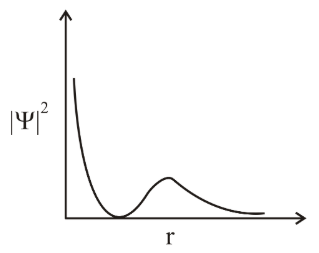
A bacterial infection in an internal wound grows as N'(t) = N$$_0$$exp(t), where the time t is in hours. A dose of antibiotic, taken orally, needs 1 hour to reach the wound. Once it reaches there, the bacterial population goes down as $$\frac{dN}{dt} = -5N^2$$. What will be the plot of $$\frac{N_0}{N}$$ vs t after 1 hour?

A gas undergoes physical adsorption on a surface and follows the given Freundlich adsorption isotherm equation
$$\frac{x}{m} = kp^{0.5}$$
Adsorption of the gas increases with:

Match the refining methods (Column I) with metals (Column II).
      Column I                       Column II
(Refining methods)              (Metals)
(I)   Liquation                      (a) Zr
(II)  Zone Refining                (b) Ni
(III) Mond Process                (c) Sn
(IV) Van Arkel Method          (d) Ga

Consider the hydrated ions of Ti$$^{2+}$$, V$$^{2+}$$, Ti$$^{3+}$$ and Sc$$^{3+}$$. The correct order of their spin-only magnetic moments is:

Three complexes,
[CoCl(NH$$_3$$)$$_5$$]$$^{2+}$$(I), [Co(NH$$_3$$)$$_5$$H$$_2$$O]$$^{3+}$$(II) and [Co(NH$$_3$$)$$_6$$]$$^{3+}$$(III)
absorb light in the visible region. The correct order of the wavelength of light absorbed by them is:

Amylopectin is composed of: