
Join Our JEE Preparation Group
Prep with like-minded aspirants; Get access to free daily tests and study material.
Sign in
Please select an account to continue using cracku.in
↓ →
Join Our JEE Preparation Group
Prep with like-minded aspirants; Get access to free daily tests and study material.
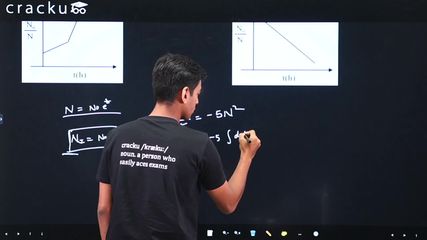
A bacterial infection in an internal wound grows as N'(t) = N$$_0$$exp(t), where the time t is in hours. A dose of antibiotic, taken orally, needs 1 hour to reach the wound. Once it reaches there, the bacterial population goes down as $$\frac{dN}{dt} = -5N^2$$. What will be the plot of $$\frac{N_0}{N}$$ vs t after 1 hour?
First, let us describe the physical situation in two clearly separated stages.
• Stage I (0 to 1 hour): the bacteria have not yet “seen” the antibiotic. According to the question their number varies with time as $$N(t)=N_0\,e^{t}\qquad(0\le t\le1).$$ At the end of this first hour (i.e. at the instant the antibiotic finally reaches the wound) the population has the value $$N(1)=N_0e.$$ We shall denote this population, the one existing at the very moment the antibiotic begins to act, by the new symbol $$N_1$$, so that $$N_1=N_0e.$$ This relabelling is done only to avoid carrying the redundant factor $$e$$ through every subsequent step.
• Stage II ($$t\ge1$$): the antibiotic is present and the population now follows the differential equation supplied in the statement, namely $$\frac{dN}{dt}=-5N^{2}.$$ From this point on we treat $$N_1$$ as the “initial” population for the decay process.
We now solve the differential equation valid during Stage II. The equation $$\frac{dN}{dt}=-5N^{2}$$ is separable. We begin by writing it in separated form,
$$\frac{dN}{N^{2}}=-5\,dt.$$
Next we integrate both sides. Taking $$t=1$$ (the instant the antibiotic arrives) as the lower limit for the time integral and $$N=N_1$$ as the corresponding lower limit for the population integral, we obtain
$$\int_{N_1}^{N(t)}\frac{dN}{N^{2}} \;=\; -5\int_{1}^{t}dt.$$
The left‐hand integral is elementary:
$$\int\frac{dN}{N^{2}}=-\frac1N.$$ Carrying out the definite integration gives $$\Bigl[-\frac1N\Bigr]_{N_1}^{N(t)} =-\frac1{N(t)}+\frac1{N_1}.$$ The right‐hand integral yields $$-5(t-1).$$
Equating the two evaluated integrals we have
$$-\frac1{N(t)}+\frac1{N_1}=-5(t-1).$$
Multiplying by $$-1$$ changes the signs everywhere:
$$\frac1{N(t)}-\frac1{N_1}=5(t-1).$$
Now isolate $$1/N(t)$$:
$$\frac1{N(t)}=5(t-1)+\frac1{N_1}.$$
Finally, multiply every term by the constant $$N_0$$ so that the ratio asked for in the problem, $$\dfrac{N_0}{N(t)},$$ appears explicitly:
$$\frac{N_0}{N(t)} \;=\; 5N_0\,(t-1)+\frac{N_0}{N_1}.$$
But $$N_1=N_0e$$, therefore $$\frac{N_0}{N_1}=\frac1e,$$ a mere numerical constant. Hence we may rewrite the result as
$$\frac{N_0}{N(t)}=\bigl(5N_0\bigr)\,(t-1)+\frac1e.$$
The right‐hand side is of the form $$\text{(constant)}\times t +\text{(another constant)},$$ which is unmistakably the equation of a straight line. That straight line rises with time because the coefficient of $$t$$ is positive ($$5N_0\gt 0$$).
Therefore, when we draw a graph of $$\dfrac{N_0}{N}$$ versus the time $$t$$ (after the initial one-hour delay) we obtain a line that starts from a finite value and increases uniformly—i.e. linearly—with time.
Consequently, among the choices offered, the correct description is “a graph starting from 1 that increases linearly.”
Hence, the correct answer is Option A.
Was this solution helpful?
Click on the Email ☝️ to Watch the Video Solution
Create a FREE account and get:
_1.webp)

Educational materials for JEE preparation

Ask our AI anything

AI can make mistakes. Please verify important information.
AI can make mistakes. Please verify important information.
