
Join Our JEE Preparation Group
Prep with like-minded aspirants; Get access to free daily tests and study material.
Sign in
Please select an account to continue using cracku.in
↓ →
Join Our JEE Preparation Group
Prep with like-minded aspirants; Get access to free daily tests and study material.
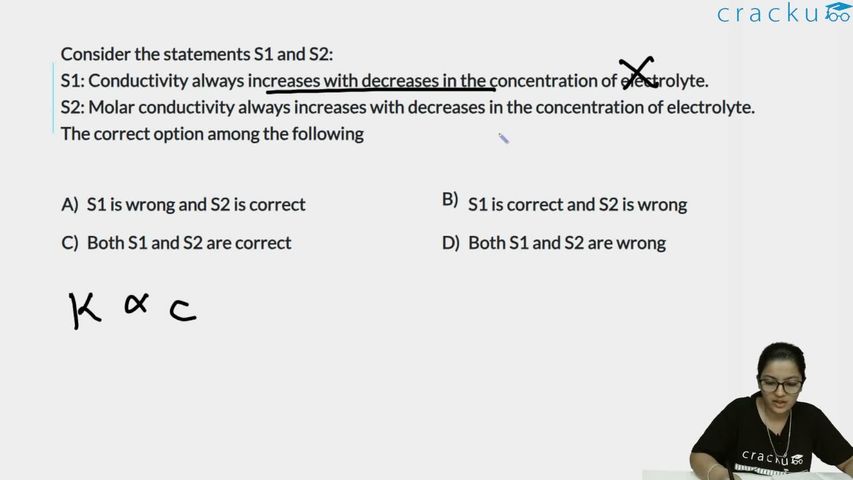
Consider the statements S1 and S2:
S1: Conductivity always increases with decreases in the concentration of electrolyte.
S2: Molar conductivity always increases with decreases in the concentration of electrolyte.
The correct option among the following
We start by recalling the definitions that link the electrical properties of an electrolyte solution with its concentration.
First, the electrical conductivity (also called specific conductance) is denoted by $$\kappa$$ and is defined as the conductance of a solution placed between two opposite faces of a (hypothetical) cube of length $$1\ \text{cm}$$. Mathematically, its fundamental relation with resistivity $$\rho$$ is
$$\kappa \;=\;\dfrac{1}{\rho}.$$
For an electrolyte solution, $$\kappa$$ is directly proportional to the actual number of ions present in a unit volume. If we denote the amount‐of‐substance concentration by $$c\;(\text{mol L}^{-1})$$, then—keeping temperature fixed—we can write
$$\kappa\;\propto\;c.$$
In simple words, as concentration decreases, the number of ions per unit volume decreases, and therefore $$\kappa$$ also decreases. There is no point beyond which $$\kappa$$ spontaneously starts increasing; the trend is monotonic.
Second, the molar conductivity of the same solution is denoted by $$\Lambda_m$$ and is defined by the formula
$$\Lambda_m \;=\;\dfrac{\kappa\;1000}{c},$$
where the factor $$1000$$ merely converts litres to cubic centimetres (because $$\kappa$$ is measured with distances in centimetres). This definition means that $$\Lambda_m$$ represents the conductance of all the ions produced by one mole of the electrolyte when they are placed between the same two electrodes $$1\ \text{cm}$$ apart.
Now observe the algebraic relationship carefully. If we substitute the proportionality $$\kappa \propto c$$ into the definition of $$\Lambda_m$$, we get
$$\Lambda_m \;=\;\dfrac{\kappa\;1000}{c}\;\propto\;\dfrac{c}{c}\;=\;1.$$
However, this proportionality misses an important physical detail: although $$\kappa$$ indeed falls linearly with decreasing $$c$$ in very dilute ranges, the factor $$1/c$$ multiplies the conductivity. Consequently, the net result is that molar conductivity increases as concentration decreases. At the limit $$c\to 0$$ (infinite dilution) we reach the maximum attainable molar conductivity $$\Lambda_m^\circ$$.
Putting both results together:
• Specific conductivity $$\kappa$$ decreases with decreasing concentration.
• Molar conductivity $$\Lambda_m$$ increases with decreasing concentration.
Examine the given statements:
S1: “Conductivity always increases with decrease in the concentration of electrolyte.” This is the opposite of what we have just deduced, so S1 is wrong.
S2: “Molar conductivity always increases with decrease in the concentration of electrolyte.” This matches our conclusion exactly, so S2 is correct.
Only the option that declares S1 wrong and S2 correct fits the analysis, and that option is Option A.
Hence, the correct answer is Option A.
Was this solution helpful?
Click on the Email ☝️ to Watch the Video Solution
Create a FREE account and get:
_1.webp)

Educational materials for JEE preparation

Ask our AI anything

AI can make mistakes. Please verify important information.
AI can make mistakes. Please verify important information.
