
Join Our JEE Preparation Group
Prep with like-minded aspirants; Get access to free daily tests and study material.
Sign in
Please select an account to continue using cracku.in
↓ →
Join Our JEE Preparation Group
Prep with like-minded aspirants; Get access to free daily tests and study material.
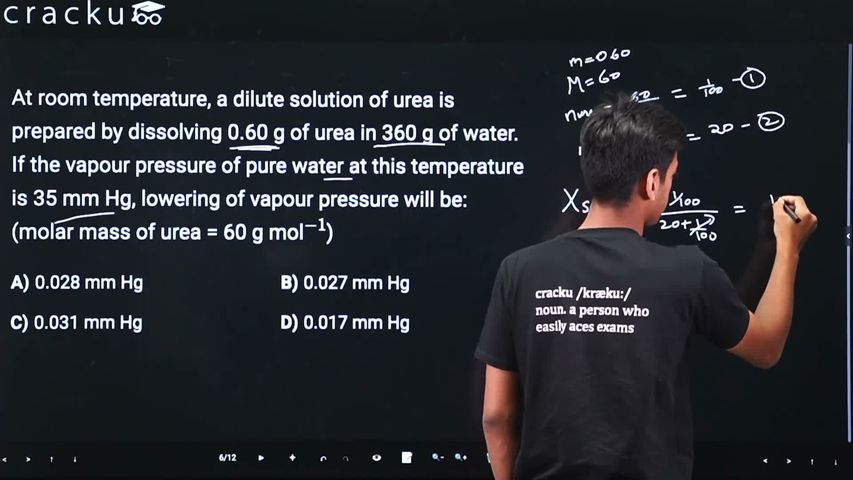
At room temperature, a dilute solution of urea is prepared by dissolving 0.60 g of urea in 360 g of water. If the vapour pressure of pure water at this temperature is 35 mm Hg, lowering of vapour pressure will be:
(molar mass of urea = 60 g mol$$^{-1}$$)
We first find the amount (in moles) of each component present in the solution.
For urea, we have mass $$m_{\text{urea}} = 0.60\ \text{g}$$ and molar mass $$M_{\text{urea}} = 60\ \text{g mol}^{-1}.$$
Using the definition $$n = \dfrac{m}{M},$$ we get
$$n_{\text{urea}} = \dfrac{0.60\ \text{g}}{60\ \text{g mol}^{-1}} = 0.010\ \text{mol}.$$
For water, the mass is $$m_{\text{water}} = 360\ \text{g}$$ and its molar mass is $$M_{\text{water}} = 18\ \text{g mol}^{-1}.$$
So,
$$n_{\text{water}} = \dfrac{360\ \text{g}}{18\ \text{g mol}^{-1}} = 20.0\ \text{mol}.$$
The total number of moles in the solution is therefore
$$n_{\text{total}} = n_{\text{urea}} + n_{\text{water}} = 0.010\ \text{mol} + 20.0\ \text{mol} = 20.010\ \text{mol}.$$
The mole fraction of the solute (urea) is obtained from its definition $$X_{\text{solute}} = \dfrac{n_{\text{solute}}}{n_{\text{total}}}.$$ Substituting the values,
$$X_{\text{urea}} = \dfrac{0.010}{20.010}.$$
To express this as a decimal, we divide directly:
$$X_{\text{urea}} = 0.0004998 \;(\text{approximately } 5.0 \times 10^{-4}).$$
Now, we apply Raoult’s law for a dilute ideal solution. The law states:
$$\frac{P^{\circ} - P}{P^{\circ}} = X_{\text{solute}},$$
where $$P^{\circ}$$ is the vapour pressure of the pure solvent, $$P$$ is the vapour pressure of the solution, and $$X_{\text{solute}}$$ is the mole fraction of the solute. The quantity $$P^{\circ} - P$$ is called the lowering of vapour pressure, denoted $$\Delta P.$$ Rearranging the expression, we get
$$\Delta P = P^{\circ} X_{\text{solute}}.$$
We are given $$P^{\circ} = 35\ \text{mm Hg}.$$ Substituting, we find
$$\Delta P = 35\ \text{mm Hg} \times 0.0004998.$$
Carrying out the multiplication,
$$\Delta P = 0.01749\ \text{mm Hg}.$$
Rounding to two significant figures,
$$\Delta P \approx 0.017\ \text{mm Hg}.$$
Among the given options, this value matches 0.017 mm Hg.
Hence, the correct answer is Option D.
Was this solution helpful?
Click on the Email ☝️ to Watch the Video Solution
Create a FREE account and get:
_1.webp)

Educational materials for JEE preparation

Ask our AI anything

AI can make mistakes. Please verify important information.
AI can make mistakes. Please verify important information.
