
Join Our JEE Preparation Group
Prep with like-minded aspirants; Get access to free daily tests and study material.
Sign in
Please select an account to continue using cracku.in
↓ →
Join Our JEE Preparation Group
Prep with like-minded aspirants; Get access to free daily tests and study material.
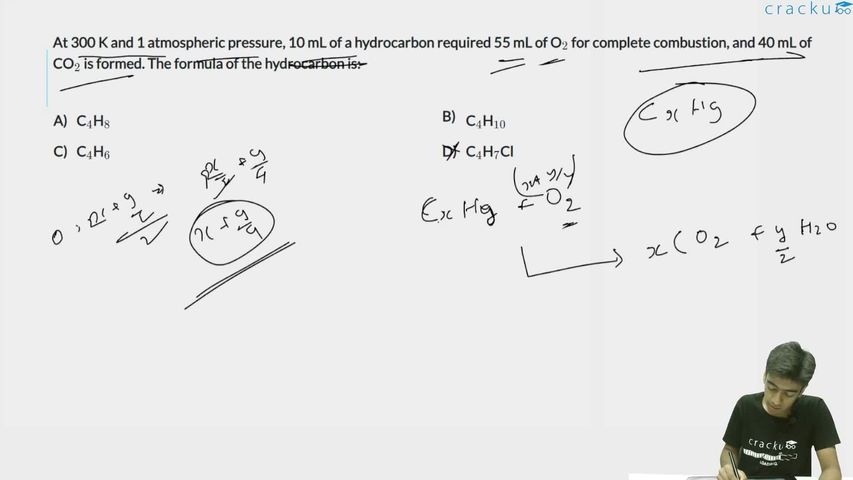
At 300 K and 1 atmospheric pressure, 10 mL of a hydrocarbon required 55 mL of O$$_2$$ for complete combustion, and 40 mL of CO$$_2$$ is formed. The formula of the hydrocarbon is:
At 300 K and 1 atm all gases behave nearly ideally, so Avogadro’s law tells us that equal volumes of different gases at the same temperature and pressure contain equal numbers of moles. Hence, the ratio of volumes of the reactants and products is the same as the ratio of their stoichiometric coefficients in the balanced chemical equation.
Let the unknown hydrocarbon have the general formula $$\mathrm{C_xH_y}.$$
First, we write the general combustion reaction of a hydrocarbon:
$$\mathrm{C_xH_y + O_2 \;\longrightarrow\; CO_2 + H_2O}.$$
To balance carbon and hydrogen, we must have $$x$$ molecules of $$\mathrm{CO_2}$$ (because each $$\mathrm{CO_2}$$ contains one carbon) and $$\dfrac{y}{2}$$ molecules of $$\mathrm{H_2O}$$ (because each $$\mathrm{H_2O}$$ contains two hydrogens). Writing this explicitly we get
$$\mathrm{C_xH_y + O_2 \;\longrightarrow\; x\,CO_2 + \dfrac{y}{2}\,H_2O}.$$
Now we balance oxygen. On the product side the total number of oxygen atoms is
$$2x \;(\text{from } x\,CO_2) \;+\; \dfrac{y}{2} \;(\text{from } \dfrac{y}{2}\,H_2O).$$
Since each molecule of $$\mathrm{O_2}$$ supplies two oxygen atoms, the required number of $$\mathrm{O_2}$$ molecules is
$$\dfrac{2x + \dfrac{y}{2}}{2} \;=\; x + \dfrac{y}{4}.$$
Thus the fully balanced combustion equation is
$$\boxed{\;\mathrm{C_xH_y + \left(x + \dfrac{y}{4}\right)O_2 \;\longrightarrow\; x\,CO_2 + \dfrac{y}{2}\,H_2O}\;}.$$
Because volumes are proportional to coefficients, we can match the given experimental volumes directly to these coefficients.
We are told that 10 mL of the hydrocarbon produce 40 mL of $$\mathrm{CO_2}$$:
$$\dfrac{\text{Volume of }CO_2}{\text{Volume of hydrocarbon}} \;=\; \dfrac{40\ \text{mL}}{10\ \text{mL}} \;=\; 4.$$
This means the stoichiometric coefficient of $$\mathrm{CO_2}$$, namely $$x,$$ must be 4.
Therefore, $$x = 4.$$
Next, we are told that the same 10 mL of the hydrocarbon consume 55 mL of $$\mathrm{O_2}:$$
$$\dfrac{\text{Volume of }O_2}{\text{Volume of hydrocarbon}} \;=\; \dfrac{55\ \text{mL}}{10\ \text{mL}} \;=\; 5.5.$$
Hence the coefficient of $$\mathrm{O_2},$$ which is $$x + \dfrac{y}{4},$$ must equal 5.5:
$$x + \dfrac{y}{4} \;=\; 5.5.$$
We already have $$x = 4,$$ so substituting this value gives
$$4 + \dfrac{y}{4} = 5.5.$$
Now we isolate $$\dfrac{y}{4}:$$
$$\dfrac{y}{4} = 5.5 - 4 = 1.5.$$
Multiplying both sides by 4 to solve for $$y$$:
$$y = 1.5 \times 4 = 6.$$
So the empirical formula of the hydrocarbon is
$$\boxed{\mathrm{C_4H_6}}.$$
Among the given options, this corresponds to Option C.
Hence, the correct answer is Option C.
Was this solution helpful?
Click on the Email ☝️ to Watch the Video Solution
Create a FREE account and get:
_1.webp)

Educational materials for JEE preparation

Ask our AI anything

AI can make mistakes. Please verify important information.
AI can make mistakes. Please verify important information.
