Join WhatsApp Icon JEE WhatsApp Group

NTA JEE Main 10th April 2015 Online - Physics

For the following questions answer them individually

If the capacitance of a nanocapacitor is measured in terms of a unit $$u$$, made by combining the electronic charge $$e$$, Bohr radius $$a_0$$, Planck's constant $$h$$ and speed of light $$c$$ then

A block of mass $$m = 10$$ kg rests on a horizontal table. The coefficient of friction between the block and the table is 0.05. When hit by a bullet of mass 50 g moving with speed $$v$$, that gets embedded in it, the block moves and comes to stop after moving a distance of 2 m on the table. If a freely falling object were to acquire speed $$\frac{v}{10}$$ after being dropped from height $$H$$, then neglecting energy losses and taking $$g = 10$$ m s$$^{-2}$$, the value of $$H$$ is close to

A block of mass $$m = 0.1$$ kg is connected to a spring of unknown spring constant k. It is compressed to a distance $$x$$ from its equilibrium position and released from rest. After approaching half the distance $$\left(\frac{x}{2}\right)$$ from the equilibrium position, it hits another block and comes to rest momentarily, while the other block moves with velocity 3 m s$$^{-1}$$. The total initial energy of the spring is:

Consider a thin uniform square sheet made of a rigid material. If its side is $$a$$, mass m and moment of inertia $$I$$ about one of its diagonals, then:

A uniform solid cylindrical roller of mass $$m$$ is being pulled on a horizontal surface with force $$F$$ parallel to the surface and applied at its centre. If the acceleration of the cylinder is $$a$$ and it is rolling without slipping then the value of $$F$$ is:

A very long (length $$L$$) cylindrical galaxy is made of uniformly distributed mass and has radius $$R$$ $$(R << L)$$. A star outside the galaxy is orbiting the galaxy in a plane perpendicular to the galaxy and passing through its centre. If the time period of the star is $$T$$ and its distance from the galaxy's axis is $$r$$, then

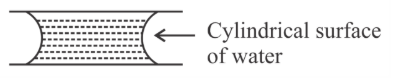
If two glass plates have water between them and are separated by very small distance (see the figure below), it is very difficult to pull them apart. It is because the water in between forms cylindrical surface on the side that gives rise to lower pressure in the water in comparison to atmosphere. If the radius of the cylindrical surface is R and surface tension of water is T then the pressure in water between the plates is lower by:

image

If it takes 5 minutes to fill a 15 litre bucket from a water tap of diameter $$\frac{2}{\sqrt{\pi}}$$ cm then the Reynolds number for the flow is (density of water = $$10^3$$ kg/m$$^3$$ and viscosity of water = $$10^{-3}$$ Pa.s) close to:

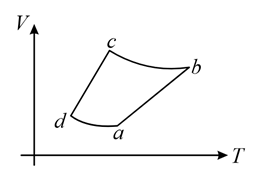
An ideal gas goes through a reversible cycle $$a \rightarrow b \rightarrow c \rightarrow d$$ has the V - T diagram shown below. Process $$d \rightarrow a$$ and $$b \rightarrow c$$ are adiabatic.

The corresponding P - V diagram for the process is (all figures are schematic and not drawn to scale):

A simple harmonic oscillator of angular frequency 2 rad s$$^{-1}$$ is acted upon by an external force $$F = \sin t$$ N. If the oscillator is at rest in its equilibrium position at $$t = 0$$, its position at later times is proportional to:

A bat moving at 10 m s$$^{-1}$$ towards a wall sends a sound signal of 8000 Hz towards it. On reflection, it hears a sound of frequency $$f$$. The value of $$f$$ in Hz is close to (speed of sound = 320 m s$$^{-1}$$)

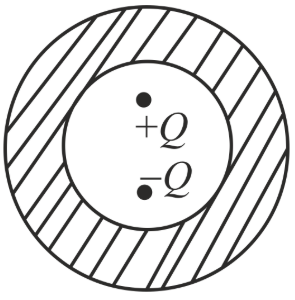
Shown in the figure are two point charges $$+Q$$ and $$-Q$$ inside the cavity of a spherical shell. The charges are kept near the surface of the cavity on opposite sides of the centre of the shell. If $$\sigma_1$$ is the surface charge on the inner surface and $$Q_1$$ net charge on it and $$\sigma_2$$ the surface charge on the outer surface and $$Q_2$$ net charge on it then:

image

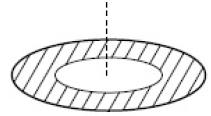
A thin disc of radius $$b = 2a$$ has a concentric hole of radius $$a$$ in it (see figure). It carries uniform surface charge $$\sigma$$ on it. If the electric field on its axis at a height h (h $$<<$$ a) from its centre is given as Ch then the value of C is

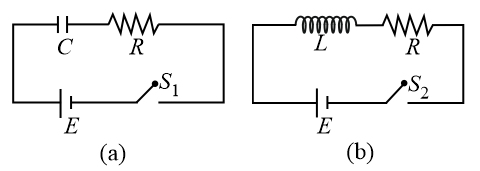
In the given circuits (a) and (b), switches $$S_1$$ and $$S_2$$ are closed at $$t = 0$$ and kept close for a long time. The variation of currents in the two circuits for $$t \geq 0$$ are shown in the options. (Figures are schematic and not drawn to scale.)

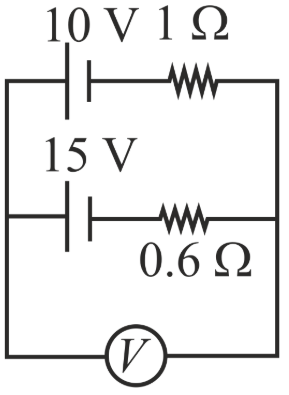
A 10 V battery with internal resistance 1 $$\Omega$$ and a 15 V battery with internal resistance 0.6 $$\Omega$$ are connected in parallel to a voltmeter (see figure). The reading in the voltmeter will be close to:

image

A 25 cm long solenoid has the radius 2 cm and 500 turns. It carries a current of 15 A. If it is equivalent to a magnet of the same size and magnetization $$\vec{M}$$ $$\left(\frac{\text{Magnetic Moment}}{\text{volume}}\right)$$, then $$|\vec{M}|$$ is:

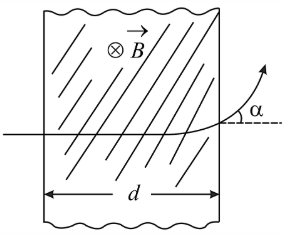
A proton (mass $$m$$), accelerated by a potential difference $$V$$, flies through a uniform transverse magnetic field $$B$$. The field occupies a region of the space by a width $$d$$. Let $$\alpha$$ be the angle of deviation of the proton from the initial direction of motion (see the figure), then the value of $$\sin \alpha$$ will be:

image

An electromagnetic wave travelling in the $$x-$$ direction has frequency of $$2 \times 10^{14}$$ Hz and electric field amplitude of 27 V m$$^{-1}$$ oscillates in $$Y-$$direction. From the options given below, which one describes the magnetic field for this wave?

A telescope has an objective lens of focal length 150 cm and an eyepiece of focal length 5 cm. If a 50 m tall tower at a distance of 1 km is observed through this telescope in a normal setting, the angle formed by the image of the tower is $$\theta$$, then $$\theta$$ is close to

You are asked to design a shaving mirror assuming that a person keeps it at 10 cm from his face and views the magnified image of the face at the closest comfortable distance of 25 cm. The radius of curvature of the mirror would then be:

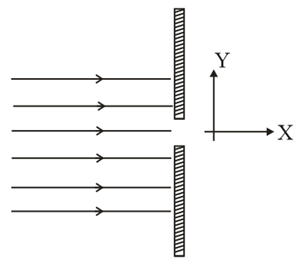
A parallel beam of electrons travelling in x - direction falls on a slit of width d (see the figure below). If after passing the slit, an electron acquires momentum $$p_y$$ in the y - direction, then for a majority of electrons passing through the slit (h is Planck's constant):

De-Broglie wavelength of an electron accelerated by a voltage of 50 V is close to $$(|e| = 1.6 \times 10^{-19}$$ C, $$m_e = 9.1 \times 10^{-31}$$ kg, $$h = 6.6 \times 10^{-34}$$ J s$$)$$

If one were to apply the Bohr model to a particle of mass $$m$$ and charge $$q$$ moving in a plane under the influence of a magnetic field 'B', the energy of the charged particle in the $$n^{th}$$ level will be:

In an unbiased p - n junction electrons diffuse from n-region to p-region because:

Diameter of a steel ball is measured using a Vernier calipers which has divisions of 0.1 cm on its main scale (MS) and 10 divisions of its Vernier scale (VS) match 9 divisions on the main scale. Three such measurements for a ball are given as:

S.No.   MS (cm)   VS divisions
1.            0.5          8
2.            0.5         4
3.            0.5          6

If the zero error is -0.03 cm, then mean corrected diameter is: