91- 6303239042
At what time do Ram and Shyam first meet each other?
Sign in
Please select an account to continue using cracku.in
↓ →
 CAT WhatsApp Group
Ram and Shyam run a race between points A and B, 5 km apart. Ram starts at 9 a.m. from A at a speed of 5 km/hr, reaches B, and returns to A at the same speed. Shyam starts at 9:45 a.m. from A at a speed of 10 km/hr, reaches B and comes back to A at the same speed.
At what time do Ram and Shyam first meet each other?
Let the time at which they meet be t minutes past 10.
So, distance run by Ram + distance run by Shyam = 10 km
=> (60+t)5/60 [t+60 because he would have traveled for 9 am to 10 am and t minutes more before meeting Shyam]+ (15+t)*10/60 [15+t because he would have traveled from 9:45 to 10:00 and t minutes more]= 10
=> 300+5t+150+10t = 600 => t = 10
So, they meet at 10.10 am
At what time does Shyam overtake Ram?
Let the time at which Shyam overtakes Ram be t minutes past 10.
So, distance run by both of them is the same till that moment.
(60+t)5 = (15+t)10 => 300 + 5t = 150 + 10t => 5t = 150 => t = 30 min.
So, at 10.30 am, Shyam overtakes Ram
If R = $$(30^{65}-29^{65})/(30^{64}+29^{64})$$ ,then
$$\frac{(30^{65}-29^{65})}{(30^{64}+29^{64})} = ((30-29)*\frac{(30^{64}+30^{63}*29+....+29^{64})}{(30^{64}+29^{64})}$$ , which is greater than 1 . Hence option D.

What is the distance in cm between two parallel chords of lengths 32 cm and 24 cm in a circle of radius 20 cm?
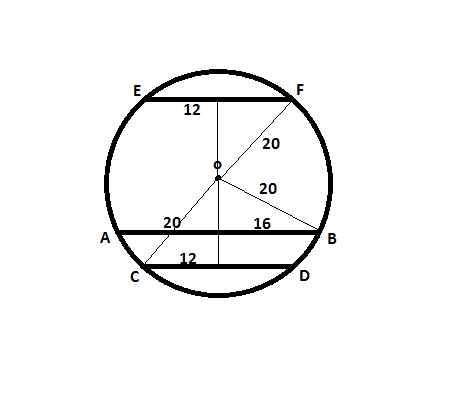
The distances of the chords from the center are 12 cm and 16 cm respectively.
If the chords lie on the same side of the center, the distance between the chords is 4 cm, if they lie on opposite sides of the center, the distance between them is 28 cm.
For which value of k does the following pair of equations yield a unique solution for x such that the solution is positive?
$$x^2 - y^2 = 0$$
$$(x-k)^2 + y^2 = 1$$
From 1st equation we know that $$(x)^2 = y^2 $$
Substituting this in 2nd equation. we get , $$2*x^2 - 2*x*k + k^2-1 =0 $$ and for unique solution $$b^2-4ac=0$$ must satisfy.
This is possible only when k = $$\sqrt{2}$$
If x = $$(16^3 + 17^3+ 18^3+ 19^3 )$$, then x divided by 70 leaves a remainder of
We know that x = $$16^3 + 17^3 + 18^3 + 19^3 = (16^3 + 19^3) + (17^3 + 18^3)$$
= $$(16 + 19)(16^2 - 16 * 19 + 19^2) + (17 + 18)(17^2 - 17 * 18 + 18^2)$$ = 35 × odd + 35 × odd = 35 × even = 35 × (2k)
=> x = 70k
=> Remainder when divided by 70 is 0.

A chemical plant has four tanks (A, B, C, and D), each containing 1000 litres of a chemical. The chemical is being pumped from one tank to another as follows:
From A to B @ 20 litres/minute
From C to A @ 90 litres/minute
From A to D @ 10 litres/minute
From C to D @ 50 litres/minute
From B to C @ 100 litres/minute
From D to B @ 110 litres/minute
Which tank gets emptied first, and how long does it take (in minutes) to get empty after pumping starts?
After 1 min the cans will contain following amount of chemicals : A - 1060 B - 1030 C - 970 D - 950
So, we can see that the can D loses 50 ltrs in 1 min which is highest. So the can D will lose 1000 ltrs in 20*1 = 20 mins.
Two identical circles intersect so that their centres, and the points at which they intersect, form a square of side 1 cm. The area in sq. cm of the portion that is common to the two circles is
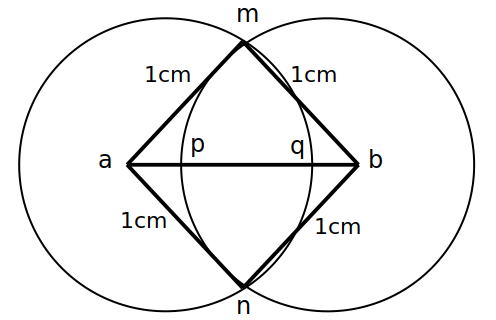
We know that quad ambn is a square of side 1.
Area of the sector a-mqn is $$\frac{90}{360}* \pi *1*1$$ = $$\frac{\pi }{4}$$.
Area of square = 1*1 = 1
Area of common portion = 2 * Area of sector - Area of square
= 2 * $$\frac{\pi }{4}$$ - 1 = $$\frac{\pi }{2}$$ - 1
A jogging park has two identical circular tracks touching each other, and a rectangular track enclosing the two circles. The edges of the rectangles are tangential to the circles. Two friends, A and B, start jogging simultaneously from the point where one of the circular tracks touches the smaller side of the rectangular track. A jogs along the rectangular track, while B jogs along the two circular tracks in a figure of eight. Approximately, how much faster than A does B have to run, so that they take the same time to return to their starting point?
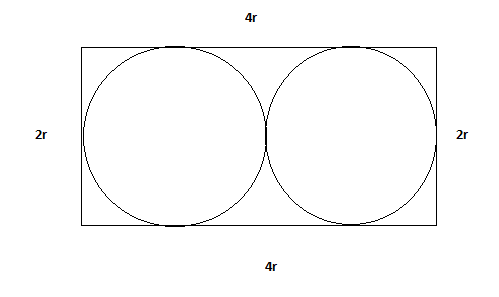
Let the radius of 2 circles be r . Speed of A would be 12r/t and Speed of B would be 4*Pi*r/t . To find percentage faster B have to run than A we have : (4*Pi - 12)*100/ (12) = 4.7% approx. Hence, option D.

In a chess competition involving some boys and girls of a school, every student had to play exactly one game with every other student. It was found that in 45 games both the players were girls, and in 190 games both were boys. The number of games in which one player was a boy and the other was a girl is
Number of games in which both the players are girls = $$^GC_2$$ where G is the number of girls
$$^GC_2 = 45$$
$$^{10}C_2 = 45$$
So, G = 10
Similarly, number of games in which both the players are boys = $$^BC_2$$, where B is the number of boys
$$^BC_2 = 190$$
$$^{20}C_2 = 190$$
So, B = 20
So, number of games in which one player is a boy and the other player is a girl is 20*10 = 200
Let $$n!=1*2*3* ...*n$$ for integer $$n \geq 1$$.
If $$p = 1!+(2*2!)+(3*3!)+... +(10*10!)$$, then $$p+2$$ when divided by 11! leaves a remainder of
According to given condiiton we have p = (1 × 1!) + (2 × 2!) + (3 × 3!) + (4 × 4!) + … + (10 × 10!) . So n × n! = [(n + 1) - 1] × n! = (n + 1)! - n!. So equation becomes p = 2! - 1! + 3! - 2! + 4! - 3! + 5! - 4! +… + 11! - 10!. So p = 11! - 1! = 11! - 1. p + 2 = 11! + 1 .So when it is divided by 11! gives a remainder of 1. Hence, option 4.
Consider a triangle drawn on the X-Y plane with its three vertices at (41, 0), (0, 41) and (0, 0), each vertex being represented by its (X,Y) coordinates. The number of points with integer coordinates inside the triangle (excluding all the points on the boundary) is
The number of points on x = 1 is 39. The number of points on x = 2 is 38 and so on till x = 39, which has one point.
So, the total is 1+2+3+...+39 = $$\frac{39*40}{2}$$ = 780.

The digits of a three-digit number A are written in the reverse order to form another three-digit number B. If B > A and B-A is perfectly divisible by 7, then which of the following is necessarily true?
Let A = 100x + 10y + z and B = 100z + 10y + x .According to given condition B - A = 99(z - x) As (B - A) is divisible by 7 . So clearly (z - x) should be divisible by 7. z and x can have values 8,1 or 9,2 , such that 8-2=9-2=7 and y can have value from 0 to 9.
So Lowest possible value of A lowest x,y and z which is is 108 and the highest possible value of A is 299.
If $$a_1 = 1$$ and $$a_{n+1} - 3a_n + 2 = 4n$$ for every positive integer n, then $$a_{100}$$ equals
Using given condition we find $$a_2$$ = 5 and $$a_3$$ = 21 and so on.
We see that the numbers are of form $$3^n-(2*n)$$
So for 100 we have $$3^{100}-200$$
Let S be the set of five-digit numbers formed by the digits 1, 2, 3, 4 and 5, using each digit exactly once such that exactly two odd positions are occupied by odd digits. What is the sum of the digits in the rightmost position of the numbers in S?
When the odd numbers occupy places 1 and 3, only 2 or 4 can be in the 5th place. Odd numbers can occupy places 1 and 3 in 3C2*2! = 6 ways. When 2 is at the 5th place, the other odd number and 4 can be arranged in the remaining places in 2 ways. So, 2 occurs at the end 6*2 = 12 times. Similarly, 4 occurs 12 times.
If odd numbers occupy places 1 and 5, then 2 or 4 should come in the 3rd place. The other two numbers can then be arranged in 2 ways in the remaining blanks. So, if 1 is in the first place and 5 is in the 5th place, the other numbers can be arranged in 2*2 = 4 ways. Similar for 1 and 3; 5 and 1; 3 and 1; 5 and 3; 3 and 5. So, 5 occurs 8 times, 1 8 times and 3 8 times. Similar is the case when odd numbers are placed in 3rd and 5th places.
On the whole, 4 occurs 12 times, 2 occurs 12 times, 5, 3 and 1 each occur 16 times. The total is, therefore, 48+24+80+48+16 = 216

The rightmost non-zero digit of the number $$30^{2720}$$ is
Rightmost non-zero digit of $$30^{2720}$$ is same as rightmost non-zero digit of $$3^{272}$$.
272 is of the form 4k.
All $$3^{4k}$$ end in 1.
=> Right most non-zero digit is 1.
Four points A, B, C, and D lie on a straight line in the X-Y plane, such that AB = BC = CD, and the length of AB is 1 metre. An ant at A wants to reach a sugar particle at D. But there are insect repellents kept at points B and C. The ant would not go within one metre of any insect repellent. The minimum distance in metres the ant must traverse to reach the sugar particle is
Since ant cant go more near than 1 m.
So it'll have to travel in circular path from A till it is south of pt.
B and hence travels a quarter circle with radius = 1 and center as B, so travel $$\frac{\pi }{2}$$ m distance.
Then from B to C it travels 1m in straight line till C.
Then again from C to D in circular path way with distance $$\frac{\pi }{2}$$ m.
Hence total distance traveled = $$\frac{\pi }{2}$$ + $$\frac{\pi }{2}$$ +1 = $$\pi $$ +1.
Alternate solution :
Let the given figure represent the situation. A,B,C,D are the points with distance between them 1 m.
The repellents are at B and C respectively. The circles drawn with centre at B and C and radius equal to AB = 1 m.
Let E and F be the points of intersection of the circles and G and H be the points on the circle perpendicular to B and C.

Therefore, the ant can only travel at the circumference of the circles.
The shortest path for the to take will take is : A-G-H-D.
This is because taking the curve G-E and E-H will be a longer path than travelling straight from G to H.
While travelling from G to H, the distance of the ant will be more than 1 m from the repellant.

Thus, the distance travelled by the ant on the circumference of the circle ie
arc AG = $$\dfrac{90}{360} \times 2 \times \pi 1 = \dfrac{\pi}{2} $$
Length of arc HD = length of arc AG = $$\dfrac{\pi}{2} $$
Total length = $$(2 \times \dfrac{\pi}{2})+ BC = \pi + 1$$
If x >= y and y > 1, then the value of the expression $$log_x (x/y) + log_y (y/x)$$ can never be
$$log_x (x/y) + log_y (y/x)$$ = $$1 - log_x (y) + 1 - log_y (x)$$
= $$2 - (log_x y + 1/log_x y)$$ <= 0 (Since $$log_x y + 1/log_x y$$ >= 2)
So, the value of the expression cannot be 1.

For a positive integer n, let $$P_n$$ denote the product of the digits of n, and $$S_n$$ denote the sum of the digits of n. The number of integers between 10 and 1000 for which $$P_n$$ + $$S_n$$ = n is
Let n can be a 2 digit or a 3 digit number.
First let n be a 2 digit number.
So n = 10x + y and Pn = xy and Sn = x + y
Now, Pn + Sn = n
Therefore, xy + x + y = 10x + y , we have y = 9 .
Hence there are 9 numbers 19, 29,.. ,99, so 9 cases .
Now if n is a 3 digit number.
Let n = 100x + 10y + z
So Pn = xyz and Sn = x + y + z
Now, for Pn + Sn = n ; xyz + x + y + z = 100x + 10y + z ; so. xyz = 99x + 9y .
For above equation there is no value for which the above equation have an integer (single digit) value.
Hence option D.
Rectangular tiles each of size 70 cm by 30 cm must be laid horizontally on a rectangular floor of size 110 cm by 130 cm, such that the tiles do not overlap. A tile can be placed in any orientation so long as its edges are parallel to the edges of the floor. No tile should overshoot any edge of the floor. The maximum number of tiles that can be accommodated on the floor is

As seen from the fig. If following configuration is used max 6 number of tiles that can be accommodated on the floor.
In the X-Y plane, the area of the region bounded by the graph of |x+y| + |x-y| = 4 is
If the moduli are removed, the equations formed are
x+y+x-y = 4 => x=2
x+y-x+y = 4 => y =2
-x-y+x-y = 4 => y=-2
-x-y-x+y = 4 => x=-2
The area enclosed by these equations is a square with vertices at (2,2), (-2,2), (-2,-2), (2,-2) as shown in figure.
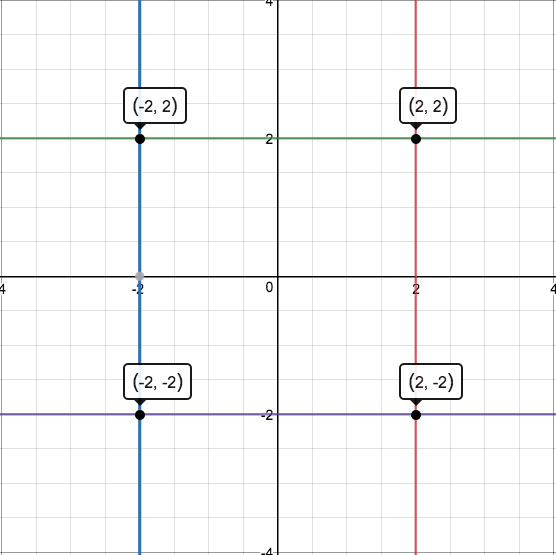
The required area = 4*4 = 16

In the following figure, the diameter of the circle is 3 cm. AB and MN are two diameters such that MN is perpendicular to AB. In addition, CG is perpendicular to AB such that AE:EB = 1:2, and DF is perpendicular to MN such that NL:LM = 1:2. The length of DH in cm is
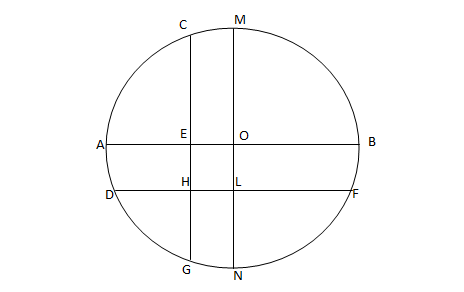
Let EO = x, So, AE = 1.5 - x
AE : EB = 1:2 => x = 1/2
(1.5-x):(1.5+x) = 1:2.
x=0.5.
So, EO = 0.5
Similarly, OL = 0.5
Now, EOLH is a parallelogram and EO = OL = 0.5
In triangle DOL, DO = radius = 1.5 and OL = 0.5
So, DL = $$\sqrt2$$
=> DH = $$(2\sqrt2 - 1)/2$$
Consider the triangle ABC shown in the following figure where BC = 12 cm, DB = 9 cm, CD = 6 and $$\angle{BCD} = \angle{BAC}$$
What is the ratio of the perimeter of the triangle ADC to that of the triangle BDC?
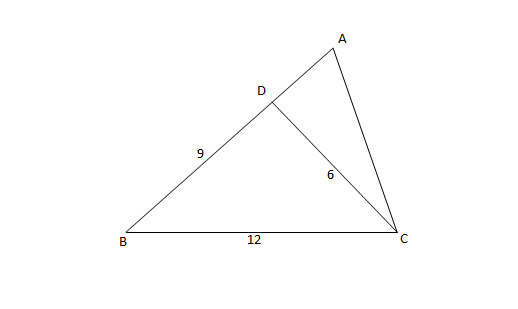
Consider triangles ABC and BDC
Angle B is common in both triangles. Also $$\angle A = \angle C$$
Since 2 angles are equal, the third angles $$\angle{ACB} = \angle{BDC}$$
Hence, triangle BCA $$\sim$$ BDC (BCA and BDC are similar)
AC/DC = BC/BD = AB/BC
BC = 12 cm, DB = 9 cm, CD = 6 cm
=> AC = 12/9 * 6 = 8 cm
AB = 8/6 * 12 = 16 cm
So, AD = 16 - 9 = 7 cm
Perimeter of ADC = 7+8+6 = 21 cm
Perimeter of BCD = 27 cm
Ratio = 21/27 = 7/9
P, Q, S, and R are points on the circumference of a circle of radius r, such that PQR is an equilateral triangle and PS is a diameter of the circle. What is the perimeter of the quadrilateral PQSR?
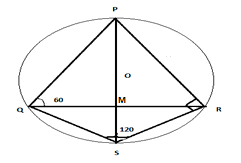
Let PQR be an equilateral triangle with side equal to x and let the intersection point of PS and QR be M.
Clearly, the circle is the circumcircle of the triangle PQR.
QR = x => QM = $$\frac{x}{2}$$ because a perpendicular from the centre to any chord bisects the chord.
Angle OQM = 30 degrees and QM is equal to $$\frac{x}{2}$$ => OQ = $$\frac{\frac{x}{2}}{cos(30)}$$ = $$\frac{x}{\sqrt{3}}$$
Hence the radius of the circumcircle of an equilateral triangle is equal to $$\frac{x}{\sqrt{3}}$$.
Angle PQS = 90 degrees as it is an angle in a semicircle. PS bisects angle QPR => angle QPS is 30 degrees. Hence QS subtends an angle of 30 degrees in the major arc => QS subtends an angle of 60 degrees at the centre because angle subtended by a chord at the centre is twice the angle subtended by the chord in the major arc.
Angle QOS = 60 degrees => Triangle QOS is equilateral and hence QS is equal to radius of the circle => QS = $$\frac{x}{\sqrt{3}}$$
Given that radius is r => r = $$\frac{x}{\sqrt{3}}$$ => x = $$r\sqrt{3}$$
=> Perimeter of PQRS = PQ+QS+SR+RP= $$ r\sqrt{3} + r + r + r\sqrt{3}$$ = $$2r(1+\sqrt{3})$$

Let S be a set of positive integers such that every element n of S satisfies the conditions
A. 1000 <= n <= 1200
B. every digit in n is odd
Then how many elements of S are divisible by 3?
The no. has all the digits as odd no. and is divisible by 3. So the possibilities are
1113
1119
1131
1137
1155
1173
1179
1191
1197
Hence 9 possibilities .
Let $$x = \sqrt{4+\sqrt{4-\sqrt{4+\sqrt{4- \ to \ infinity}}}}$$. Then x equals
$$x = \sqrt{4+\sqrt{4-\sqrt{4+\sqrt{4- \ to \ infinity}}}}$$
=> $$x = \sqrt{4+\sqrt{4-x}}$$
=> $$x^2 = 4 + \sqrt{4-x}$$
=>$$x^4 + 16 - 8x^2 = 4 - x$$
=> $$x^4 - 8x^2 + x +12 = 0$$
On substituting options, we can see that option C satisfies the equation.
Let g(x) be a function such that g(x+1) + g(x-1) = g(x) for every real x. Then for what value of p is the relation g(x+p) = g(x) necessarily true for every real x?
According to given condition we have , g(x+1) = -g(x-1) + g(x)
Putting x=x+1 we get g(x+2) = g(x+1) - g(x) = -g(x-1)
Putting x=x+2 we get g(x+3)=-g(x)
Similarly g(x+4)=-g(x+1), g(x+5)=-g(x+2)=-g(x+1) + g(x) and g(x+6) = g(x+1)-g(x+2)=g(x).
So p=6.

A telecom service provider engages male and female operators for answering 1000 calls per day. A male operator can handle 40 calls per day whereas a female operator can handle 50 calls per day. The male and the female operators get a fixed wage of Rs. 250 and Rs. 300 per day respectively. In addition, a male operator gets Rs. 15 per call he answers and a female operator gets Rs. 10 per call she answers. To minimize the total cost, how many male operators should the service provider employ assuming he has to employ more than 7 of the 12 female operators available for the job?
Let x be no. of male and y be no. of female operators.
We have 40x+50y=1000 .
So x = 25-(5*y/4) also 7<=y<=12.
So y can be 8 or 12.
If y=8 then x=15 and y=12 then x=10 .
Then we have to find total cost incurred in both the cases.
We find that cost is minimum in 2nd case when no. of males are 10.
Three Englishmen and three Frenchmen work for the same company. Each of them knows a secret not known to others. They need to exchange these secrets over person-to-person phone calls so that eventually each person knows all six secrets. None of the Frenchmen knows English, and only one Englishman knows French. What is the minimum number of phone calls needed for the above purpose?
Consider there are 6 people numbered 1-3 englishmen and 3-6 frenchmen, let 3 know both english and french.
First call would be between 1-3 then 2-3 such that 3 know secret of all 3 englishmen.
Let 3 call 4 .
Similarly there would be call between 4-5 then 4-6 such that 4 know secret of all 3 frenchmen.
Now 3 would call 4 . Such that 3 and 4 would know secret of all 6 members.
Now to let this know to 1,2,5,6 more 4 calls would be required.
Hence, minimum calls required would be 9.
A rectangular floor is fully covered with square tiles of identical size. The tiles on the edges are white and the tiles in the interior are red. The number of white tiles is the same as the number of red tiles. A possible value of the number of tiles along one edge of the floor is
Let C and R be no. of columns and rows respectively.
The number of red coloured tiles would be given by (R-2)(C-2). This is because two outer rows made of white tiles and the two outer columns made up of outer columns are removed.
Similarly the number of white tiles would be given by R*2 + (C-2)*2. Two tiles are removed from columns because the corner tiles would have already been included while considering the rows.
So according to given condition we have (C-2)*2 + 2*R = (C-2)(R-2).
Now start putting value of c from options into this equation. Only for one option B we get an integer value of R .

A management institute was established on January 1, 2000 with 3, 4, 5, and 6 faculty members in the Marketing, Organisational Behaviour (OB), Finance, and Operations Management (OM) areas respectively, to start with. No faculty member retired or joined the institute in the first three months of the year 2000. In the next four years, the institute recruited one faculty member in each of the four areas. All these new faculty members, who joined the institute subsequently over the years, were 25 years old at the time of their joining the institute. All of them joined the institute on April a) During these four years, one of the faculty members retired at the age of 60. The following diagram gives the area-wise average age (in terms of number of completed years) of faculty members as on April 1 of 2000, 2001, 2002, and 2003.

From which area did the faculty member retire?
We know that average of the particular area would increase by 1 each year if there is no change in any member of the group.
So, now in marketing, ob and om, we can see increase in average by 1 in 3 successive years.
But in Finance we see that average decreases 2 times, once when a new teacher is recruited and other time when the 60 year old retires.
Hence option A.
Professors Naresh and Devesh, two faculty members in the Marketing area, who have been with the Institute since its inception, share a birthday, which falls on 20th November. One was born in 1947 and the other one in 1950. On April 1 2005, what was the age of the third faculty member, who has been in the same area since inception?
Since one was born in 1947 and the other one in 1950 and have birthday on 20th November, on 1st April 2000 they will have age 49 and 52 respectively.
Average age of all three on 1st April 2000 = 49.33 => Total age = 49.33*3 =148
Hence, age of the third member on 1st April 2000 = 148 - 49 - 52 = 47
Age of the third member on 1st April 2005 = 47+5 = 52.
Hence option D.
In which year did the new faculty member join the Finance area?
The average age in the Finance area dropped twice - once due to the retirement of a member and once due to the joining of a new member. We see that the average age of the faculty is around 45-50. This number is closer to the retirement age of 60 than to the joining age of 25. Hence, the new joining will produce a greater drop in average age than the retirement. Hence, the new faculty member must have joined in 2002 and the old faculty member must have retired in 2001. Hence option C.

What was the age of the new faculty member, who joined the OM area, as on April 1, 2003?
As the average age for OM area decreases in 2001, we can infer that the new faculty member joined OM on 1st April 2001. As his age was 25 on that date, his age on 1st April 2003 would be 25+2 = 27 years. Thus, the new faculty member would be 27 years old. Hence option C.
The table below reports annual statistics related to rice production in select states of India for a particular year.

Which two states account for the highest productivity of rice (tons produced per hectare of rice cultivation)?
Calculating the tons produced per hectare of rice cultivation for different states ,we get highest value for punjab and haryana , the ratio being above 5 for both . Hence option A.
How many states have a per capita production of rice (defined as total rice production divided by its population) greater than Gujarat?
Only 4 states Haryana , Punjab , Maharashtra, Andhra Pradesh have a per capita production of rice greater than Gujarat. Hence option B.

An intensive rice producing state is defined as one whose annual rice production per million of population is at least 400,000 tons. How many states are intensive rice producing states?
10 lakh ton = 1 million ton. States whose annual rice production per million of population is at least 400,000 tons are Haryana , Gujarat, Punjab , Madhya pradesh, Tamil nadu, maharashtra, uttar pradesh,andhra pradesh . Hence 8 states.
The table below reports the gender, designation and age-group of the employees in an organization. It also provides information on their commitment to projects coming up in the months of January (Jan), February (Feb), March (Mar) and April (Apr), as well as their interest in attending workshops on: Business Opportunities (BO), Communication Skills (CS), and E-Governance (EG).

M=Male, F= Female; Exe=Executive, Mgr=Manager, Dir=Director; Y=Young, I=In-between, O=Old
For each workshop, exactly four employees are to be sent, of which at least two should be Females and at least one should be Young. No employee can be sent to a workshop in which he/she is not interested in. An employee cannot attend the workshop on
Communication Skills, if he/she is committed to internal projects in the month of January;
Business Opportunities, if he/she is committed to internal projects in the month of February;
E-governance, if he/she is committed to internal projects in the month of March.
Assuming that Parul and Hari are attending the workshop on Communication Skills (CS), then which of the following employees can possibly attend the CS workshop?
Since we require atleast 2 women and 1 women is selected , other girl can be any one out of the yamini or lavanya. Now seeing the options and given data , we can infer that dinesh and anshul cannot attend as they have projects in january and rahul can attend it. So we have rahul and yamini. Hence option A.
How many Executives (Exe) cannot attend more than one workshop?
Gayatri and Urvashi are interested in only one workshop each, that is, EG. So they cannot attend more than one workshop.
Zeena is interested in all three workshops but she is committed to internal projects during the months of Jan and Mar. So she cannot attend the CS and EG workshops.
These are 3 executives gayatri , urvashi , zeena who can't attend more than 1 workshop.
Similarly using the same above logic we find that Anshul, Bushkant, Charu, Eshwaran, Fatima, Hari, Indiri, John, Mandeep, Nandlal, Rahul, Sunita and Yamini cannot also attend more than one workshop.
So, in total there are only 3 executives who cannot attent more than one work shop.

Which set of employees cannot attend any of the workshops?
The common interest of all the people in option B is EG.
But, all the four are committed to projects in March => They cannot attend EG.
Hence, people in option 4 cannot attend a workshop.
In the table below is the listing of players, seeded from highest (#1) to lowest (#32), who are due to play in an Association of Tennis Players (ATP) tournament for women. This tournament has four knockout rounds before the final, i.e., first round, second round, quarterfinals, and semi-finals. In the first round, the highest seeded player plays the lowest seeded player (seed # 32) which is designated match No. 1 of first round; the 2nd seeded player plays the 31st seeded player which is designated match No. 2 of the first round, and so on. Thus, for instance, match No. 16 of first round is to be played between 16th seeded player and the 17th seeded player. In the second round, the winner of match No. 1 of first round plays the winner of match No. 16 of first round and is designated match No. 1 of second round. Similarly, the winner of match No. 2 of first round plays the winner of match No. 15 of first round, and is designated match No. 2 of second round. Thus, for instance, match No. 8 of the second round is to be played between the winner of match No. 8 of first round and the winner of match No. 9 of first round. The same pattern is followed for later rounds as well.

If there are no upsets (a lower seeded player beating a higher seeded player) in the first round, and only match Nos. 6, 7, and 8 of the second round result in upsets, then who would meet Lindsay Davenport in quarter finals, in case Davenport reaches quarter finals?
There are no upsets in 1st round, so top 16 players go to the 2nd round.
In second round, nth player would play (17-n)th player. Now, match Nos. 6, 7, and 8 of the second round result in upsets.
So the people in the quarter finals would be 1,2,3,4,5,11,10,9.
So in quarterfinal 2nd seeeded player would play (9-2) = 7th position player.
Here no. 10 is in the 7th position and No. 10 player is venus williams.
Hence option D.
If Elena Dementieva and Serena Williams lose in the second round, while Justine Henin and Nadia Petrova make it to the semi-finals, then who would play Maria Sharapova in the quarterfinals, in the event Sharapova reaches quarterfinals?
If Elena Dementieva and Serena Williams lose in the second round, Nadia petrova and patty schnyder will go through.
Hence ,in the quarter finals, following seed no. players will be in quarter finals: 1,2,3,4,5,11,7,9.
So, now Maria Sharapova is ranked is 1 so she'll play 9th seed player who is Nadia Petrova.
Hence option C.

If, in the first round, all even numbered matches (and none of the odd numbered ones) result in upsets, and there are no upsets in the second round, then who could be the lowest seeded player facing Maria Sharapova in semi-finals?
According to given condition, players of following ranking will go to the 2nd round 1,31,3,29,5,27,7,25,9,23,11,21,13,19,15,17.
Out of these players going to 3rd round / quarter finals are 1,15,3,13,5,11,7,9.
If maria (no.1) goes to semifinal she'll face any on eout of the 13/5 th no. player in semis.
13th seed player is the lowest so Anastasia Myskina.
If the top eight seeds make it to the quarterfinals, then who, amongst the players listed below, would definitely not play against Maria Sharapova in the final, in case Sharapova reaches the final?
If the top eight seeds make it to the quarterfinals then one out of Kim Clijsters or svetana kuznetsova will compete with maria sharapoava in semis.
So now if maria reaches semis, she'll beat any one out of the two and both will definitely not play against Maria Sharapova in the final, if she reaches .
Venkat, a stockbroker, invested a part of his money in the stock of four companies --- A, B, C and D. Each of these companies belonged to different industries, viz., Cement, Information Technology (IT), Auto, and Steel, in no particular order. At the time of investment, the price of each stock was Rs.100. Venkat purchased only one stock of each of these companies. He was expecting returns of 20%, 10%, 30%, and 40% from the stock of companies A, B, C and D, respectively. Returns are defined as the change in the value of the stock after one year, expressed as a percentage of the initial value. During the year, two of these companies announced extraordinarily good results. One of these two companies belonged to the Cement or the IT industry, while the other one belonged to either the Steel or the Auto industry. As a result, the returns on the stocks of these two companies were higher than the initially expected returns. For the company belonging to the Cement or the IT industry with extraordinarily good results, the returns were twice that of the initially expected returns. For the company belonging to the Steel or the Auto industry, the returns on announcement of extraordinarily good results were only one and a half times that of the initially expected returns. For the remaining two companies, which did not announce extraordinarily good results, the returns realized during the year were the same as initially expected.
What is the minimum average return Venkat would have earned during the year?
For the average profit to be minimum, the companies with returns higher than the initially expected returns have to be the companies with the least expected returns.
So, the company with twice the initially expected returns has to be the company that was expected to return 10%. So, the returns now become 20%.
The company with one and a half times the initially expected returns has to be the company with the next least expected results, which is 20%. So, the returns now become 30%.
The companies with 30% and 40% expected results got the same as the expected results.
The average overall profit can be calculated as,
$$\dfrac{20\ +\ 30\ +\ 30\ +\ 40}{4}\ =\ 30\%$$
The minimum average return during the year for Venkat would be 30%.
Hence, the correct answer is option A.

If Venkat earned a 35% return on average during the year, then which of these statements would necessarily be true?
I. Company A belonged either to Auto or to Steel Industry.
II. Company B did not announce extraordinarily good results.
III. Company A announced extraordinarily good results.
IV. Company D did not announce extraordinarily good results.
For the overall average to be 35%, there are two possible cases as shown below in the table,
Case 1: A gets double the expected results, and D gets one and a half times the expected results.
Case 2: C gets double the expected results, and A gets one and a half times the expected results.

In both cases, we can see that A must announce extraordinary results, and the results of B are as expected. But we can see that D has expected results in one case and had unexpected results in the other. Hence, statements 1 and 4 need not be necessarily true, and 2 and 3 must be true.
Hence, option B is the correct answer.
If Venkat earned a 38.75% return on average during the year, then which of these statement(s) would necessarily be true?
I. Company C belonged either to Auto or to Steel Industry.
II. Company D belonged either to Auto or to Steel Industry.
III. Company A announced extraordinarily good results.
IV. Company B did not announce extraordinarily good results.
For the average overall to be 38.75%, the sum of all the results has to be 38.75 * 4 = 155%. The sum is 155 in only a single case, when the results of D are doubled and the results of C become one and a half times the expected results. The calculations are as shown in the table below,

To give a 38.75 % average return, we can see that B didn't give extraordinary returns, and we know that one of the auto or steel industries had one and a half times the expected results. As Company C got one and a half times the expected results, Company C has to be either the auto or steel industry.
So, the correct statements are 1 and 4 only.
Hence, the correct answer is option C.
If Company C belonged to the Cement or the IT industry and did announce extraordinarily good results, then which of these statement(s) would necessarily be true?
I. Venkat earned not more than 36.25% return on average.
II. Venkat earned not less than 33.75% return on average.
III. If Venkat earned 33.75% return on average, Company A announced extraordinarily good results.
IV. If Venkat earned 33.75% return on average, Company B belonged either to Auto or to Steel Industry.
Let us calculate the minimum average that Venkat can obtain in this case, and for this to happen, one and a half times the expected results must be obtained for company B. The value is calculated as follows,

We can see that the minimum average obtained in the case is 33.75%, and Venkat cannot earn less than 33.75% in this case, making statement 2 true.
As we can see above, in the case of a 33.75% average return, Company A did not report extraordinary results, and Company C must belong to an auto or steel company, as it received one and a half times the expected results. So, statement 3 is false and 4 is true.
For the average to be maximum, one and a half must be obtained from company D.
Average maximum return = $$\dfrac{20\ +\ 10\ +\ 60\ +\ 60}{4}\ =\ 37.5\%$$
We can see that statement 1 is also false.
So, the correct statements are 2 and 4 only.
Hence, the correct answer is option B.

The year is 2089. Beijing, London, New York, and Paris are in contention to host the 2096 Olympics. The eventual winner is determined through several rounds of voting by members of the IOC with each member representing a different city. All the four cities in contention are also represented in IOC.

In any round of voting, the city receiving the lowest number of votes in that round gets eliminated. The survivor after the last round of voting gets to host the event.
A member is allowed to cast votes for at most two different cities in all rounds of voting combined. (Hence, a member becomes ineligible to cast a vote in a given round if both the cities (s)he voted for in earlier rounds are out of contention in that round of voting.)
A member is also ineligible to cast a vote in a round if the city (s)he represents is in contention in that round of voting.
As long as the member is eligible, (s)he must vote and vote for only one candidate city in any round of voting.The following incomplete table shows the information on cities that received the maximum and minimum votes in different rounds, the number of votes cast in their favour, and the total votes that were cast in those rounds.It is also known that:
All those who voted for London and Paris in round 1, continued to vote for the samecities in subsequent rounds as long as these cities were in contention. 75% of those whovoted for Beijing in round 1, voted for Beijing in round 2 as well.
Those who voted for New York in round 1, voted either for Beijing or Paris in round 2.
The difference in votes cast for the two contending cities in the last round was 1.
50% of those who voted for Beijing in round 1, voted for Paris in round 3.
What percentage of members from among those who voted for New York in round 1, voted for Beijing in round 2?
Let us consider that there are 'm' members totally,there are 4 cities so total number of voters in round 1 will be m - 4, as 4 members of the cities are not allowed to vote.In the same way we have in total m - 3 members who will vote in the 2nd round.For the 3rd round, we have m - 2 - r members voting, r - number of of voters who voted for NY and Beijing in Round 1 and 2. According to given conditions these voters can't vote again. Also ,m - 3 = 83. So in total there were m = 86 members. And 83 people voted in 1st round and it is given that there are 75 votes in 3rd round . So we have r=9 i.e. 9 voters who voted for Ny in 2st round and beijing in 2nd round.
Also it is given that Ny voters in Round 1 voted either for Beijing or Paris and there are 9 voters who voted for NY in round 1, voted for Beijing in round 2.So 9*100/12 = 75% . hence option D.
What is the number of votes cast for Paris in round 1?
According to given condition 75% of voters who voted for Beijing in round 1, voted for Beijing in round 2. There are 21-9 = 12 voters who voted for Beijing in round 2 also Beijing in round 1. Hence total voters for beijing in round 1 is 16. Son in round 1 total 82 voters , out of which beijing -16 voters,london - 30 , new york - 12. Hence total voters for paris 82-16-30-12 = 24. Hence option D .
What percentage of members from among those who voted for Beijing in round 2 and were eligible to vote in round 3, voted for London?
From given conditions we find that :

Required value is 8*100/12 = 66.67 %. Hence option D.

Which of the following statements must be true?
a. IOC member from New York must have voted for Paris in round 2.
b. IOC member from Beijing voted for London in round 3.
From given conditions we find that :

We can see that - IOC member from New York must have voted for Paris in round 2.(IOC member - representative). Hence a is true. Also we can see that IOC member from Beijing voted for paris in round 3.Hence b is false. So answer is option A.
The table below presents the revenue (in million rupees) of four firms in three states. These firms, Honest Ltd., Aggressive Ltd., Truthful Ltd. and Profitable Ltd. are disguised in the table as A,B,C and D, in no particular order.

Further, it is known that:
In the state of MP, Truthful Ltd. has the highest market share.
Aggressive Ltd.’s aggregate revenue differs from Honest Ltd.’s by Rs. 5 million.
What can be said regarding the following two statements?
Statement 1: Profitable Ltd. has the lowest share in MP market.
Statement 2: Honest Ltd.’s total revenue is more than Profitable Ltd.
We have ,

There is a difference of 5 million between Firm A and Firm D and also between Firm C and Firm B .
Now if Profitable Ltd. has the lowest share in MP market then Firm B is profitable ltd. Honest ltd. would be any firm out of A and D. So now if statement 1 is true then statement 2 is false as honest will have more revenue than profitable. hence option c.
What can be said regarding the following two statements?
Statement 1: Aggressive Ltd.’s lowest revenues are from MP.
Statement 2: Honest Ltd.’s lowest revenues are from Bihar.
We have ,
There is a difference of 5 million between Firm A and Firm D and also between Firm C and Firm B . Now if statement 1 is true then , Firm B is aggressive ltd. and Firm C is Honest Ltd. And also statement 2 is fulfilled.

What can be said regarding the following two statements?
Statement 1: Honest Ltd. has the highest share in the UP market.
Statement 2: Aggressive Ltd. has the highest share in the Bihar market.
We have ,
There is a difference of 5 million between Firm A and Firm D and also between Firm C and Firm B . Now if statement 1 is true then Honest ltd. would be firm B , and aggressive ltd. would be firm C. But now if we consider statement 2 we get Agressive ltd. as firm B and Honest ltd as firm C. Thus any 1 out of the 2 statements can be true and not both together. hence option C.
If Profitable Ltd.’s lowest revenue is from UP, then which of the following is true?
We have ,
By Statement 1, Truthful is A or C.
If Profitable's lowest revenue are from UP, Profitable is either A or D.
By Statement 2, Honest and Aggressive are either A-D or B-C. As Profitable is either A or D, Honest and Aggressive will be one of B or C.
Hence, Truthful is A => Profitable is D.
Hence, Truthful's lowest revenues are from UP.
Help Distress (HD) is an NGO involved in providing assistance to people suffering from natural disasters. Currently, it has 37 volunteers. They are involved in three projects: Tsunami Relief (TR) in Tamil Nadu, Flood Relief (FR) in Maharashtra, and Earthquake Relief (ER) in Gujarat. Each volunteer working with Help Distress has to be involved in at least one relief work project.
The number of volunteers involved in the TR project alone is one less than the number ofvolunteers involved in ER project alone.
Ten volunteers involved in the TR project are also involved in at least one more project.
Based on the information given above, the minimum number of volunteers involved in both FR and TR projects, but not in the ER project is:
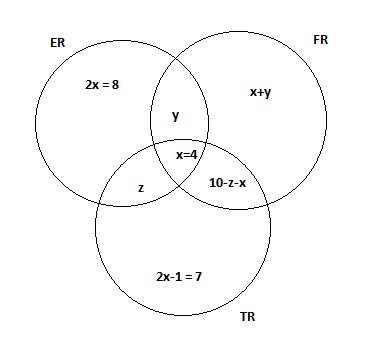
Total number of volunteers are 37
=> 2x+y+x+y+x+y+z+10-z-x+2x-1=37
=> 5x+2y+9=37
=> 5x+2y=28
Also we know that 3x + 2y = 20.
We get x=4, => y=4
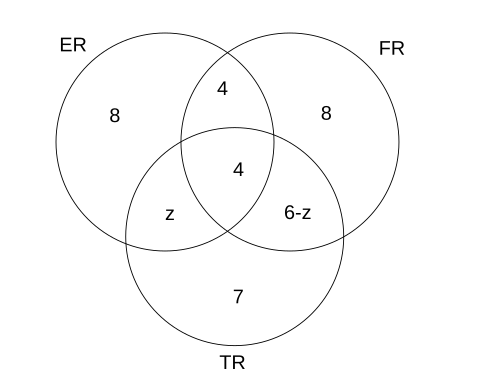
We need to find the minimum value of 6-z, and it is given FR get the most number of volunteers, We get that z cannot be more than 2 because if it is 3 or above ER will have the maximum number of volunteers.

Which of the following additional information would enable to find the exact number of volunteers involved in various projects?
We can get the information mentioned in options B and C using the data given in the passage.
But, we need the information in option A to find the exact number of volunteers in various projects.
Hence, option A is the answer.
After some time, the volunteers who were involved in all the three projects were asked to withdraw from one project. As a result, one of the volunteers opted out of the TR project, and one opted out of the ER project, while the remaining ones involved in all the three projects opted out of the FR project. Which of the following statements, then, necessarily follows?
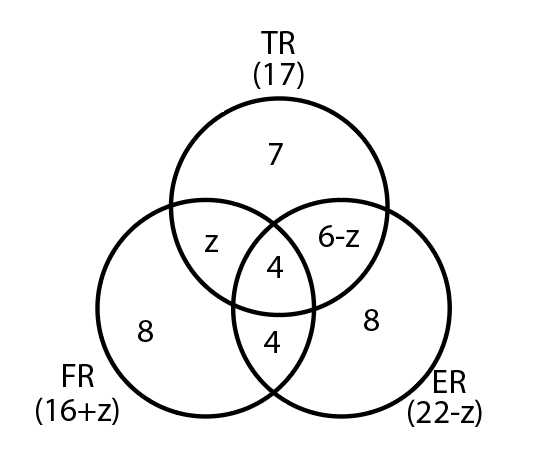
FR is greater than ER, thus z is 4,5,6.
If z=4,
FR=20, ER= 18
If z=5,
FR=21, ER= 17
If z=6,
FR=22, ER= 16
Now even if we transfer one of the volunteers opted out of the TR project thus he will now be handling FR and ER, and one opted out of the ER project will be handling TR and FR, while the remaining ones involved in all the three projects opted out of the FR project.
The worst-case scenario will be when z=4. Now 2 are out of FR, 1 from ER and 1 from TR.
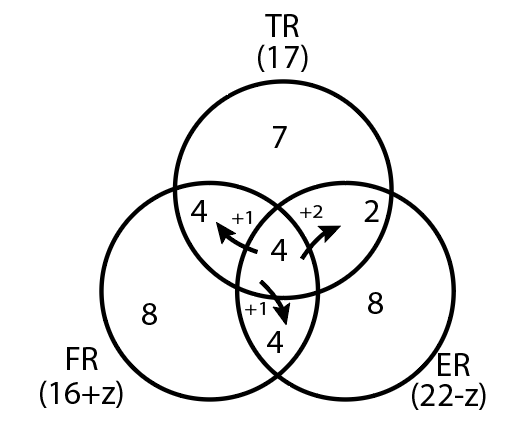
FR=20-2=18 and ER=18-1=17
So we can see that even if volunteers are withdrawn, the number of volunteers in FR are more as in, total if we calculate comes out to be more. Hence option B.
After the withdrawal of volunteers, as indicated in the previous question, some new volunteers joined the NGO. Each one of them was allotted only one project in a manner such that, the number of volunteers working in one project alone for each of the three projects became identical. At that point, it was also found that the number of volunteers involved in FR and ER projects was the same as the number of volunteers involved in TR and ER projects. Which of the projects now has the highest number of volunteers?
Consider p volunteers be added to TR project and q be added to each of FR and ER projects.
Then, 7 + p = 8 + q => p = q + 1
Also, Number of volunteers working on TR = 7 + q + 1 + 4 + 5 = 17 + q
Number of volunteers working on FR = 17 + q
Number of volunteers working on ER = 18 + q.
So if we take any values we get ER greater than both FR and TR.

A game of strategy, as currently conceived in game theory, is a situation in which two or more “players” make choices among available alternatives (moves). The totality of choices determines the outcomes of the game, and it is assumed that the rank order of preferences for the outcomes is different for different players. Thus the “interests” of the players are generally in conflict. Whether these interests are diametrically opposed or only partially opposed depends on the type of game.
Psychologically, most interesting situations arise when the interests of the players are partly coincident and partly opposed, because then one can postulate not only a conflict among the players but also inner conflicts within the players. Each is torn between a tendency to cooperate, so as to promote the common interests, and a tendency to compete, so as to enhance his own individual interests.
Internal conflicts are always psychologically interesting. What we vaguely call “interesting” psychology is in very great measure the psychology of inner conflict. Inner conflict is also held to be an important component of serious literature as distinguished from less serious genres. The classical tragedy, as well as the serious novel, reveals the inner conflict of central figures. The superficial adventure story, on the other hand, depicts only external conflict; that is, the threats to the person with whom the reader (or viewer) identifies stem in these stories exclusively from external obstacles and from the adversaries who create them. On the most primitive level this sort of external conflict is psychologically empty. In the fisticuffs between the protagonists of good and evil, no psychological problems are involved or, at any rate, none are depicted in juvenile representations of conflict.
The detective story, the “adult” analogue of a juvenile adventure tale, has at times been described as a glorification of intellectualized conflict. However, a great deal of the interest in the plots of these stories is sustained by withholding the unraveling of a solution to a problem. The effort of solving the problem is in itself not a conflict if the adversary (the unknown criminal) remains passive, like Nature, whose secrets the scientist supposedly unravels by deduction. If the adversary actively puts obstacles in the detective’s path toward the solution, there is genuine conflict. But the conflict is psychologically interesting only to the extent that it contains irrational components such as a tactical error on the criminal’s part or the detective’s insight into some psychological quirk of the criminal or something of this sort. Conflict conducted in a perfectly rational manner is psychologically no more interesting than a standard Western. For example, Tic-tac-toe, played perfectly by both players, is completely devoid of psychological interest. Chess may be psychologically interesting but only to the extent that it is played not quite rationally. Played completely rationally, chess would not be different from Tic-tac-toe.
In short, a pure conflict of interest (what is called a zero-sum game) although it offers a wealth of interesting conceptual problems, is not interesting psychologically, except to the extent that its conduct departs from rational norms.
According to the passage, internal conflicts are psychologically more interesting than external conflicts because
Options A ,B and D are never mentioned in any part of the passage . Options C seems to be explaining perfectly why internal conflicts are psychologically more interesting than external conflicts.
Which, according to the author, would qualify as interesting psychology?
By adopting a defensive strategy, the chess player is co-operating with his opponent though he wants to win the game. In the beginning of the passage, it has been given that conflict of interests like these lead to interesting psychology. In the other 3 options given, there is no conflict of interest involved (Only one person is involved in all the other 3 cases).
According to the passage, which of the following options about the application of game theory to a conflict-of-interest situation is true?
In the 1st paragraph, the last 3 lines indicate that the options A and B are true.
In the 2nd paragraph, the first 2 lines indicate that the option C is true.
Hence, all the above is the answer.
The problem solving process of a scientist is different from that of a detective because
Refer to the lines of 2nd last para.
The effort of solving the problem is in itself not a conflict if the adversary (the unknown criminal) remains passive, like Nature, whose secrets the scientist supposedly unravels by deduction. If the adversary actively puts obstacles in the detective's path toward the solution, there is genuine conflict. But the conflict is psychologically interesting only to the extent that it contains irrational components such as a tactical error on the criminal's part or the detective's insight into some psychological quirk of the criminal or something of this sort. Conflict conducted in a perfectly rational manner is psychologically no more interesting than a standard Western.
Option C agrees with these lines and none of the other options does. Hence, option C is the answer.
The sentences given in the question, when properly sequenced, form a coherent paragraph. Each sentence is labeled with a letter. Choose the most logical order of sentences from among the given choices to construct a coherent paragraph.
The sentences given in each question, when properly sequenced, form a coherent paragraph. Each sentence is labeled with a letter. Choose the most logical order of sentences from among the given choices to construct a coherent paragraph.
(A) Similarly, turning to caste, even though being lower caste is undoubtedly a separate cause of disparity, its impact is all the greater when the lower-caste families also happen to be poor.
(B) Belonging to a privileged class can help a woman to overcome many barriers that obstruct women from less thriving classes.
(C) It is the interactive presence of these two kinds of deprivation - being low class and being female - that massively impoverishes women from the less privileged classes.
(D) A congruence of class deprivation and gender discrimination can blight the lives of poorer women very severely.
(E) Gender is certainly a contributor to societal inequality, but it does not act independently ofclass.
EB pair is clearly a link as E says inequality is dependent on class and B takes it forward. Thus we have option B and option C. Out of these link DCA is in logical sequence. Hence option B.
(A) When identity is thus ‘defined by contrast’, divergence with the West becomes central.
(B) Indian religious literature such as the Bhagavad Gita or the Tantric texts, which are identified as differing from secular writings seen as ‘western’, elicits much greater interest in the West thando other Indian writings, including India’s long history of heterodoxy.
(C) There is a similar neglect of Indian writing on non-religious subjects, from mathematics,epistemology and natural science to economics and linguistics.
(D) Through selective emphasis that point up differences with the West, other civilizations can, in this way, be redefined in alien terms, which can be exotic and charming, or else bizarre and terrifying, or simply strange and engaging.
(E) The exception is the Kamasutra in which western readers have managed to cultivate an interest.
Out of B and D , B is a perfect starting sentence. Also there is a link among sentences BCE as C explains how there is a neglect in Indian writing in not just religious topics but also in non-religious subjects and E gives exception to above 2 sentences. Only option D follows the requirement.
The sentences given in each question, when properly sequenced, form a coherent paragraph. Each sentence is labeled with a letter. Choose the most logical order of sentences from among the given choices to construct a coherent paragraph.
A) This is now orthodoxy to which I subscribe - up to a point.
B) It emerged from the mathematics of chance and statistics.
C) Therefore the risk is measurable and manageable.
D) The fundamental concept: Prices are not predictable, but the mathematical laws of chance can describe their fluctuations.
E) This is how what business schools now call modern finance was born.
Here finding the starting statement is a problem. So we first find link among the given statements. From statement B we can see the word 'it' , so it must refer to some statement before. From statement E we can see that 'it' refers to modern finance. Out of other statements , correct order is DCA ,as A concludes. Hence , option B.
Choose the option in which the usage of the word is incorrect or inappropriate.
"Near"
The correct word in option B is "close friend". The usage of "near" is not appropriate here.
Hence, option B is the answer.
Choose the option in which the usage of the word is incorrect or inappropriate.
"Hand"
[CAT 2005]
Sentence A is incorrect. The correct usage is 'I have my hands full'.
Choose the option in which the usage of the word is incorrect or inappropriate.
"For"
In statements A ,B and C 'for' is correctly used. However in statement D, there shouldn't be any space between for and ever. Correct statement is 'It couldn’t be done forever'.
Crinoline and croquet are out. As yet, no political activists have thrown themselves in front of the royal horse on Derby Day. Even so, some historians can spot the parallels. It is a time of rapid technological change. It is a period when the dominance of the world’s superpower is coming under threat. It is an epoch when prosperity masks underlying economic strain. And, crucially, it is a time when policy-makers are confident that all is for the best in the best of all possible worlds. Welcome to the Edwardian Summer of the second age of globalisation.
Spare a moment to take stock of what’s been happening in the past few months. Let’s start with the oil price, which has rocketed to more than $65 a barrel, more than double its level 18 months ago. The accepted wisdom is that we shouldn’t worry our little heads about that, because the incentives are there for business to build new production and refining capacity, which will effortlessly bring demand and supply back into balance and bring crude prices back to $25 a barrel. As Tommy Cooper used to say, ‘just like that’.
Then there is the result of the French referendum on the European Constitution, seen as thick-headed luddites railing vainly against the modern world. What the French needed to realise, the argument went, was that there was no alternative to the reforms that would make the country more flexible, more competitive, more dynamic. Just the sort of reforms that allowed Gate Gourmet to sack hundreds of its staff at Heathrow after the sort of ultimatum that used to be handed out by Victorian mill owners. An alternative way of looking at the French “non” is that our neighbours translate “flexibility” as “you’re fired”.
Finally, take a squint at the United States. Just like Britain a century ago, a period of unquestioned superiority is drawing to a close. China is still a long way from matching America’s wealth, but it is growing at a stupendous rate and economic strength brings geo-political clout. Already, there is evidence of a new scramble for Africa as Washington and Beijing compete for oil stocks. Moreover, beneath the surface of the US economy, all is not well. Growth looks healthy enough, but the competition from China and elsewhere has meant the world’s biggest economy now imports far more than it exports. The US is living beyond its means, but in this time of studied complacency a current account deficit worth 6 percent of gross domestic product is seen as a sign of strength, not weakness.
In this new Edwardian summer, comfort is taken from the fact that dearer oil has not had the savage inflationary consequences of 1973-74, when a fourfold increase in the cost of crude brought an abrupt end to a postwar boom that had gone on uninterrupted for a quarter of a century. True, the cost of living has been affected by higher transport costs, but we are talking of inflation at 2.3 per cent and not 27 per cent. Yet the idea that higher oil prices are of little consequence is fanciful. If people are paying more to fill up their cars it leaves them with less to spend on everything else, but there is a reluctance to consume less. In the 1970s unions were strong and able to negotiate large, compensatory pay deals that served to intensify inflationary pressure. In 2005, that avenue is pretty much closed off, but the abolition of all the controls on credit that existed in the 1970s means that households are invited to borrow more rather than consume less. The knock-on effects of higher oil prices are thus felt in different ways - through high levels of indebtedness, in inflated asset prices, and in balance of payments deficits.
There are those who point out, rightly, that modern industrial capitalism has proved mightily resilient these past 250 years, and that a sign of the enduring strength of the system has been the way it apparently shrugged off everything - a stock market crash, 9/11, rising oil prices - that have been thrown at it in the half decade since the millennium. Even so, there are at least three reasons for concern. First, we have been here before. In terms of political economy, the first era of globalisation mirrored our own. There was a belief in unfettered capital flows, in free trade, and in the power of the market. It was a time of massive income inequality and unprecedented migration. Eventually, though, there was a backlash, manifested in a struggle between free traders and protectionists, and in rising labour militancy.
Second, the world is traditionally at its most fragile at times when the global balance of power is in flux. By the end of the nineteenth century, Britain’s role as the hegemonic power was being challenged by the rise of the United States, Germany, and Japan while the Ottoman and Hapsburg empires were clearly in rapid decline. Looking ahead from 2005, it is clear that over the next two or three decades, both China and India - which together account for half the world’s population - will flex their muscles.
Finally, there is the question of what rising oil prices tell us. The emergence of China and India means global demand for crude is likely to remain high at a time when experts say production is about to top out. If supply constraints start to bite, any declines in the price are likely to be short-term cyclical affairs punctuating a long upward trend.
By the expression ‘Edwardian Summer’, the author refers to a period in which there is
The author talks about the complacency of people due to economic prosperity in the 1st para.
Hence the answer is B
What, according to the author, has resulted in a widespread belief in the resilience of modern capitalism?
Refer to the lines :
There are those who point out, rightly, that modern industrial capitalism has proved mightily resilient these past 250 years, and that a sign of the enduring strength of the system has been the way it apparently shrugged off everything - a stock market crash, 9/11, rising oil prices - that have been thrown at it in the half decade since the millennium
Option C is a gist of these reasons. Hence, option C is the answer.
Which of the following best represents the key argument made by the author?
Options B and C are negated as the author does not support any of these: B is too narrow while C is a universal truth which may not be the case.
Option D is incorrect as the author does not say that the crisis is imminent in the west. Additionally, this is one of the reasons supporting the author’s argument but is not his key argument as such.
Option A is correct as the author has made arguments in its support.
What can be inferred about the author’s view when he states, ‘As Tommy Cooper used to say “just like that”’?
The author has sarcastically written this line. The main argument of the author is "It is a period when the dominance of the world’s superpower is coming under threat. It is an epoch when prosperity masks underlying economic strain. And, crucially, it is a time when policy-makers are confident that all is for the best in the best of all possible worlds." Author don't agree with the arguments, thus he has provided others views for the following as oil prices is likely to come down due to market incentives.
Tommy Cooper's argument was that the oil price would go down once the correction takes place.
But the author has made arguments throughout the passage that it might not happen soon.
Read the following paragraph carefully and answer the questions given below:
While complex in the extreme, Derrida’s work has proven to be a particularly influential approach to the analysis of the ways in which language structures our understanding of ourselves and the world we inhabit, an approach he termed deconstruction. In its simplest formulation, deconstruction can be taken to refer to a methodological strategy which seeks to uncover layers of hidden meaning in a text that have been denied or suppressed. The term ‘text’, in this respect, does not refer simply to a written form of communication, however. Rather, texts are something we all produce and reproduce constantly in our everyday social relations, be they spoken, written or embedded in the construction of material artifacts. At the heart of Derrida’s deconstructive approach is his critique of what he perceives to be the totalitarian impulse of the Enlightenment pursuit to bring all that exists in the world under the domain of a representative language, a pursuit he refers to as logocentrism. Logocentrism is the search for a rational language that is able to know and represent the world and all its aspects perfectly and accurately. Its totalitarian dimension, for Derrida at least, lies primarily in its tendency to marginalize or dismiss all that does not neatly comply with its particular linguistic representations, a tendency that, throughout history, has all too frequently been manifested in the form of authoritarian institutions. Thus logocentrism has, in its search for the truth of absolute representation, subsumed difference and oppressed that which it designates as its alien ‘other’. For Derrida, western civilization has been built upon such a systematic assault on alien cultures and ways of life, typically in the name of reason and progress.
In response to logocentrism, deconstruction posits the idea that the mechanism by which this process of marginalization and the ordering of truth occurs is through establishing systems of binary opposition. Oppositional linguistic dualisms, such as rational/irrational, culture/nature and good/bad are not, however, construed as equal partners as they are in, say, the semiological structuralism of Saussure. Rather, they exist, for Derrida, in a series of hierarchical relationships, with the first term normally occupying a superior position. Derrida defines the relationship between such oppositional terms using the neologism 'différance'. This refers to the realization that in any statement, oppositional terms differ from each other (for instance, the difference between rationality and irrationality is constructed through oppositional usage), and at the same time, a hierarchical relationship is maintained by the deference of one term to the other (in the positing of rationality over irrationality, for instance). It is this latter point which is perhaps the key to understanding Derrida’s approach to deconstruction.
For the fact that at any given time, one term must defer to its oppositional ‘other’, means that the two terms are constantly in a state of interdependence. The presence of one is dependent upon the absence or ‘absent-presence’ of the ‘other’, such as in the case of good and evil, whereby to understand the nature of one, we must constantly relate it to the absent term in order to grasp its meaning. That is, to do good, we must understand that our act is not evil, for without that comparison, the term becomes meaningless. Put simply, deconstruction represents an attempt to demonstrate the absent-presence of this oppositional ‘other’, to show that what we say or write is in itself not expressive simply of what is present, but also of what is absent. Thus, deconstruction seeks to reveal the interdependence of apparently dichotomous terms and their meanings relative to their textual context; that is, within the linguistic power relations which structure dichotomous terms hierarchically. In Derrida’s own words, a deconstructive reading “must always aim at a certain relationship, unperceived by the writer, between what he commands and what he does not command of the patterns of a language that he uses. . . .[It] attempts to make the not-seen accessible to sight.”
Meaning, then, is never fixed or stable, whatever the intention of the author of a text. For Derrida, language is a system of relations that are dynamic, in that all meanings we ascribe to the world are dependent not only on what we believe to be present but also on what is absent. Thus, any act of interpretation must refer not only to what the author of a text intends, but also to what is absent from his or her intention. This insight leads, once again, to Derrida’s further rejection of the idea of the definitive authority of the intentional agent or subject. The subject is decentred; it is conceived as the outcome of relations of différance. As author of its own biography, the subject thus becomes the ideological fiction of modernity and its logocentric philosophy, one that depends upon the formation of hierarchical dualisms, which repress and deny the presence of the absent ‘other’. No meaning can, therefore, ever be definitive, but is merely an outcome of a particular interpretation.
According to the passage, Derrida believes that:
From the starting part of the passage we have '..can be taken to refer to a methodological strategy which seeks to uncover layers of hidden meaning in a text that have been denied or suppressed..' Hence option D is the correct answer.
To Derrida, ‘logocentrism’ does not imply:
In the lines "Logocentrism is the search for a rational language that is able to know and represent the world and .............. establishing systems of binary opposition", Derrida has mentioned three charecteristics of logocentrism, which are options A, B and D.
Only option C is not mentioned and is hence the answer.
According to the passage, Derrida believes that the system of binary opposition
From the part of passage where the following sentence occurs ' ... they exist, for Derrida, in a series of hierarchical relationships with the first term normally occupying a superior position..' we can infer that option A is correct option.
Derrida rejects the idea of ‘definitive authority of the subject’ because
From the following sentences ' ... refer not only to what the author of a text intends, but also to what is absent from his or her intention. This insight leads, once again, to Derrida’s further rejection of the idea of the definitive authority..' we can make out that option A is the reason why Derrida rejects the idea of ‘definitive authority of the subject'.
From the given options, choose the one that completes the paragraph in the most appropriate way.
The audiences for crosswords and sudoku, understandably, overlap greatly, but there are differences, too. A crossword attracts a more literary person, while sudoku appeals to a keenly logical mind. Some crossword enthusiasts turn up their noses at sudoku because they feel it lacks depth. A good crossword requires vocabulary, knowledge, mental flexibility and sometimes even a sense of humor to complete. It touches numerous areas of life and provides an "Aha!" or two along the way. _____
The last line of the paragraph should talk about Sudoku and the description should be in contrast to the description of Crossword. a) captures this the best way.
From the given options, choose the one that completes the paragraph in the most appropriate way.
Most firms consider expert individuals to be too elitist, temperamental, egocentric, and difficult to work with. Force such people to collaborate on a high-stakes project and they just might come to fisticuffs. Even the very notion of managing such a group seems unimaginable. So most organizations fall into default mode, setting up project teams of people who get along nicely. ______
The last sentence should talk about the result of forming such a team.
And from the flow of the paragraph, it is clear that such a result will be mediocre.
So, the best concluding sentence is b.
From the given options, choose the one that completes the paragraph in the most appropriate way.
Federer’s fifth grand slam win prompted a reporter to ask whether he was the best ever. Federer is certainly not lacking in confidence, but he wasn’t about to proclaim himself the best ever. “The best player of this generation, yes”, he said, “But nowhere close to ever. Just look at the records that some guys have. I’m a minnow.” ______
We must select that sentence that follows the line of thought presented in the passage.
The author talks about the question asked by the reporter to Federer. Federer says that he was the best player of his generation but not even close to all-time best. He says that compared to “some guys” he is a minnow. So, the concluding line must be related to his answer.
Now, let’s check each of the options. Agassi might not be one of the “some guys” that Federer referred to in his statement and hence, the concluding sentence cannot be option A. Moreover, the win against Agassi does not prove that he is an all-time best tennis player. So, option A is wrong.
Option B is clearly out of scope as Sampras was not mentioned anywhere in the given passage.
Option C says that Federer is more than a minnow to his contemporaries. This sentence extends the idea given in the previous sentence and hence is in line with rest of the passage. Also, this line concludes the paragraph perfectly. Hence, sentence C could be the answer.
Option D is definitely related to the paragraph, but is not related to the question posed by the reporter. Between options C and D, option C fits better because it is more related to the question posed by the reporter and the answer given by Federer.
Hence, option C is the answer.
From the given options, choose the one that completes the paragraph in the most appropriate way.
Thus the end of knowledge and the closing of the frontier that it symbolizes is not a looming crisis at all, but merely one of many embarrassing fits of hubris in civilization’s long industry. In the end, it will pass away and be forgotten. Ours is not the first generation to struggle to understand the organizational laws of the frontier, deceive itself that it has succeeded, and go to its grave having failed. _____
The paragraph says that it is not a crisis. So, option c) is wrong. Also, the frontier has not been reached and the it is not a success story. So, options b) and d) are also incorrect concluding statements. The best concluding sentence is a).
Some sentences are grammatically incorrect or inappropriate. Select the option that indicates the grammatically correct and appropriate sentence(s).
A. When virtuoso teams begin their work, individuals are in and group consensus is out.
B. As project progresses, however, the individual stars harness themselves to the product of the group.
C. Sooner or later, the members break through their own egocentrism and become a plurality with single-minded focus on the goal.
D. In short, they morph into a powerful team with a shared identity.
Statement B should be: "As the project progresses..."
Statement C should be:"...a plurality with a single-minded focus..."
Statements A and D are correct. Option b)
Some sentences are grammatically incorrect or inappropriate. Select the option that indicates the grammatically correct and appropriate sentence(s).
A. Large reductions in the ozone layer, which sits about 15-30 km above the Earth, take place each winter over the polar regions, especially the Antarctic, as low temperatures allow the formation of stratospheric clouds that assist chemical reactions breaking down ozone.
B. Industrial chemicals containing chlorine and bromine have been blamed for thinning the layer because they attack the ozone molecules, making them to break apart.
C. Many an offending chemicals have now been banned.
D. It will still take several decades before these substances have disappeared from the atmosphere.
Statements A and D are correct.
Statement B should be "...making them break apart".
Statement C should be "...many an offending chemical.." or "many offending chemicals"
Some sentences are grammatically incorrect or inappropriate. Select the option that indicates the grammatically correct and appropriate sentence(s).
A. The balance of power will shift to the East as China and India evolve.
B. Rarely the economic ascent of two still relatively poor nations has been watched with such a mixture of awe, opportunism, and trepidation.
C. Postwar era witnessed economic miracles in Japan and South Korea, but neither was populous enough to power worldwide growth or change the game in a complete spectrum of industries.
D. China and India, by contrast, possess the weight and dynamism to transform the 21st-century global economy.
Statements B and C are incorrect.
Statement B should be "Rarely has the economic...been watched".
Statement C should be "The post war era".
Hence option b) is the correct answer.
Some sentences are grammatically incorrect or inappropriate. Select the option that indicates the grammatically correct and appropriate sentence(s).
A. People have good reason to care about the welfare of animals.
B. Ever since Enlightenment, their treatment has been seen as a measure of mankind's humanity.
C. It is no coincidence that William Wilberforce and Sir Thomas Foxwell Buxton, two leaders of the movement to abolish the slave trade, helped found the Royal Society for the Prevention of Cruelty to Animals in 1820s.
D. An increasing number of people go further: mankind has a duty not to cause pain to animals that have the capacity to suffer.
Statements A and D are correct.
Statement B should be "Ever since the Enlightenment..."
Statement C should be "...in the 1820s"
Hence, option a) is the correct answer.
The following question has a paragraph with one italicized word that does not make sense. Choose the most appropriate replacement for that word from the options given below the paragraph.
Intelligent design derives from an early 19th-century explanation of the natural world given by an English clergyman, William Paley. Paley was the populariser of the famous watchmaker analogy. Proponents of intelligent design are $${crupping}$$ Paley's argument with a new gloss from molecular biology.
The key word mentioned in this paragraph is "Proponents." Proponents of some theory will always try to revive that theory. hence option c is correct. Resurrect means to revive. Option a,b,d are negative opinions and are irrelevant
The following question has a paragraph with one italicized word that does not make sense. Choose the most appropriate replacement for that word from the options given below the paragraph.
Women squat, heads covered, beside huge piles of limp fodder and $$blunk$$ oil lamps, and just about all the cows in the three towns converge upon this spot. Sinners, supplicants and yes, even scallywags hand over a few coins for a crack at redemption and a handful of grass.
If you carefully observe the passage, the ideas described are sad and pale. Hence sputtering is the most appropriate word as "Sputtering" means the light of flame which is dying out. Rest of the options are synonym to bright and shiny.
The following question has a paragraph with one italicized word that does not make sense. Choose the most appropriate replacement for that word from the options given below the paragraph.
It is $$kiang$$ to a sensitive traveler who walks through this great town, when he sees the streets, the roads, and cabin doors crowded with beggars, mostly women, followed by three, four, or six children, all in rags and importuning every passenger for alms.
In this paragraph, the key word is sensitive. Sensitive is especially mentioned in this paragraph. Therefore distressing is the most appropriate word. Sensitive persons feel distressed on seeing a grim situation.
The following question has a paragraph with one italicized word that does not make sense. Choose the most appropriate replacement for that word from the options given below the paragraph.
Or there is the most $$fingummy$$ diplomatic note on record: when Philip of Macedon wrote to the Spartans that, if he came within their borders, he would leave not one stone of their city, they wrote back the one word - “If”.
Since the answer to the letter is just a single letter "if", it means the reply is terse. "Terse" means "to use less words to convey your idea."
Start your IIM journey with the right preparation and crack CAT 2026.

Educational materials for CAT preparation
 Share
Share